TL;DR:
- International banking offers global asset protection, privacy, and multi-currency flexibility for high-net-worth clients.
- It enables diversification across currencies, jurisdictions, and financial products to preserve and grow wealth.
- Success depends on ongoing strategy, choosing stable jurisdictions, and leveraging advanced digital and compliance tools.
Global wealth is moving. According to the 2026 Global Family Office Report, geopolitical risk now ranks as the top concern for high-net-worth families worldwide, pushing more capital into cross-border banking structures than at any point in the past decade. For wealthy individuals and corporate clients, international banking is no longer a luxury reserved for the ultra-rich. It is a practical, strategic decision driven by the need for security, privacy, and real financial flexibility. This article breaks down what international banking actually delivers, clears up common misconceptions, and gives you a clear framework for evaluating your options.
Table of Contents
- What is international banking and why it matters
- Core benefits: Security, privacy, and asset protection
- Global diversification and tax optimization
- Advanced international banking: Technology, service, and global connectivity
- Our perspective: The new blueprint for international banking success
- Explore secure, tailored solutions with Prominence Bank
- Frequently asked questions
Key Takeaways
| Point | Details |
|---|---|
| Security and privacy | International banking offers superior asset security and privacy compared to domestic banks. |
| Global diversification | Clients benefit from diversified holdings across currencies and jurisdictions, reducing risk. |
| Tax optimization | International banks provide compliant structures that help optimize tax strategies. |
| Advanced technology | Modern platforms deliver real-time asset control and enhanced service flexibility for global clients. |
| Strategic risk management | Choosing the right international bank and jurisdiction minimizes exposure to political risk and sanctions. |
What is international banking and why it matters
International banking refers to financial services provided by institutions operating across multiple jurisdictions, offering clients access to accounts, investments, and financial infrastructure beyond their home country. At its core, it means holding assets in foreign currencies, managing wealth through foreign-chartered banks, and accessing global payment networks that domestic banks simply cannot reach.
The clients who benefit most are high-net-worth individuals, multinational corporations, and globally mobile entrepreneurs. These are people whose financial lives do not fit neatly inside one country’s borders. A business owner operating in three continents cannot afford to rely on a single domestic bank with limited cross-border capability. A family office managing assets across real estate, equities, and private equity in multiple currencies needs a banking partner that thinks globally by default.
Privacy and security sit at the center of why international banking is growing so fast. Global events impacting currency values, sanctions regimes, and political instability have made it clear that concentrating wealth in one jurisdiction carries real risk. The 2026 JP Morgan Family Office Report found that 64% of family offices cite geopolitics as their top risk factor, a sharp increase from prior years.
Here is what international banking typically provides:
- Multi-currency accounts with real-time conversion
- Access to foreign investment markets and instruments
- Cross-border wire transfers with reduced friction
- Jurisdiction-specific asset protection structures
- Confidential banking relationships governed by strong privacy laws
“Family offices are increasingly prioritizing geographic diversification of banking relationships as a direct response to geopolitical and regulatory uncertainty.” — JP Morgan Private Bank, 2026 Global Family Office Report
Understanding the discreet banking benefits available through international institutions is the first step toward protecting what you have built. For a broader overview of how these structures work in practice, the global banking solutions framework is worth reviewing before you make any decisions.
Core benefits: Security, privacy, and asset protection
Security in international banking goes far beyond a strong password and two-factor authentication. It means structural protection: holding assets in jurisdictions with stable legal systems, robust regulatory oversight, and treaty protections that make arbitrary seizure or government interference legally difficult.

Privacy is equally important, and it is frequently misunderstood. Privacy in international banking does not mean hiding assets from regulators. It means operating within compliant structures that limit unnecessary disclosure to third parties, reduce exposure to litigation, and protect sensitive financial information from public access. The 2026 JP Morgan report confirms that advanced privacy protections and compliant asset structures are among the top reasons wealthy clients move banking relationships offshore.
| Feature | International banking | Domestic banking |
|---|---|---|
| Jurisdiction diversification | Yes, multiple options | Limited to one country |
| Privacy protections | Strong, legally structured | Moderate, varies by country |
| Asset seizure risk | Lower in stable hubs | Higher in volatile economies |
| Multi-currency accounts | Standard offering | Often limited or unavailable |
| AML/KYC compliance | International standards | Domestic standards only |
| Cross-border transfers | Fast, low-friction | Slow, high-cost |
The advantages are clear when you compare them side by side. Stable banking hubs such as those in offshore financial centers with strong regulatory frameworks offer legal protections that most domestic banks cannot replicate.
Key asset protection benefits include:
- Legal separation of personal and business assets across jurisdictions
- Protection from domestic litigation through foreign account structures
- Currency diversification reducing single-economy exposure
- Confidential account structures compliant with international AML/KYC standards
Pro Tip: When selecting a banking hub, prioritize jurisdictions with a long track record of political stability, strong rule of law, and recognized international compliance standards. A flashy offshore address means nothing if the legal framework is fragile.
Setting up a private wealth setup with the right institutional partner is what separates clients who truly protect their assets from those who only think they do.
Global diversification and tax optimization
Security and privacy are foundational, but global diversification and tax optimization are transformative for clients who want to build and preserve wealth across generations. International banking gives you tools that simply do not exist in a single-country setup.
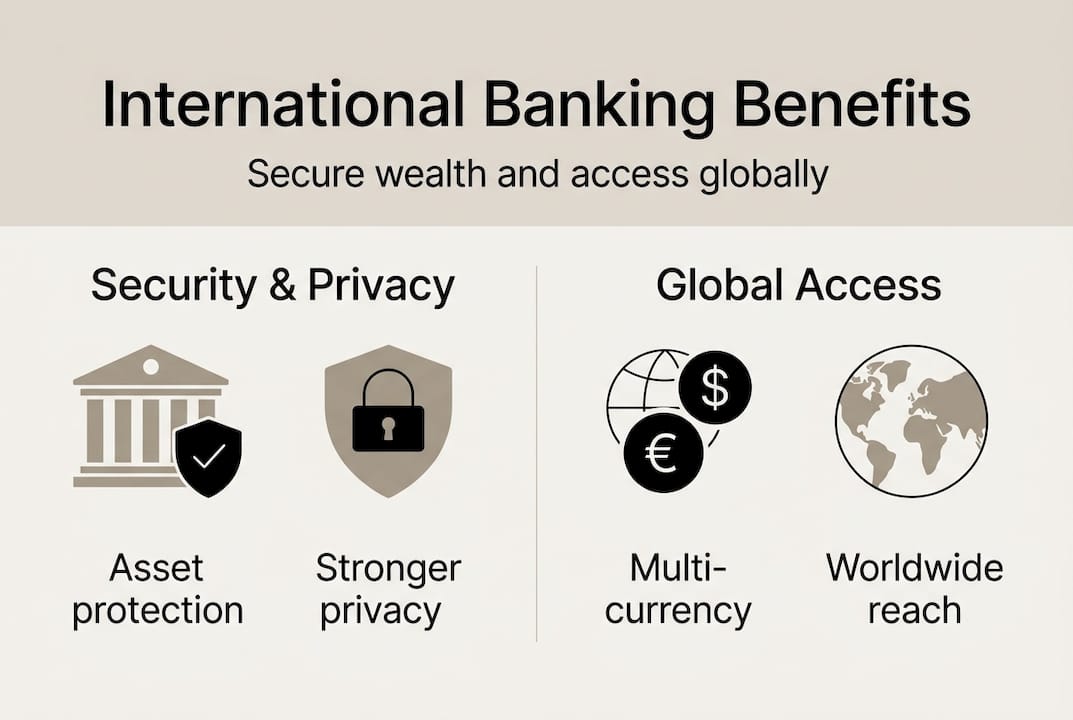
Diversification through international banking works across three dimensions: currency, country, and financial product. Holding assets in multiple currencies protects you from the depreciation of any single currency. Spreading accounts across stable jurisdictions reduces your exposure to one country’s economic or political shocks. And accessing financial products available only in specific markets, such as certain bond classes or structured investment vehicles, expands your return potential significantly.
Here is a breakdown of common asset types and the jurisdictions typically associated with them:
| Asset type | Common jurisdictions | Primary benefit |
|---|---|---|
| Cash and deposits | Switzerland, Singapore | Stability and privacy |
| Equities and funds | Luxembourg, Cayman Islands | Tax efficiency and access |
| Real estate holdings | UAE, Channel Islands | Asset protection |
| Corporate treasury | Hong Kong, BVI | Operational flexibility |
| Digital assets | Malta, Liechtenstein | Regulatory clarity |
Tax optimization through international banking is legal, structured, and increasingly essential for corporate clients. The compliant tax structures used by sophisticated clients are designed to work within international reporting frameworks such as FATCA and CRS, not around them.
Steps to approach tax optimization correctly:
- Identify your tax residency and reporting obligations in each jurisdiction.
- Work with qualified advisors to structure holdings in tax-efficient vehicles.
- Select banking jurisdictions that have favorable tax treaties with your home country.
- Ensure all structures are disclosed as required under applicable reporting rules.
- Review and update structures annually as regulations evolve.
Pro Tip: Multi-currency accounts are one of the simplest and most effective risk reduction tools available. Holding operational funds in the currency of your largest expense base eliminates conversion losses and reduces FX volatility exposure.
Exploring corporate banking options designed for complex international structures is a practical next step for businesses operating across multiple markets. Understanding the tax privacy benefits available through compliant offshore structures can also reshape how you think about long-term wealth planning.
Advanced international banking: Technology, service, and global connectivity
Beyond the basics, advanced technology and bespoke client service are redefining what international banking offers to top clients. The gap between a traditional private bank and a modern digital international banking platform is enormous, and it is widening every year.
The 2026 JP Morgan report highlights that adoption of advanced banking solutions for global connectivity has accelerated sharply among family offices and institutional clients, with technology cited as a primary driver of banking relationship changes.
Advanced international banking platforms now offer:
- Multi-currency accounts with instant conversion across 30 or more currencies
- Digital onboarding with full KYC completion in days, not weeks
- Real-time transaction monitoring with automated alerts and fraud detection
- KTT-enabled account structures for streamlined international transfers
- Institutional-grade treasury management tools accessible via secure online portals
- Dedicated relationship managers available across time zones
- API integrations for corporate treasury and ERP system connectivity
Global connectivity is not just a convenience feature. For a corporate client managing payroll across five countries or a family office rebalancing a multi-asset portfolio in real time, the ability to execute transactions instantly and monitor positions 24/7 is operationally critical. Understanding the digital banking advantages that modern platforms offer makes it easier to evaluate whether your current banking setup is actually serving your needs.
Security technology in advanced international banking includes biometric authentication, end-to-end encryption, and multi-layer authorization protocols for high-value transfers. These are not optional features. They are baseline expectations for clients operating at this level. Reviewing secure banking technology standards before selecting a platform ensures you are not trading convenience for vulnerability.
Pro Tip: When evaluating a digital international banking platform, test the responsiveness of the client service team before you commit. Technology is only as good as the human support behind it when something goes wrong at 2 a.m. in a different time zone.
For clients who want access to exclusive banking services that go beyond standard offerings, the right platform makes all the difference in execution speed and financial outcomes.
Our perspective: The new blueprint for international banking success
Here is something most guides will not tell you: the biggest mistake wealthy clients make is treating international banking as a one-time setup rather than an ongoing strategy. They open an account, move some funds, and assume the work is done. It is not.
Traditional domestic banks are not built for global clients. Their compliance processes are slow, their currency capabilities are limited, and their understanding of cross-border structures is often shallow. We have seen clients lose significant value simply because their bank could not execute a time-sensitive cross-border transaction efficiently.
The 2026 JP Morgan report is clear that compliance structure and cost management are the defining factors in long-term international banking success. Jurisdiction selection matters enormously, and it should be revisited as your business and personal circumstances evolve.
What most guides also miss is the balance between privacy and transparency. True discretion does not mean opacity. It means working within frameworks that protect your information while meeting every reporting obligation. Clients who try to use privacy as a shield against compliance always pay a higher price in the end.
The private banking blueprint that works in 2026 combines compliant structures, technology-forward platforms, and proactive relationship management. That combination is rare, but it is what separates genuinely protected wealth from wealth that only feels protected.
Explore secure, tailored solutions with Prominence Bank
Ready to put these insights into practice? Prominence Bank is built specifically for clients who need more than a standard banking relationship. Our corporate banking services are designed for complex international structures, multi-jurisdiction operations, and high-value treasury management.
For individuals, our private banking solutions deliver the discretion, security, and global access that high-net-worth clients require. We also offer digital currency options for clients integrating digital assets into their broader wealth strategy. Every solution is tailored, every relationship is managed with full confidentiality, and every account is backed by our commitment to international compliance standards. Connect with our team to discuss your specific needs.
Frequently asked questions
What makes international banking more secure than domestic banking?
International banks use advanced security technology, robust compliance frameworks, and often operate in stable jurisdictions to offer stronger structural protection for assets than most domestic institutions can provide.
Can international banking help optimize taxes?
Yes, international banking gives clients access to compliant tax structures designed to work within international reporting rules while enhancing financial flexibility and reducing unnecessary tax exposure.
Is privacy guaranteed for international bank account holders?
Privacy protections are significantly stronger in international banking, but true discretion depends on selecting stable banking hubs and institutions with proven compliance and confidentiality standards.
What are the risks to consider before opening an international account?
Clients should carefully evaluate compliance costs and geopolitical risk, as well as sanctions exposure, when selecting international banking jurisdictions and institutional partners.