Most people assume global banking simply means holding accounts in multiple countries. That assumption misses the point entirely. For high-net-worth individuals and international corporations, international private banking is a sophisticated ecosystem of secure, private, and bespoke solutions built for complex cross-border financial needs. This article breaks down exactly what global banking is, how its core mechanics work, what privacy and security really look like at this level, what fees to expect, and how real clients apply these solutions to protect and grow wealth across borders.
Table of Contents
- What is global banking? Key definitions and scope
- Core solutions: Key services and mechanics
- Privacy and security: How global banks protect clients
- Global banking fees: Typical charges and value comparisons
- Practical applications: Case studies for HNWIs and corporations
- Next steps: Access tailored global banking solutions
- Frequently asked questions
Key Takeaways
| Point | Details |
|---|---|
| Global banking defined | Global banking offers secure, private, and tailored solutions for high-net-worth and corporate clients. |
| Comprehensive services | It includes integrated wealth management, lending, tax optimization, and family office services. |
| Privacy and security | Global banks deploy advanced privacy and data protection methods for client safety. |
| Fee transparency | Typical fees for global banking are clearly structured with all-in rates about 1-2% of assets. |
| Actionable next steps | Clients can access premium tailored solutions by connecting with specialized global banking providers. |
What is global banking? Key definitions and scope
Global banking, at the level that matters to high-net-worth individuals and corporations, is not a product. It is a relationship-driven financial infrastructure. It covers everything from multi-currency cash management and cross-border lending to estate planning, tax optimization, and access to private investment markets. The goal is to consolidate complex financial needs under one coordinated, discreet framework.
Contrast this with standard retail banking. A typical bank account offers deposits, payments, and maybe a credit card. Global banking, by contrast, offers tailored cross-border solutions that integrate wealth management, structured financing, and international compliance into a single, seamless experience. The client does not manage these moving parts. A dedicated team does.
The primary clients are ultra-high-net-worth individuals (those with investable assets above $30 million), family offices, multinational corporations, and institutional investors. Each has unique needs. A family office managing generational wealth across five jurisdictions has very different requirements than a corporation executing cross-border trade finance. Global banking serves both, with integrated wealth management built around each client’s specific structure.
Here is a quick comparison of global banking versus standard banking:
| Feature | Standard banking | Global banking |
|---|---|---|
| Account types | Checking, savings | Multi-currency, offshore, trust |
| Client focus | Mass market | HNWIs, corporations |
| Services | Deposits, loans | Wealth management, lending, tax planning |
| Privacy level | Standard | High discretion, encrypted |
| Relationship model | Branch-based | Dedicated relationship manager |
| Investment access | Retail funds | Private markets, hedge funds |
Key services under the global banking umbrella include:
- Wealth and asset management across multiple jurisdictions
- Securities-based lending and structured credit facilities
- Tax and estate planning with cross-border compliance
- Family office services for multi-generational wealth
- Access to private markets, hedge funds, and alternative investments
- Philanthropy management and impact investing
For a broader view of how these services connect, the private banking overview at Prominence Bank outlines the full scope of what a modern global banking relationship looks like.
Core solutions: Key services and mechanics
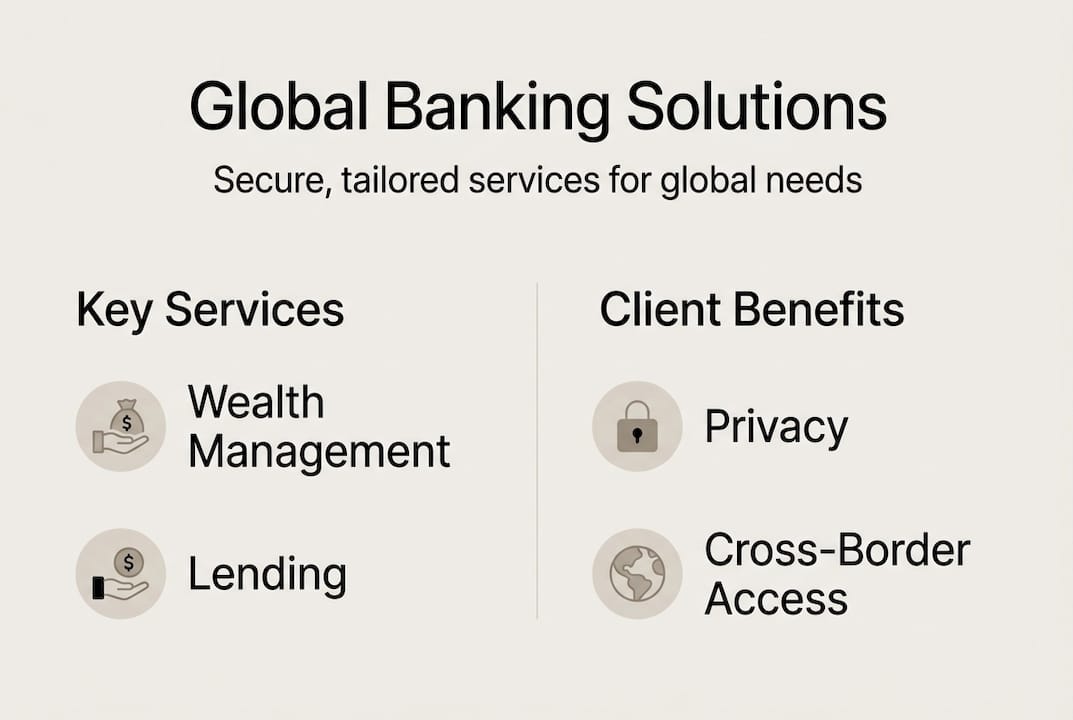
The engine behind global banking is the relationship manager. This is not a call center representative. It is a senior financial professional who coordinates a global team of specialists, including tax advisors, investment strategists, legal counsel, and compliance officers. Dedicated relationship managers handle investment strategies, cross-border cash management, and structured financing on behalf of the client.
Here is how the core mechanics typically work in practice:
- Multi-currency cash management: Funds are held and moved across currencies with real-time visibility, minimizing foreign exchange risk and maximizing liquidity.
- Securities-based lending (Lombard loans): Clients borrow against their investment portfolio without liquidating assets. This preserves market exposure while unlocking capital for other uses.
- NAV facilities: Used by family offices and funds, these credit lines are secured against the net asset value of a portfolio, enabling large-scale, flexible financing.
- Structured financing: Custom credit solutions for acquisitions, real estate, or business expansion, often spanning multiple jurisdictions.
- Estate and succession planning: Legal and financial structures that protect wealth transfer across generations, minimizing tax exposure and legal risk.
- Philanthropy management: Dedicated advisory for charitable giving, including foundation setup and impact measurement.
Core private banking mechanics also include investment management, lending secured by securities, and estate planning as foundational pillars. These are not add-ons. They are the baseline.
Pro Tip: If you are evaluating a global banking relationship, ask specifically about the composition of the team behind your relationship manager. A strong global bank assigns specialists in tax, legal, and investment to each client, not just a single point of contact.
For corporations with complex structures, corporate banking solutions and premium exclusive banking provide the institutional-grade infrastructure needed to manage treasury, trade, and capital across borders. Multi-currency accounts are often the operational foundation of these arrangements.
Privacy and security: How global banks protect clients
Privacy is not a feature in global banking. It is a prerequisite. High-net-worth individuals and corporations operate in environments where financial information is a target. A data breach does not just cause inconvenience. It can expose business strategies, trigger regulatory scrutiny, or create personal security risks.
Global banks address this through layered security architecture. The key methods include:
- Encrypted communications across all client-facing and internal channels
- Vetted, compartmentalized teams where only authorized personnel access specific client data
- Integrated AML/KYC compliance that satisfies international regulatory standards without exposing client information unnecessarily
- AI-powered personalization that adapts to client behavior patterns and flags anomalies in real time
- Secure digital platforms with multi-factor authentication and biometric access controls
Global banking networks prioritize seamless cross-border coordination for complex needs, leveraging global infrastructure for both privacy and security. This is not just about keeping data safe. It is about ensuring that the right information reaches the right people at the right time, and no one else.
“At the highest levels of private banking, privacy is not a compliance checkbox. It is the foundation of the entire client relationship. Every system, every process, and every team structure is built around protecting the client’s financial identity.”
For clients who require secure private banking with full digital access, the architecture of the platform matters as much as the services it delivers. The global banking platform at Prominence Bank is built with this principle at its core.

Global banking fees: Typical charges and value comparisons
Fees in global banking are not hidden, but they are layered. Understanding the structure helps you evaluate whether the value justifies the cost, and where there is room to negotiate.
Asset management fees range from 0.5% to 2.5% of assets under management annually. Custody fees run 0.1% to 0.5%. Performance fees, charged when returns exceed a benchmark, typically fall between 10% and 20% of gains. All-in, most clients pay between 1% and 2% of total assets per year.
Here is how fees typically scale by asset size:
| Asset tier | Management fee | Custody fee | All-in estimate |
|---|---|---|---|
| $5M to $20M | 1.5% to 2.5% | 0.3% to 0.5% | 1.8% to 3.0% |
| $20M to $100M | 1.0% to 1.5% | 0.2% to 0.4% | 1.2% to 1.9% |
| $100M+ | 0.5% to 1.0% | 0.1% to 0.2% | 0.6% to 1.2% |
Key points to understand about fee structures:
- Larger asset bases attract lower percentage fees, but absolute costs are still significant
- Performance fees align incentives, but only if the benchmark is clearly defined and fair
- Bundled fees (all-in pricing) are easier to evaluate than itemized structures
- Negotiation is expected at the $20M+ level. Banks want the relationship and will adjust
- Transaction fees for foreign exchange, wire transfers, and structured products are often separate
Pro Tip: Always request a full fee disclosure before signing any global banking agreement. Ask for a breakdown of management, custody, transaction, and performance fees separately. Then model the total annual cost against your expected returns to assess real net value.
For a transparent view of how fees are structured in a modern digital banking context, the banking fee structures page and private banking cost overview at Prominence Bank provide clear benchmarks.
Practical applications: Case studies for HNWIs and corporations
Theory is useful. Real-world application is what drives decisions. Here are two scenarios that illustrate how global banking works in practice.
Case study 1: Family office wealth management
A family office managing $150 million across real estate, equities, and private equity in four countries needs consolidated reporting, tax-efficient structuring, and succession planning. The global bank assigns a relationship manager who coordinates a tax advisor in each jurisdiction, an investment team managing the portfolio, and a legal team handling trust structures. The family gets a single dashboard, one point of contact, and a coordinated strategy across all assets.
Case study 2: Cross-border corporate lending
A corporation expanding into three new markets needs $40 million in structured financing. Rather than approaching each country’s banks separately, the global bank structures a single Lombard loan secured against the company’s existing securities portfolio. The loan is disbursed in multiple currencies, and the repayment schedule is aligned with projected cash flows from the new markets.
Here is a practical framework for choosing the right global banking partner:
- Define your primary need: Wealth management, lending, tax optimization, or trade finance?
- Assess team depth: Does the bank have specialists in your specific jurisdictions?
- Evaluate technology: Can you access accounts, reports, and communications securely online?
- Compare boutique vs. major bank: Boutiques offer niche expertise; global banks offer scale and network reach.
- Review fee transparency: Is pricing clear, negotiable, and benchmarked against industry standards?
Integrated lending and investment strategies are central to both HNWI and corporate global banking relationships. For trade-specific needs, trade finance services and investment banking solutions extend the range of what is possible.
Next steps: Access tailored global banking solutions
If the scenarios above resonate with your situation, the next step is finding a banking partner whose infrastructure matches your complexity. Prominence Bank offers premium global banking built specifically for high-net-worth individuals and international corporations who need secure, private, and fully digital solutions.
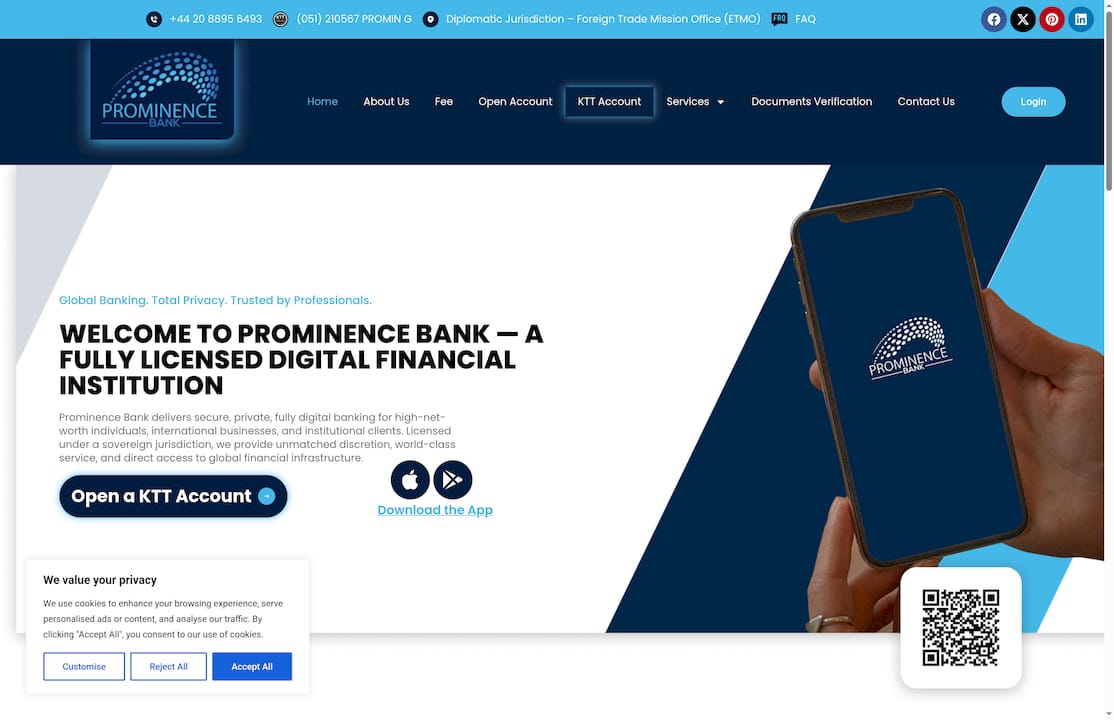
From digital currency solutions to institutional-grade corporate banking, Prominence Bank’s platform is designed to handle the full spectrum of cross-border financial needs. Every service is backed by advanced security architecture, AML/KYC compliance, and direct access to global financial infrastructure. Whether you are structuring a family office, managing multi-currency treasury operations, or seeking discreet offshore banking, the team at Prominence Bank is equipped to build a solution around your specific requirements. Reach out directly to begin a confidential consultation.
Frequently asked questions
What types of clients benefit most from global banking?
Global banking serves HNWIs and international corporations with complex, cross-border financial needs. It is best suited for those managing significant assets across multiple jurisdictions who require coordinated, private, and bespoke financial solutions.
What is Lombard lending in global banking?
Lombard lending is a secured loan where the client’s securities portfolio serves as collateral, enabling large-scale, flexible financing without liquidating investments. It is a core tool for both HNWIs and corporations needing capital without disrupting their investment positions.
How do global banks ensure privacy and data security?
Global banks use encrypted communication and vetted teams alongside integrated compliance frameworks to protect client information. Access is compartmentalized so that only authorized personnel can view specific client data.
What are typical fee ranges for global banking?
Asset management fees range from 0.5% to 2.5% of assets under management annually, with custody fees at 0.1% to 0.5% and performance fees between 10% and 20%. Most clients pay an all-in rate of 1% to 2% per year, depending on asset size and service complexity.