
Most business owners assume their domestic bank is the safest place for corporate funds. That assumption costs some of them dearly. Local banks are subject to local political risk, currency instability, and legal systems that may not prioritize your interests as a foreign-owned entity. For high-net-worth individuals and international business owners, a corporate bank account abroad is not a luxury or a loophole. It is a deliberate financial strategy that delivers stronger asset protection, greater privacy, and the kind of operational flexibility that domestic accounts simply cannot match.
Table of Contents
- Defining corporate accounts abroad
- Key motivations for opening accounts internationally
- Regulatory and legal considerations
- How to open a corporate bank account abroad
- The real value of offshore corporate banking
- Secure your assets with global corporate banking
- Frequently asked questions
Key Takeaways
| Point | Details |
|---|---|
| Asset protection benefits | International corporate accounts provide robust privacy and legal shields for global assets. |
| Strategic flexibility | Overseas accounts empower cross-border operations and currency management for businesses. |
| Legal compliance matters | Proper documentation and regulatory awareness are crucial when opening accounts abroad. |
| Step-by-step guidance | Success with offshore banking starts with careful research, preparation, and trusted advisors. |
Defining corporate accounts abroad
A corporate bank account abroad is a business account held at a financial institution outside your country of residence or incorporation. It operates under the laws of the host jurisdiction, meaning your assets are subject to that country’s legal protections, not your home country’s. That distinction matters enormously when you are managing significant wealth or operating across multiple markets.
Domestic corporate accounts are tied to one currency, one legal system, and one set of regulatory risks. International accounts, by contrast, give you access to multi-currency functionality, cross-border payment infrastructure, and jurisdictions with laws specifically designed to protect private capital. The advantages of discreet banking include stronger privacy protections and asset shields that domestic banks rarely offer.
Here is what sets international corporate accounts apart:
- Multi-currency accounts that hold and transact in USD, EUR, GBP, and other major currencies simultaneously
- Jurisdictional asset protection under foreign legal frameworks that limit creditor access
- Enhanced privacy standards with stricter confidentiality laws than most domestic banks
- Global payment rails for faster, lower-cost international wire transfers
- Separation of assets from home-country political or economic instability
Not every jurisdiction is equal. Some countries, like Switzerland, Singapore, and certain Caribbean jurisdictions, have built entire legal frameworks around protecting private corporate assets. Others, like Bulgaria, have attracted international businesses for their EU membership combined with lower operational costs. If you are exploring opening accounts in Bulgaria, for example, you benefit from EU regulatory standards while keeping costs manageable.
Pro Tip: When selecting a jurisdiction, prioritize countries with strong rule of law, clear asset protection statutes, and bilateral tax treaties with your home country. The goal is legal protection, not opacity.
The core principle is straightforward. Spreading corporate assets across jurisdictions reduces your exposure to any single legal or economic risk. That is not evasion. That is sound financial architecture.
Key motivations for opening accounts internationally
High-net-worth individuals and global entrepreneurs are not opening international accounts on a whim. There are concrete, strategic reasons driving this decision, and the numbers back it up. A growing share of globally active businesses now maintain at least one account outside their home country, recognizing that secure global banking solutions offer tailored protections that domestic banks cannot replicate.
The primary motivations break down into four categories:
- Asset protection: Keeping funds in a jurisdiction where foreign creditors, litigation, or political seizure have limited reach
- Currency diversification: Holding balances in multiple currencies to hedge against exchange rate volatility
- Operational efficiency: Paying international suppliers, employees, and partners without costly conversion fees or delays
- Privacy: Accessing banking systems with stronger confidentiality standards and fewer disclosure requirements
Here is a direct comparison of what you get with each option:
| Feature | Domestic corporate account | International corporate account |
|---|---|---|
| Currency options | Usually 1-2 | 10+ major currencies |
| Asset protection | Subject to local courts | Governed by host jurisdiction law |
| Privacy level | Moderate | High, with confidentiality statutes |
| Cross-border payments | Slow, high fees | Fast, lower cost |
| Political risk exposure | High | Diversified |
| Regulatory environment | Single jurisdiction | Chosen jurisdiction |
The discreet international accounts available through specialized offshore banks provide asset shields that most domestic options simply cannot match. This is especially relevant for business owners operating in markets with unpredictable regulatory environments or currency controls.
Currency diversification deserves particular attention. Holding operating capital in multiple currencies means a devaluation in your home currency does not wipe out your liquidity. For businesses with payroll or supplier contracts in foreign currencies, this is not optional. It is essential risk management. Explore corporate finance options that align with your currency exposure to build a more resilient financial structure.

Regulatory and legal considerations
Opening a corporate account abroad is entirely legal. But it requires careful navigation of compliance requirements in multiple jurisdictions. Ignoring this step is where businesses get into trouble, not the act of banking internationally itself.
Securing corporate banking internationally starts with understanding that every jurisdiction has its own anti-money-laundering (AML) and know-your-customer (KYC) standards. You will need to satisfy both the host country’s requirements and your home country’s reporting obligations.
Here are the key legal steps in sequence:
- Determine your reporting obligations in your home country (FATCA for US persons, CRS for most others)
- Select a compliant jurisdiction with a strong regulatory reputation and clear corporate banking laws
- Engage a local legal advisor familiar with both the host jurisdiction and your home country’s rules
- Prepare your compliance documentation including corporate structure, beneficial ownership disclosures, and source of funds
- Submit your application with full transparency about business activities and fund origins
- Maintain ongoing compliance through annual reporting and account reviews
Here is a snapshot of common documentation requirements by region:
| Region | Key requirements |
|---|---|
| European Union | Company registration, UBO declaration, AML certification |
| Caribbean jurisdictions | Certificate of incorporation, director IDs, business plan |
| Southeast Asia | Audited financials, local registered agent, compliance letter |
| Switzerland | Notarized documents, source of wealth declaration, legal opinion |
The corporate finance expertise required to navigate these requirements is not trivial. Mistakes in documentation or disclosure can result in account rejection or, worse, legal liability.
Pro Tip: Never attempt to open an international corporate account without qualified legal and financial advisors who specialize in cross-border structures. The cost of expert guidance is a fraction of the cost of getting it wrong.
Compliance is not the enemy of privacy. A well-structured international account that meets all regulatory requirements can still offer significantly more confidentiality than a domestic account, because the host jurisdiction’s laws govern what gets disclosed and to whom.
How to open a corporate bank account abroad
With the legal framework understood, the practical process becomes much more manageable. Step-by-step corporate banking setup requires strategic preparation and a clear understanding of what each bank and jurisdiction demands.
Follow this sequence:
- Define your objectives before choosing a jurisdiction. Are you prioritizing asset protection, currency diversification, or operational efficiency? Your answer shapes everything else.
- Research jurisdictions based on political stability, legal protections, tax treaty networks, and banking infrastructure.
- Select a bank that specializes in international corporate clients, not a retail bank that happens to accept foreign companies.
- Prepare your documentation package including corporate formation documents, director and shareholder IDs, proof of business activity, and source of funds evidence.
- Submit your application with complete transparency. Incomplete applications are the number one reason for rejection.
- Complete due diligence by responding promptly to any follow-up requests from the bank’s compliance team.
Common mistakes to avoid:
- Choosing a jurisdiction for secrecy alone rather than legal protection and compliance quality
- Submitting incomplete documentation which triggers delays and red flags
- Ignoring home-country reporting requirements which creates legal exposure
- Selecting a bank without international corporate experience which leads to poor service and account restrictions
Pro Tip: Start building relationships with international banks before you urgently need an account. Banks respond better to proactive applicants with clean financial histories than to rushed applications under time pressure.
You can begin the process today by opening an account with a specialized institution that understands the needs of global business owners. If you are also managing personal wealth alongside your corporate structure, consider whether to open a personal account in the same jurisdiction to simplify your financial management.
The real value of offshore corporate banking
Here is the uncomfortable truth most financial commentators avoid: the biggest risk in offshore banking is not fraud or legal exposure. It is the risk of doing nothing while your domestic account sits exposed to political, legal, and currency risks you could have managed.
The myth that offshore accounts are only for people with something to hide has been thoroughly discredited. Sophisticated business owners use international accounts for the same reason they use insurance: not because they expect disaster, but because they understand risk. Offshore accounts provide a hedge against national risks and open global investment doors that domestic banks cannot access.
What we have observed consistently is that business owners who diversify their banking early have more options, more leverage, and more resilience when markets shift. Those who wait until they need protection often find the window has closed. The real value is not secrecy. It is strategic positioning. A well-structured international account is a legal, compliant, and powerful tool for anyone serious about long-term wealth security. The discreet banking perspective that drives this approach is grounded in strategy, not evasion.
Secure your assets with global corporate banking
If this article has clarified anything, it is that international corporate banking is not a niche strategy for the ultra-wealthy. It is a practical tool for any serious business owner managing assets across borders.
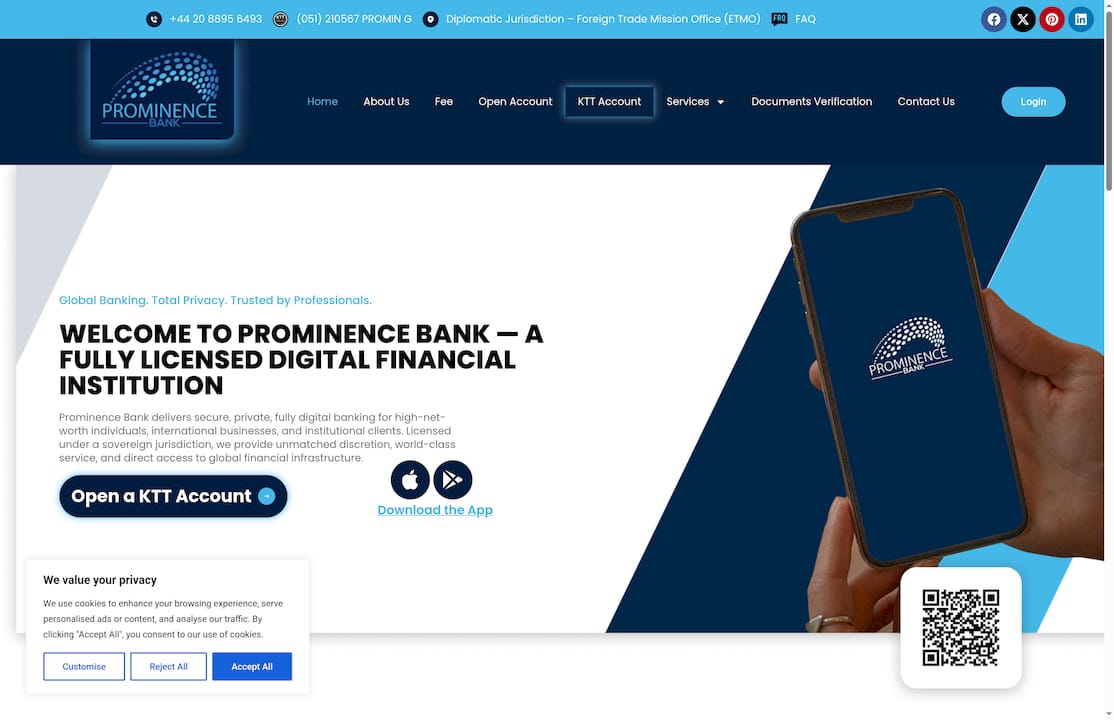
Prominence Bank specializes in exactly this. As a fully licensed digital banking institution, we offer global corporate banking solutions built for high-net-worth individuals and international businesses that need privacy, security, and global reach. From multi-currency accounts to KYC-compliant onboarding, our platform is designed to make international corporate banking straightforward. Review our secure corporate banking guide to understand the full process, then take the next step toward protecting and growing your corporate assets with a banking partner that understands your world.
Frequently asked questions
What documents are required for opening a corporate bank account abroad?
You will typically need company formation papers, proof of business activity, government-issued ID for all directors, and AML/KYC compliance certifications. Strategic preparation and full transparency in your application are the most reliable ways to avoid delays.
Is opening an international corporate bank account legal?
Yes, it is fully legal as long as you comply with tax reporting obligations and anti-money-laundering laws in each relevant jurisdiction. Corporate banking across borders requires careful regulatory navigation, but it is a standard practice for global businesses.
Can offshore accounts help with asset protection?
Yes. International accounts governed by foreign legal frameworks often provide stronger asset shields and greater privacy than domestic banks. Discreet international accounts are specifically designed to limit creditor access and protect private capital.
Do I need to visit the country to open a corporate bank account?
Not always. Many specialized international banks allow fully remote account setup through digital onboarding. Some jurisdictions may require a local visit depending on their specific regulations, as outlined in remote account setup guidance for specific countries.