
Corporate and private banking clients are among the most targeted groups in the global cybersecurity landscape. 43% of family offices experienced a cyberattack in the last 12 to 24 months, with North American organizations hit hardest at 57%. The financial and reputational damage from a single breach can be catastrophic, yet most organizations still rely on outdated protocols. This guide walks you through every critical step, from understanding your exposure to implementing advanced controls and verifying your defenses, so your corporate accounts stay protected at every level.
Table of Contents
- Understanding corporate banking security risks
- Preparation: What you need for secure corporate banking
- Step-by-step guide to securing corporate accounts
- Managing privacy and secure data in corporate banking
- Securing treasury and cash management operations
- Verification: Auditing and continuous improvement
- Take the next step in secure banking
- Frequently asked questions
Key Takeaways
| Point | Details |
|---|---|
| Security is ongoing | Robust corporate banking protection requires continuous improvement and regular evaluation. |
| Preparation is crucial | Gather tools, policies, and staff training before implementing new banking security processes. |
| Layered defenses work best | Combining multi-factor authentication, encryption, privacy controls, and AI monitoring creates a resilient system. |
| Vendor and process oversight | Diligent third-party risk management and up-to-date protocols are vital for cash management security. |
Understanding corporate banking security risks
The threat environment facing corporate banking clients has grown sharply in both scale and sophistication. Attackers no longer target individuals at random. They map organizational structures, exploit cross-border complexity, and time their strikes around high-value transactions. The faster a company digitizes its operations, the wider its attack surface becomes.
Family offices are especially vulnerable due to small teams managing complex global structures, and 22% now rank cyber risk as their top concern in 2026. That number will only climb as attackers grow more capable.
The main risk vectors in corporate banking break down as follows:
| Risk vector | Description | Prevalence |
|---|---|---|
| Phishing and spear-phishing | Targeted email attacks impersonating executives or banks | Very high |
| Business email compromise (BEC) | Fraudulent wire transfer requests via spoofed accounts | High |
| Insider threats | Employees or contractors misusing privileged access | Moderate |
| Third-party vendor breaches | Weak links in outsourced technology or service providers | Growing |
| Ransomware | Encrypted systems held hostage for payment | High |
| Regulatory lapses | Non-compliance creating legal and financial exposure | Moderate |
Beyond external attacks, insider threats and regulatory failures create compounding risks. A single compliance gap can trigger audits, freeze accounts, or expose client data. For executives managing business bank account options across multiple jurisdictions, the stakes are even higher.
“Cybersecurity is now a top-tier business risk for family offices and executive teams. The question is no longer whether you will be targeted, but when.”
Preparation: What you need for secure corporate banking
Before you can secure your accounts, you need to audit what you already have. Most organizations discover significant gaps at this stage, and that is actually a good thing. Knowing your weaknesses is the first step toward fixing them.
Only 31% of family offices have a cyber incident response plan they are satisfied with, and 43% admit theirs could be significantly better. That gap is where attackers operate.
Here is what a solid preparation checklist looks like:
- Hardware security keys for all finance and executive accounts
- Dedicated devices used exclusively for banking and financial operations
- Privileged access management (PAM) software to control who can do what
- Cyber insurance covering financial loss, legal fees, and breach notification
- Staff training programs with scenario-based phishing simulations
- Vendor security protocols requiring third-party compliance documentation
- Regulatory certifications including AML and KYC documentation up to date
The comparison below shows where most organizations fall short:
| Security area | Best practice | Common gap |
|---|---|---|
| Incident response | Tested plan updated annually | No plan or untested plan |
| Staff training | Quarterly scenario-based drills | Annual generic awareness email |
| Cyber insurance | Comprehensive coverage in place | No coverage or minimal policy |
| Vendor protocols | Formal due diligence and SLAs | Informal or no vendor review |
| Device management | Dedicated finance-only devices | Shared personal and work devices |
For executives who want access to premium services for executives with built-in security layers, the preparation phase is where you define your requirements before onboarding. Pair that with secure payment solutions that support hardware authentication from day one. The FDIC cybersecurity resources also provide practical training materials and incident readiness frameworks worth reviewing.
Pro Tip: Never use a shared or personal device for corporate banking. Dedicated hardware with full-disk encryption and hardware-based MFA is the minimum standard for high-value accounts.
Step-by-step guide to securing corporate accounts
With your preparation complete, you can now implement security in a structured sequence. Skipping steps here creates the exact gaps attackers exploit.

Private banks rely on a layered model combining AML/KYC compliance, AI fraud detection, segregated accounts, end-to-end encryption, and biometric authentication. You should demand the same from your banking provider and mirror these controls internally.
Follow this sequence:
- Set up accounts with full KYC verification and document all beneficial owners
- Enable advanced MFA using hardware keys or biometrics, not SMS codes
- Implement role-based access controls so staff only access what they need
- Encrypt all communications related to financial operations using end-to-end tools
- Establish a risk-based AML model with enhanced due diligence (EDD) for high-risk counterparties
- Screen all clients and vendors against PEP (politically exposed persons) and sanctions lists
- Verify source of wealth for all significant inflows as part of AML compliance
- Deploy AI-powered fraud monitoring to flag anomalous transaction patterns in real time
- Conduct periodic security assessments covering all systems, access logs, and vendor connections
- Review and update all protocols after any personnel change, system upgrade, or incident
The data reveals a critical gap: 85% of organizations use MFA, but only 34% conduct regular security assessments. Enabling MFA without ongoing testing is like locking your front door but leaving the windows open.
Pro Tip: Add network segmentation so your banking systems operate on an isolated network, and activate dark web monitoring to catch leaked credentials before attackers use them.
For organizations managing digital assets alongside traditional accounts, digital currency compliance adds another layer of regulatory complexity that must be addressed in your security model. Explore secure corporate banking solutions that integrate these controls natively.
Managing privacy and secure data in corporate banking
Technical security and data privacy are not the same thing, though they overlap significantly. Privacy controls protect sensitive client and transaction data from both external exposure and internal misuse.
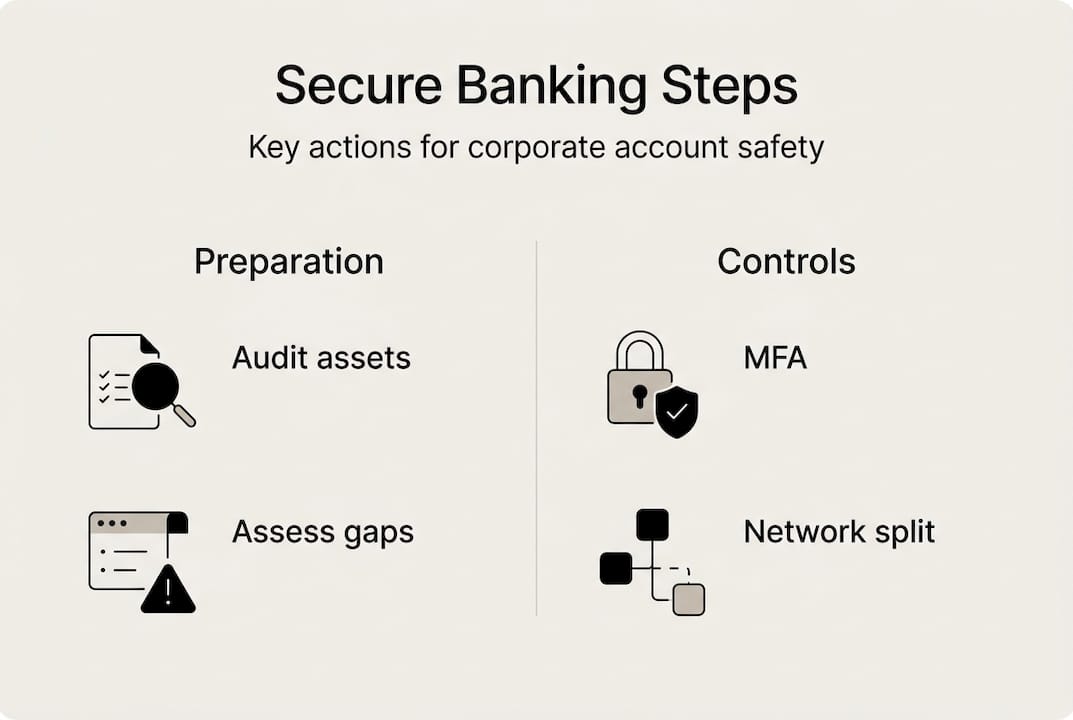
Best-in-class data privacy in wealth management relies on data minimization, role-based access control, AES-256 encryption, comprehensive audit logs, and Swiss data hosting for jurisdictional sovereignty. These are not optional extras for high-value clients. They are baseline requirements.
Key privacy controls to implement:
- Data minimization: Collect and retain only what is operationally necessary
- Role-based access control (RBAC): Restrict data visibility by job function and clearance level
- AES-256 encryption: Apply to all stored and transmitted financial data
- Audit logs: Maintain tamper-proof records of every data access and transaction event
- Cross-border data protocols: Define which jurisdictions can access which data sets
- Privileged user oversight: Monitor and log all actions taken by administrators
“For highly sensitive operations, AES-256 encryption and scenario-based staff training are non-negotiable.”
For executives managing accounts across multiple countries, cross-border discretion requires explicit data residency agreements with your banking provider. Review how personal bank data security is handled at the account level, and ensure your provider can demonstrate audit-ready processes on demand.
Securing treasury and cash management operations
Treasury operations carry some of the highest transaction values in any organization, making them a prime target. Security here must be operational, not just technical.
49% of treasurers now prioritize scalable treasury solutions focused on liquidity risk management and technology outsourcing. That outsourcing creates third-party risk that must be actively managed.
| Operational risk | Security control |
|---|---|
| Unauthorized wire transfers | Dual authorization and transaction limits |
| Vendor payment fraud | Verified payee protocols and callback confirmation |
| Liquidity exposure | Real-time cash position dashboards |
| Reconciliation errors | Automated daily reconciliation with exception alerts |
| Third-party system breach | TPRM framework with contractual SLAs |
Banks follow a structured TPRM (third-party risk management) life cycle covering governance, risk assessment, due diligence, contracts with SLAs, ongoing monitoring, and exit strategies. Your treasury team should apply the same rigor to every vendor relationship.
Daily treasury security controls should include:
- Reconcile all accounts every business day without exception
- Require dual authorization for all outgoing transfers above a defined threshold
- Review access logs weekly for any anomalous activity
- Confirm all new payees via a secondary verification channel before first payment
- Audit vendor access to treasury systems quarterly
For organizations managing large cross-border flows, secure trade finance and secure interbank transfers must be supported by providers with proven security infrastructure and transparent SLA commitments.
Verification: Auditing and continuous improvement
Implementing security controls is not a one-time event. Threats evolve, personnel change, and systems get updated. Verification is what keeps your defenses current.
Only 26% of organizations are satisfied with their current incident response plans. That means the vast majority are operating with plans that have never been properly tested or updated. That is a serious vulnerability.
Top benchmarks for continuous improvement:
- Run a full security audit at least once per year covering all systems and access controls
- Test your incident response plan with a simulated breach scenario annually
- Update all protocols within 30 days of any major system change or personnel departure
- Review vendor security certifications and SLA compliance every six months
- Monitor threat intelligence feeds for emerging attack patterns relevant to your sector
- Track and close every finding from internal and external audits within defined timelines
The FDIC cybersecurity resources include ransomware defense guides, cyber awareness training videos, and annual resilience reports that provide practical benchmarks for corporate banking clients. Supplement these with cybersecurity best practices specific to private banking environments.
Pro Tip: Schedule a third-party penetration test and resilience assessment annually. Internal teams often miss what an outside expert finds in the first hour.
When you are ready to put these practices into action, start secure banking practices with a provider that has these controls built into the platform from day one.
Take the next step in secure banking
The steps outlined above represent the gold standard for corporate banking security. Implementing them requires both the right internal discipline and the right banking partner. Prominence Bank is built specifically for clients who cannot afford to compromise on security, privacy, or global reach.
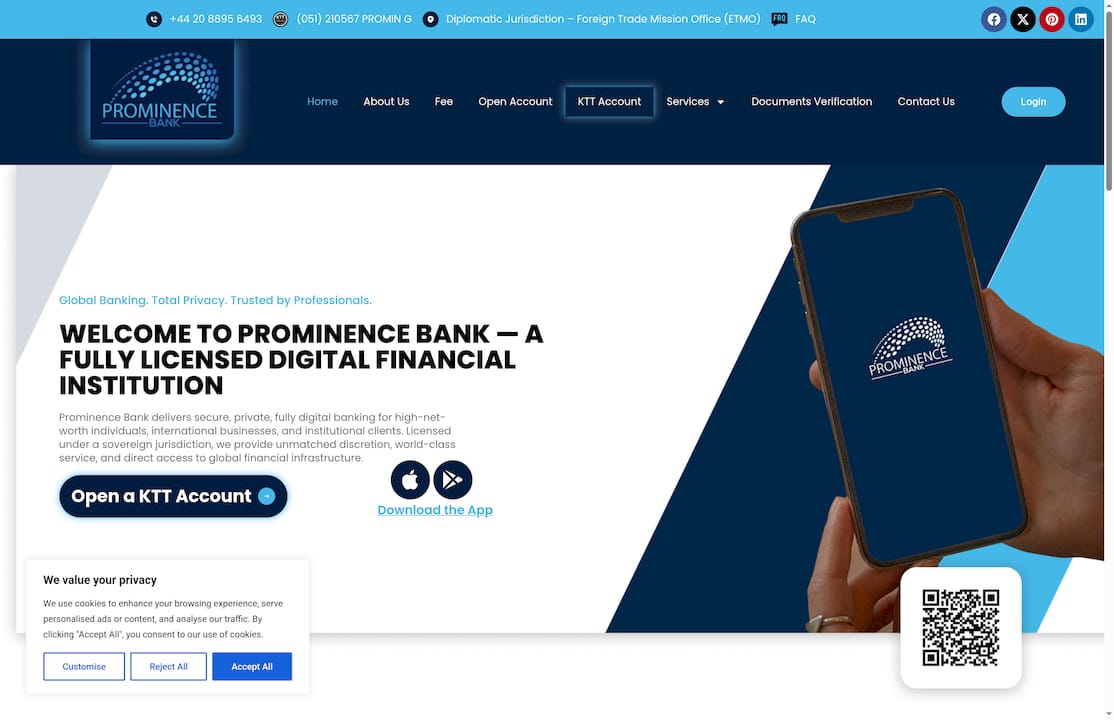
Our secure corporate banking solutions integrate AML/KYC compliance, AI fraud monitoring, end-to-end encryption, and multi-currency access into a single, fully digital platform. Whether you need business banking services for complex corporate structures or advanced digital currency services for institutional-grade asset management, we provide the infrastructure and discretion your operations demand. Contact us today to begin a personalized security assessment and onboarding process tailored to your specific risk profile and jurisdictional requirements.
Frequently asked questions
What is the most effective way to prevent cyberattacks on corporate accounts?
Combine multi-factor authentication, strict access controls, and regular security assessments for the strongest protection. 85% of organizations use MFA but only 34% conduct regular assessments, which is where most vulnerabilities go undetected.
How often should companies update their incident response plan?
Review and test your incident response plan at least annually or after any major system or process change. Only 26% of organizations are satisfied with their current plan, making regular updates essential.
What security features should I demand from an international corporate bank?
Look for end-to-end encryption, biometric authentication, AML/KYC compliance, AI fraud monitoring, and dedicated client support. Private banks rely on segregated accounts and layered security controls as standard practice.
Is cyber insurance necessary for corporate accounts?
Yes, cyber insurance is essential because many attacks bypass even strong technical defenses, and coverage provides critical financial and legal protection. 63% of family offices currently lack cyber insurance despite facing increasing attack frequency.