
A numbered account changes how your name appears on bank statements. It does not change what you report to the U.S. government. If you are a U.S. citizen, resident or other U.S. person with a numbered account at a non-U.S. bank, you generally report it the same way you would report any other foreign account: an FBAR with FinCEN when the combined balances pass $10,000, and Form 8938 with your tax return when you pass the higher FATCA thresholds.
This guide walks through both filings, the thresholds, deadlines, records and the points that trip up holders of numbered, custody and crypto-related accounts. It is general information, not tax advice. For your own facts, a CPA or tax attorney who handles international filings is the right person to confirm.
TL;DR
- A numbered account is still your account. Naming practices on statements do not remove a U.S. person’s reporting duty.
- FBAR (FinCEN Form 114) is required when your foreign accounts together exceed $10,000 at any time in the year. It is due April 15, with an automatic extension to October 15.
- Form 8938 is a separate filing attached to your tax return, with higher thresholds that depend on filing status and where you live. Filing one never replaces the other.
- Keep account records for five years, including the account number, bank name and address, account type and maximum value.
- Custody receipts, crypto holdings and KTT-enabled accounts each raise their own questions. Settle them with a professional before the filing deadline.
Table of Contents
- What a numbered account is, and what it is not
- Who counts as having an interest in the account
- FBAR: the filing most numbered-account holders face first
- Form 8938: the FATCA statement on your tax return
- Reporting the income, not just the account
- Records you need to keep
- Custody receipts, KTT and crypto: where the questions get specific
- Penalties for missing a filing
- A yearly checklist for numbered-account holders
- Perspective
- Opening a numbered account with reporting in mind
- FAQ
- Sources
What a numbered account is, and what it is not
In a numbered account, the account number replaces your name on routine documents and statements. The bank still knows who you are. It completed identity checks and anti-money-laundering review before opening the account, and those records exist whether or not your name appears on a statement.
That distinction matters for tax. Privacy within a bank’s internal and client-facing systems is an operating feature. Reporting duties to the U.S. attach to the person who has an interest in the account, not to the label on the statement. For a broader explanation of how these accounts work, see our guide to numbered accounts, privacy, legality and global use.
A federal appellate opinion shows the point in practice. In that case the taxpayer’s UBS account was a numbered account, with statements listing only the account number and not the holder’s name or address. The court’s opinion also records that the taxpayer did not file timely FBARs disclosing the account. The numbered format did not remove the filing duty.
Who counts as having an interest in the account
The FBAR rules are broader than “the name on the account.” Under the FinCEN regulation on foreign account reports, a U.S. person has a financial interest in a foreign account that is held in their name or legal title, or held by an agent, a nominee, certain entities, or specified trusts. An entity created to evade reporting is also covered.
In practice, this means you should look at four situations:
- Accounts in your own name or under your number. These are plainly yours.
- Accounts held through a company you own or control. Ownership above the regulatory thresholds can create a reportable interest.
- Accounts held for you by a nominee or agent. The interest follows you, not the nominee.
- Accounts where you only sign. Signature or other authority over an account, such as for an employer, can trigger an FBAR duty even with no ownership. We cover this in more detail in our piece on international bank account signatory rules.
FBAR: the filing most numbered-account holders face first
The FBAR is FinCEN Form 114. FinCEN requires one when a U.S. person has a financial interest in, or signature authority over, foreign financial accounts whose aggregate value exceeds $10,000 at any time during the calendar year.
Two features of that sentence catch people out.
The threshold is aggregate. You add up every foreign account, not each one separately. Three accounts holding $4,000 each at their peak put you over the line, even though none comes close alone.
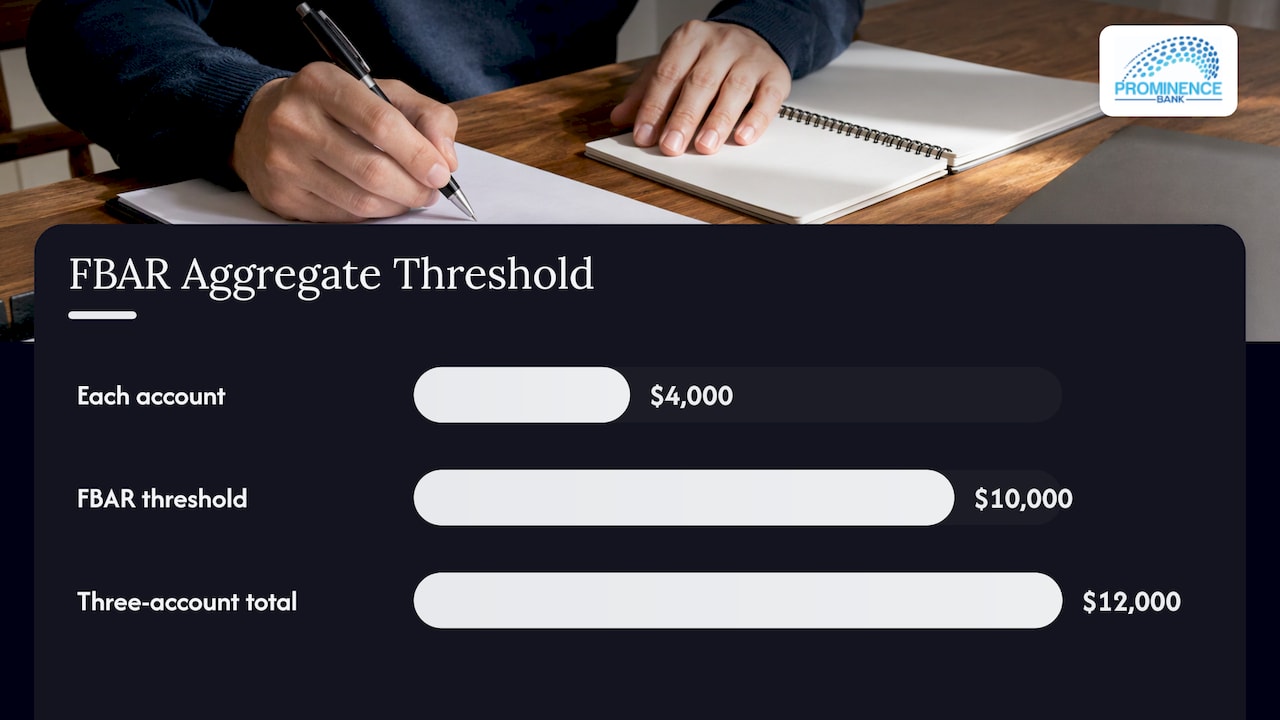
The test is “at any time.” A balance that was above $10,000 for one day and then dropped still counts. Year-end balances alone do not decide it.
Deadline and where to file
The IRS explains that the FBAR is due April 15, with an automatic extension to October 15. It is filed electronically through FinCEN, not with your federal income tax return. The IRS manual confirms that for calendar years 2016 and later no extension request is required.
How to work out the maximum value
For each account, you report the maximum value reached during the year. FinCEN guidance on maximum account value says periodic account statements are a reasonable approximation if they fairly reflect the maximum. For balances in a non-U.S. currency, you convert using the Treasury rate for the last day of the calendar year, and you convert to U.S. dollars before applying the $10,000 threshold.
This matters for multi-currency accounts. If you hold euros, sterling and dollars in one relationship, convert each balance, then compare the total to the threshold. Our overview of multi-currency accounts explains how balances sit side by side in one account.
Income does not matter for the FBAR
A common mistake is thinking an account that earns no interest need not be reported. The IRS states that whether the account produced taxable income generally has no effect on whether it is a foreign financial account for FBAR purposes. A zero-interest numbered account holding $60,000 is reportable.
Form 8938: the FATCA statement on your tax return
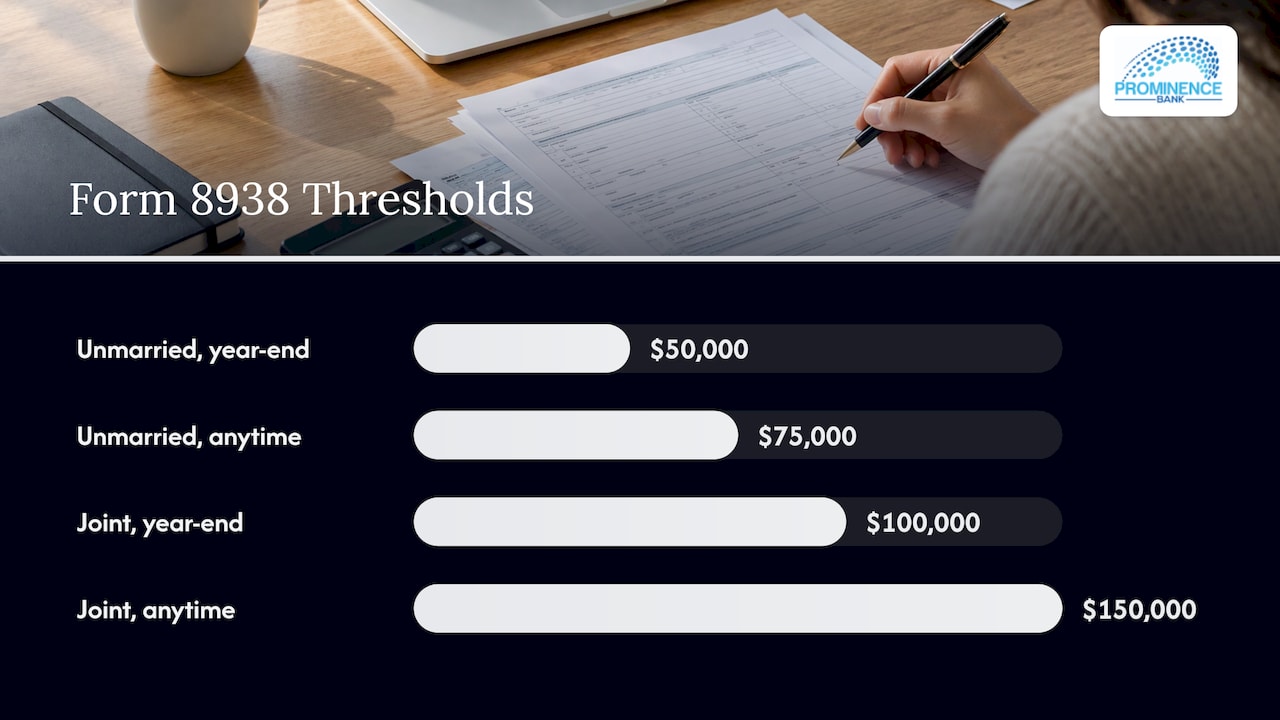
Form 8938 is a different regime with different thresholds. According to the IRS FAQ on international individual tax matters, unmarried U.S. citizens and residents living in the United States must file above $50,000 at year-end or $75,000 at any time during the year. For married couples filing jointly, the thresholds are $100,000 and $150,000. The thresholds differ for people living abroad and by filing status, so check the form instructions for your situation.
The IRS also notes that financial accounts maintained with a foreign financial institution are reportable on Form 8938, with savings, deposit and checking accounts as examples. An account must be reported even if it holds assets issued by a U.S. person.
FBAR and Form 8938 compared
| Feature | FBAR (FinCEN Form 114) | Form 8938 |
|---|---|---|
| Where filed | FinCEN, electronically | Attached to your federal income tax return |
| Basic threshold | Aggregate foreign accounts above $10,000 at any time | Starts at $50,000 year-end or $75,000 any time for unmarried filers living in the U.S. |
| Deadline | April 15, automatic extension to October 15 | Same as your tax return, including extensions |
| Replaces the other? | No | No |
The IRS comparison page states that the FBAR is filed directly with FinCEN, separately from the IRS, and that Form 8938 does not replace or otherwise affect the obligation to file an FBAR. Many holders of larger numbered accounts need both.
Reporting the income, not just the account
The FBAR and Form 8938 disclose the existence of accounts. They are separate from reporting income. U.S. persons are generally taxed on worldwide income, so interest, dividends and gains earned inside a foreign account go on your income tax return like any other. Where foreign tax was paid, a tax professional can tell you whether a credit or deduction applies.
Three practical habits keep this manageable:
- Download the annual statement from the bank each January, in the currency of the account.
- Note the highest balance of the year for each account, which you need for the FBAR.
- Give your preparer the account number, the bank’s name and address, and the account type.
Records you need to keep
The recordkeeping rule is explicit. Under 31 CFR 1010.420, each person with a financial interest in or signature authority over a reportable account must keep records for five years. They must include the account name, the account number or designation, the foreign bank’s name and address, the account type and the maximum value during the period.
A numbered account makes this easier, not harder, if you organize it well. Keep a one-page schedule that links your account number to the legal name on the relationship, the bank address and the currency, and store it alongside each year’s maximum value calculation.
Custody receipts, KTT and crypto: where the questions get specific
Numbered accounts are often used alongside other services. Each raises a classification question that a professional should answer on the facts.
Safekeeping receipts (SKR) and custody
We are not aware of IRS guidance that addresses safekeeping receipts as a category. What matters is how the underlying arrangement is characterized. The FBAR regulation defines a bank account as an account with a person engaged in banking, and a securities account as one with a person engaged in buying, selling, holding or trading stock or other securities, per 31 CFR 1010.350. A custody arrangement held by a bank may therefore fit one of those definitions depending on what is held and by whom. Bring the receipt, the custody agreement and a description of the assets to your adviser, and let them document the conclusion in your file.
KTT-enabled accounts
KTT (key tested telex) is a transfer method. It describes how funds move, not a separate type of account for reporting. The question for a KTT-enabled account is the same as for any other: is it an account with a bank or other financial institution outside the U.S., and do you have an interest in it or authority over it? If yes, the aggregate-balance tests apply.
Crypto accounts
The rules here have been moving. In a 2020 notice, FinCEN said foreign accounts holding only virtual currency were not a reportable FBAR account type under the regulations at that time, and that it intended to propose amendments to include virtual currency. Because that intention may have developed since, confirm the current rule before each filing season. A crypto account that also holds fiat currency or other reportable assets raises a separate question. Our guide to secure crypto bank account opening covers the banking side.
Penalties for missing a filing
The penalties are the reason to file even when you are late and unsure. The IRS comparison page lists these:
- Form 8938: up to $10,000 for failure to disclose, plus $10,000 for each 30 days of non-filing after IRS notice, to a maximum of $60,000. Criminal penalties can also apply.
- FBAR, willful: up to the greater of $100,000 or 50 percent of the account balances, with potential criminal penalties.
- FBAR, non-willful: a smaller civil penalty that is adjusted for inflation each year.
The current inflation-adjusted figures are on the IRS comparison page. If you have missed prior years, see our walkthrough on how to fix U.S. offshore filings, and talk to a tax attorney or enrolled agent about the right correction path before you file anything.
A yearly checklist for numbered-account holders
- January: collect year-end statements and note each account’s peak balance.
- February: convert foreign-currency balances using the Treasury year-end rate, then total them.
- March: compare the total to $10,000 for the FBAR and to your Form 8938 threshold.
- Before April 15: file the FBAR electronically with FinCEN, or use the automatic extension to October 15.
- With your return: attach Form 8938 if you are over the threshold, and report all account income.
- Year-round: keep the five-year records file current.
Perspective
Clients often come to us believing that privacy and compliance pull in opposite directions. We see it the other way. A numbered account is designed to limit who sees your name in everyday banking, and it sits inside a bank that applies international AML/KYC standards. Your own filings with FinCEN and the IRS are a separate duty that rests with you.
Our view is that the best-run private banking relationships are the ones where the client’s adviser, the client and the bank all work from the same clean file: account number, legal holder, currency, peak balance. We provide clear year-end statements so that the FBAR and Form 8938 work is routine rather than a scramble.
If you are weighing a numbered, custody or multi-currency account, we would rather you plan the reporting before opening than after. That is how privacy and lawful, orderly reporting sit together.
Harold
Opening a numbered account with reporting in mind
We offer numbered bank accounts for high-net-worth individuals, international businesses and institutions. Our published fee for numbered bank account opening is $/€ 50,000 one-off, with a monthly fee of $100 or €100 for the numbered account. Standard bank account opening is $25,000 or €25,000 one-off. Enhanced due diligence is priced at €5,000, €10,000 or €15,000 depending on level. The full schedule is on our fees page.

If you want a relationship structured for private banking, our private banking team can walk you through onboarding. For a broader view of what we ask for, read our global account opening requirements.
FAQ
Does a numbered account hide my account from the IRS?
No. A numbered account changes how the account is labeled on statements, not your duty as a U.S. person to report it. The FBAR and Form 8938 rules look at your financial interest or authority, not at the naming format. Report it as you would any foreign account.
Do I need both an FBAR and Form 8938?
Possibly. They have separate thresholds and are filed in different places, and the IRS says filing one does not replace the other. An FBAR goes to FinCEN above $10,000 in aggregate. Form 8938 goes with your tax return once you pass the higher threshold for your filing status and residence.
What if my account earned no interest?
You still report it. For the FBAR, the IRS says taxable income generally has no effect on whether an account is a reportable foreign financial account. Income, if any, is reported separately on your tax return.
How long do I keep records?
Five years. The regulation calls for the account name, account number, bank name and address, account type and the maximum value during the period. A one-page schedule updated each year covers all of these.
Sources
- U.S. Court of Appeals for the Federal Circuit opinion, numbered UBS account
- 31 CFR 1010.350, reports of foreign financial accounts
- 31 CFR 1010.420, records to be retained
- FinCEN, report foreign bank and financial accounts
- IRS, FBAR overview
- IRS Internal Revenue Manual 4.26.16
- FinCEN, reporting maximum account value
- IRS, FAQ on international individual tax matters
- IRS, basic questions and answers on Form 8938
- IRS, comparison of Form 8938 and FBAR requirements
- FinCEN, filing requirement for virtual currency