
A KTT (key tested telex) transfer is verified in three layers: the bank verifies who you are, the sending and receiving banks authenticate each other, and the receiving bank confirms the funds are really in place before it credits anything. If one layer is missing, the transfer is not verified, whatever any document says. This guide walks through each layer, what you should have ready, and the checks that keep you safe.
TL;DR
- KTT verification starts with you: identity, source of funds and beneficial ownership are checked under AML/KYC rules before a KTT-enabled account is usable.
- Banks then authenticate each other over a bank-to-bank channel. A PDF or screenshot sent by a third party is never the verification.
- Verify through your own bank’s official channels, using contact details taken from its website, never from the person selling you the deal.
- At Prominence Bank, the published KTT transaction fee is 1.5% of the face value stated in the KTT, charged on every KTT received, of any type, even when no settlement follows. Enhanced due diligence is priced in three published levels.
- Nobody other than your own bank should ask for a “verification fee” before funds are confirmed.
Table of Contents
- What a KTT is, and what “verification” means
- Layer 1: client verification (KYC, AML and source of funds)
- Layer 2: bank-to-bank authentication
- Layer 3: funds confirmation and credit
- The KTT verification process step by step
- Red flags during verification
- Costs to expect
- Our perspective on KTT verification
- Working with Prominence Bank
- US reader notes
- Preparing your file so verification moves faster
- FAQ
What a KTT is, and what “verification” means
KTT stands for key tested telex, also called a tested telex transfer or E-Telex. It is an authenticated instruction passed between two banks, each of which already knows the other’s test key or authentication arrangement. It is used for large, often time-sensitive transfers in trade finance, treasury and private wealth structures. If you want the background first, our guide to KTT funds transfers covers the mechanics.
“Verification” gets used for three different things, and mixing them up is where people get hurt:
- Client verification: the bank confirms that you and your entity are who you say you are and that the money is clean.
- Message verification: the banks confirm that the instruction really came from the other bank.
- Funds verification: the receiving bank confirms that the funds exist and can be released to the beneficiary.
Each layer has a different owner. You are responsible for the first, the banks for the second and third. A transfer that skips any of them is not a KTT in any meaningful sense.
Layer 1: client verification (KYC, AML and source of funds)
Before a KTT can be sent or received, the account has to exist, and for that the bank has to know its customer. International banks work to AML/KYC standards, and a digital bank serving cross-border clients is no different. Expect to be asked for:
- Identity documents for every principal: passport, proof of address, and a second form of ID where required.
- Corporate documents for entities: certificate of incorporation, articles, register of directors and shareholders, and a structure chart showing the ultimate beneficial owner.
- Source of funds and source of wealth: where the specific money came from (a sale, a dividend, a contract) and how you built your wealth overall.
- Purpose of the account and the expected volume, currencies and counterparties.
Prominence Bank runs this stage online. Its documents verification page is where document checks are handled, and our walkthrough on how to open a KTT account shows the order of the steps.
Enhanced due diligence for complex cases
Large sums, layered ownership or cross-border structures usually call for enhanced due diligence (EDD). Prominence Bank publishes three EDD levels on its fees page:
| EDD level | Intended for | Published fee |
|---|---|---|
| Level 1 (Enhanced Standard) | Higher-value or more international profiles | €5,000 one-off |
| Level 2 (Advanced) | Multi-jurisdiction structures | €10,000 one-off |
| Level 3 (Critical / Complex) | The most complex files | €15,000 one-off |
The level descriptions are our shorthand for the tier names on the page; the fees are as published on 12 September 2026. Check the fees page for the current schedule before you plan a budget.
Layer 2: bank-to-bank authentication
Once your account is open and cleared, the sending bank issues the instruction. What makes it a tested telex is the authentication step: the two banks confirm, through an agreed secure channel, that the message is genuine and that the sender is authorized to send it. In practice this rests on relationships that already exist between the banks, such as correspondent (nostro and vostro) arrangements and agreed test keys.
Three things follow from this:
- The verification happens between banks. You can request confirmation from your bank, but you do not perform or supervise it.
- The instruction is tied to a named account at the receiving bank, with the beneficiary name, account number and amount matching your documents exactly.
- A mismatch stops the process. A different spelling of a name, a wrong currency or an unexplained intermediary is a reason to pause, not to push through.
Some sellers circulate PDFs of transfer messages as “proof” that a KTT is on its way. Documents of this kind are easy to forge, and fraud researchers warn that fabricated SWIFT-style confirmations are used to lower a victim’s guard. Treat any such document as a claim to be checked with the bank, never as the check itself.
Layer 3: funds confirmation and credit
The last layer is the receiving bank confirming that the funds are available and the transfer is consistent with your profile. Only then is the credit applied and made available. A responsible bank will also screen the transaction against sanctions lists and its own risk rules. That screening can add time, particularly on first transfers, so plan around it rather than around a promised hour.
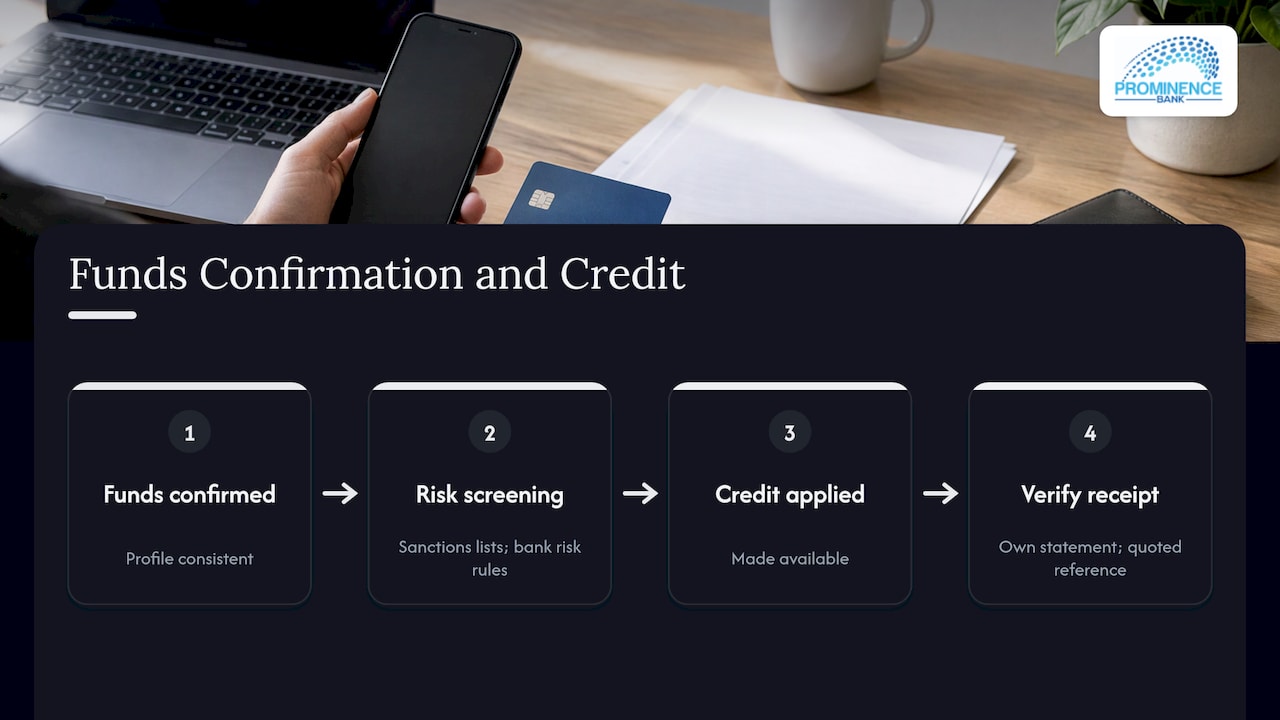
What you should see at the end is simple: the credit on your own statement, in your own online banking, with a reference you can quote to the bank. If the only evidence of the money is an e-mail attachment, it has not arrived.
The KTT verification process step by step
- Open and clear the account. Submit identity, entity and source-of-funds documents and complete any EDD the bank requires.
- Confirm the KTT arrangement in writing with your bank. Ask which transaction types the account supports, which currencies, and what the fee will be.
- Agree the transfer details. Beneficiary name, account, amount, currency and purpose must match across every document.
- Sending bank issues the authenticated instruction to the receiving bank.
- Banks authenticate each other over their secure channel.
- Receiving bank screens and confirms funds.
- Credit is applied and visible in your account.
- Keep the file: reference numbers, statements and correspondence for your own compliance records.
Red flags during verification
Most of what ranks for this topic is warning material, and the warnings are worth taking in as part of the process. Pause and call your bank if you see any of the following:
- A third party asks for a processing, compliance, tax or “verification” fee before the funds are confirmed. Fees belong to your own bank and are listed on its fee schedule.
- The conversation happens only over free e-mail, social apps or encrypted chat, with no named bank officer you can reach through the bank’s published switchboard.
- You are given contact details for “the bank” by the person who is selling you the deal.
- The deal is presented as a way to pledge a transfer as collateral, or to “lease” a KTT, with unusually high returns.
- Pressure to act quickly, or to keep the arrangement confidential from your own advisers.
The safe habit is the same each time: find the bank’s number on its official website, call it yourself, and ask the bank to confirm the account, the instruction and the status in its own system. Involve your attorney or a licensed compliance professional on any transaction of size.
Costs to expect
Verification is not free for a bank, and a transparent bank says so. Prominence Bank’s published schedule includes:
| Item | Published price |
|---|---|
| Bank account opening | 25,000 (USD or EUR), one-off |
| Numbered bank account opening | $/€ 50,000, one-off |
| Incoming or outgoing KTT (E-Telex) transaction | 1.5% |
| Bank endorsement | 1.5% |
| Internal transfer within Prominence Bank | 0.2% |
| Currency conversion | 4% |
| Proof of funds (POF) | €25,000, one-off |
| Reference or comfort letter | €25,000, one-off |
SWIFT and IBAN wire transfers are published at 1% (minimum $/€100), and outgoing transfers also carry applicable SWIFT/SEPA charges. The published fee for the Safekeeping Receipt (SKR) / custody service is $/€ 25,000 for the custody account plus 2%. These are the figures shown on the fees page, so check it for any update.
Our perspective on KTT verification
Most of the trouble we see around KTT comes from one confusion: people treat verification as a document they receive, when it is a process their own bank performs. A genuine KTT is a bank-to-bank event. You should be able to see it in your own account, with a reference, through a channel that you opened yourself.
That is why we put the weight on the front of the process. Clear identity, a documented source of funds and, where the structure is complex, enhanced due diligence make every later step faster and cleaner. We publish our fees, including the three EDD levels, because clients deserve to know the cost of being verified properly before they start.
Our model is fully digital: onboarding, document checks and account access happen online, under AML/KYC standards, within our extraterritorial regulatory framework. For clients who value discretion, including those who want KTT-enabled or numbered accounts, that combination of privacy and a rigorous process is what we are built for.
Harold
Working with Prominence Bank
If you need KTT-enabled banking, the practical route is to open the account first and run the transfer through it. Prominence Bank offers KTT-enabled accounts, multi-currency business accounts, private numbered accounts, custody and safekeeping receipt services, with account opening handled online. Start with the fees and account opening schedule, or read about corporate banking and private banking if you are choosing between structures.

For entities, the business account application is the place to begin. Our overview of an offshore KTT account explains how the account type fits into a wider structure.
US reader notes
If you are a US person, an account outside the US brings reporting duties of its own. Our article on expat offshore banking and FBAR sets out the basics. Speak to a US tax adviser or CPA about your specific filings before you move funds, since reporting thresholds and forms depend on your situation.
Preparing your file so verification moves faster
The most common cause of delay is an incomplete or inconsistent file, not the bank. A short checklist helps:
- Make sure names are spelled identically across passports, corporate records and the application.
- Provide documents that are current, legible and, where required, certified or translated.
- Prepare a one-page narrative of how the funds were earned, with supporting contracts, sale agreements or statements.
- Draw the ownership chart down to every individual who owns or controls the entity.
- Name your expected counterparties and the purpose of the first transfer.
- Keep one point of contact on your side who can answer the bank’s questions the same day.
For a larger entity, our corporate account structuring checklist goes through the structure questions a bank will ask.
FAQ
What is the KTT verification process?
It is a three-layer check. The bank verifies your identity and source of funds, the sending and receiving banks authenticate each other’s message, and the receiving bank confirms the funds before crediting your account. The evidence of success is the credit in your own account, not a document from a third party.
How long does KTT verification take?
There is no honest universal figure. Client onboarding depends on how complete your file is and whether enhanced due diligence applies, and the transfer itself depends on sanctions screening and the banks involved. Ask your bank for its expected timeline in writing for your specific case.
Can I verify a KTT myself?
You can confirm the outcome, but not run the authentication. Call your own bank, using the number on its official website, and ask it to confirm the instruction and status. Do not rely on a PDF, screenshot or message that someone else sends you.
Who pays for KTT verification?
You pay your own bank according to its published fee schedule. At Prominence Bank, the published KTT transaction fee is 1.5% of the face value stated in the KTT, charged on every KTT received, of any type, even when no settlement follows. Enhanced due diligence costs €5,000, €10,000 or €15,000 depending on level. Be wary of any third party asking for a separate verification fee.