
Offshore bank accounts are a legal tool for expats, but they come with strings attached. If you hold accounts abroad, check your aggregate balances against the $10,000 FBAR threshold and talk to a tax advisor if you are close to it. The details on FBAR and Form 8938 filings matter more than the account itself, so treat compliance as step one, not an afterthought.
TL;DR:
- Offshore accounts are legal when properly declared, but compliance with FBAR and Form 8938 reporting is mandatory for US persons and should be prioritized over account choice.
- Jurisdictions participating in the Common Reporting Standard now prioritize stability and transparency over secrecy, requiring careful review of regulatory and deposit insurance frameworks.
- Opening an offshore account requires well-prepared documentation, with complex structures significantly extending processing times due to enhanced due diligence.
- Foreign account holders must file FBAR if combined balances exceed $10,000 and potentially face additional reporting on Form 8938, with penalties for non-compliance often outweighing the costs of proper reporting.
- Digital banking providers specializing in high-net-worth and cross-border clients offer transparent fee schedules, multi-currency support, and structured onboarding suited for complex ownership arrangements.
Table of Contents
- What is offshore banking and why expats use it
- Offshore account types, currencies, and typical services
- Choosing a jurisdiction: privacy, transparency, and deposit protection
- How to open an account: eligibility, documents, and KYC expectations
- US tax and reporting essentials: FBAR, Form 8938, and FATCA
- Practical risks, fees, and insurance considerations
- Action checklist: how to pick a bank and questions to ask first
- When offshore banking actually makes sense for expats
- Prominence Bank: licensed digital banking for globally mobile clients
- Sources
- FAQ
What is offshore banking and why expats use it
An offshore account is simply a bank account held at an institution outside your country of residence. For expats, that often means banking somewhere other than where they grew up or where they now live, sometimes both.
Expats use offshore accounts for practical reasons:
- Receiving multi-currency payroll without repeated conversion losses
- Holding foreign-earned income in the currency it was earned
- Custody for cross-border investment portfolios
- Corporate treasury management for businesses operating across borders
None of this is a gray area. Offshore banking is legal when the accounts are declared and properly reported, which is the part many people skip.
Offshore account types, currencies, and typical services
Not every offshore account serves the same purpose, and picking the wrong type creates friction later.
- Multi-currency current or checking accounts handle daily spending and payroll across currencies without constant conversion.
- Savings accounts hold longer-term balances, usually with modest interest and fewer transaction features.
- Custody or numbered accounts protect and manage investment assets, often with added privacy layers.
- Corporate accounts support business treasury functions, trade finance, and multi-entity structures.
A freelancer paid in three currencies needs a different setup than a business managing supplier payments across continents. Daily spenders want a current account with strong card and wire access. Investors need custody arrangements built for safekeeping and settlement, not everyday transactions.
Common services worth comparing include SWIFT and IBAN wire capability, multi-currency debit cards, online access across multiple entities, and custodial safekeeping for securities or instruments.
Pro Tip: Match the account type to the transaction pattern you actually have, not the one you expect to have someday.
Choosing a jurisdiction: privacy, transparency, and deposit protection
Jurisdiction choice used to be about secrecy. Now it is about regulatory quality and how much information gets automatically shared.
Every jurisdiction that participates in the OECD’s Common Reporting Standard exchanges account-holder information with tax authorities automatically, so true anonymity offshore is largely gone. What is left is a trade-off between privacy protections, the strength of the local regulator, and deposit insurance limits, which vary widely and are often lower than what savers expect from home-country coverage.
Before picking a jurisdiction, check a few things:
- Whether the regulator publishes clear rules on capital requirements and bank licensing
- Whether the jurisdiction has signed CRS or bilateral tax information exchange agreements
- Whether beneficial-owner registries exist and how accessible they are
- How stable the local banking infrastructure and online access have been historically
A jurisdiction with strong infrastructure and clear CRS implementation is usually a safer long-term bet than one that markets itself purely on secrecy.
How to open an account: eligibility, documents, and KYC expectations
Most delays in offshore account opening come from incomplete paperwork, not rejection. Prepare these in advance:
- A valid passport and secondary government-issued ID
- Proof of address, typically a utility bill or bank statement less than three months old
- Proof or source of funds documentation, such as pay stubs, sale agreements, or business financials
- Corporate formation documents and shareholder registries, if opening a business account
- Identification for all beneficial owners holding a qualifying stake
Banks apply enhanced due diligence to complex ownership structures because FATF guidance calls for a risk-based approach to customer due diligence, with closer scrutiny for layered corporate structures and high-risk relationships. This is regulatory routine, not a personal judgment on the applicant.
Pro Tip: Submit certified copies and a clean, well-documented source-of-funds explanation upfront. It shaves days, sometimes weeks, off approval.
Expect standard accounts to open in one to two weeks and complex structures to take longer once enhanced due diligence kicks in. A step-by-step onboarding guide walks through document sequencing in more detail.
US tax and reporting essentials: FBAR, Form 8938, and FATCA
This is the part that trips up most expats, and skipping it carries real penalties.
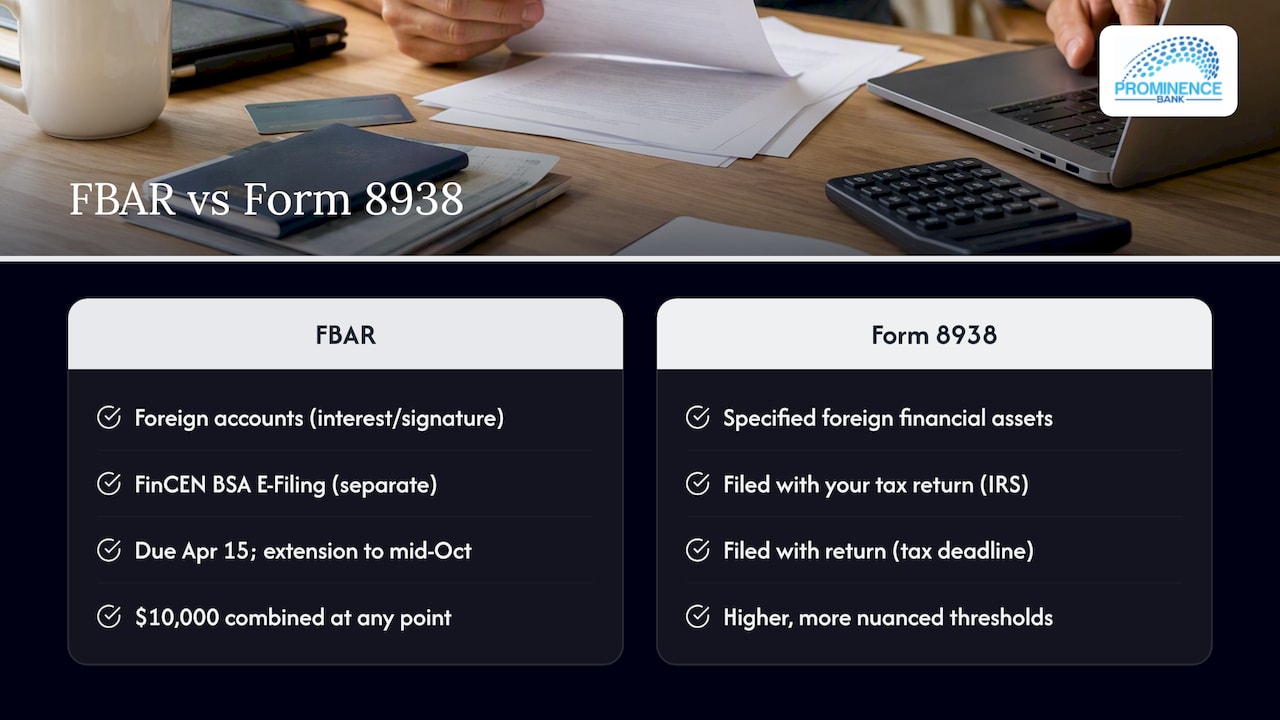
Any U.S. person with a financial interest in or signature authority over foreign accounts must file an FBAR (FinCEN Form 114) if the combined value of those accounts exceeds $10,000 at any point in the year. FBAR is filed electronically through FinCEN’s BSA E-Filing system, due April 15 with an automatic extension to mid-October. It is filed separately from your tax return, not attached to it.
Form 8938 is a different filing with different math. It covers specified foreign financial assets and carries higher, more nuanced thresholds than FBAR, and it is filed with your tax return rather than to FinCEN directly. Owning foreign accounts can trigger both filings at once, since they cover overlapping but distinct categories of assets. A few exceptions apply, including accounts held at U.S. branches of foreign institutions and foreign branches of U.S. financial institutions, which are treated differently under IRS comparison guidance. A SmileTax breakdown lays out the threshold differences side by side if you want a quick reference.
In practice, FATCA means many foreign banks will ask you for a W-9 and may report your account activity to U.S. authorities through an intergovernmental agreement. If a bank is vague about how it handles FATCA reporting for U.S. clients, ask directly before opening the account. A missed FBAR filing can trigger penalties that far exceed the cost of doing it right the first time.
Practical risks, fees, and insurance considerations
Offshore accounts are not free, and the fee structure is often less transparent than domestic banking.
- FX spreads on currency conversion are frequently the largest hidden cost, more than wire fees themselves.
- Outgoing wire fees and account maintenance charges add up for active accounts.
- Deposit insurance offshore is often thinner than U.S.-style protection, and large balances may sit outside any guarantee scheme entirely.
- Operational risk includes account freezes during enhanced due diligence reviews, transfer delays, and exposure to currency volatility on uninsured balances.
None of these risks are reasons to avoid offshore banking outright, but they are reasons to read the fee schedule before opening an account, not after the first statement arrives.
Action checklist: how to pick a bank and questions to ask first
Before committing to a bank, run through a short list of priorities and ask direct questions.
- Confirm the bank’s license and the regulator that oversees it.
- Check whether online and mobile access covers your daily transaction needs.
- Verify multi-currency support matches the currencies you actually use.
- Ask how the bank handles FATCA and CRS reporting for U.S.-connected clients.
- Get the full fee schedule, including wire, FX, and maintenance charges, in writing.
- Ask for a realistic onboarding timeline given your document set.
Pro Tip: Ask directly, “How do you handle U.S. clients and FATCA or CRS reporting?” A vague answer is a red flag worth walking away from.
A standard cross-border retail account covers most simple needs. High-net-worth individuals, businesses with custody requirements, or anyone needing structured finance typically need a specialized institution built for that complexity.
When offshore banking actually makes sense for expats
Offshore banking earns its keep for high-net-worth individuals, businesses running cross-border payroll, and anyone managing multi-currency investments. For someone with a single modest checking account and simple needs, the compliance overhead usually outweighs the benefit. Talk to a U.S. tax professional before opening anything that might trigger new reporting, and have your documents ready before you need them.
— Harold
Prominence Bank: licensed digital banking for globally mobile clients
If your needs match the profile above, an all-digital option is worth a look. There are licensed digital banking institutions built for high-net-worth individuals, international businesses, and institutional clients who need multi-currency accounts, KTT-enabled account access, and institutional custody without stepping into a branch.

The onboarding process is built around the same enhanced due diligence complex structures require elsewhere, so applicants with layered corporate ownership or trust arrangements go through structured, documented review rather than guesswork. Fees are transparent and published, including account opening and ongoing charges, so there are no surprises once the account is live. Business owners can start directly through the business account application, while clients weighing custody or wealth management should look at private banking or reach out for a direct consult on structuring the right account.
Sources
For readers filing forms or checking their obligations directly, these sources carry the most weight:
- Report of Foreign Bank and Financial Accounts (FBAR) | Internal Revenue Service
- Guidance for a risk-based approach for trust and company service providers | FATF
- Consolidated text of the common reporting standard (CRS) | OECD
This article is general information, not a substitute for advice from a qualified financial advisor. Consult a qualified financial professional about your own circumstances before acting on anything here.
FAQ
Can a US citizen have an offshore bank account?
Yes, U.S. citizens can legally open and hold offshore bank accounts. Doing so triggers reporting obligations, including an FBAR filing if aggregate foreign account balances exceed $10,000 at any point in the year, and potentially Form 8938 depending on asset thresholds.
Where do people with large balances keep money beyond standard deposit insurance limits?
Large balances are often split across multiple institutions, account types, or jurisdictions to manage counterparty exposure, since deposit insurance limits vary by country and offshore accounts frequently offer thinner protection than domestic accounts. Custody and private banking arrangements are also used to hold assets outside a single bank’s balance sheet.
What happens if I have more than $10,000 in a foreign bank account?
Once your combined foreign account balances exceed $10,000 at any point during the year, you are required to file an FBAR with FinCEN. This is separate from your tax return and has its own deadline, with an automatic extension to October 15.
Can the IRS track offshore accounts?
Yes. Under FATCA, many foreign banks report U.S.-linked account information to U.S. authorities, and participating jurisdictions under the OECD’s Common Reporting Standard automatically exchange account-holder data with tax authorities. This makes undisclosed offshore accounts increasingly visible to regulators.
How is Form 8938 different from the FBAR?
Form 8938 covers specified foreign financial assets with its own thresholds and is filed with your annual tax return, while the FBAR is filed separately to FinCEN once aggregate account balances cross $10,000. Some accounts can require both filings, since the two forms cover overlapping but distinct categories of foreign assets.