
A KTT (key tested telex) moves through four stages: agreement and onboarding, key exchange, message transmission, and posting by the receiving bank. The message itself can be sent and authenticated within a single business day. Funds count as available only when the receiving bank has posted and released them under its own procedures. That last stage is the one you plan around. In the US, it follows wire-transfer rhythms: banking days, cutoff times and compliance reviews.
Below we walk through each stage in order, show where time is usually spent, and explain how to build a schedule you can rely on.
TL;DR
- A KTT is an authenticated bank-to-bank instruction. The authentication step is quick, but availability of funds depends on posting at the receiving bank.
- Plan in banking days, not hours: weekends, Federal Reserve holidays and cutoff times decide whether a payment moves today or on the next business day.
- Most of the elapsed time sits before the message is sent: account opening, due diligence and agreement of the transaction terms.
- Cross-border legs, currency conversion and compliance reviews add days. Build them into your schedule from the start.
- At Prominence Bank, incoming and outgoing KTT (e-telex) transactions carry a published fee of 1.5%, listed on our fees page.
Table of Contents
- What a KTT is, and why it shapes the timeline
- The KTT process timeline at a glance
- Stage 1: Account opening and due diligence
- Stage 2: Agreeing the transaction terms
- Stage 3: Key exchange
- Stage 4: The message is sent
- Stage 5: Review at the receiving bank
- Stage 6: Posting and availability
- A worked schedule
- Fees that belong in your timeline plan
- Checking an offer before you rely on its timeline
- Perspective
- Open a KTT-enabled account with Prominence Bank
- FAQ
- Sources
What a KTT is, and why it shapes the timeline
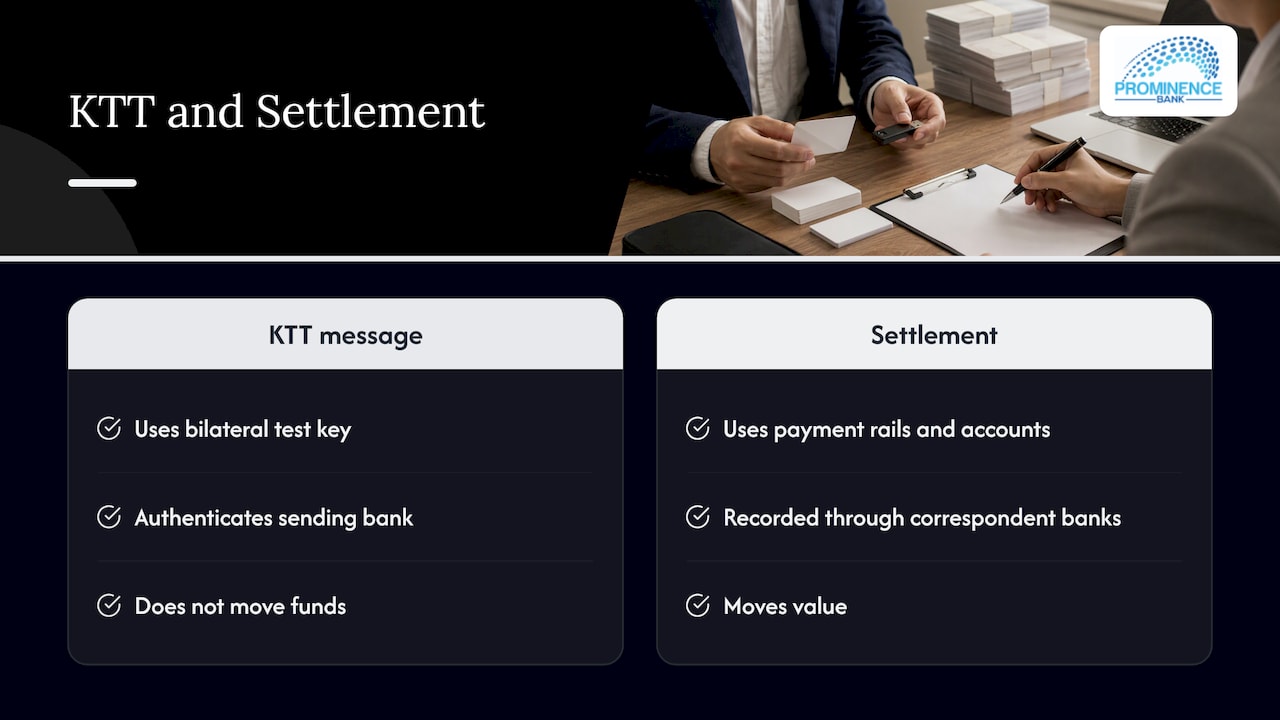
KTT stands for Key Tested Telex. It is a bank-to-bank messaging method from the era before SWIFT. Two institutions with a bilateral relationship agree on a test key formula. The sender applies the formula to a payment instruction, and the receiver checks the result to confirm that the message came from the expected counterparty.
US federal banking regulators describe the same mechanism. According to the FFIEC IT Examination Handbook, telex has no built-in security features. Institutions that use it must exchange security codes. The sender includes a test key in every instruction, and the receiver safeguards each sender’s unique key and decodes each test message.
This tells you how to read the timeline. A KTT answers one question: did this instruction really come from that bank? Whether value then moves is a separate question, answered by the accounts and payment rails behind the message. Analysis from FG Capital Advisors makes the same point. It says a telex is closer to secure messaging than to a funds transfer, and that settlement is recorded through account movements at correspondent banks.
So a sound schedule has two clocks. One covers the KTT mechanics. The other covers settlement and posting.
The KTT process timeline at a glance
The table shows the stages in the order they happen. The durations are planning ranges that depend on the parties and the amounts. They are not guarantees, and each bank’s own procedures decide the final timing.
| Stage | What happens | What drives the timing |
|---|---|---|
| 1. Account and due diligence | Accounts open at both institutions and KYC, AML and sanctions checks are completed | Completeness of documents, complexity of the ownership structure, enhanced due diligence level |
| 2. Transaction terms | Parties agree on amount, currency, purpose and the bank-to-bank contact protocol | How quickly both sides sign off |
| 3. Key exchange | The banks exchange test keys through an agreed secure channel | Bilateral coordination between the two institutions |
| 4. Message sent | The sending bank transmits the authenticated instruction | Business hours and cutoffs |
| 5. Receiving-bank review | The receiving bank checks the sender, account, purpose and settlement route | Compliance review, amount, counterparty history |
| 6. Posting and release | Funds are posted, reconciled and released under the receiving bank’s procedures | Banking days, cutoffs, currency conversion |
Stages 1 and 2 usually take the longest and are fully in your control. Stages 4 to 6 are measured in banking days.
Stage 1: Account opening and due diligence
Before any message is sent, both sides need accounts that can receive and send the transfer. This is where most of the calendar time goes, and it is also where preparation pays off most.
A receiving side should expect to provide the following, according to guidance on KTT documentation: the identity and regulatory status of the sending institution, the sender’s account name, the amount and currency, the commercial purpose, source-of-funds evidence, beneficial ownership information, and KYC, AML and sanctions documents for every material party. Gathering these in one pack before you start removes the most common cause of idle time.
At Prominence Bank, the onboarding path depends on the account you choose and on the due diligence level your structure requires. Our published fees include a one-off bank account opening fee of 25,000 (USD or EUR) and a numbered account opening fee of $/€ 50,000. Enhanced due diligence is priced in three levels: €5,000 for Level 1 (Enhanced Standard), €10,000 for Level 2 (Advanced) and €15,000 for Level 3 (Critical / Complex). The more layers your ownership has, the more review it needs, so mapping your structure first shortens this stage. For a practical walk-through, see our step-by-step international banking process guide and the international account setup guide.
A tip from experience: put the corporate documents, proof of address, source-of-funds evidence and a clear transaction rationale in a single folder before you apply. Reviewers then work through one complete file instead of sending several rounds of requests.
Stage 2: Agreeing the transaction terms
Once accounts exist, the parties settle the commercial details. These include the amount, the currency, the purpose of the payment, the underlying agreement, how the banks will contact each other, and what happens to the funds after receipt.
This stage is short when everything is written down and signed by both sides. It stretches when terms are discussed informally or when a party’s authority to sign is unclear. Two habits keep it tight:
- Name the regulated institution on each side, with the details you obtained yourself.
- State the disbursement instructions for after receipt, so the receiving side does not wait for further decisions once funds post.
Stage 3: Key exchange
Key exchange is the heart of a KTT. The two banks agree on the test key formula and keep it secure. The FFIEC notes that the receiving institution is responsible for safekeeping the unique test code keys of each sender. In practice, this stage is about coordination between two compliance and operations teams rather than about technology. It can usually run in parallel with the final steps of stage 2, provided the relationship between the two banks is already in place.
Security controls here matter as much as speed. Keys are exchanged through channels both banks have agreed on, and they are never circulated in the general transaction paperwork. Readers who handle legacy key-based controls in their own operations may also find it useful to see how other jurisdictions treat payment controls. For example, foreign-exchange payment controls can add documentation steps to cross-border payments in some countries, and your plan should allow for them when a counterparty sits in such a jurisdiction.
Stage 4: The message is sent
This is the shortest stage. After the keys are in place, the sending bank transmits the authenticated instruction, and the receiving bank decodes and tests it. On its own, the sending and testing of the message can happen within the same banking day.
What decides which day is the calendar. In the US, the Federal Reserve’s Fedwire operating hours show how the banking day is built: the funds-transfer business day opens at 9:00 p.m. ET on the preceding calendar day and closes at 7:00 p.m. ET. A payment released after the relevant cutoff rolls to the next funds-transfer business day. Individual banks set their own, usually earlier, customer cutoffs, so check the time your own bank publishes.
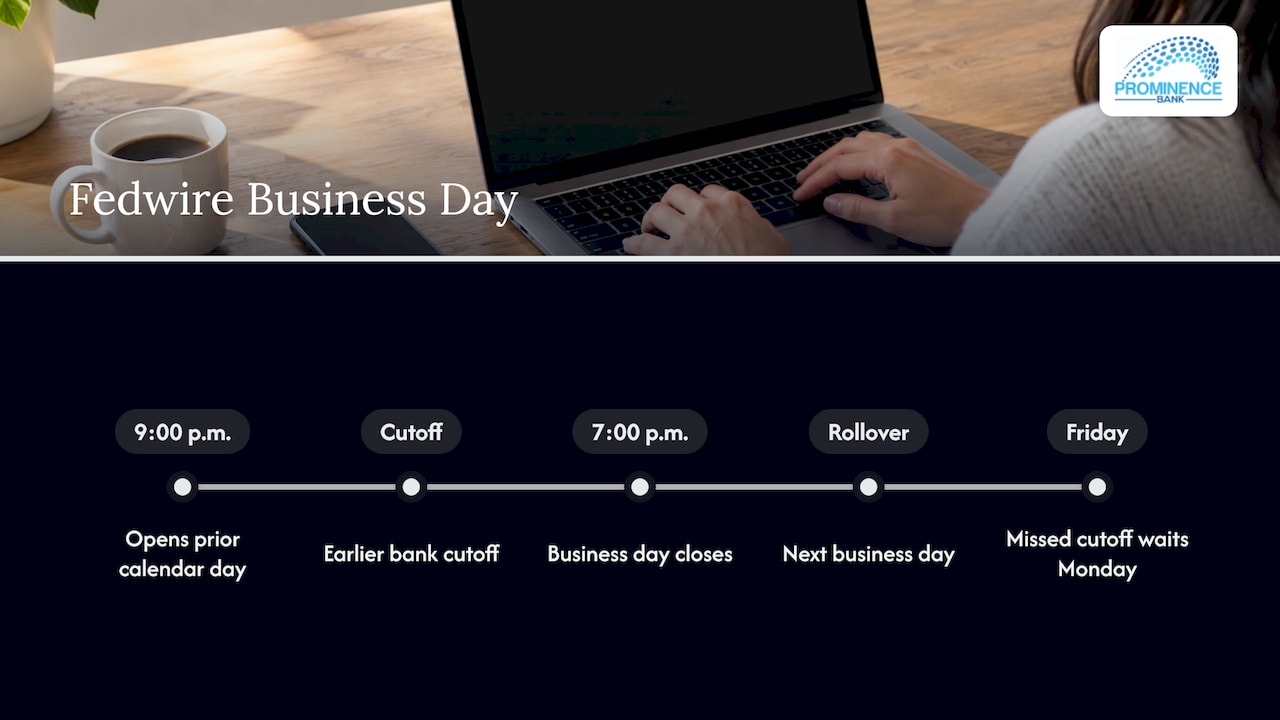
A practical rule: send early in the business day, and never plan an important release for a Friday afternoon. Anything that misses the cutoff waits for Monday.
Stage 5: Review at the receiving bank
After the message arrives, the receiving bank runs its own checks. It must recognize the sender, the account, the payment purpose and the settlement route. Every international transfer also passes AML and sanctions screening, and an unusual amount, a new beneficiary or a high-risk corridor can trigger a manual review.
This is not a sign that something is wrong. It is how regulated banking works, and it is the reason a clean file matters. A review is shorter when:
- the sender and receiver have a documented relationship;
- the stated purpose matches the underlying agreement;
- the source of funds is evidenced in advance;
- the amount is consistent with the account’s profile.
Stage 6: Posting and availability
Funds are available when the receiving institution has posted, reconciled and released them according to its own procedures. Copies of messages, slips and declarations are communications. The bank’s own records are what show the money.
For domestic wires, timing is quick once the instruction is in the system. A US broker’s published guidance, for example, asks customers to allow at least one business day for domestic wires and up to five business days for international wires, and notes that wires cannot be reversed. Treat those as the outer planning numbers for a cross-border leg, not as promises from any particular bank.
What lengthens the posting stage
- Cutoff times. A message sent after the cutoff is processed on the next banking day.
- Weekends and holidays. Fedwire does not operate on Federal Reserve holidays, and most payment systems run on weekday schedules.
- Currency conversion. Converting into another currency adds a step. Our own currency conversion fee is 4%, so it pays to hold funds in the right currency from the start. Our guide to multi-currency accounts explains how.
- Correspondent banks. When a payment crosses several institutions, each one adds its own review.
- Compliance holds. Large amounts or new counterparties are checked more closely.
A worked schedule
Here is an illustrative plan for a business moving funds between two accounts at institutions that already know each other. The numbers are a planning example, not a promise of any bank’s performance.
- Weeks before: complete onboarding, finalize the due diligence pack and sign the transaction terms.
- Several days before: confirm key exchange with both banks and agree the contact protocol.
- Tuesday morning: the sending bank transmits the instruction, well ahead of its cutoff.
- Tuesday to Wednesday: the receiving bank reviews and posts the funds.
- Thursday: funds are confirmed on your statement and disbursed per the pre-agreed instructions.
Notice what the plan avoids. It does not send on a Friday, it leaves a spare day for review, and it has the disbursement decision made in advance. Those three choices remove most avoidable delay.
Fees that belong in your timeline plan
Cost and time travel together, so budget both. Our published fee schedule lists the figures below, and the fees page carries the full list.
| Item | Published fee |
|---|---|
| Incoming / outgoing KTT (e-telex) transaction | 1.5% |
| Prominence Bank internal transfer | 0.2% |
| Currency conversion | 4% |
| Bank endorsement | 1.5% |
| Reference or comfort letter | €25,000 one-off |
| Proof of funds (POF) | €25,000 one-off |
Internal transfers between Prominence Bank accounts carry the lowest rate of the group, which is a reason to keep related entities on the same platform when the structure allows it.
Checking an offer before you rely on its timeline
A realistic timeline also protects you from offers that promise too much. The UN Commission on International Trade Law lists indicators of commercial fraud that include undue secrecy, irregular documents, misuse of technical terms, frustration of due diligence, and an immediate or irrevocable transfer of funds. UNCITRAL stresses that one indicator is a signal to look closer, and that several together should raise concern.
Apply that list to any KTT proposal you receive:
- The sender cannot name a regulated institution that you can confirm independently. Use contact details you found yourself, not those inside the transaction package.
- Someone asks you to pay a release or activation charge before your bank can see the transfer.
- The message is described as money in itself. A key tested message is an authenticated instruction. It does not replace settlement, and your bank must still recognize the sender, the account and the route.
- The timeline skips onboarding. A genuine transfer between regulated banks needs accounts, due diligence and agreed terms first.
If you are receiving funds for a purchase such as property, the same discipline applies. A guide on international transfers for a property purchase shows why confirming the sending institution and your own bank’s acceptance before the transfer date prevents last-minute surprises.
Perspective
We see the same pattern with clients who plan KTT-enabled transactions: the transfer itself is rarely the slow part. The weeks go into preparation, so the most useful thing a client can do is arrive with a complete file.
Our approach is to treat KTT as part of a properly documented banking relationship. That means a licensed digital bank, a clear account structure, KYC and AML compliance, and a published fee for every step, including 1.5% for KTT (e-telex) transactions. Because onboarding is fully digital, clients can work through documents and approvals online instead of waiting on couriers and branch appointments.
We also advise clients to think in banking days and to keep the authentication step separate from the settlement step in their plans. When both are planned, the schedule is predictable and the conversation with every counterparty gets easier. For clients with complex structures, our KTT-enabled accounts, multi-currency capability and custody services are built to keep the whole process in one place.
Harold
Open a KTT-enabled account with Prominence Bank
If you need to move funds between institutions with discretion and clear documentation, we can help you set up the account first, which is the step that saves the most time later. Prominence Bank is a licensed digital bank serving high-net-worth individuals, international businesses and institutional clients, with multi-currency accounts, numbered accounts, custody services and KTT-enabled accounts.

Review the published fees on our fees page, read about our KTT account, or start a business or corporate account application. For a broader view of KTT-related services, see our KTT funds transfer guide.
FAQ
How long does a KTT transfer take?
The authenticated message can be sent and tested within a banking day. The overall timeline is longer, because accounts, due diligence, agreed terms and key exchange come first, and posting at the receiving bank follows. Funds are available only once that bank has posted and released them.
Does a KTT work on weekends?
Plan on banking days only. Fedwire does not operate on Federal Reserve holidays, and most payment systems run on weekday schedules. A message sent late on a Friday will usually wait until Monday to move.
Is the KTT message the same as received funds?
No. The message authenticates an instruction between two institutions. Funds are received when your bank shows them posted in your account, so rely on your own bank’s records and statements.
What speeds up a KTT transaction?
A complete due diligence file, a documented relationship between both banks, a clear transaction purpose and early-day sending. Holding funds in the right currency also avoids a conversion step, which carries a 4% fee at Prominence Bank and adds processing time.
Can I use a numbered or custody account for KTT?
Prominence Bank offers numbered accounts, custody services and KTT-enabled accounts. The right structure depends on your purpose and due diligence level, and our team can guide you through the options when you apply.
Sources
- FFIEC IT Examination Handbook: Telex-based messaging systems
- Federal Reserve Financial Services: Fedwire Funds Service operating hours
- UNCITRAL: Recognizing and Preventing Commercial Fraud
- FG Capital Advisors: Do KTT transfers work?
- KTT transfers: complete guide to key-tested telex
- Wire deposits: processing times
- Foreign-exchange payment controls in Bosnia and Herzegovina
- International transfer for a property purchase in Spain