
Banks may lawfully offer crypto safekeeping when they meet safe and sound banking practices, satisfy BSA/AML and OFAC obligations, and apply the correct fiduciary or non-fiduciary framework, but they retain full supervisory responsibility even when a third-party sub-custodian handles the technical work. The OCC, FDIC, Federal Reserve, and SEC each govern a piece of this picture, and mapping an activity to the wrong authority is a common compliance misstep.
TL;DR:
- Fiduciary custody falls under 12 CFR parts 9 and 150, while nonfiduciary custody relies on safety and soundness principles; both require BSA/AML and OFAC controls.
- Pure custody stays closest to traditional safekeeping law, but execution, staking, lending, or payment links add counterparty, market, securities, or transfer rules.
- Before launch, banks need board and BSA officer approval, separate risk assessments for each activity, key controls, independent verification, customer agreements, and a controlled pilot.
- A third party custodian does not take supervisory responsibility away; banks must verify key controls, asset segregation, continuity plans, audit rights, and insolvency treatment.
- Banks serving investment advisers must meet adviser qualified custodian requirements separately; banking authority alone does not satisfy those rules, and advisers need independent verification access.
Table of Contents
- What the interagency guidance and major agency actions require
- Key statutes, regulations, and rules to map your program to
- Practical compliance checklist: governance, controls, audit, and recordkeeping
- Third-party and sub-custodian risk management
- Minimum launch sequence for a compliant safekeeping program
- How SEC custody developments affect advisers and bank custodians
- Overview of international regulatory variations affecting crypto banking regulations
- Impact of crypto banking regulations on cross-border transactions and correspondent banking
- Specific licensing requirements and approval processes for crypto banking operations
- Privacy and data protection compliance considerations in crypto banking
- Recent legislative developments and trends in crypto banking regulation globally
- Author perspective: compliance priorities and recommended next steps
- FAQ
- Sources
- Primary agency statements and practitioner documents to consult
What the interagency guidance and major agency actions require
The OCC, Federal Reserve, and FDIC jointly define safekeeping as holding an asset on a customer’s behalf, and their interagency statement frames crypto-asset safekeeping as a clarification of how existing banking law and risk management principles apply, not a new licensing regime. That distinction matters for any team trying to figure out whether it needs fresh approval or simply a documented risk assessment against standards that already exist.
The OCC’s confirmation of bank authority for certain crypto activities, paired with Bulletin 2025-17 aimed at community banks, tells smaller institutions they can offer safekeeping if they evaluate the risks, benefits, and any third-party providers before launch. The FDIC moved in the same direction: on March 28, 2025, it clarified that FDIC-supervised institutions may engage in permissible crypto-related activities without seeking prior FDIC approval, as long as they manage the associated risks adequately. The FDIC also noted that further guidance was still coming, so banks need to keep checking with their primary regulator rather than treating the March statement as a final word.
Three points worth holding onto from this stretch of guidance:
- Safekeeping can be offered in either a fiduciary or non-fiduciary capacity, each with different compliance paths.
- The OCC and FDIC describe crypto safekeeping as an activity that may be conducted under existing bank authority, subject to applicable rules.
- The Federal Reserve has withdrawn some of its earlier crypto-related guidance, signaling that supervisory expectations are still moving.
Key statutes, regulations, and rules to map your program to
A safekeeping program is only as sound as the legal mapping behind it. Fiduciary safekeeping triggers 12 CFR parts 9 and 150, the OCC’s trust powers regulations for national banks and federal savings associations, while non-fiduciary safekeeping relies more heavily on general safety and soundness principles and contract law. Either path still runs through BSA/AML program requirements, OFAC sanctions screening, and applicable obligations for qualifying transfers, plus whatever state banking or trust law applies to the chartering institution.
The legal authority that governs a given product changes with what the bank is actually doing:
- Pure custody, where the bank holds keys and does not trade, sits closest to traditional safekeeping law.
- Execution services, staking, and lending layer additional counterparty, market, and sometimes securities-law questions onto the custody relationship.
- Payment-system rules apply when safekeeping ties into transfers, settlement, or stablecoin reserve management.
Banks also need to watch the SEC’s side of the fence. Custody that looks settled under banking law does not automatically satisfy the separate qualified custodian obligations that investment advisers owe their clients, a gap that trips up banks marketing custody services to RIAs.
Practical compliance checklist: governance, controls, audit, and recordkeeping
Turning agency guidance into an operating program means working through governance, technical controls, and recordkeeping in a deliberate order rather than all at once.
- Secure board and senior management approval, with the BSA officer involved from the start and a documented risk assessment covering every activity type: custody, execution, staking, lending, stablecoin reserve custody, and any linked payment services.
- Build the operational backbone before onboarding a single client: hardware security modules, multi-signer key schemes (M-of-N), a defined cold and hot wallet architecture, incident response procedures, and business continuity plans.
- Establish audit and independent verification routines, including periodic attestations, regular reconciliations, and standing access for independent auditors to review custody records and controls.
- Draft customer agreements that spell out the bank’s duties, how forks and airdrops are handled, and what happens to customer assets if the bank or a sub-custodian becomes insolvent.
Pro Tip: Treat each custody product as its own risk assessment rather than approving one generic “crypto program”: a staking service and a pure safekeeping account trigger different legal authorities and controls.
Our guide to institutional custody governance walks through how this scaffolding connects audit expectations to day to day controls, and our cold storage custody primer covers the hot and cold architecture question in more depth.
Third-party and sub-custodian risk management
Hiring a sub-custodian does not hand off supervisory responsibility. Agencies still hold the chartered bank accountable for how the sub-custodian manages cryptographic keys, internal controls, recordkeeping, and business continuity. A proper due diligence review covers:
- Cryptographic key management practices and whether they match the bank’s own standards.
- Internal controls, liquidity position, and how customer assets are treated in an insolvency scenario.
- Business continuity planning and regulatory compliance history.
Contracts with sub-custodians should lock in audit rights, clear notification and escalation procedures, defined service level limits, segregation of customer assets from the sub-custodian’s own holdings, and a workable dispute resolution process. None of this substitutes for the bank’s own oversight obligations, which remain in place regardless of how much operational work gets delegated.
Minimum launch sequence for a compliant safekeeping program
Before any safekeeping product reaches a customer, internal milestones need to be completed before launch:
- Obtain board or designated committee sign-off, along with BSA officer and legal review, and finish vendor due diligence on any sub-custodian.
- Finalize documentation: a written risk assessment, customer agreement templates, contingency plans, and monitoring tooling configured for the specific product.
- Run a small, controlled pilot with independent verification built in, and set explicit go or no-go criteria tied to what the pilot needs to prove before a wider rollout.
Skipping the pilot stage is the fastest way to discover control gaps after launch rather than before it.
How SEC custody developments affect advisers and bank custodians
A bank’s authority to hold crypto assets under banking law and an investment adviser’s obligation to use a qualified custodian are two separate legal questions, and resolving one does not resolve the other. The SEC’s custody framework analysis makes clear that an adviser using a bank as custodian still has to confirm the arrangement satisfies adviser-specific custody rules, not just the bank’s own regulatory standing.
The SEC’s proposed Safeguarding Rule would widen the scope of assets subject to custody protections and has prompted discussion of alternative models, including a Qualified Self-Custodian framework that would let advisers self-custody certain digital assets under written policies, independent verification, and client notice when no reasonable qualified custodian option exists.
For banks serving advisers as custodians, coordination means lining up:
- Written assurances the adviser can rely on for its own regulatory filings.
- Verification access so the adviser’s auditors can confirm asset holdings independently.
- Contractual rights that match what the Safeguarding Rule, if finalized, is likely to require.
Overview of international regulatory variations affecting crypto banking regulations
Crypto banking rules diverge sharply once a bank’s activity crosses borders. A framework built around the OCC and FDIC’s safekeeping guidance may apply to a U.S.-chartered institution, but a counterparty bank in another jurisdiction may operate under a licensing regime that treats custody, staking, or stablecoin reserves as entirely different categories of regulated activity, or that has no settled position at all.
This creates real friction for banks trying to build consistent controls across a global custody book. Key management standards that satisfy a U.S. examiner may not satisfy a foreign regulator’s data localization or reporting requirements, and a product structured as non-fiduciary safekeeping domestically can be reclassified as a trust or investment service abroad. Sanctions exposure compounds the problem: a transaction routed through a jurisdiction with weaker AML enforcement raises OFAC and BSA risk even when every domestic control is working as designed.
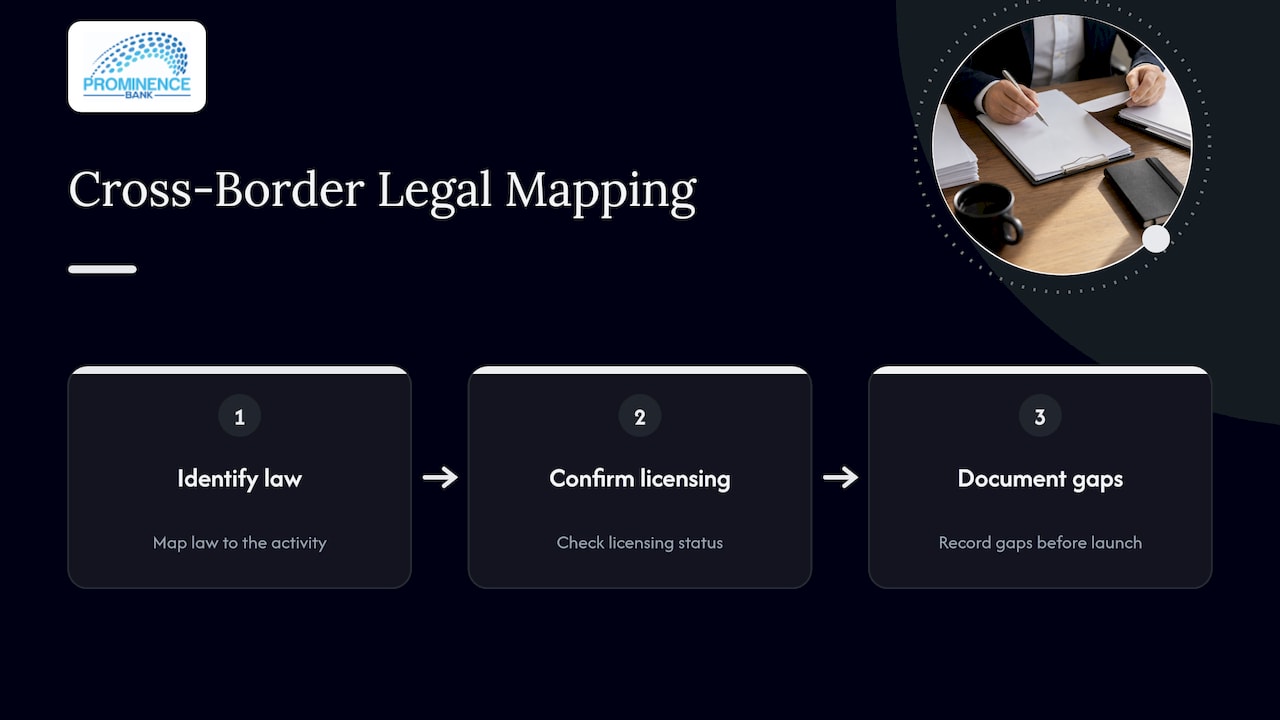
Practically, this means a bank cannot treat its domestic compliance program as portable. Each jurisdiction where a bank, a client, or a sub-custodian operates needs its own legal mapping exercise, using a disciplined approach: identify which law applies to the specific activity, confirm licensing status, and document the gap analysis before any cross-border custody relationship goes live. Treasury and other U.S. agencies also coordinate on cross-agency digital-asset risk in ways that touch sanctions enforcement for cross-border activity, making it another reference point for teams building out an international control framework.
Impact of crypto banking regulations on cross-border transactions and correspondent banking
Crypto safekeeping and payment activity intersect with correspondent banking in ways that add additional scrutiny compared with a standard wire. Correspondent banks evaluating a respondent institution’s crypto-related business now factor in whether that institution has documented BSA/AML controls, sanctions screening, and Travel Rule compliance specific to digital asset transfers, as well as its general AML program.
Correspondent banks may weigh reputational and compliance risk alongside transaction volume when assessing institutions with crypto-related business. A bank offering crypto safekeeping or settlement services should be prepared to explain how its sanctions screening and transaction monitoring address wallet addresses and counterparties, as well as traditional account holders.
For firms running crypto treasury operations across multiple currencies and jurisdictions, this means correspondent banking access often depends on the strength of the compliance narrative as much as the underlying financial relationship. Clear recordkeeping, consistent Travel Rule compliance on qualifying transfers, and a documented sanctions program make it easier for a correspondent bank to approve and retain the relationship.
Specific licensing requirements and approval processes for crypto banking operations
The interagency guidance consistently frames crypto safekeeping as an activity banks can conduct under their existing charter authority, not one requiring a new standalone license, provided the activity is conducted safely and in compliance with applicable law. The OCC’s bulletin for community banks reinforces that point directly: it treats the interagency statement as clarification of existing expectations rather than a new approval regime, and the FDIC’s March 2025 clarification confirms that FDIC-supervised institutions do not need prior FDIC approval for permissible crypto-related activities as long as risks are managed adequately.
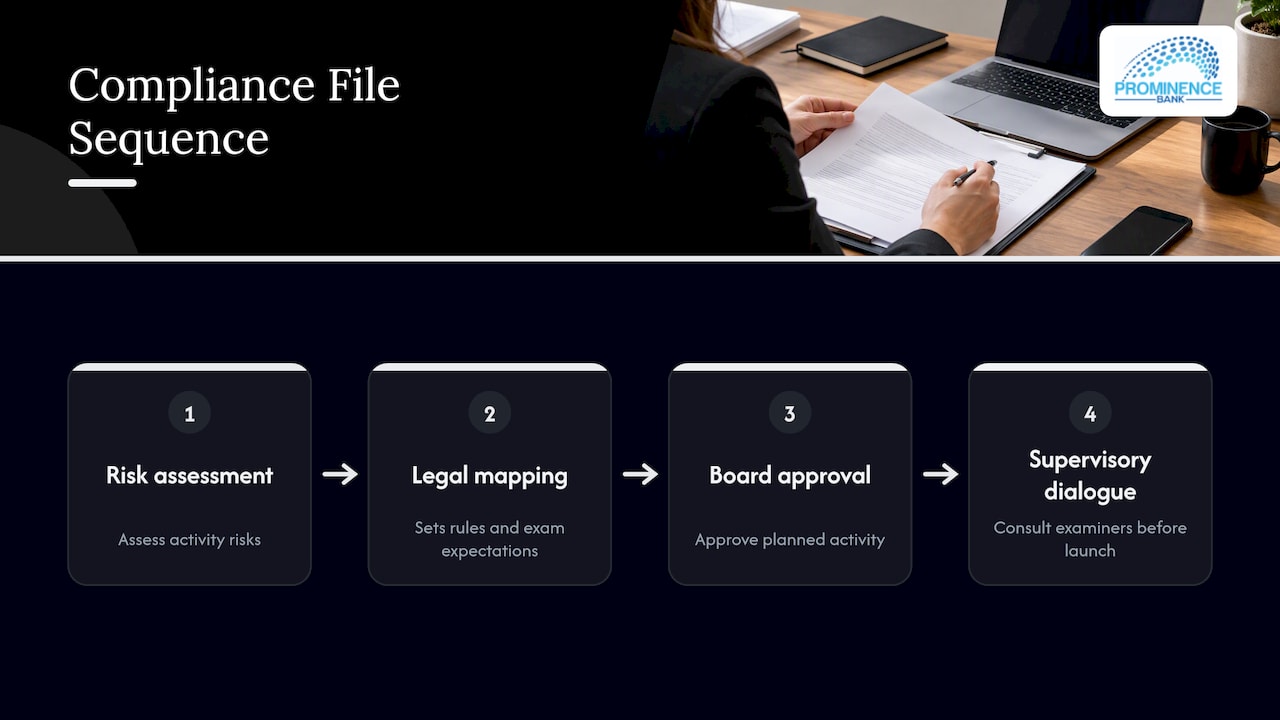
That does not mean there is no process at all. A bank still needs to work through its primary regulator’s expectations for safety and soundness, document the specific activity it plans to offer, and in many cases consult with examiners before a significant new product line goes live, particularly where fiduciary powers under 12 CFR parts 9 or 150 come into play. State-chartered institutions face an additional layer: state banking and trust law can impose its own approval or notification steps that run parallel to federal guidance.
The practical approval process, then, looks less like applying for a new license and more like building a defensible compliance file: risk assessment, legal mapping to the correct authority, board approval, and ongoing supervisory dialogue. Firms unsure where their planned activity sits should treat the legal mapping step in the earlier checklist as the real gating item, since it determines which rules, and which regulator’s expectations, actually apply.
Privacy and data protection compliance considerations in crypto banking
Crypto safekeeping adds data protection obligations on top of standard banking privacy law, because custody records link customer identity to wallet addresses, transaction histories, and key management metadata that are more granular than a typical deposit account record. Banks offering safekeeping need controls that keep this data segregated and access-limited, consistent with the same internal controls expectations the interagency statement applies to cryptographic key management generally.
Sub-custodian relationships raise the stakes further. When a bank hands technical custody to a third party, it needs confirmation that the sub-custodian’s data handling, encryption standards, and access logging meet the same bar the bank would apply internally, since the bank remains accountable for how that data is protected regardless of who technically holds it.
Recordkeeping obligations tied to BSA/AML compliance, including customer identification and transaction monitoring records, may affect how long crypto safekeeping data is retained and what details are recorded. Building the data retention and access control framework into the initial program design, rather than retrofitting it after launch, keeps a custody product aligned with both privacy expectations and the audit trail examiners will eventually ask to see.
Recent legislative developments and trends in crypto banking regulation globally
The regulatory posture toward crypto banking has evolved, with agencies clarifying how existing rules apply. The Federal Reserve’s withdrawal of prior crypto-asset guidance in April 2025 signaled a recalibration of supervisory expectations rather than a tightening, alongside the joint interagency statement. The FDIC’s clarification on permissible activities and the OCC’s community bank bulletin both continued that trend toward letting banks engage with crypto custody under existing authority rather than waiting for bespoke rules.
On the securities side, the SEC’s work toward a modernized custody framework for registered investment advisers points to further rulemaking that will shape how qualified custodian requirements apply to digital assets, including discussion of alternative frameworks like the Qualified Self-Custodian model for cases where no reasonable qualified custodian option exists.
Broader federal legislation aimed at defining market structure for digital assets has been under discussion, though its passage and final scope remain unresolved, and banks should treat any specific legislative outcome as unsettled until it clears both chambers and is signed into law. The consistent thread across these developments is that agencies are converging on mapping crypto activity to existing legal categories, custody, fiduciary duty, safety and soundness, rather than building an entirely separate regulatory track.
Author perspective: compliance priorities and recommended next steps
Institutions can prioritize BSA/AML program updates, vendor due diligence, and board briefings rather than treating them as afterthoughts to a product launch. Audit readiness and independent verification need to exist before the pilot, not after a regulator asks for them.
Document go or no-go criteria tied to concrete legal and operational milestones rather than a launch date. Guidance here will keep shifting, and a program built on documented reasoning survives that shift better than one built on a single agency statement.
— Harold
This article is general information, not a substitute for advice from a qualified financial advisor. Consult a qualified financial professional about your own circumstances before acting on anything here.
FAQ
What are the new crypto regulations?
A significant recent development is the joint interagency statement from the OCC, Federal Reserve, and FDIC clarifying how existing safekeeping law applies to crypto assets, alongside the FDIC’s March 2025 clarification that supervised banks do not need prior approval for permissible crypto activities. These are clarifications of existing authority rather than entirely new rules.
Are banks blocking crypto purchases?
Individual bank policies on crypto-related transactions vary and are not set by a single federal rule. Agency guidance focuses on how banks may safely offer crypto custody and related services, not on whether banks must process or block any particular customer purchase.
Is the Clarity Act going to pass?
Market structure legislation for digital assets has been under active discussion in Congress, but its final passage and scope remain unresolved. Banks should treat any specific bill as pending until it is signed into law rather than planning around an assumed outcome.
Are banks allowed to use crypto?
Yes, under current guidance banks may engage in permissible crypto-related activities, including safekeeping, when they manage the risks safely and comply with applicable banking, BSA/AML, and fiduciary law. The OCC’s community bank bulletin confirms this applies to smaller institutions as well, provided they evaluate the activity before launch.
Sources
- Fdic
- Bank Activities: Crypto-Asset Safekeeping Services | OCC
- Crypto Asset Custody by Investment Advisers After the SEC’s Proposed Safeguarding Rule
Primary agency statements and practitioner documents to consult
The sources below cover the interagency safekeeping statement, OCC and FDIC guidance for custody programs, and SEC materials on custody obligations for advisers. They are worth reading directly before finalizing any program design, since examiner expectations continue to evolve around them. Our custody accounts explainer offers additional background on custody account mechanics for readers newer to the topic.