
Institutional crypto custody is the combination of secure key control, legal segregation, and audit-ready reporting that lets an organization hold digital assets under the same governance standards it applies to any other balance sheet item. The core benefit is not just theft prevention. It is turning crypto from an unaccounted risk into a reportable, auditable, board-defensible position. Everything below explains how that scaffolding actually works and what to demand from a provider.
TL;DR:
- Over 60% of asset managers hold digital assets, and regulatory compliance has become a top priority for crypto custody in 2025.
- Custodians must have validated hardware security modules, SOC 2 Type II reports, and ISO 27001 certification to meet institutional security standards.
- Legal segregation, contractual safeguards, and direct custody reporting are essential to meet regulator and board expectations.
- Operational controls like tiered approvals, just-in-time execution, and automated reconciliation enable secure asset use without increasing risk.
- Evaluating providers should include verifying licensing, insurance coverage, recent attestations, and reviewing live transaction workflows.
Table of Contents
- What Sets Institutional Crypto Custody Apart From Retail Storage
- Core Security Technologies and Standards to Verify
- The Legal and Governance Scaffolding Behind Compliant Custody
- Making Custodied Assets Usable, Not Just Safe
- How to Evaluate a Custody Provider Before You Sign
- A Licensed Digital Bank’s View on Institutional Custody
- Why Custody Only Works Inside a Bigger Governance Plan
- Get Licensed Custody and Treasury Support From Prominencebank
- Sources
- FAQ
What Sets Institutional Crypto Custody Apart From Retail Storage
A retail wallet protects a private key. Institutional custody protects an organization’s entire relationship with a digital asset, including who can move it, how the movement gets recorded, and how an auditor or regulator can verify the whole chain later. That gap is what the industry calls the “scaffolding” around custody, the legal structures, audit trails, and segregated wallet architecture that turn raw key storage into something a compliance officer can sign off on. Chainlink Labs frames this shift as moving from simply “holding risk” to actively “managing” digital assets, because storage alone tells you nothing about ownership boundaries or transaction history.
Institutional-grade custody typically includes:
- Legally segregated client assets, kept separate from the custodian’s own balance sheet
- Documented governance over who can authorize a transaction and under what conditions
- Continuous audit trails linking every on-chain movement to an internal record
- Reporting built for accountants, boards, and regulators, not just a dashboard
Self-custody or hybrid models still make sense for smaller treasuries or highly technical teams comfortable managing keys directly, but once assets sit on a balance sheet subject to audit, most institutions need a custodian.
Core Security Technologies and Standards to Verify
Three technologies dominate institutional custody, and each one solves a different problem. Hardware security modules, or HSMs, isolate private keys in tamper-resistant hardware and remain the most battle-tested option for cold storage. Multi-party computation (MPC) splits key material across multiple parties so no single device or person ever holds a complete key, which suits active trading and frequent signing. Cold storage vaults, whether HSM-based or air-gapped, minimize exposure by keeping keys offline entirely.
None of these technologies mean much without a certification trail behind them. Ask any prospective custodian for:
- FIPS 140-2 validation on the HSMs themselves, ideally Level 3 or higher
- SOC 2 Type II reports covering a sustained operating period, not a point-in-time snapshot
- ISO 27001 certification for the broader information security management system
- Recent penetration test summaries and key-generation ceremony documentation
Institutions are watching this closely. Over 60% of hedge funds, pensions, and asset managers now hold digital assets, and regulatory compliance ranked as a top crypto risk priority in 2025. FIPS 140-2 is the benchmark that separates a custodian’s marketing claims from something NIST has actually validated. If a provider can’t produce a current certificate, treat that as a diligence failure, not a paperwork gap. Our own guide to cold storage custody banking breaks down how multi-signature architecture layers onto these controls.
The Legal and Governance Scaffolding Behind Compliant Custody
Security technology only answers half the question. The other half is whether custody meets the legal bar regulators and boards expect. Registered investment advisers face specific obligations here: the custody rule requires client assets to sit with a qualified custodian, legally separated from the adviser’s own operating funds. The rule’s actual text lives in 17 CFR 275.206(4)-2-2), and any fund evaluating a custodian should map the provider’s structure against that language directly rather than take a sales deck’s word for it.
What this means in practice:
- Verify qualified-custodian status in writing, not through a vague “regulated entity” claim
- Look for contractual segregation and indemnities that hold up if the custodian itself faces financial stress
- Confirm custody reporting feeds directly into fund accounting and board reporting cycles, so auditors aren’t reconstructing positions manually
A bank or trust charter, where a provider holds one, adds another layer of bankruptcy-remoteness that pure technology vendors typically can’t offer. Our custody accounts explainer covers how this fits into broader wealth and institutional account structures.
Making Custodied Assets Usable, Not Just Safe
Locking assets away solves the theft problem and creates a new one: how does the treasury team actually use them? Modern custody platforms solve this with policy engines built directly into the signing flow. Because crypto is a bearer asset, no single operator should ever be able to sign or execute a transaction alone, so maker-checker approval chains, wallet allowlists, and notional transaction caps get embedded at the infrastructure level rather than enforced by policy memos nobody reads under pressure.
Three operational patterns matter most:
- Tiered approvals that scale required sign-offs to transaction size, so a $5,000 transfer and a $5 million transfer don’t hit the same review bar
- Just-in-time execution, where assets move onto a trading venue only when a trade actually needs to happen, reducing counterparty exposure compared to leaving balances parked on an exchange
- API-driven reconciliation that syncs on-chain wallet activity with internal ledgers and exchange integrations automatically, rather than through manual spreadsheet exports
Staking and other on-chain participation can happen inside this same framework, as long as the custodian preserves segregation and keeps a full audit trail of when assets left cold storage and why.
Pro Tip: Ask a prospective custodian to walk through a live transaction end to end, from initiation to settlement to ledger reconciliation, before you sign anything. Slide decks describe controls; a live walkthrough exposes the gaps between them.

How to Evaluate a Custody Provider Before You Sign
Vendor selection for institutional crypto custody breaks into four buckets: operational, legal, technical, and commercial. Skipping any one of them tends to surface as a problem later, usually during an audit or a market stress event.
Operational and governance checks:
- Confirm segregation of client assets and request the governance documentation behind it
- Ask for the incident response plan and how fast the custodian commits to notifying clients after an event
- Request SOC 2 Type II and ISO 27001 reports, not summaries
Commercial and legal checks:
- Understand the fee model fully, including withdrawal, staking, and reporting fees, not just the headline custody rate
- Review settlement flow timing and whether it matches your treasury’s liquidity needs
- Get the SLA in writing, along with named liquidity partners if the custodian supports trading
For the diligence packet itself, request in this order:
- Current SOC reports and FIPS certification numbers for HSM hardware
- Insurance or crime coverage certificates, with coverage limits stated explicitly
- Proof-of-reserves or independent attestation reports, dated within the last reporting cycle
- A sample SLA and at least one reference client in a comparable size range
Our international custody account procedures guide walks through a similar checklist for onboarding, and it’s worth reading alongside whatever RFP template your compliance team already uses.
A Licensed Digital Bank’s View on Institutional Custody
An institutional digital bank approaches custody by building the legal and operational scaffolding first, then layering technology on top of it. Such institutions apply multi-currency account structures, tailored legal frameworks, and international AML/KYC standards to complex corporate and institutional clients.
That same discipline extends to how the bank thinks about crypto custody:
- Multi-signature account structures that mirror the maker-checker controls institutions expect elsewhere in banking
- KYC/AML screening built into onboarding rather than bolted on afterward
- Tailored legal scaffolding for institutions with complex ownership or fund structures
Institutions weighing custody options can request RFP-level detail directly from Prominencebank’s institutional team, rather than relying on generic product pages to answer structure-specific questions.
Why Custody Only Works Inside a Bigger Governance Plan
Custody is the visible piece, but it only earns its value when it sits inside a broader governance and accounting framework. Treat the custodian’s controls as one input into your accounting policy, your board reporting cycle, and your risk limits, not a substitute for building those out. The institutions that get this right pull legal, finance, and treasury into the custody decision early, before the RFP goes out, not after a provider is already selected.
— Harold
Get Licensed Custody and Treasury Support From Prominencebank
Certain regulated digital banking institutions provide a direct path to licensed custody without requiring institutions to stitch together a technology vendor, a fund administrator, and a bank separately. They build multi-currency accounts, multi-signatory structures, and institutional onboarding into one relationship, reducing the complexity of coordinating multiple vendors with different compliance calendars.
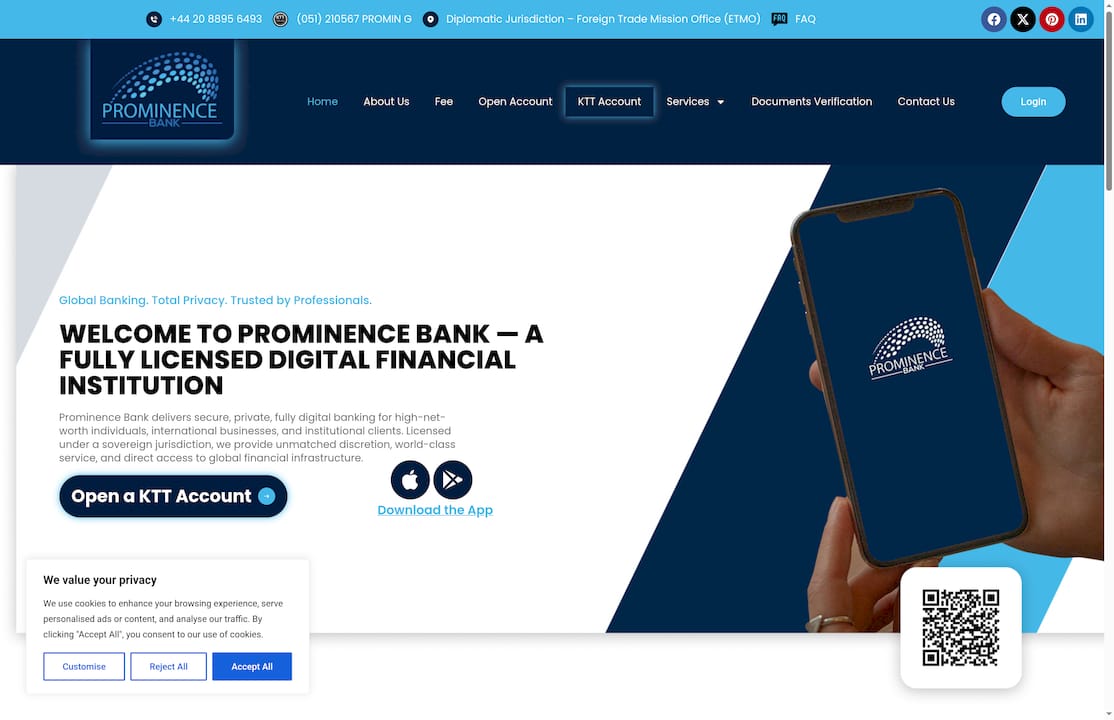
That matters most when your board wants a single point of accountability for reporting, not a patchwork of statements from different providers. Explore the bank’s digital currency services to see how custody fits alongside multi-currency banking, or review the multi-signatory corporate account structure if your institution needs segregated control across multiple authorized signers. Request an RFP packet or schedule a consultation with Prominencebank’s institutional team to see how onboarding works for your specific structure.
Sources
- Institutional digital asset custody — Chainlink Labs
- FIPS 140-2 and the Cryptographic Module Validation Program — NIST
- Crypto asset management best practices — Stripe
- Investor
FAQ
What Is Institutional Custody in Crypto?
Institutional custody is the secure storage of digital assets combined with legal segregation, governance controls, and audit-ready reporting, structured so organizations can hold crypto under the same compliance standards applied to other assets.
Who Are the Biggest Crypto Custodians?
Custody providers range from specialized digital asset custodians to licensed banks adding crypto custody to existing institutional services, and the right choice depends on whether an institution needs banking integration, trading access, or pure cold storage.
What Does a Crypto Custodian Do?
A custodian secures private keys through HSMs, MPC, or cold storage, enforces approval controls like maker-checker workflows, and provides the segregation and reporting institutions need for audits and regulatory filings.
What Is the Custody Rule in Crypto?
The custody rule requires certain investment advisers to hold client assets, including digital assets, with a qualified custodian that keeps those assets legally separate from the adviser’s own operating funds.