
Cold storage custody banking means holding digital asset private keys on devices or systems fully disconnected from the internet, managed under a regulated custodian’s controls rather than a self-managed wallet. For institutional investors, the appropriate model usually depends on scale and operational need: qualified custodians or bank custody for regulatory protection and auditability, self-custody for firms with mature internal key-management programs, and hybrid setups for those who need both liquidity and long-term security.
The choice matters because private key control is the whole game. Lose the keys, and there is no fraud department to call.
- Qualified custody offers segregation and bankruptcy-remote protections most institutions can’t replicate alone.
- Self-custody demands internal expertise in HSMs, multisig, and key ceremonies.
- Hybrid models split assets between hot trading pools and deep cold vaults.
- Prominence Bank offers institutional banking services aligned with these custody needs, including multi-currency accounts and asset safekeeping built for high-net-worth and institutional clients.
Key Takeaways
Cold storage custody banking works when offline key storage is paired with tested governance, independent audits, and clear legal segregation, not treated as a security feature on its own.
| Point | Details |
|---|---|
| Cold storage is a layer, not a solution | Offline keys stop remote hacking but require separate controls for physical, insider, and supply-chain risk. |
| Match storage tier to liquidity need | Keep trading collateral in hot or warm wallets and long-term holdings in cold or deep cold vaults. |
| Demand documented key ceremonies | Ask any custodian for witness logs and audit trails before trusting a “cold storage” claim. |
| Verify insurance scope, not just existence | Check named perils and exclusions, since key-management failure is often excluded from coverage. |
| Prominence Bank fits institutional custody needs | Its licensed digital banking, AML/KYC compliance, and institutional treasury services align with a custody-focused due-diligence checklist. |
Table of Contents
- Where Private Keys Live in Cold Storage Custody Banking
- Hot Vs Cold Storage: How Should You Balance Liquidity And Security?
- Which Custody Model Fits Institutional Investors?
- What Key-Management Controls Should Institutions Demand?
- What Risks Does Cold Storage Not Protect Against?
- What Should Be on a Custodian Due-Diligence Checklist?
- How Do Custodians Prove They Can Recover From a Failure?
- What Do Regulators Expect From Custody Banking Programs?
- How Does Prominence Bank Support Institutional Custody Needs?
- Industry Best Practices for Cold Storage Implementation
- What Technology Trends Are Reshaping Cold Custody Banking?
- How Should Cold Storage Integrate With Trading Platforms?
- What Insurance Coverage Applies to Cold Storage Assets?
- What Happens When a Cold Custody Breach Is Detected?
- Why Cold Storage Deserves More Scrutiny, Not Less
- Get Institutional Custody Banking Built for This Standard
- Sources
- FAQ
Where Private Keys Live in Cold Storage Custody Banking
A private key is the only thing standing between an owner and their digital assets. Whoever controls the key controls the coins, full stop. That single fact is why custody conversations in this industry are really key-management conversations wearing a different name.
Blockchain transactions are irreversible once confirmed. There is no charge-back, no fraud reversal, no customer service line that can undo a transfer signed with a compromised key. That irreversibility is what separates digital asset custody from traditional securities custody, where a broker-dealer can often freeze or reverse a mistaken trade. Cold storage keeps private keys offline specifically to reduce the odds that a remote attacker ever gets a chance to sign a transaction they shouldn’t.
Wallet architecture generally falls into four tiers:
- Hot wallets stay connected to the internet for active trading and settlement.
- Warm wallets sit behind additional access controls but retain some network connectivity.
- Cold wallets hold keys on offline hardware, air-gapped devices, or encrypted paper backups.
- Deep cold storage adds geographic distribution, multi-party approval, and extended time locks for assets rarely touched.
Statistic Callout: Cold storage removes the internet-facing attack surface, but it does not remove risk entirely. It shifts exposure toward operational and physical domains, including theft, insider collusion, and backup failure, according to guidance referenced by the Harvard Law School Forum on Corporate Governance. Institutions that treat “cold” as a finish line rather than one layer of a broader program tend to discover the gap the hard way.
Hot Vs Cold Storage: How Should You Balance Liquidity And Security?
Every institution runs some version of the same balancing act: assets that need to move fast versus assets that need to stay untouched. Getting the ratio wrong in either direction costs money, either through operational friction or through unnecessary exposure.
- Hot pools handle active trading rails. Exchanges, market-making desks, and rebalancing operations need funds accessible within seconds, so a portion of assets stays in hot or warm wallets despite the added risk.
- Cold vaults handle long-term holdings. Treasury reserves, client assets awaiting settlement, and anything not needed for near-term liquidity typically sit in cold or deep cold storage, often behind multi-signature approval.
- Segregated hot allocations limit blast radius. Many institutional architectures cap the percentage of total assets held hot at a low level to ensure a hot-wallet compromise cannot affect the majority of client funds.
- Withdrawal timing reflects the tier. Cold and deep cold withdrawals often take hours or days by design, since the friction itself is a control, not a bug.
The trade-off isn’t really security versus convenience. It’s about matching each asset’s actual liquidity need to the storage tier that protects it without slowing the business down.
Which Custody Model Fits Institutional Investors?
Institutions generally choose among four structural approaches, and the right one depends on internal capability, regulatory exposure, and how much control the client wants to retain.
Qualified custodians and bank custody provide the strongest legal protections. These arrangements typically include segregated accounts, auditability, and bankruptcy-remote structuring, meaning client assets are legally separated from the custodian’s own balance sheet and generally protected if the custodian fails. This model appeals most to institutions with fiduciary duties, regulated fund structures, or board-level requirements for third-party assurance.
Self-custody puts full responsibility for key generation, storage, and recovery on the asset owner. It offers maximum control and eliminates counterparty risk, but it also means the institution absorbs every operational burden: building HSM infrastructure, staffing key-ceremony teams, and maintaining tested backups. Industry commentary consistently notes that self-custody only works safely at scale when it’s backed by governance as rigorous as what a bank would provide internally.
Hybrid models split the difference. A firm might keep active trading collateral in a qualified custodian’s hot environment while self-custodying long-term treasury reserves, or vice versa depending on internal expertise. Hybrid structures make sense when:
- Trading desks need custodian-integrated liquidity but treasury wants direct key control.
- Regulatory requirements differ by asset class or jurisdiction.
- The institution is transitioning from self-custody toward outsourced custody and wants overlap during the migration.
What Key-Management Controls Should Institutions Demand?
Cold storage without proper key management is just an expensive way to lose assets more slowly. The controls around key generation, signing, and rotation matter as much as the offline status itself.

Multisignature (multisig) requires M-of-N signers to approve a transaction, so no single compromised key can move funds. Institutional setups often distribute signers geographically and across independent personnel or entities, so a breach at one location doesn’t cascade.
Hardware Security Modules (HSMs) are tamper-resistant devices purpose-built to generate and store keys without ever exposing them in plaintext. Multi-Party Computation (MPC) achieves a similar goal through cryptographic key-splitting rather than dedicated hardware, letting multiple parties jointly sign without any single party holding a complete key. Each approach has a place: HSMs suit fixed, high-security vault environments; MPC suits distributed teams needing flexible signing without shipping hardware.
- Run key-generation ceremonies with independent witnesses present and documented.
- Store backup shards or seed material in geographically separate, access-controlled locations.
- Rotate signing keys on a defined schedule, not just after a suspected incident.
- Test recovery from backups regularly, not only during an actual emergency.
Pro Tip: Ask any prospective custodian to walk you through their last key-ceremony video or audit log. If they can’t produce documentation of witnesses, dual control, and timestamps, the “cold storage” claim is marketing, not a program.
What Risks Does Cold Storage Not Protect Against?
Cold storage is excellent at stopping a hacker on the other side of the world. It does nothing to stop a threat standing in the same room.
Physical theft of hardware devices, duress or coercion against key holders, and inadequate vault security are real, documented failure modes in this industry. So is insider collusion, where two or more employees with legitimate access work together to bypass separation-of-duties controls that were designed to require independent action.
Supply-chain risk deserves particular attention. A compromised hardware wallet or tampered firmware, introduced before a device ever reaches the institution, can undermine every other control in the stack. Provenance checks, including tamper-evident packaging and verified firmware signatures, are becoming standard due-diligence items for exactly this reason.
Statistic Callout: Cold storage isolates keys from network-based attacks, but reduces rather than eliminates total risk. Industry guidance is explicit that operational and physical domains, not just cyber domains, need dedicated mitigation.
- Require dual-control access to any physical vault location.
- Screen and rotate personnel with vault or signing access.
- Verify hardware provenance and firmware signatures before deployment.
- Maintain duress protocols separate from routine access procedures.
What Should Be on a Custodian Due-Diligence Checklist?
A thorough vendor assessment goes well beyond asking whether a provider “uses cold storage.” That phrase alone tells you almost nothing about the controls behind it.
- Request independent assurance reports. SOC 1 and SOC 2 audits, ISO/IEC 27001 certification, and recent penetration-test summaries show whether controls are documented and actually tested, not just claimed. The SEC’s staff guidance on accounting for custodial arrangements is a useful reference point for what scope these reports should cover.
- Confirm legal segregation and bankruptcy-remote structuring. Ask for the specific legal opinion or structure that separates client assets from the custodian’s own balance sheet in an insolvency scenario.
- Verify insurance scope in detail. Coverage limits, named perils, and exclusions vary widely; a policy that excludes insider theft or key-management failure covers far less than it appears to.
- Review sub-custodian governance. If the custodian relies on another firm for part of the chain, ask how that relationship is monitored and audited.
- Check FIPS validation on hardware. Devices validated under FIPS 140 standards provide a documented baseline for cryptographic module security.
- Ask about recovery testing cadence. A custodian who can describe their last disaster-recovery drill in specifics is a custodian who has actually run one.
A security partner like TradeDupe’s published security practices shows the kind of documentation institutions should expect any custody-adjacent provider to make available.
How Do Custodians Prove They Can Recover From a Failure?
Governance only means something if it survives contact with a real incident. That’s the entire point of a recovery drill: proving the paperwork matches reality.
A well-run custodian runs recovery drills on a fixed schedule, not just after something goes wrong. A successful drill demonstrates that backup key material can be reconstructed, that the right personnel are reachable and authorized, and that the process completes within a defined time window, not an open-ended scramble.
- Audit programs should report to an independent board committee, not just internal management.
- Client agreements should spell out exactly how forks, airdrops, and governance votes affecting held assets get handled.
- Access procedures for emergency withdrawals need documented approval chains, tested in advance.
- Recovery drill results should be available for institutional clients to review, not just summarized.
Prominencebank’s custody account structures illustrate how insolvency protections and contractual responsibilities get documented for wealth clients evaluating a custody relationship.
What Do Regulators Expect From Custody Banking Programs?
Regulatory attention on crypto custody has sharpened considerably, and the guidance changes what institutions should prioritize when picking a partner.
The Office of the Comptroller of the Currency has been explicit that banking organizations remain responsible for due diligence and ongoing oversight of any sub-custodian handling crypto-asset safekeeping. Outsourcing the function doesn’t outsource the accountability.
- Independent assurance reports (SOC 1, SOC 2, ISO/IEC 27001) matter, but scope matters more than the existence of a report; a narrow-scope SOC 2 covering only physical security says little about key-management controls.
- Responsibility for sub-custodian performance stays with the contracting bank, not the sub-custodian, under current supervisory expectations.
Statistic Callout: Supervisory commentary on OCC guidance notes that the governance and tested recovery procedures around keys matter more than the hardware itself. Institutions that focus vendor evaluation purely on “is it cold” and skip the governance review are asking the wrong question.
How Does Prominence Bank Support Institutional Custody Needs?
Prominencebank operates as a fully licensed digital banking institution built for high-net-worth individuals, international businesses, and institutional clients who need discretion alongside regulatory rigor.
Relevant capabilities line up directly with the due-diligence items covered above:
- Multi-currency business accounts and institutional treasury services support the liquidity side of a hybrid custody strategy.
- Compliance with international AML/KYC standards addresses the governance expectations regulators increasingly emphasize.
- KTT-enabled account structures streamline onboarding without cutting corners on documentation.
- Institutional investment services, including asset management and treasury solutions, extend beyond basic account access into the operational territory custody programs require.
Pro Tip: When evaluating any custody-capable banking partner, ask them to map their specific service offerings against your due-diligence checklist line by line. A provider that can do this quickly usually has the documentation ready because they use it internally, not because they built it for the sales call.
Institutions exploring a custody-capable banking relationship can review secure crypto account opening procedures to understand onboarding requirements before engaging further.
Industry Best Practices for Cold Storage Implementation
Getting cold storage right operationally comes down to a handful of practices that separate institutions with mature programs from those exposed by their own procedures.
Documented, repeatable key-ceremony procedures come first. Every key generation event should follow a written script, with witnesses present and video or written logs retained. Ad hoc ceremonies, even well-intentioned ones, are where errors and disputes originate.
Geographic distribution of backup material reduces single-location risk. Storing all backup shards in one vault, even a secure one, defeats much of the purpose of splitting keys in the first place. Institutions with mature programs typically distribute shards across multiple jurisdictions and custodians.
Scheduled key rotation, rather than reactive rotation only after a suspected compromise, limits the window during which any single key remains valuable to an attacker. Rotation policies should be written into the custody agreement itself, not left as an informal practice.
Access reviews on a fixed cadence catch personnel changes before they become gaps. Someone who left the signing team eight months ago shouldn’t still theoretically retain access, even if that access was never actually used.
Finally, maintenance matters as much as initial setup. Firmware updates on hardware devices, periodic device replacement before end-of-life, and documented chain-of-custody for any physical device movement all belong in a written maintenance calendar, reviewed at the same cadence as the recovery drills themselves.

What Technology Trends Are Reshaping Cold Custody Banking?
Cold custody technology has moved well past “put it on a USB drive and lock it in a safe.” Institutional programs increasingly favor cryptographic and distributed approaches over purely physical isolation.
MPC-based signing has gained ground because it removes the need to ever reconstruct a complete private key in one place, even during signing. That reduces the value of any single compromised location or device, since no location holds a usable, complete key on its own.
HSM technology has also matured, with newer devices offering better tamper resistance and more granular audit logging of every signing event. FIPS-validated modules give institutions a documented cryptographic security baseline they can point to during regulatory exams or client due-diligence requests.
Automated policy engines now sit between signing requests and execution, enforcing rules like transaction limits, approved destination addresses, and time-based restrictions before a signature is even generated. This adds a software layer of control on top of the hardware and cryptographic layers, catching mistakes or malicious requests before they reach a human signer.
Deep cold storage is also becoming more programmable, with time-locked release schedules and multi-party approval workflows replacing purely manual vault-access procedures. The direction of travel is consistent: less reliance on a single physical location, more reliance on distributed, auditable, cryptographically enforced controls.
How Should Cold Storage Integrate With Trading Platforms?
The operational challenge institutions run into most often isn’t storing assets securely. It’s moving assets between cold storage and active trading without recreating the exact exposure cold storage was meant to prevent.
Well-designed integrations use settlement windows and pre-authorized transfer limits, so trading desks can request funds from cold storage on a schedule rather than through ad hoc, one-off approvals that bypass normal controls. Some institutional setups use a warm intermediary tier specifically to buffer this transition, so cold vaults themselves are touched infrequently.
API-level integrations between custodians and trading venues have become more common, but they introduce their own review requirements: every API credential is effectively another key that needs the same rotation, access-review, and monitoring discipline as a signing key. An institution that hardens its cold storage but leaves API credentials loosely managed has simply moved the weak point rather than closed it.
Reconciliation matters just as much as transfer speed. Institutions should confirm that custody balances, trading platform balances, and internal ledgers reconcile on a defined schedule, not only when something looks wrong. Mismatches caught early are an operational hiccup; mismatches caught late are often a much larger problem.
What Insurance Coverage Applies to Cold Storage Assets?
Insurance is one of the most misunderstood elements of custody due diligence, largely because policy language varies enormously between providers and “insured” rarely means “insured against everything.”
Coverage for cold storage assets typically addresses specific named perils: theft of hardware, insider theft, and physical loss or destruction of storage media are common inclusions. Coverage for key-management failure, meaning a loss caused by an operational error rather than external theft, is far less consistently included, and institutions should never assume it’s covered without confirming.
Policy limits also matter relative to actual assets under custody. A policy that caps total coverage well below the value held in a particular vault leaves a meaningful gap that only surfaces after a loss event, when it’s too late to renegotiate.
Exclusions deserve the same scrutiny as inclusions. Common exclusions include losses from war, government seizure, or coordinated insider fraud above a certain threshold. Reviewing the exclusions list is often more informative than reviewing the coverage list, since exclusions reveal exactly where an institution retains uninsured risk.
Any custody agreement should specify who holds the policy, whether it names the institution as a beneficiary or additional insured, and how a claim gets filed and adjudicated if a loss event actually occurs.
What Happens When a Cold Custody Breach Is Detected?
Incident response for cold storage differs meaningfully from typical cybersecurity incident response, because the “breach” is more often physical or procedural than digital.
Detection usually starts with reconciliation discrepancies or a failed access-review check, rather than an intrusion alert, since cold systems by design don’t generate network traffic to monitor. That means detection windows can be longer, which makes fast escalation procedures once something is flagged even more important.
A sound response protocol includes immediate isolation of the affected vault or key set, meaning no further signing activity involving that key material until the scope of the incident is understood. Parallel notification to insurers, legal counsel, and, where required, regulators should follow a pre-written escalation tree rather than being improvised in the moment.
Post-incident, institutions should expect a full forensic review covering physical access logs, personnel movements, and hardware chain-of-custody records, not just a review of digital systems. The recovery phase often involves re-keying unaffected assets as a precaution, even when the specific breach appears contained, since the point of a breach investigation is confirming the boundary of exposure, not assuming it.
Client communication protocols matter here too. Custody agreements should specify notification timelines so institutional clients aren’t learning about a material incident through a press report.
Why Cold Storage Deserves More Scrutiny, Not Less
The conventional advice on this topic treats cold storage as a checkbox: is it cold, yes or no. That framing lets weak programs hide behind a technically accurate label. A custodian can put keys offline and still fail an institution through sloppy backup procedures, unreviewed personnel access, or an insurance policy that excludes the exact scenario most likely to occur.
What the research actually supports is a shift in emphasis: governance and tested recovery procedures around the keys matter as much as the offline status itself. Regulators have caught up to this reality faster than marketing copy has. The OCC’s position that banks stay accountable for sub-custodian oversight isn’t a technicality, it’s a signal that the industry’s easy answers were never good enough.
Readers evaluating a custody relationship should prioritize documentation over reputation. Ask for the audit report, the insurance policy’s exclusions, and the last recovery drill’s results before asking whether the vendor uses hardware wallets or MPC. The label matters far less than the paperwork behind it.
Get Institutional Custody Banking Built for This Standard
Reading a due-diligence checklist is one thing. Finding a banking partner who already meets it is another. Prominencebank was built specifically for institutions and high-net-worth clients who need multi-currency accounts, compliant onboarding, and institutional treasury services under one regulated roof, rather than assembling separate vendors for banking, custody, and compliance.
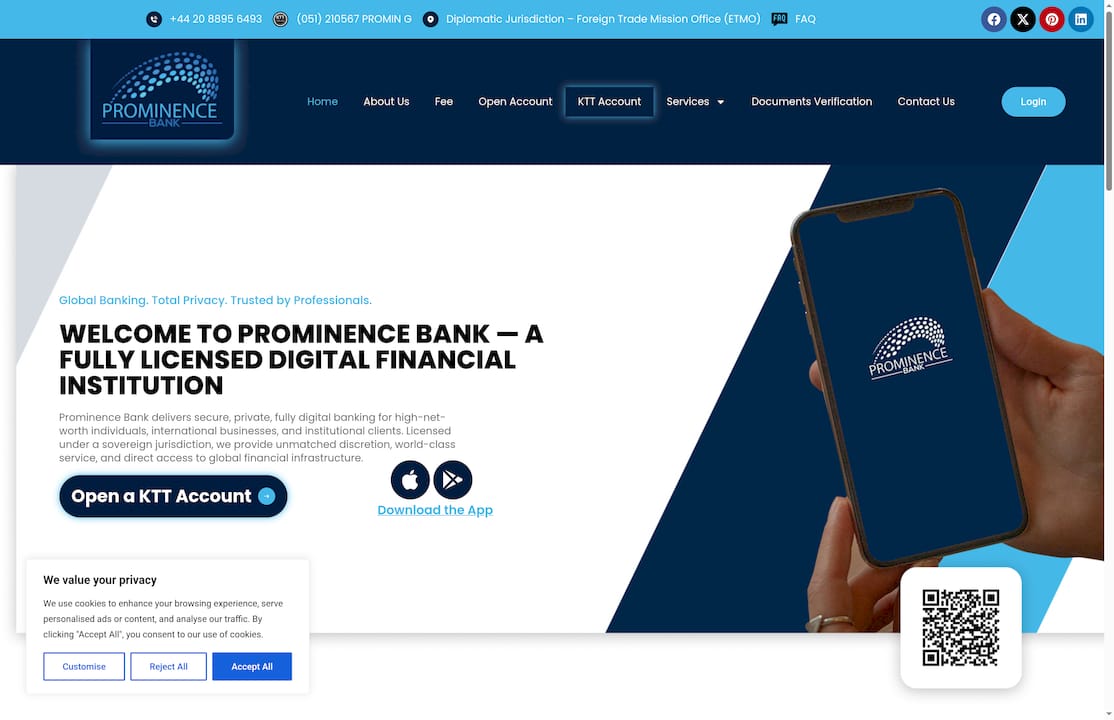
What sets this apart from piecing together a custody stack yourself is integration: account opening, AML/KYC compliance, and institutional investment services operate as one relationship instead of three separate vendor contracts to manage and audit independently. For institutions weighing self-custody against outsourcing, that consolidation often removes a meaningful chunk of the operational burden self-custody demands.
Explore multi-currency account options built for institutional clients to see how account structure, currency flexibility, and treasury services fit into a broader custody strategy. Institutions ready to move forward can begin the account discussion directly with Prominencebank’s institutional team.
Sources
- OCC updates guidance on third-party risk management (Harvard Law School Forum on Corporate Governance)
- OCC News Release and guidance on crypto-asset safekeeping (2025)
- Cold storage: What it is, how it works, theft protection (Investopedia)
- Qualified custody (BitGo)
FAQ
What Are the Big Three Custodian Banks?
The largest traditional custodian banks by assets under custody are typically State Street, BNY Mellon, and JPMorgan, though their crypto-asset custody offerings vary and continue to expand as regulatory guidance develops.
Which Banks Offer Crypto Custody Services?
A growing number of regulated banks and licensed digital banking institutions now offer crypto custody, generally through qualified custody arrangements, segregated accounts, or partnerships with specialized custody technology providers.
Which Institutional Custody Provider Is Best for XRP?
The right provider depends on the institution’s specific needs around segregation, insurance, and jurisdiction rather than any single universal answer; evaluate any XRP-capable custodian against the same due-diligence checklist used for other digital assets, including audit reports and insurance scope.
Can I Lose My Crypto With a Custodian?
Yes, losses can still occur through insider fraud, custodian insolvency without proper segregation, operational key-management errors, or insurance exclusions, which is why verifying bankruptcy-remote structuring and audit evidence matters more than the custodian’s marketing claims.