
“Offshore” describes where an account sits relative to you. “Extraterritorial” describes the legal framework a bank says it operates under. The two terms overlap in practice, but neither one changes your US reporting duties. If you are a US person, what the IRS looks at is where the account is maintained, not which label the bank uses.
This guide separates the two terms, explains why the difference matters for Americans, and lists what to check before you open any account abroad.
TL;DR
- Offshore means a banking relationship with an institution outside your country of residence. It is a description of location, not a license type.
- Extraterritorial is a legal-framework label. Prominence Bank describes itself as operating under the Extraterritorial Trade Mission Office (ETMO). It is not a recognized US banking category.
- For FBAR purposes, the IRS treats an account as foreign based on where it is maintained. Neither word changes that.
- A US person with foreign accounts above $10,000 in aggregate at any time in the year generally files an FBAR, even if the accounts earn nothing.
- Before opening, confirm the bank’s licensing, its custody and correspondent arrangements, and your own filing plan.
Table of Contents
- What “offshore” means in banking
- What “extraterritorial” means, and where it is used
- Extraterritorial vs offshore: side by side
- The rule that matters for Americans: where the account is maintained
- Deposit protection: check the actual institution
- Dollar access and correspondent banking
- Our perspective
- How to choose well: a short checklist
- What an account with us costs
- Open an account built for cross-border clients
- FAQ
- Sources
What “offshore” means in banking
In everyday use, offshore banking is a relationship with a financial institution outside the country where you live. Investopedia describes it that way, and adds that the activity can still be limited by your home country’s laws. Moving a balance abroad does not move it outside the reach of your tax authority.
Two points follow from that definition:
- Offshore is relative. An account in Singapore is offshore for a Texas resident. A US dollar account at a US bank is offshore for a resident of Dubai.
- Offshore says nothing about quality. The word does not tell you whether the bank is licensed, insured, well supervised or transparent. It only tells you where the relationship sits.
That is why careful advisors avoid treating “offshore” as a category of good or bad. The useful questions are about the bank itself: who licenses it, how it holds client assets and how it connects to the dollar system.
What “extraterritorial” means, and where it is used
In law, “extraterritorial” means reaching beyond a territory’s borders. The pages that rank for this phrase mostly discuss that legal sense, such as US statutes applied to conduct abroad. In banking marketing, the word is used differently: it points to an institution that positions itself outside the ordinary territorial framework of a single national banking system.
Prominence Bank uses the term in that second sense. By its own description, the bank is a licensed digital institution operating under the sovereignty of the ETMO, serving high-net-worth individuals, international businesses and institutional clients. Those are the bank’s own claims about its framework, and you should read them as such, alongside the licensing documents it provides.
Three practical points for a US reader:
- “Extraterritorial bank account” is not a recognized US legal or banking category. You will not find it in the IRS forms or in the deposit insurance rules. It is a descriptor the institution uses for its framework.
- The label does not remove you from US rules. US law follows US persons, wherever their accounts are.
- The label does tell you something useful. It signals that the bank is built for cross-border clients: multi-currency accounts, online onboarding, international wires and custody. For people with assets and activity in several jurisdictions, that design is the appeal. Our article on the real benefits of extraterritorial banking covers those use cases.
Extraterritorial vs offshore: side by side
| Question | Offshore | Extraterritorial |
|---|---|---|
| What does it describe? | Where the account is relative to you | The legal framework the bank operates under |
| Who decides if it applies? | Your country of residence | The institution’s own structure and licensing |
| Is it a US legal category? | No, it is a descriptive term | No |
| Does it change US reporting? | The account’s location is what counts | No |
| Can both apply at once? | Yes | Yes |
| What should you verify? | Where the account is maintained, the bank’s supervision | The licensing basis, the governing documents, the supervisor |
In short, the first term answers “where?” and the second answers “under whose rules?”. A single account can be both: held at a bank outside your home country, under a framework that is not that of a conventional national bank.
The rule that matters for Americans: where the account is maintained
The IRS does not ask whether a bank calls itself offshore or extraterritorial. Its Internal Revenue Manual says an FBAR account is foreign based on the account’s location, not the nationality of the institution. A Hong Kong branch of a US bank is foreign, while a New York branch of a foreign bank is not.
So the vocabulary question has a plain answer: a label on the bank’s website does not decide your filing treatment. The facts of the account do.
FBAR in plain terms
A US person generally must file a Report of Foreign Bank and Financial Accounts when they have a financial interest in, or signature or other authority over, foreign financial accounts whose aggregate value exceeds $10,000 at any time during the calendar year. The FDIC’s 2021 supervisory letter repeats the same threshold.
Some details readers often miss:
- The threshold is aggregate. Several small accounts can add up to more than $10,000.
- It is measured at any time in the year, not on December 31.
- Reportable accounts include bank, securities and other defined financial accounts, not just checking or savings.
- Signature authority can trigger a filing even where you do not own the funds. We explain that in our piece on international bank account signatories.
Reporting is not the same as taxation
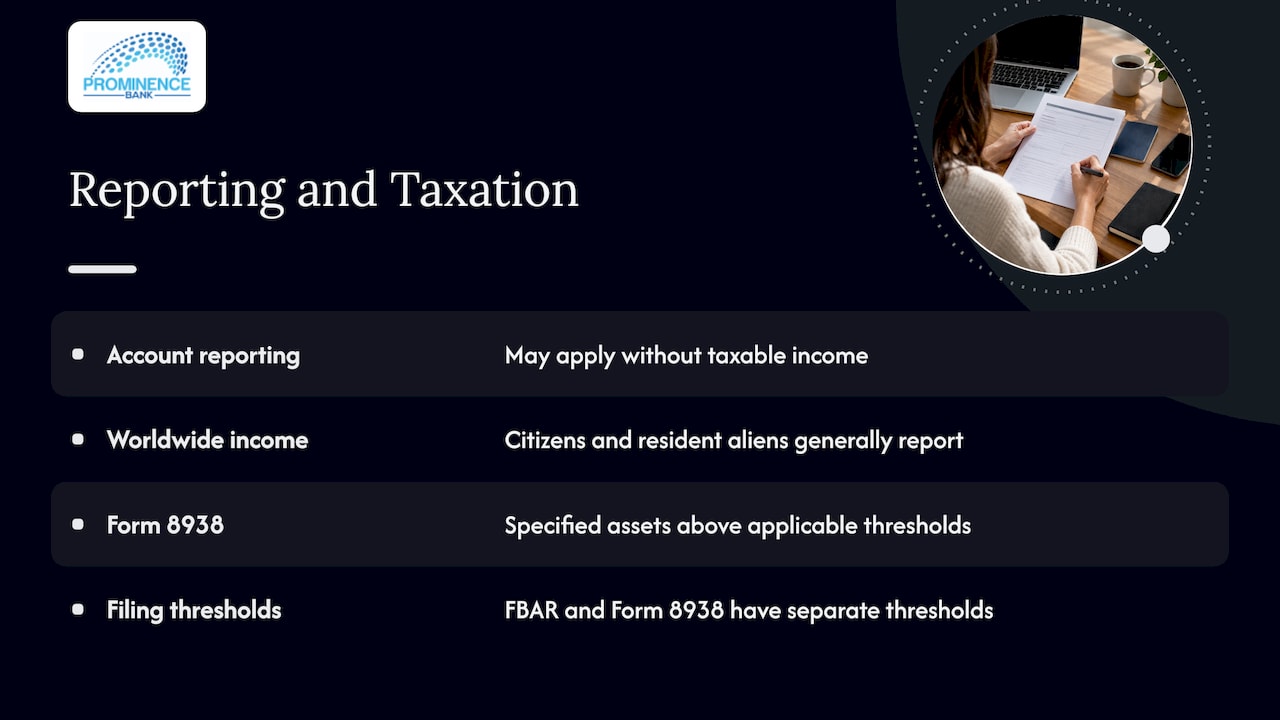
The IRS makes a clear distinction. An account can be reportable even though it produces no taxable income. Separately, US citizens and resident aliens generally must report worldwide income, including income from foreign bank and securities accounts, and Schedule B commonly asks about foreign accounts.
Certain taxpayers may also need Form 8938 for specified foreign financial assets when the applicable aggregate-value thresholds are exceeded. FBAR and Form 8938 are separate filings with separate thresholds, so a tax professional who handles foreign-account reporting should confirm which apply to you. Our guide to FBAR filings for offshore accounts walks through the practical side.
The takeaway is the opposite of a risk: transparent filing is the normal, safe way to use an account abroad. The people who run into trouble are those who assume a framework label exempts them.
Deposit protection: check the actual institution
Another difference between the vocabulary and the reality is deposit protection. FDIC and NCUA insurance protects deposits at insured US banks and credit unions up to $250,000 per ownership category at the same institution, according to the CFPB. That protection belongs to US-insured institutions. A bank outside the US system is not covered by it, however it is described.
For any account, whether domestic, offshore or extraterritorial, ask these questions:
- Which institution actually holds the funds? The FDIC notes that nonbank companies are never FDIC-insured, and funds held through a nonbank get pass-through coverage only if conditions are met, including records that identify each owner and amount.
- What happens if an intermediary fails? The FDIC warns that a nonbank’s insolvency is not protected by deposit insurance, and recovery may depend on insolvency proceedings.
- How are assets held? Custody and safekeeping structures matter. Segregated custody is a different risk profile from a pooled deposit. Our overview of offshore custody accounts explains the structures. For the diligence side, a fund due diligence guide shows how advisors evaluate documentation and fee structures.
- Is the entity real? The OCC defines a foreign shell bank as a foreign bank without a physical presence in any country, subject to statutory exceptions. US banks are restricted in dealing with such entities, so a bank’s physical presence and licensing documents are not a formality.
For a US institution, you can use FDIC BankFind to confirm insured status. For a bank outside the US, ask for the licensing documents, the identity of the supervising authority and the custody arrangements, and have your attorney review them.
Dollar access and correspondent banking
Cross-border banks rarely move dollars on their own. They rely on correspondent accounts. The OCC describes a correspondent account as one established to receive deposits from, make payments on behalf of, or handle other transactions for a foreign financial institution.
This matters because it is where onboarding and compliance standards bite. A bank with strong AML and KYC practices keeps its correspondent relationships healthy, and that is what keeps your wires moving. We explain the process in correspondent banking explained.
Our perspective
We hear the same question from US clients: is an extraterritorial bank just an offshore bank with a different name? Our answer is that the two words describe different things, and a client is better served when both are understood.
Offshore tells you where your account sits. Extraterritorial tells you the framework your bank works within. We operate under the sovereignty of the Extraterritorial Trade Mission Office, and we are built for clients whose lives and businesses cross borders: entrepreneurs, ex-pats, international companies, wealth managers and institutions.
What we offer follows from that design: fully digital onboarding, multi-currency accounts, numbered accounts, KTT-enabled accounts, cryptocurrency banking, safekeeping receipts, custody and treasury services, all with high discretion and security, and all within international AML and KYC standards.
Discretion does not mean avoiding the rules. Our clients who are US persons file their FBARs and other reports, and we encourage that. A bank built for privacy and a client who reports properly are fully compatible, and that combination is what lasts.
Harold
How to choose well: a short checklist
Whatever label an institution uses, run through this list before you commit:
- Licensing basis. Ask what authority licenses the bank and request the documentation.
- Supervisor. Identify who supervises the institution and how.
- Custody structure. Understand whether assets are held in your name or pooled, and what the safekeeping documents say.
- Dollar and euro access. Ask how the bank settles payments and which correspondent relationships it uses.
- Fee schedule. Review every fee, including due diligence, transfer, conversion and document fees.
- Your reporting plan. Decide with a US tax professional how you will handle FBAR, Form 8938 and income reporting.
- Purpose of the account. Be ready to document source of funds and the business reason. This is standard under international AML and KYC practice.
If you are comparing structures for a company, our corporate account structuring checklist goes deeper, and the step-by-step guide to opening an offshore account covers the application flow.
What an account with us costs
Our fee schedule is published, so you can plan before you apply. The figures below come from our fees page.
| Service | Published fee |
|---|---|
| Bank account opening | 25000 $/€ one-off |
| Numbered bank account opening | 50000 € one-off |
| Numbered account monthly fee | 100 $/€ per month |
| Savings account monthly fee | 40 $/€ per month |
| KTT (E-Telex) transaction, incoming or outgoing | 1.5% |
| Prominence Bank internal transfer | 0.2% |
| Currency conversion | 4% |
| Bank endorsement | 1.5% |
| Reference or comfort letter | 25000 € one-off |
| Proof of funds | 25000 € one-off |
| Enhanced due diligence, Level 1 | 5000 € one-off |
| Enhanced due diligence, Level 2 | 10000 € one-off |
| Enhanced due diligence, Level 3 | 15000 € one-off |
Wire transfer fees and safekeeping receipt (SKR) custody pricing are not published as flat amounts, so confirm them with our team when you apply.
Open an account built for cross-border clients
If your assets, company or family span more than one country, we can help you set up the right structure. Depending on your needs, that means business banking, corporate banking, private banking or investment banking, with onboarding done online.
Start on our fees page to see the full schedule, or begin at prominencebank.com and tell us what you need the account to do.
FAQ
Is an extraterritorial bank account the same as an offshore account?
Not exactly. “Offshore” describes an account held outside your country of residence. “Extraterritorial” describes the framework a bank operates under. An account can be both, but for a US person the IRS looks at where the account is maintained, not at either label.
Is “extraterritorial bank account” a recognized US category?
No. It does not appear as a defined category in the IRS reporting rules or in US deposit insurance. It is a descriptive term the institution uses for its own framework. Ask for the licensing documents and the supervising authority, and have your attorney review them.
Do I have to report an account at an extraterritorial bank?
If you are a US person and your foreign accounts exceed $10,000 in aggregate at any time during the year, you generally must file an FBAR. Reporting can be required even when the account earns no income. Form 8938 may also apply, so confirm both with a US tax professional.
Are deposits at these banks FDIC-insured?
FDIC insurance covers deposits at insured US banks, up to $250,000 per ownership category. A bank outside the US system is not part of it. Ask the bank how it holds your assets, whether in custody or as deposits, and what documents define your rights.
Who is an extraterritorial bank designed for?
It suits clients with cross-border needs: international businesses, ex-pats, entrepreneurs, wealth managers and institutions that want multi-currency accounts, online access and discretion. Our private financial services guide describes what that looks like for high-net-worth clients.
Sources
- Offshore Finance: Definition, Benefits, and Risks Explained (Investopedia)
- IRM 4.26.16, Report of Foreign Bank and Financial Accounts (IRS)
- Reports of Foreign Financial Accounts (FDIC, 2021)
- Foreign Financial Accounts Reporting Requirements (IRS)
- IRS news release IR-15-070
- Consumer advisory on payment apps and deposit insurance (CFPB)
- Banking With Third-Party Apps (FDIC)
- OCC Advisory Letter 2001-12