
To open an offshore corporate account you need four things: proof that the company legally exists, proof of who owns and controls it, proof of where the money comes from, and a clear explanation of what the account is for. The document list changes by bank. The logic behind it does not. If you are a US owner, add a fifth item: your own reporting obligations at home.
This guide walks through each layer in the order a bank reviews it, with the fees we publish at Prominence Bank and the US rules that apply to you.
TL;DR
- Expect to provide corporate formation documents, identification for every owner of 25% or more and every controlling person, and evidence of your source of funds.
- Banks do not just collect paper. They test whether your business story is coherent, and they screen every name and address against sanctions lists.
- A US person with an interest in foreign accounts must file an FBAR once the combined balance exceeds $10,000 at any point in the year.
- Budget for due diligence and opening fees up front. Our published bank account opening fee is 25,000 $/€, plus enhanced due diligence from 5,000 € depending on complexity.
- Treat any provider that promises an account with no questions as a warning sign, not a shortcut.
Table of Contents
- The four layers every bank reviews
- Corporate documents you will be asked for
- Owners, directors and signatories
- Source of funds and the business profile
- Sanctions and compliance screening
- Fees and costs to plan for
- A note for U.S. owners
- Red flags when comparing providers
- Our perspective
- Prepare your application with us
- A preparation checklist
- FAQ
- Sources
The four layers every bank reviews
It helps to think of an application as four questions, not a list of forms.
- Does the company exist? Formation and good-standing documents answer this.
- Who is behind it? Identity documents for owners, directors and signatories answer this.
- Where does the money come from, and where is it going? Source-of-funds evidence and a business profile answer this.
- Can the bank defend taking you on? Its own compliance team decides this, using sanctions screening and risk scoring.
A complete file for the first two layers still gets declined if the third and fourth are weak. Most delays we see trace back to layer three: the paperwork is there, but the story does not hold together.
Corporate documents you will be asked for
The core set is similar almost everywhere. Typical items include:
- Certificate of incorporation (or registry extract)
- Memorandum and articles of association, or the equivalent constitutional documents, such as an operating agreement for a US LLC
- Certificate of good standing or incumbency, usually issued within the last three to six months
- Register of directors and register of shareholders or members
- A board resolution authorizing the account and naming signatories
- Company profile or trade license, where the jurisdiction issues one
If the company is a US entity, the bank will also want its tax identification number. US banks must obtain at minimum a legal entity’s name, address and an identification number such as an EIN, under the Customer Identification Program rules explained in the FFIEC manual. Foreign banks run their own versions of the same checks.
Certification and translation
Many banks want copies certified by a notary or a lawyer, and documents not in English translated by a certified translator. For cross-border use, some jurisdictions also ask for an apostille. Ask your bank which of these it accepts before you pay for them: certifying a document twice is the most common avoidable cost.
Owners, directors and signatories
Banks look through the company to the people. Under US rules, a bank must identify and verify the individuals who own 25% or more of a legal entity customer, plus at least one person with significant control, as the FFIEC beneficial ownership guidance sets out. Many offshore banks apply a lower threshold or look at everyone with meaningful influence, so plan to disclose more people rather than fewer.
For each individual, prepare:
- A valid passport copy, certified if required
- Proof of residential address dated within the last three months, such as a utility bill or bank statement
- A short professional CV or LinkedIn-style biography
- Tax residency and tax identification number
- A bank or professional reference, where requested
If a trust, foundation or another company sits in the ownership chain, expect the bank to ask for the documents of every layer, down to the natural persons. Structures with several layers are exactly where the FFIEC highlights particular money laundering risk, with international business corporations and private investment companies named as examples. That is why they receive more scrutiny, and why a clean organizational chart is worth the effort.
Our corporate account structuring checklist for executives covers how to lay out roles and signing authority before you apply.
Source of funds and the business profile
This is the layer that separates a smooth opening from a stalled one. Banks want to see:
- What the company does, in plain language, with a website, contracts or invoices if available
- Who the customers and suppliers are, and in which countries
- Expected activity: monthly volumes, typical transaction size, currencies, and counterparties
- Source of initial and ongoing funds: sale of a business, retained earnings, investor capital, dividends, inheritance
- Source of wealth of the principal owners, when the account is large or the structure is complex
Evidence matters more than assertion. Audited or management accounts, a share purchase agreement, a tax return, or a prior bank statement showing the funds’ path will carry more weight than a paragraph of explanation.
The Basel Committee’s guidance on customer due diligence has long stated that a bank must know its customer. Its customer due diligence paper for banks describes this as a core element of risk management, not a formality. In practice, you should expect follow-up questions and possibly a call with a compliance officer.
Example: a consulting holding company
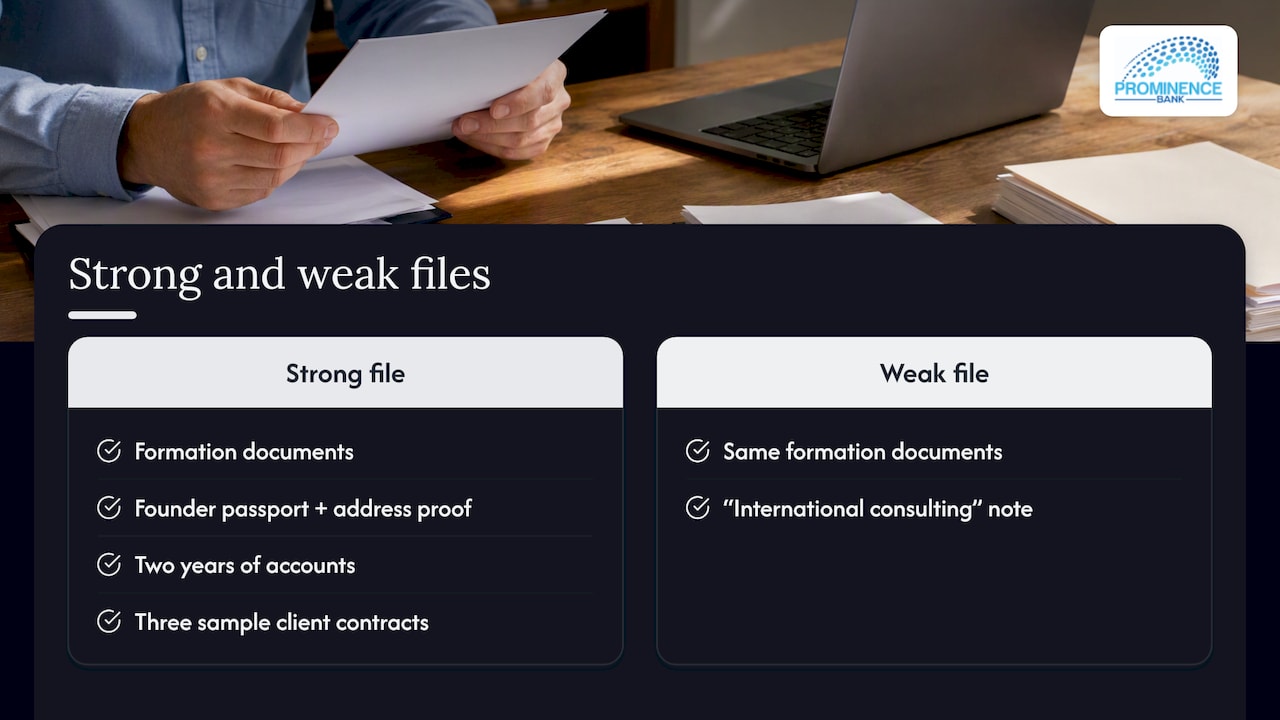
Suppose a US-resident founder owns 100% of a holding company that invoices clients in euros and pays contractors in several countries. A strong file would include the holding company’s formation documents, the founder’s passport and address proof, two years of accounts, three sample client contracts, a one-page description of the payment flows, and a statement of how the first deposit was funded. A weak file would be the same formation documents with the note “international consulting.” The documents are identical. The outcome is not.
Sanctions and compliance screening
Every name in your file gets screened, and not only against what you declare. US enforcement history is blunt about this. In a settlement with a digital asset firm, OFAC stressed that institutions should screen information customers provide at account opening and during due diligence, such as location data, instead of relying on self-declared details.
What this means for you:
- Disclose every country where the company or its owners operate, even in a minor way.
- Make sure addresses and names match across all documents. Small inconsistencies trigger manual review.
- Expect questions about counterparties in higher-risk jurisdictions before the account is opened, not after.
We explain the mechanics in the sanctions screening process, step by step and in why US compliance teams fail OFAC screening.
Fees and costs to plan for
Offshore corporate banking is priced for complexity, and a serious provider tells you the cost before you commit. At Prominence Bank, the published figures on our fees page are:
| Item | Fee |
|---|---|
| Bank account opening | 25,000 $/€ one-off |
| Numbered bank account opening | 50,000 € one-off |
| Numbered account monthly fee | 100 $/€ per month |
| Savings account monthly fee | 40 $/€ per month |
| Enhanced due diligence, Level 1 (Enhanced Standard) | 5,000 € one-off |
| Enhanced due diligence, Level 2 (Advanced) | 10,000 € one-off |
| Enhanced due diligence, Level 3 (Critical / Complex) | 15,000 € one-off |
| Incoming or outgoing KTT (E-Telex) transaction | 1.5% |
| Internal transfer within Prominence Bank | 0.2% |
| Currency conversion | 4% |
The enhanced due diligence tier reflects how complicated your structure and funds are, which ties directly back to the layers above. A single-owner company with a documented source of funds sits at the simple end. A multi-layer structure with several jurisdictions sits at the other. SWIFT and IBAN wire transfers are published at 1% (minimum $/€100), and outgoing transfers also carry applicable SWIFT/SEPA charges. The published fee for the Safekeeping Receipt (SKR) / custody service is €25,000 for the custody account plus 2%.
A note for U.S. owners
If you are a U.S. person, holding a foreign account can create separate tax and reporting obligations in the United States. Those obligations depend on your own circumstances and are outside the scope of this article. Confirm them with a qualified U.S. tax adviser before you open an account.
Red flags when comparing providers
Requirements that are too light are a risk to you, not a perk.
- No verification at all. Banks that skip beneficial ownership checks attract regulatory pressure and tend to lose their own correspondent relationships. The Basel Committee has long warned about correspondent relationships with shell banks and weak-KYC jurisdictions.
- Vague promises about custody instruments. Safekeeping receipts are legitimate in a regulated custody setting, but fraudsters have used them in high-yield schemes. One example is the SEC’s complaint against U.S. Reservation Bank & Trust. Ask who the custodian is, what is held, and how it is valued.
- Pressure to move funds before due diligence is complete.
- Fees that are not clearly published. Know what you will pay for opening, monthly maintenance and document issuance before you wire anything.
Our perspective
We get one misconception more than any other: that offshore means less paperwork. In our experience, it means different paperwork, and often more of it, because a cross-border account has to satisfy several regulatory expectations at once.
Our view is that the best preparation is a file that tells one consistent story. Formation documents, ownership chart, source-of-funds evidence and expected activity should all describe the same business. When they do, review moves faster and the enhanced due diligence tier is easier to assess. When they do not, no amount of extra documentation fixes it.
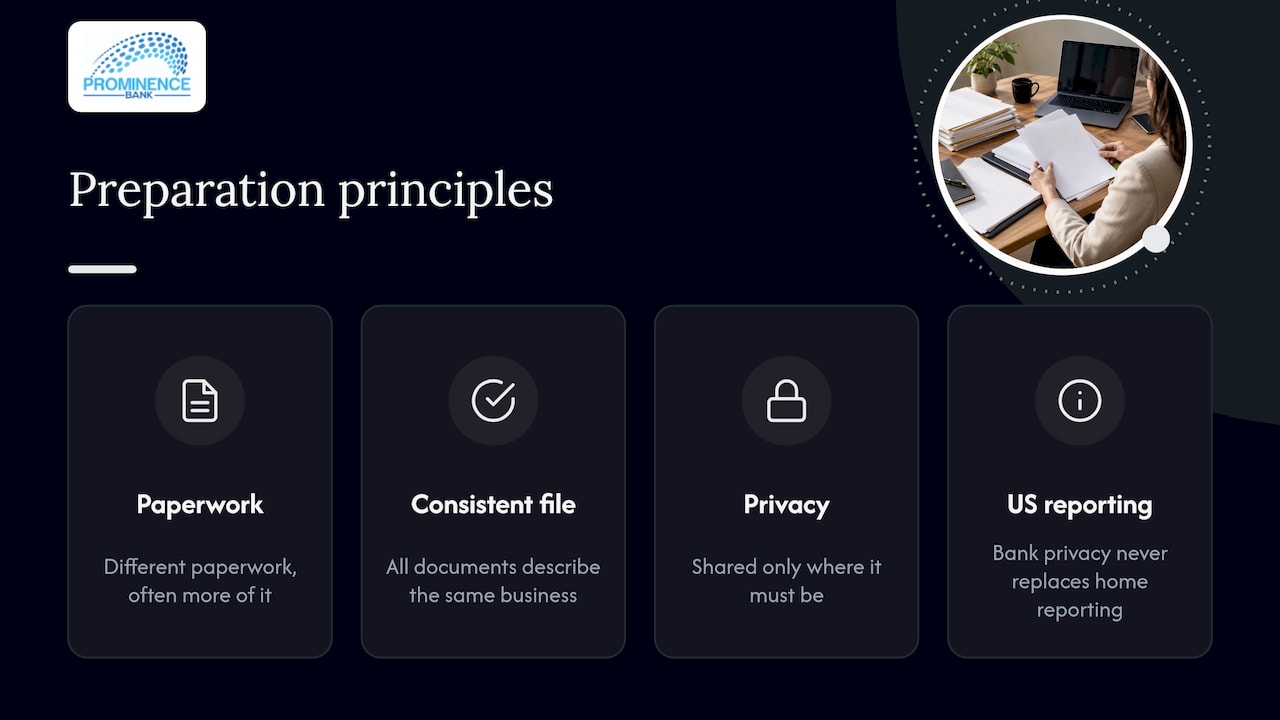
We built Prominence Bank around fully digital onboarding, multi-currency accounts and a high standard of discretion, while following international AML/KYC standards. Privacy and compliance are not opposites. Privacy means your information is handled with care and shared only where it must be. It does not mean nobody asks questions.
For US clients, we also tell people plainly: bank privacy never replaces your reporting at home. File what you owe, and you can use an offshore account with confidence.
— Harold
Prepare your application with us
If you are ready to apply, our business and corporate account application is the starting point. You can review our corporate banking and business banking services first, and our step-by-step guide to opening an offshore bank account shows what happens after you submit. Fees are listed on our fees page so you can plan the full cost before you begin.
A preparation checklist
Use this before you contact any bank:
- Collect formation documents and a recent good-standing certificate.
- Draw an ownership chart down to every natural person.
- Gather passports, address proofs and tax IDs for owners, directors and signatories.
- Write a one-page business description with customers, suppliers, countries and expected monthly volumes.
- Assemble evidence of source of funds and, for larger relationships, source of wealth.
- Decide who will sign, and prepare the board resolution.
- Speak with your tax adviser about FBAR, Form 8938 and any entity-level filings.
- Ask for a written fee schedule.
For a wider view of what high-net-worth clients are asked for around the world, see global account opening requirements for HNW clients.
FAQ
What are the requirements to open a corporate account offshore?
You typically provide formation documents, a certificate of good standing, registers of directors and owners, identification and address proof for every owner and signatory, a business description and evidence of your source of funds. Banks may add references, financial statements or a board resolution. The exact list varies by institution and by how complex your structure is.
Are offshore accounts illegal for US persons?
No. Holding a foreign account is legal. What the law requires is reporting: an FBAR once foreign accounts together exceed $10,000 at any time in the year, and possibly Form 8938 at higher thresholds, as the IRS explains. Ask a CPA or tax attorney which filings apply to you.
Do I need to visit the bank in person?
Not always. Many institutions, including ours, onboard digitally. Some banks and jurisdictions still ask for original certified documents or a meeting, so confirm the process before you pay for certifications.
How long does opening take?
It depends mostly on how complete and consistent your file is, and on the due diligence tier. We do not promise a fixed timeline, because complex ownership or higher-risk activity adds review steps. Prominence Bank normally reviews complete applications within 48 to 72 hours after all requested information, documents and verification steps have been completed and accepted; this is an estimate, not a guarantee, and additional review may take longer. A clear source-of-funds file is the best way to shorten it.
Why was my offshore account application declined?
Common reasons are unclear source of funds, inconsistent documents, opaque ownership layers, or links to sanctioned or high-risk jurisdictions. Ask the bank whether you can resubmit with additional evidence, and fix the underlying inconsistency first.
Sources
- IRS: Comparison of Form 8938 and FBAR requirements
- IRS: Summary of FATCA reporting for US taxpayers
- FFIEC: Beneficial ownership requirements for legal entity customers
- FFIEC: Risks associated with business entities
- FinCEN: Beneficial ownership information
- Federal Register: BOI reporting requirement revision, August 2026
- OFAC: Enforcement release, March 31, 2023
- Basel Committee: Customer due diligence for banks
- FDIC: Is my money insured
- SEC: Complaint against U.S. Reservation Bank & Trust