
Multi-jurisdiction corporate banking means a business holds accounts with banks in more than one country, and gives each account a defined job: collecting in one currency, paying suppliers in another, holding reserves somewhere else. For a U.S.-connected company the model works when every account has a purpose, the reporting is centralized, and the U.S. filing duties are met on time. This guide covers how to choose jurisdictions, what U.S. rules apply, what to prepare before applying, and where our corporate banking fits.
TL;DR
- Match each jurisdiction to a role (collections, payments, reserves, custody) instead of opening accounts wherever it is easy.
- U.S. persons with a financial interest in, or signature authority over, foreign accounts must file an FBAR when the combined balance exceeds $10,000 at any point in the year.
- Expect beneficial ownership checks on anyone owning 25% or more of the company, plus anyone who controls it.
- Central governance of balances, settlement instructions and signatories matters more than the number of accounts.
- Prominence Bank publishes its fees, so you can budget the structure before you apply.
Table of Contents
- What multi-jurisdiction corporate banking actually means
- How to choose jurisdictions and banking relationships
- The operational risk: fragmentation
- Cash pooling and intercompany flows
- A note for U.S. companies
- Due diligence checklist before you apply
- Account types you will meet, and what they mean
- Perspective: why we build for this model
- What it costs with us
- Open a corporate account with Prominence Bank
- FAQ
- Sources
What multi-jurisdiction corporate banking actually means
The idea is simple. One legal entity, or a group of entities, maintains banking relationships in several legal systems. The reasons are practical: local payment rails, accounts in the currencies you earn and spend, and a fallback if one relationship is restricted or closed.
It is also common among large American companies. Greenwich Associates data showed the average number of banks large U.S. companies used for international cash management rising from 4.0 in 2018 to 4.5 in 2019, and roughly two-thirds using a bank in Western Europe for payments, receivables or cash management in 2019, up from 58%.
The interest has not faded. According to CFO.com, banking executives in late 2025 reported growing demand for foreign currency accounts as a hedge against currency swings and fast-changing trade agreements. That article describes U.S.-based foreign currency accounts that follow the U.S. regulatory process. Offshore and international institutions are a different category, with their own rules, which the rest of this guide addresses.
Three roles an account can play
| Role | Typical use | What to look for |
|---|---|---|
| Operating | Receive customer payments, pay local vendors | Local or multi-currency rails, fast access |
| Treasury | Hold reserves, manage liquidity across entities | Multi-currency balances, clear conversion terms |
| Custody and instruments | Safekeeping of assets, trade and structured finance | Clear contract terms, documented asset records |
Write the role down before you pick a bank. An account without a role is the start of the fragmentation problem described below.
How to choose jurisdictions and banking relationships
Start from your cash flows, not from a list of countries.
- Map where money comes from and goes. List customers, suppliers, payroll and intercompany flows by currency and country.
- Pick the currencies you need to hold. Holding the currency you earn and spend reduces repeated conversion. Conversion costs vary widely by bank, so compare the published rate. Ours is a 4% currency conversion fee, listed on the fee schedule.
- Decide the role of each jurisdiction. Operating, treasury, custody. One jurisdiction can hold more than one role.
- Check the regime behind the license. Correspondent-banking due diligence rules in the U.S. direct banks to weigh the AML and supervisory regime of the jurisdiction that issued a foreign institution’s charter or license, as the FDIC’s guidance lays out. Your own counterparties and U.S. banks will look at the same factors, so you should too.
- Plan for redundancy. Keep at least one relationship that can carry critical payments if another is paused.
Our team has written about this in more depth in Corporate Banking Structures Explained, which covers roles, risks and optimization.
The operational risk: fragmentation
Most multi-jurisdiction problems are not legal, they are administrative. Accounts pile up one entity and one urgent need at a time. The result is balances nobody can see in one place, slow reconciliations, and settlement instructions that differ by bank. A payment sent against an outdated instruction can be delayed or misdirected.
A few controls prevent most of it:
- One register of every account: bank, entity, currency, signatories, purpose.
- One owner for settlement instructions, with a change-approval process.
- A fixed cadence for balance reporting, so treasury sees all cash, not only the main account.
- Annual review of whether each account still earns its place.
Our Corporate Account Structuring Checklist for Executives turns these into a working list.
Cash pooling and intercompany flows
If you want to concentrate cash from several countries, you may look at a cash pool. A cross-border cash pool concentrates cash held in separate accounts in different countries into one location. Treasury Today notes that physical cash transfers are treated as intercompany lending for tax and regulatory purposes, and that liquidity structures generally need to meet arm’s-length interest, business purpose and economic substance requirements.
In practice: document the purpose, price intercompany balances at arm’s length, and ask your tax adviser to review the structure before cash moves. The same article points to the OECD’s BEPS project as a reason treasurers should expect to revisit documentation of liquidity, FX and intercompany financing.

A note for U.S. companies
If you are a U.S. person, holding a foreign account can create separate tax and reporting obligations in the United States. Those obligations depend on your own circumstances and are outside the scope of this article. Confirm them with a qualified U.S. tax adviser before you open an account.
Due diligence checklist before you apply
Prepare once, reuse everywhere. The Commerce Department checklist describes what U.S. banks commonly ask of foreign-owned companies: an FEIN confirmation letter or Form SS-4, corporate documents, two forms of ID for the representative (at least one with a photo) and personal proof of address. Other jurisdictions ask for comparable sets.
Build a standard pack:
- Certificate of incorporation, articles, and a current good standing certificate
- Ownership chart down to every individual at 25% or more, and those who control the entity
- Government ID and proof of address for each principal and signatory
- Description of business, main counterparties and countries, expected monthly volumes by currency
- Source of funds and source of wealth documents
- Recent financial statements
Banks must also keep their due diligence records. The Basel guidelines call for a retention period of at least five years after the relationship ends. Keep your own copies for at least as long, and keep them consistent across banks. Differences between what you told one bank and another are the most common reason for follow-up questions.
For a step-by-step view, see our international business account workflow.
Account types you will meet, and what they mean
Names in this market can be loose, so read the contract, not the label.
- Multi-currency business account. Holds balances in several currencies under one relationship. The workhorse for operating and treasury roles.
- Numbered account. An account identified by a number in routine records, with the same identity verification behind it. It is a privacy feature in internal handling, not an exemption from KYC.
- KTT (key tested telex) transfers. A bank-to-bank transfer method used in some trade and structured finance settings, often alongside instruments such as bank endorsements.
- Custody account and safekeeping receipt (SKR). A safekeeping receipt is issued by a custodian to confirm it holds a specified asset for the owner. It records custody, and the contract defines what else it can be used for. Read the terms before you rely on a receipt for financing or collateral.
- Cryptocurrency account. Custody of crypto assets means holding private keys for others. The GDF research paper advises customers to read the custody contract and understand their rights if keys are lost, because liability varies with the contractual and licensing status of the custodian.
The common thread: ask what the account is legally, who holds the asset, and what the contract says about return, access and fees.
Perspective: why we build for this model
We see the same pattern in nearly every client with several entities: the accounts were opened for good reasons and never designed as a system. Our view is that the structure should come first, and the bank should fit it.
That is why we offer multi-currency business accounts, corporate banking for complex structures, custody, treasury and trade finance in one digital relationship, with online access and AML/KYC standards applied from onboarding. Operating under the Extraterritorial Trade Mission Office (ETMO) framework, we aim to give clients who need discretion a single, well-documented place to hold the roles that matter most.
Our advice to any U.S.-connected business: decide each account’s job, document it, and file what you owe. A private structure and a compliant structure are the same structure when it is built properly.
Harold
What it costs with us
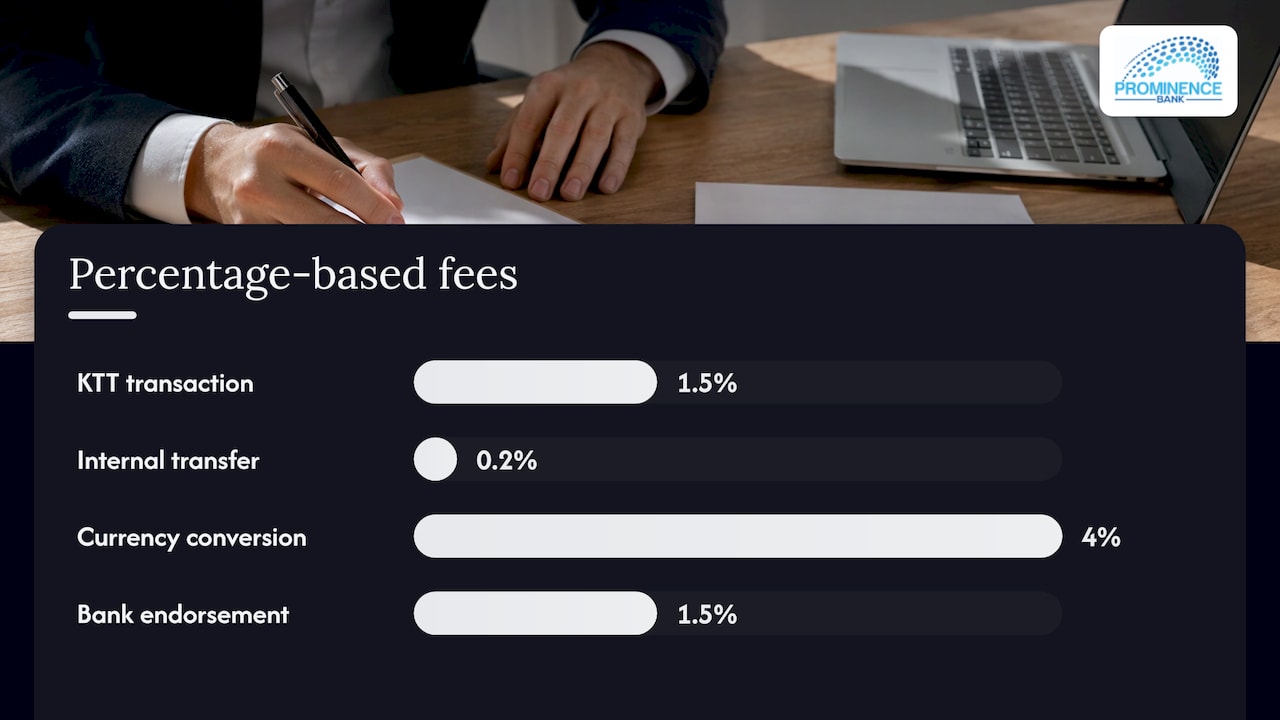
We publish our fees, so you can model the structure up front. The figures below come from our fee schedule.
| Item | Fee |
|---|---|
| Bank account opening | 25,000 (USD or EUR), one-off |
| Numbered bank account opening | $/€ 50,000, one-off |
| Numbered account monthly fee | 100 (USD or EUR) per month |
| Savings account monthly fee | 40 (USD or EUR) per month |
| KTT (E-Telex) transaction, incoming or outgoing | 1.5% |
| Prominence Bank internal transfer | 0.2% |
| Currency conversion | 4% |
| Bank endorsement | 1.5% |
| Enhanced due diligence, Level 1 / 2 / 3 | €5,000 / €10,000 / €15,000, one-off |
| Proof of funds, reference or comfort letter | €25,000 each, one-off |
SWIFT and IBAN wire transfers are published at 1% (minimum $/€100), and outgoing transfers also carry applicable SWIFT/SEPA charges. The published fee for the Safekeeping Receipt (SKR) / custody service is $/€ 25,000 for the custody account plus 2%.
The internal transfer rate is worth noting for a group: when entities hold accounts inside the same bank, moves between them are priced at 0.2%.
Open a corporate account with Prominence Bank
If your structure needs a multi-currency, custody-capable and discreet banking partner, you can apply fully online, subject to review and compliance. Our corporate banking team works with international businesses and complex structures, and you can start with the business and corporate account application.

Have your ownership chart, incorporation documents and expected monthly volumes ready. It shortens onboarding. For the sequence from first contact to a funded account, read our guide to setting up corporate accounts for global businesses.
FAQ
Is multi-jurisdiction banking legal for a U.S. company?
Yes, holding foreign accounts is lawful. The obligations come with it: FBAR filing when aggregate foreign balances exceed $10,000, beneficial ownership disclosure to banks, and tax reporting. Your CPA should confirm which forms apply to your entities and owners.
How many banks should a business use?
Use as few as your roles require, plus one for redundancy. Large U.S. companies averaged 4.5 banks for international cash management in 2019 according to Greenwich Associates, but the right number depends on your currencies, countries and controls, not on a benchmark.
What is the FBAR deadline?
The FBAR is due April 15 each year, with an automatic extension to October 15. It is filed electronically with FinCEN through the BSA E-Filing System, separately from your tax return.
Does a numbered account avoid KYC?
No. A numbered account changes how the account is identified in routine records. Identity verification and ownership checks still apply, and the owner’s reporting duties in the U.S. do not change.
How long should I keep account opening documents?
Basel Committee guidance sets a bank retention period of at least five years after the relationship ends. Keep your own copy for at least that long, along with your FBAR records, and longer if there is an investigation or dispute.
Sources
- Greenwich Associates: Geopolitics and New Providers Lead to Surge of Money in Motion
- CFO.com: US firms show renewed interest in foreign currency accounts
- FDIC FIL-23-040B: Due Diligence Programs for Correspondent Accounts
- Treasury Today: Plunging into the cash pool
- IRS: FBAR Reference Guide (Publication 5569)
- IRS: Comparison of Form 8938 and FBAR requirements
- U.S. Department of Commerce: Banking Checklist for Foreign Companies
- Basel Committee on Banking Supervision: AML/CFT guidelines, June 2017
- Joint Fact Sheet on Foreign Correspondent Banking
- GDF: Crypto Asset Safekeeping and Custody