
You can get an apostille for a bank document in the United States, but not directly. A bank statement, reference letter or proof-of-funds letter is a private document. It has to be notarized first, and the Secretary of State of the state where the notary is commissioned then apostilles the notary’s signature and seal. The apostille does not vouch for the balance or the bank. It vouches for the notary.
This guide walks through the sequence, who issues what, what to bring, and the mistakes that get a package sent back.
TL;DR
- A bank document is private, so the chain is: bank document, notarization, state apostille, then use abroad.
- The apostille certifies the notary’s signature and seal, never the figures on the document.
- State-level notarized documents go to the Secretary of State of the notary’s state, and federal documents go to the U.S. Department of State.
- A plain online statement often has no signature to notarize. Ask the bank for a signed letter or certification, or use a notarized copy certification.
- If the destination country is not in the Hague Apostille Convention, you need an authentication certificate and usually embassy legalization.
Table of Contents
- What an apostille actually certifies
- Why bank documents need a notary first
- Three routes to a notarized bank document
- Which authority issues the apostille
- Step by step: from bank document to apostille
- Fees and timing
- Common reasons packages get rejected
- When you need a bank letter rather than a statement
- Our perspective
- Reference letters and proof of funds at Prominence Bank
- FAQ
- Sources
What an apostille actually certifies
An apostille is a certificate attached to a document so it is recognized in another country that belongs to the 1961 Hague Convention. The Florida Department of State explains that a public document is one issued by an elected or appointed public official, or one that has been notarized, and that only the state’s competent authority can issue the apostille.
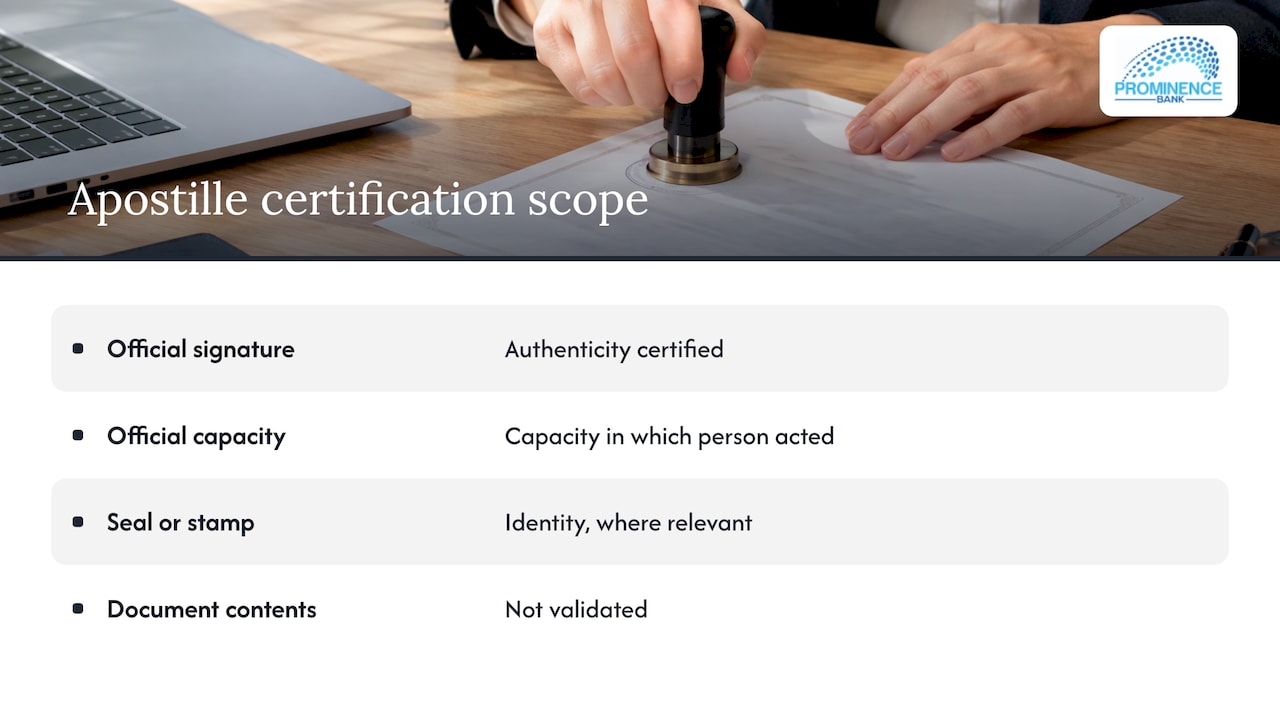
What it covers is narrow. The California Secretary of State says the apostille certifies the authenticity of the public official’s signature, the capacity in which that person acted, and, where relevant, the identity of the seal or stamp, such as a notary seal. It does not validate the contents of the document. The Louisiana Department of State says the same: apostilles do not certify the content of a public document.
For banking paperwork this matters. A foreign registry, consulate or bank that receives an apostilled statement learns that a genuine, commissioned notary handled it. It does not learn that the balance is correct. The receiving party will still judge the figures on their own terms, which is why recency and bank-issued wording count.
Why bank documents need a notary first
A bank is a private company, and its officers are not public officials. So a statement, balance certificate or reference letter has no public signature for a Secretary of State to authenticate. The notary supplies one.
The Texas Secretary of State’s guide says the office must receive the original Texas notarized document to issue an apostille, and that the apostille attests to the validity of the Texas public official, not to the underlying contents. The Louisiana office adds that documents without a proper certification must be notarized by a Louisiana notary before the office will accept them for legalization.
The U.S. Department of State lists financial documents among the examples of state documents that may need authentication. It instructs that these first be authenticated by the issuing state before anything goes to the federal Office of Authentications.
One rule from the Foreign Affairs Manual is worth remembering: notaries public in the United States do not perform authentications. A notary notarizes. The state authority apostilles.
Three routes to a notarized bank document
What the notary notarizes depends on what kind of document you hold. There are three common routes.
Route 1: a signed letter or certification from the bank
The cleanest route is a document the bank itself signs. A bank officer signs a letter confirming the account, the holder and the balance as of a date. The officer then signs in front of a notary, usually through an acknowledgment or jurat. The notary seal is what the Secretary of State authenticates.
This works well for reference letters, balance confirmations and proof-of-funds letters, because the document is born with a signature. Many branches have a notary on staff, but a bank can decline under its own policy, so ask before you travel.
Route 2: a notarized copy certification of a statement
A statement you download as a PDF usually carries no signature. A common workaround is a copy certification. You show the original statement to a notary, sign a statement that the copy is true and complete, and the notary certifies your signature. The apostille then authenticates the notary.
The National Notary Association notes that notarizations include acknowledgments, jurats and copy certifications, and that documents should be complete with no blank spaces. Vital records are the exception: notaries cannot make or certify copies of birth, marriage or death certificates. Rules on copy certification vary by state, so confirm that your notary is permitted to do it.
Route 3: an affidavit from the account holder
An affidavit from the account holder attaching the statement is the third option. You swear before the notary that the attached statement is genuine, and the notary completes a jurat. Some foreign recipients want the bank’s own signature rather than yours, so check what they accept before choosing this route.
A warning: a bank’s signature guarantee or Medallion stamp is not a notarization. It is a different instrument, and a state office will not apostille it on that basis.
Which authority issues the apostille
There is no single national apostille office for notarized documents. The competent authority is the Secretary of State, or an equivalent office, of the state where the notary is commissioned.
| Document type | Who apostilles it | Notes |
|---|---|---|
| Bank letter or statement notarized by a state notary | Secretary of State of the notary’s state | Original notarized document required |
| State-issued records, such as vital records | Secretary of State of the issuing state | Separate from bank paperwork |
| Federal documents | U.S. Department of State, Office of Authentications | Not used for ordinary bank letters |
| Destination not in the Hague Convention | State authentication, then U.S. Department of State, then embassy legalization | Authentication certificate instead of apostille |
The USAGov guidance confirms the split: state documents go to the state’s Secretary of State and federal documents go to the U.S. Department of State, when the destination country is a Hague member. For a non-member, you need an authentication certificate instead.
The practical point: notarize in the state whose office you intend to use. A Texas notary’s seal is verified by Texas, not by Arizona. Sending a document to the wrong authority is the quickest way to lose weeks.
Step by step: from bank document to apostille
- Confirm the destination and the requirement. Ask the receiving party whether they want an apostille, which documents, and how recent the statement must be. Windows of 30 to 90 days are common, and some authorities also want a certified translation.
- Get the right document from the bank. Request a signed letter or certification if you can. If you only have an online statement, plan for a copy certification.
- Find a notary in the state whose apostille office you will use. Check that the commission is current. A notary acknowledgment should show the notary’s name, commission details, expiration date and county.
- Sign in front of the notary where required. Do not sign in advance, and do not leave blanks.
- Submit the original notarized document to the Secretary of State. Include the request form, the fee and a prepaid return envelope. The American Society of Notaries stresses that obtaining the apostille is the client’s responsibility, and that you should state the destination country in a cover letter.
- Check the result before you send it abroad. The apostille should be attached to the notarized original, with the notary’s name matching.
Fees and timing
Fees are set by each state, so read the official page. As one example, the Arizona Secretary of State charges $3 per document. Mail processing takes 10 to 20 business days, and walk-in service carries a $25 expedite fee with a limit of six documents. Other states differ in price, speed and whether they accept walk-ins. Add the notary’s fee, courier costs and any translation.
Because a statement’s date matters, order matters too. Do not request a statement and then wait weeks to notarize it. Start the chain once you know the recipient’s window, and leave room for a second round if something is rejected.
Common reasons packages get rejected
- Plain printout submitted as is. With no signature to authenticate, the state office has nothing to apostille.
- Wrong state office. The notary’s commission state decides the authority.
- Photocopy instead of the original. The office needs the original notarized document, as Texas states in its guide.
- Expired or incomplete notary seal. Missing commission details can stop the file.
- Signature guarantee instead of notarization. These are different instruments.
- Wrong destination track. A non-Hague country needs authentication and often embassy legalization.
- Stale statement. The apostille can be perfect and the foreign authority can still ask for a newer document.
When you need a bank letter rather than a statement
Many cross-border requests, such as a company incorporation abroad, a visa file or a real estate purchase, do not actually need a monthly statement. They ask for a bank reference, a comfort letter or proof of funds, each signed by the bank. These are easier to apostille because they come with a signature and carry wording the recipient expects. For the format that foreign recipients tend to look for, see our guide to the correct bank reference letter format. If the request is about where the money came from, our piece on auditable source of funds proof explains what a clean paper trail looks like.
If you are a foreign national who needs a U.S. account in the first place, there is a separate checklist of documents to gather. This overview of opening a U.S. bank account as a foreigner covers the starting point.
Our perspective
Most apostille problems we see are sequencing problems, not paperwork problems. People request a document, notarize it in one state, and only then discover the recipient wanted a bank-signed letter dated within the last few months.
Our view is simple: decide what the recipient needs first, then ask the bank for a document that is built to be notarized. A signed letter beats a printed statement every time, because the notary has something real to certify.
For clients with cross-border needs, we design our banking around that reality. Our fee schedule lists reference letters and proof of funds as defined services, so you know the cost before you start, and our documents verification page explains how we approach authenticity checks. Build the chain backward from the recipient, and the apostille becomes a routine last step.
Harold
Reference letters and proof of funds at Prominence Bank
If your file needs a bank-issued document, we publish our pricing openly. On our fees page, a Reference Letter / Comfort Letter and a Proof of Funds (POF) are each listed at €25,000 one-off. Enhanced due diligence is listed at €5,000, €10,000 or €15,000 one-off depending on level, and bank account opening is listed at $25,000/€25,000 one-off. Our bank instruments page covers related products.
We serve high-net-worth individuals, international businesses and institutions that need discreet, fully online banking with global reach. If a foreign authority is asking for bank paperwork, tell us the destination and the requirement up front.
See the full fee schedule or start from our private banking and business banking pages.
FAQ
Can I apostille a printed or PDF online bank statement as is?
Usually not. A state office authenticates a public official’s or notary’s signature, and a plain printout has none. Get a signed letter from the bank, or have a notary certify a copy, then submit the notarized original for the apostille.
Does the apostille prove my balance is real?
No. It confirms the notary’s signature, capacity and seal, as California and Louisiana both state. It does not check the bank’s records or the figures. The receiving party decides how much weight to give the content.
Where do I send a notarized bank document for an apostille?
Send it to the Secretary of State, or equivalent office, of the state where the notary is commissioned. Federal documents go to the U.S. Department of State instead. Check that office’s current fee, form and processing time before mailing.
What if the destination country is not part of the Hague Convention?
You need an authentication certificate rather than an apostille. Per the U.S. Department of State, state documents are authenticated by the issuing state first, then by the federal Office of Authentications. The destination country’s embassy or consulate often completes legalization, so confirm its rules.
Can my bank notarize the document for me?
Many branches have a notary, but a bank may decline based on its own policy, and not every branch offers the service. Call ahead, and ask whether the officer can sign a letter or certification in front of the notary.
Sources
- Florida Department of State: Apostille FAQ
- California Secretary of State: Apostille FAQ
- Louisiana Department of State: Apostilles and Authentications
- Texas Secretary of State: Apostille/Authentication Certificate Guide
- U.S. Department of State: Preparing a Document for an Authentication Certificate
- 7 FAM 870: Authentication of Documents
- USAGov: Authenticate an official document for use outside the U.S.
- National Notary Association: How to Get Something Notarized
- American Society of Notaries: Apostille and Certificate of Authority
- Arizona Secretary of State: Authentication