
Commodity trade finance is financing tied directly to a physical commodity transaction, structured so the sale or delivery of that commodity repays the loan. It’s asset-based and self-liquidating, meaning the deal pays for itself rather than relying on the borrower’s balance sheet. Producers, traders, processors, and offtakers use it to bridge the gap between paying for goods and getting paid for them, or to stretch payment terms across longer shipping and processing cycles.
TL;DR:
- Commodity trade finance relies on physical commodity flows for repayment, making it highly asset-based and self-liquidating without depending on the borrower’s long-term solvency.
- The most common structures include pre-export finance, warehouse financing, repo transactions, and forfaiting, each suited to different supply chain stages and transaction tenors.
- Lenders mitigate risks through collateral management, warehouse receipts, insurance, credit guarantees, and strict documentation, especially in volatile markets affected by price swings and geopolitical factors.
- Digital solutions like blockchain and streamlined onboarding improve traceability, reduce paperwork delays, and enhance compliance efficiency in these complex cross-border deals.
- ESG considerations are increasingly factored into financing decisions, emphasizing origin, sustainability, and transparent supply chains, often with pricing incentives for verified environmentally responsible practices.
Table of Contents
- What Is Commodity Trade Finance, Exactly?
- Which Commodity Finance Structure Fits Your Deal?
- Instruments and Documents That Make the Deal Work
- What Risks Do Lenders Actually Worry About?
- How Do You Choose the Right Structure for Your Deal?
- How Do You Actually Get a Commodity Trade Finance Deal Done?
- How Does a Digital Bank Support Commodity Trade Finance?
- Why Is Compliance So Complicated in This Market?
- How Do Price Swings and Geopolitics Affect These Deals?
- Is Blockchain Actually Changing Commodity Trade Finance?
- How Do ESG Standards Factor Into Trade Financing Decisions?
- Who Else Is Involved Beyond the Bank and the Trader?
- What Does a Real Commodity Trade Finance Deal Look Like?
- The Practical Takeaway for Finance and Treasury Teams
- How Prominence Bank Supports Trade Finance
- Sources
- FAQ
What Is Commodity Trade Finance, Exactly?
Commodity trade finance sits inside the broader category of commodity finance, but it’s narrower and more mechanical. Commodity finance can include equity investments in mining operations, long-term project loans, or hedging books. Commodity trade finance is specifically about funding a transaction, moving a cargo of crude, a shipment of copper concentrate, or a silo of wheat from seller to buyer, and getting repaid from that specific flow.
That’s what separates it from structured trade finance in the loosest sense of the term. Structured trade finance is the umbrella term for the techniques banks use to build these self-liquidating deals: pre-export finance, borrowing base facilities, revolving credit facilities, and warehouse financing all fall under it. Commodity trade finance is what happens when those techniques get applied to physical commodities specifically, as opposed to, say, manufactured goods or services receivables.
Lenders favor this model because repayment doesn’t depend on the borrower staying solvent for the next five years. It depends on a cargo actually existing, moving, and selling. Repayment is tied to the sale or proceeds of the underlying commodity rather than the borrower’s general balance sheet, which is why a trading house with thin equity can still access eight-figure facilities if its flows are clean and traceable.
The main participants each show up with different needs:
- Producers (miners, farms, oil fields) need financing that covers production costs before the commodity is even harvested or extracted.
- Traders move commodities between markets and typically need short-term facilities, often 30 to 180 days, to fund the purchase-to-resale window.
- Processors need financing that covers raw material purchases while goods sit in transformation, before they become sellable finished product.
- Offtakers sometimes prepay producers in exchange for guaranteed future delivery, which itself becomes a financing structure.
Each group’s tenor and facility type differs based on how long their piece of the supply chain actually takes.
Which Commodity Finance Structure Fits Your Deal?
Seven structures dominate this market, and picking the wrong one is the single most common reason a facility gets renegotiated mid-deal or, worse, rejected by the credit committee.
-
Pre-export finance (PXF). A lender advances funds to a producer before goods are shipped, secured against future export proceeds, usually under an offtake contract. Repayment comes from those export sales. Tenor typically runs one to three years, and lenders want a track record of consistent export volumes before they’ll extend it.
-
Borrowing base facilities. A revolving line sized against a formula, usually a percentage of eligible receivables plus eligible inventory, that moves up and down as the collateral pool changes. Traders like these because the facility grows with their book. Lenders demand frequent reporting (often weekly) and tight eligibility criteria, since the collateral value moves daily with commodity prices. Read more on borrowing base mechanics and collateral tactics for a deeper walk-through.
-
Revolving credit facilities (RCF). Broader and less collateral-specific than a borrowing base, an RCF gives a trading company a standing credit line it draws and repays repeatedly. It suits companies with diversified flows and strong general creditworthiness rather than a single deal to point to.
-
Warehouse financing. Commodities sitting in storage, grain in a silo, metal in a bonded warehouse, become the collateral, evidenced by a warehouse receipt from an approved custodian. Advance rates typically run 70% to 90% of market value, with the rest held as a margin buffer against price swings. Tenor is short, usually 30 to 180 days.
-
Repurchase transactions (repo). The lender buys the commodity outright and the seller commits to buy it back at a fixed future date and price. This converts inventory into cash instantly without technically being a loan, which sometimes suits regulatory or balance-sheet preferences. Repo transactions and prepayment financing convert physical inventory into immediate liquidity through this sale-and-buyback mechanic.
-
Prepayment financing. An offtaker pays a producer upfront for goods to be delivered later, often over multiple shipments. The producer gets working capital; the offtaker locks in supply and sometimes a favorable price. Risk sits heavily on delivery performance, so lenders backing the offtaker’s prepayment usually want assignment of the underlying sales contract.
-
Forfaiting and factoring. Both involve selling receivables for immediate cash, but they diverge sharply on tenor and recourse. Forfaiting is a non-recourse purchase of medium and long-term receivables, 180 days out to several years, and ticket sizes tend to start around $100,000 given the fixed costs of documentation and legal review. Factoring is shorter, usually 90 days or less, and can be structured with or without recourse depending on the deal. If you’re weighing forfaiting vs factoring, the real question is whether you need to fully offload credit risk (forfaiting) or just accelerate cash flow on receivables you’re still willing to stand behind (factoring).
Structures 1, 4, and 5 demand the tightest operational controls since the lender’s security is a physical asset, not paper. Anything touching warehouse receipts or repo means a collateral manager is watching the goods, not just the contract.
Instruments and Documents That Make the Deal Work
The structures above are the skeleton. Letters of credit, standby letters of credit, promissory notes, bills of exchange, and escrow accounts are the connective tissue that actually moves money and reduces payment risk between counterparties who often don’t know each other well.
A letter of credit (LC) is a bank’s conditional promise to pay the seller once specified shipping and quality documents are presented. It shifts payment risk from the buyer to the buyer’s bank, which is why sellers in unfamiliar markets often won’t ship without one. A standby letter of credit (SBLC) works differently: it’s a backup, drawn only if the buyer fails to pay through the primary agreed method. SBLCs frequently sit behind prepayment and RCF structures as a fallback guarantee rather than the primary payment mechanism.
Promissory notes and bills of exchange are negotiable instruments, essentially IOUs that can be transferred, discounted, or sold before maturity. A bill of exchange drawn under an LC and accepted by a bank becomes a bankers’ acceptance, which traders can sell at a discount for immediate cash. This is often how forfaiting transactions get funded: the forfaiter buys the accepted bill at a discount and collects full value at maturity.
Escrow accounts hold funds or documents with a neutral third party until contractual conditions are met, common in prepayment deals where the offtaker wants assurance that funds only release against confirmed shipment.
Banks arranging any of these structures typically want a documentation package that includes:
- The underlying sale and purchase contract with clear delivery and payment terms
- Warehouse receipts or bills of lading proving custody and title
- Insurance certificates covering cargo and, where relevant, credit risk
- KYC and beneficial-ownership documentation on every counterparty in the chain
- Historical performance data on prior shipments under similar contracts
A trader missing even one of these, especially clean title documentation, will see underwriting stall regardless of how strong the counterparty credit looks. For a closer look at how these instruments interact in practice, see this breakdown of trade finance instruments.
What Risks Do Lenders Actually Worry About?
Four risk categories drive every underwriting decision in this market, and they don’t weigh equally depending on the commodity or the counterparty.
- Credit risk — Will the offtaker or buyer actually pay when the goods arrive? This is the risk LCs, SBLCs, and credit insurance exist to manage.
- Market/price risk — Commodity prices swing, and collateral value can drop mid-transaction. Margining and overcollateralization exist specifically to absorb this.
- Custody/operational risk — Is the physical commodity actually where the paperwork says it is, in the condition claimed? This is where collateral managers and approved warehouses earn their fee.
- Legal/compliance risk — Is the contract enforceable across the jurisdictions involved, and does the deal clear AML and sanctions screening?
Mitigation follows a predictable pattern. Lenders overcollateralize warehouse and repo deals, typically advancing only 70% to 90% of market value so a price drop doesn’t immediately erase their margin. They require regular mark-to-market reporting and can call for additional collateral if prices move against the position. Approved warehouses and independent collateral managers provide the physical verification layer that turns a paper claim into an enforceable one. Credit insurance and bank guarantees add a further backstop against counterparty default.
The recourse question deserves its own note. In a recourse structure, if the underlying receivable doesn’t pay out, the lender can chase the original seller for the shortfall. In a non-recourse structure, the lender absorbs that loss entirely. Forfaiting is built almost entirely around non-recourse purchases, providing full financing without recourse to the seller, which is exactly why forfaiters charge more and vet transactions harder than a standard factoring desk would.
Pro Tip: If you’re a mid-size trading company weighing forfaiting, talk to the forfaiter before you finalize pricing with your buyer. Forfaiting costs can often be built into the sales contract rather than absorbed after the fact, and forfaiters increasingly want that conversation early rather than after documents are already signed.
How Do You Choose the Right Structure for Your Deal?
Four variables decide which structure fits: tenor, commodity type, counterparty credit, and whether you need non-recourse treatment.
- Check your tenor first. Under 180 days generally points to warehouse financing, factoring, or a borrowing base draw. Beyond that, medium to long-term deals suit pre-export finance or forfaiting.
- Weigh transaction size against forfaiting minimums. Forfaiting typically needs a ticket north of roughly $100,000 to justify the fixed legal and documentation costs, so smaller receivables usually route through factoring instead.
- Assess counterparty credit honestly. Weak offtaker credit with a documented sales contract often points toward prepayment or LC-backed structures rather than an unsecured facility.
- Decide how much recourse you can tolerate. If you need the credit risk fully off your books, forfaiting or non-recourse factoring is the only real answer; recourse structures cost less but leave you exposed.
Red flags that push a deal toward structured trade finance instead of a conventional loan: thin borrower equity relative to deal size, commodities stored across multiple jurisdictions, or a buyer the lender has never financed before. Any of those three should trigger a conversation about collateral managers and escrow before terms get finalized.
How Do You Actually Get a Commodity Trade Finance Deal Done?
Arranging a facility follows a fairly consistent sequence, though timelines vary sharply depending on how clean the documentation is going in.
- Deal preparation. Line up the sale contract, offtake agreement, and any existing relationship with a collateral manager before approaching a bank. Incomplete contracts are the number one cause of delay at this stage.
- Custody arrangement. If the structure involves warehousing or repo, select an approved custodian and confirm warehouse receipt procedures upfront, since lenders increasingly demand documented custody arrangements before releasing funds.
- KYC/AML submission. Provide beneficial-ownership records, sanctions screening results, and counterparty due diligence early. This step alone can take weeks if ownership structures are complex.
- Underwriting review. Banks evaluate traceability of goods, custody controls, and whether cash flows are genuinely ring-fenced to the transaction, the core pillars underwriters check before committing capital.
- Drawdown and monitoring. Once approved, funds release against agreed triggers (shipment, warehouse receipt, LC presentation), with ongoing reporting obligations through the life of the facility.
The single fastest way to shorten this cycle: have your collateral manager relationship and KYC files ready before you start shopping the deal, not after a bank asks for them.
How Does a Digital Bank Support Commodity Trade Finance?
A licensed digital institution like Prominencebank illustrates how modern trade-finance support can work without a traditional branch network. Multi-currency business accounts let a trading company settle in the currencies its counterparties actually invoice in, cutting the friction of constant conversion. Corporate banking services accommodate the layered ownership structures common in trading groups, while services built around escrow and documentary support align with the custody and ring-fencing needs described above.
The bank’s emphasis on AML and KYC compliance matters directly here, since underwriting for structured deals leans heavily on clean beneficial-ownership records. Digital onboarding speeds the front end of the process, though clients should still expect the same document readiness, custody verification, and compliance depth that any structured facility demands, digital delivery doesn’t shortcut underwriting rigor.
Why Is Compliance So Complicated in This Market?
Commodity trade finance carries compliance weight that standard corporate lending doesn’t, mostly because physical goods cross borders, change hands multiple times, and often originate in jurisdictions with weaker corporate transparency. AML and KYC checks aren’t a formality here; they’re the mechanism that keeps a bank from unknowingly financing sanctioned parties, conflict-mineral flows, or layered ownership structures designed to obscure the real beneficiary.
Banks financing commodity flows typically run beneficial-ownership verification on every entity in the chain, not just the immediate borrower. That means a trading company’s suppliers, its offtakers, and sometimes its logistics partners all get screened. Sanctions exposure is a particular headache in commodities because certain sectors, oil, metals, precious stones, carry elevated sanctions risk depending on origin country, and screening has to account for indirect exposure, not just direct counterparties.
Documentation fraud is another persistent problem. Forged bills of lading or inflated warehouse receipts have caused real losses in this market, which is part of why independent collateral managers and approved custodians carry so much weight in underwriting decisions. A bank that can’t independently verify the goods exist, in the quantity and quality claimed, is exposed regardless of how clean the paperwork looks.
Enhanced due diligence tiers exist precisely for cases where ownership structures, jurisdictions, or transaction complexity raise the risk profile beyond standard KYC. The deeper the structure, layered offshore entities, unfamiliar counterparties, complex flows of funds, the more scrutiny a compliance team applies before capital moves.
How Do Price Swings and Geopolitics Affect These Deals?
Commodity prices move fast, and every structured trade facility is built with that volatility priced in. A borrowing base facility that advances 80% against collateral value can suddenly find that collateral worth 15% less within a week if prices drop sharply, which is exactly why lenders demand mark-to-market reporting and reserve the right to call for additional margin.
Currency exposure compounds the problem. Many commodity contracts are dollar-denominated even when the producer’s costs and the buyer’s revenue sit in different currencies entirely. A trading company earning in one currency and repaying a facility in dollars is running an unhedged currency position unless it actively manages that mismatch, and lenders often require evidence of hedging before extending longer-tenor facilities.
Geopolitical risk has become harder to model than it used to be. Export bans, sanctions regimes, and shipping-lane disruptions can strand a cargo mid-transit, turning a clean self-liquidating structure into a stalled asset overnight. Lenders increasingly build jurisdiction-specific covenants into facilities covering commodities that pass through politically sensitive chokepoints or origin countries with a history of abrupt policy shifts.
This is part of why structured trade finance tends to outperform conventional lending during volatile periods. A conventional loan depends on the borrower’s overall financial health holding steady through a rough quarter. A structured facility depends on a specific transaction closing out, and the collateral, margining, and hedging built into the structure absorb price and currency shocks that would otherwise sink an unsecured facility.
Is Blockchain Actually Changing Commodity Trade Finance?
Digitization has moved faster in this sector over the past few years than most outsiders realize, though the change is more about reducing paperwork friction than reinventing the underlying structures.
Electronic bills of lading and digitized warehouse receipts are gradually replacing paper documents that used to travel by courier between counterparties, sometimes taking longer to arrive than the cargo itself. That lag created real settlement delays and fraud opportunities, since a paper document can be duplicated or altered in ways a properly implemented digital record resists.
Blockchain-based platforms attempt to solve the traceability problem at its root: creating a shared, tamper-resistant ledger of who owns a cargo and where custody has transferred. In theory, this addresses exactly the custody and operational risk that collateral managers exist to police. In practice, adoption remains uneven across the industry, since blockchain-based trade platforms only deliver their promised value when every counterparty in a chain, buyer, seller, bank, warehouse, insurer, actually uses the same system, and getting an entire supply chain onto one platform is a coordination problem as much as a technology one.
Digital onboarding and straight-through KYC processing have seen more consistent gains, cutting the weeks-long document-gathering phase that used to precede underwriting. A digitally native bank may be able to verify beneficial ownership and screen sanctions exposure more quickly, which matters enormously when a trader is trying to close a facility before a shipping window closes.
How Do ESG Standards Factor Into Trade Financing Decisions?
ESG considerations have moved from a nice-to-have disclosure item to an active underwriting variable in commodity trade finance, particularly for agricultural commodities, metals, and energy.
Lenders increasingly ask for traceability not just of custody and title, but of origin, where was this commodity actually produced, and under what labor and environmental conditions. Deforestation-linked agricultural commodities and conflict-linked minerals face the most scrutiny, since financing a tainted supply chain carries reputational and, increasingly, regulatory risk for the bank itself.
Sustainability-linked trade facilities have emerged as a distinct product category, offering pricing incentives tied to verified environmental or social performance metrics rather than just transaction mechanics. A producer that can document lower-emissions extraction or verified fair-labor practices may access marginally better terms than a peer that can’t, though the market for these instruments remains smaller and less standardized than conventional structured trade finance.
The practical challenge is verification. ESG claims in commodity supply chains are notoriously hard to audit independently, especially across multiple layers of intermediaries between a raw producer and a final buyer. Collateral managers and third-party auditors increasingly get pulled into ESG verification alongside their traditional custody role, adding a layer of complexity, and cost, that wasn’t part of standard underwriting a decade ago.
Who Else Is Involved Beyond the Bank and the Trader?
Commodity trade finance transactions involve a wider cast than the two parties signing the facility agreement.
Insurers cover both cargo risk (physical loss or damage in transit) and credit risk (buyer default), and a strong insurance package often determines whether a lender will extend better pricing or looser covenants. Logistics providers, freight forwarders, shipping lines, and terminal operators, generate much of the documentation (bills of lading, delivery confirmations) that underwriting depends on, making their reliability part of the risk equation even though they’re rarely a named party to the financing itself.
Collateral managers and approved custodians sit at the center of any warehouse-financing or repo structure, providing the independent verification that turns a claim about inventory into something a lender can actually rely on. Rating agencies matter less for the transaction itself than for the broader counterparties involved, a trading house’s credit rating affects the pricing and structure lenders will offer, even on a deal that’s fundamentally asset-based rather than balance-sheet-based.
Legal counsel across relevant jurisdictions verifies enforceability, particularly for cross-border structures where collateral sits in one country, the borrower is incorporated in another, and the buyer operates in a third. Enforceability gaps between jurisdictions are one of the more common reasons a seemingly solid structure falls apart during a dispute.
Each of these parties adds a layer of cost and time to a transaction, but each also reduces a specific risk that would otherwise sit entirely with the lender, which is exactly why complex structured deals involve more signatures than a simple bilateral loan ever would.
What Does a Real Commodity Trade Finance Deal Look Like?
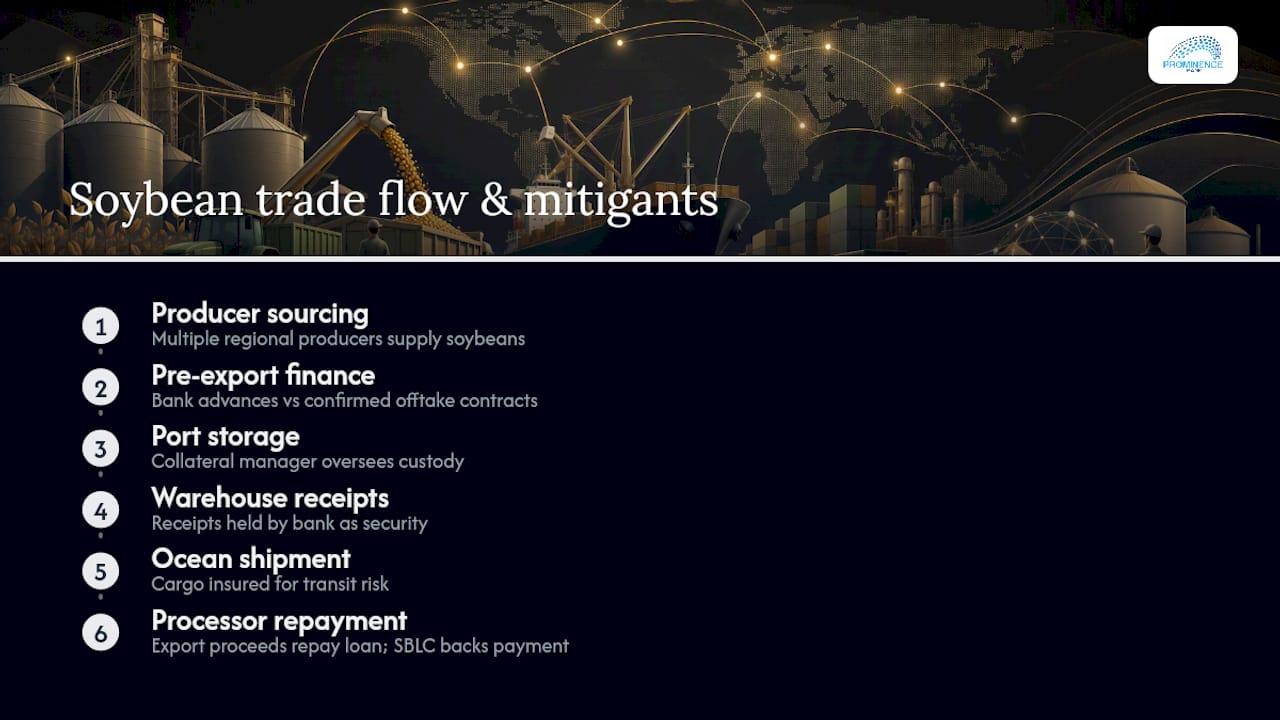
Consider a mid-size agricultural trading company sourcing soybeans from multiple regional producers for export to processors in another country. The trader doesn’t own storage infrastructure at scale and doesn’t have the balance sheet to prepay every producer upfront, so a pre-export finance structure gets built around confirmed offtake contracts with the processors.

The bank advances funds against those offtake contracts, with repayment scheduled against confirmed export proceeds. A collateral manager oversees the grain once it reaches port storage, issuing warehouse receipts that the bank holds as security until shipment. An SBLC backs the processor’s payment obligation in case of dispute, and cargo insurance covers the ocean transit leg.
This structure works precisely because every risk has a named mitigant: custody risk sits with the collateral manager, payment risk sits with the SBLC and offtake contract, and transit risk sits with the insurer. No single party is exposed to the full chain of things that could go wrong, which is the entire point of layering structured trade finance rather than relying on one blanket loan against the trader’s general creditworthiness.
A comparable pattern shows up in metals trading, where a processor might use warehouse financing against LME-registered warehouse stock to fund purchases of concentrate, repaying as refined metal sells forward under an offtake agreement. Different commodity, same underlying logic: collateral, ring-fenced cash flow, and a repayment path that doesn’t depend on the borrower’s balance sheet holding up on its own.
The Practical Takeaway for Finance and Treasury Teams
The core value of commodity trade finance is simple: it lets a deal’s own cash flow carry the risk instead of your balance sheet. Before you approach a lender, get your offtake contracts, custody arrangements, and KYC files in order, then consider piloting one structure, warehouse financing or a borrowing base, rather than trying to build a full program at once. Engage a collateral manager early; that relationship often decides how fast underwriting moves. If you want to discuss which structure fits your flows, contact Prominence Bank about its trade finance services, which are subject to review and compliance.
— Harold
How Prominence Bank Supports Trade Finance
Prominence Bank reviews trade finance requirements for eligible businesses with a defined underlying trade transaction, including documentary credits, documentary collections, guarantees and standby structures. Published bank instrument fees include 4% for a Bank Guarantee (BG) and 4% for a Standby Letter of Credit (SBLC).
Each request is reviewed against the contract, counterparties, documents and timing, and is subject to KYC/AML, credit and compliance review and final approval. An enquiry is not a commitment to issue an instrument. See the fees page for the current published schedule.
Sources
- Structured trade and commodity finance | Global Trade Review
- Trade
- A comprehensive introduction to commodity trade finance – ICC Academy (PDF)
- Demystifying Structured Trade Finance – Watson Farley & Williams
FAQ
Do Commodity Traders Make a Lot of Money?
Trading margins vary enormously by commodity, volume, and market conditions, and profitability depends heavily on access to financing that lets a trader move volume without tying up capital. Structured facilities like borrowing bases and pre-export finance are often what makes higher-volume trading economically viable in the first place, rather than trading margin alone.
What Are the Top Five Traded Commodities?
Crude oil, natural gas, gold, copper, and agricultural staples like soybeans and wheat consistently rank among the most heavily traded commodities globally. Each relies on different financing structures, energy and metals often use warehouse financing and repo, while agricultural flows lean more on pre-export finance and prepayment deals tied to harvest cycles.
Why Is Commodity Trading on Exchanges Considered Risky?
Exchange-traded commodity derivatives carry high leverage, meaning small price moves can produce outsized gains or losses relative to the capital committed. That volatility is exactly why physical commodity trade finance structures build in overcollateralization, margining, and hedging requirements that pure exchange speculation doesn’t have built in.
What Is Commodity Trade Finance in Simple Terms?
It’s financing structured around a specific physical commodity transaction, where the loan gets repaid from the sale or delivery of that commodity rather than the borrower’s broader finances. It’s asset-based and self-liquidating, which lets companies with strong trade flows but thin balance sheets access financing that a conventional loan wouldn’t offer them.