
The main collateral options in trade finance are inventory or warehouse receipts, receivables (through factoring, invoice discounting, or forfaiting), cash and financial securities, payment instruments like letters of credit and standby letters of credit, and third-party guarantees. Choose cash, securities, or receivables when you need higher advance rates and faster approval. Choose warehouse receipts or a Collateral Management Agreement when the deal is commodity or inventory heavy and you can absorb tighter monitoring requirements.
TL;DR:
- Cash, securities, or receivables offer higher advance rates and quicker approval compared to inventory or warehouse collateral.
- Proper collateral perfection with registration, inspections, and legal controls is essential to prevent double financing and enforce security rights.
- Collateral management agreements and structured trade finance solutions enhance control and verify the condition of physical assets, reducing risks during delivery.
- The valuation, monitoring frequency, and substitution rights of collateral significantly influence the overall cost and flexibility of a trade finance facility.
- An account structure supporting multi-currency, blocked, and escrow arrangements can speed up transactions and reduce disputes in cross-border trade finance deals.
Table of Contents
- What Are the Main Trade Finance Collateral Options?
- How Do Lenders Value and Structure Collateral?
- What Are Collateral Management Agreements and Structured Trade Finance?
- What Risks Come With Trade Finance Collateral?
- How Do You Choose Collateral and Negotiate Terms?
- Why Collateral Structure Matters More Than the Asset Itself
- Ready to Structure a Trade Finance Facility?
- Sources
- FAQ
What Are the Main Trade Finance Collateral Options?
Every trade finance collateral decision comes down to one trade off: how liquid is the asset versus how much control does the lender need over it. Cash sits at one end. A warehouse full of unrefined copper sits at the other. Here’s how the five major categories break down in practice.
- Inventory and warehouse receipts. Common in pre-export finance and warehouse financing, where goods sit in a bonded or licensed facility and a warehouse receipt evidences ownership. Attornment (the warehouse operator formally acknowledging the lender’s interest) is what makes this collateral enforceable rather than theoretical.
- Receivables financing. Factoring, invoice discounting, and forfaiting turn unpaid invoices or export receivables into immediate cash. Factoring tends to be seller-led and ongoing; forfaiting is typically a one-off sale of medium-term receivables, often without recourse back to the exporter.
- Cash and financial collateral. Margin deposits, blocked accounts, and pledged securities offer lenders the cleanest form of security because valuation and liquidation are not in question. Banks favor this for quick credit enhancement on complex or higher-risk structures.
- Payment instruments as security. Letters of credit, standby letters of credit (SBLCs), and bills of exchange function as contingent collateral. A bank views a confirmed LC differently than a bill of exchange from an unrated counterparty, and the International Trade Administration’s guide to core instruments walks through how exporters typically layer these with other tools.
- Guarantees and third-party credit support. Parent company guarantees, performance guarantees, and export credit agency (ECA) backing substitute for physical collateral when the underlying trade flow is sound but the borrower’s balance sheet is thin. ECA-backed instruments and SBA export tools remain a standard resource for U.S. exporters who need that extra layer of credit support.
The Trade Finance Instruments overview breaks down how these categories interact with specific deal structures, which matters once you start mixing more than one type in the same facility.
How Do Lenders Value and Structure Collateral?
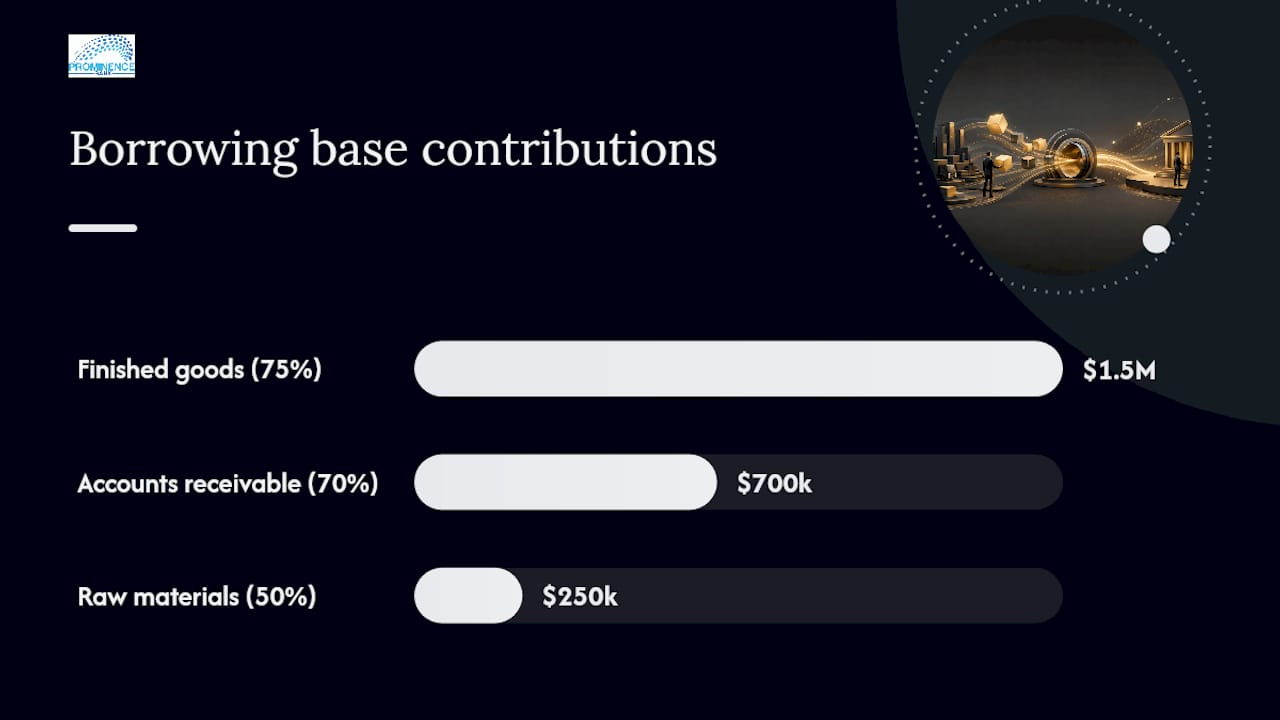
Lenders build what’s called a borrowing base: a formula that caps how much you can draw against a pool of eligible collateral, recalculated as the value and mix of that collateral shifts. It is not a static number. Submit a new inventory report or receivables aging schedule, and your available credit moves with it.
Three mechanics drive the math:
- Advance rates. Finished goods sitting in a bonded warehouse typically command a higher advance rate than raw materials or goods still in transit, because they’re easier to value and liquidate fast. Accounts receivable usually falls somewhere in between, depending on customer concentration and payment history.
- Haircuts and reserves. Lenders shave a percentage off book value to protect against price swings, obsolescence, or collection shortfalls. Seasonal businesses often see reserve requirements tighten ahead of slow periods, and a drop below a set coverage ratio triggers a margin call.
- Composition limits. A single customer or a single commodity type usually can’t dominate the collateral pool. Concentration limits force diversification within the borrowing base itself.
A simplified example: $2 million in finished goods inventory at a 75% advance rate contributes $1.5 million. $1 million in receivables at a 70% advance rate adds $700,000. $500,000 in raw materials at a 50% advance rate adds $250,000. That’s a $2.45 million borrowing base from $3.5 million in book collateral value, a gap that reflects exactly how advance rates vary by asset class.
What Are Collateral Management Agreements and Structured Trade Finance?
A Collateral Management Agreement (CMA) brings in an independent inspector to monitor stored goods on the lender’s behalf, verifying quantity and condition on a set schedule and controlling release once repayment conditions are met. This isn’t paperwork theater. Registered warehouse receipt systems and independent inspection are what separate an enforceable claim on physical goods from a lender’s hope that the inventory is still there.
- CMA structure. Involves the borrower, lender, and an independent inspector, with daily or weekly monitoring and clear release triggers tied to payment or shipment.
- Warehouse receipts and attornment. Title has to be proven under whatever legal regime governs the storage location, which is why cross-border deals often hinge on which country’s law applies to the warehouse contract.
- Structured trade finance (STF). Repurchase agreements, pre-export finance, prepayment structures, and tolling arrangements are all “self-liquidating.” Repayment comes straight from the trade flow or offtake contract, not the borrower’s general cash flow, which is the core distinction Watson Farley & Williams draws in its explainer on structured trade finance.
Pro Tip: Ask your lender for the CMA draft before you sign a term sheet, not after. Inspection frequency and release mechanics buried in a schedule can add weeks to your cash conversion cycle if nobody flags them early.
A structured solution makes sense when the underlying commodity flow is predictable and self-liquidating. A plain inventory advance works better for simpler, single-location stock that doesn’t need offtake-contract engineering. Prominence Bank’s structured finance page covers how these facilities get built around actual trade flows rather than generic balance-sheet lending.
What Risks Come With Trade Finance Collateral?
Double financing is the risk every lender fears most: the same inventory pledged to two different creditors because nobody controlled the documents. Proper perfection of security (registration, physical possession, or document control through a CMA) is what prevents it.
- Price volatility on physical collateral erodes coverage fast, which is why margin buffers and insurance requirements exist.
- Cross-border legal gaps can make a security interest unenforceable in the jurisdiction where the goods actually sit.
- Lenders typically require pledged inventory lists, insurance certificates, and scheduled inspections as non-negotiable conditions.
Independent inspectors and registered warehouse receipt systems materially reduce the risk of double-financing and missing inventory, particularly in high-value commodity deals where a single inventory count discrepancy can unwind an entire facility. Working with unfamiliar counterparties raises the stakes further, and resources like Stopfakes exist specifically to help firms vet trade partners before fraud becomes a collateral problem instead of a due diligence one.
How Do You Choose Collateral and Negotiate Terms?
Walking into a term sheet negotiation without a checklist is how finance managers end up locked into reserve requirements they didn’t notice until the first margin call.
- Map liquidity to advance rate expectations. Ask for the exact borrowing-base formula in writing, including which asset classes qualify and at what percentage.
- Confirm inspection cadence and cost allocation. Find out who pays for third-party monitoring and how often valuations get updated, since borrowing-base facilities recalculate constantly as asset composition shifts.
- Negotiate cure periods and substitution rights. Push for the ability to swap in replacement collateral if a specific asset drops in value, rather than facing an immediate reduction in availability.
- Assemble documentation early. Warehouse receipts, assigned invoices, insurance certificates, and title evidence should be ready before the term sheet stage, not scrambled together after.
Pro Tip: Request the lender’s valuation methodology in writing, not just the advance rate percentage. Two lenders quoting the same 70% rate can land on very different dollar figures depending on how they define “eligible” receivables.
Why Collateral Structure Matters More Than the Asset Itself
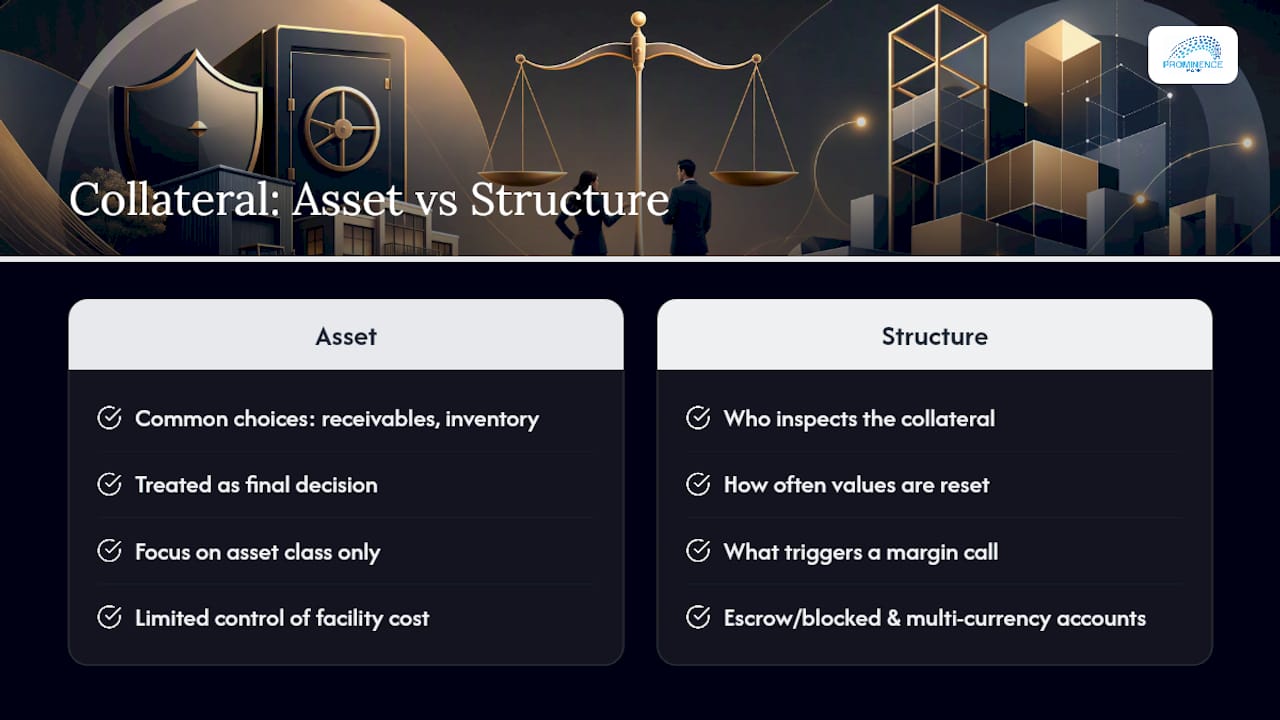
Most guidance on trade finance collateral treats the asset choice as the whole decision: pick receivables, pick inventory, done. That misses the real lever. The structure wrapped around the asset (who inspects it, how often values reset, what triggers a margin call) usually determines the actual cost of the facility more than which asset class sits underneath it.
A digital bank built around multi-currency accounts and blocked or escrow arrangements removes a lot of the friction that traditionally slows collateralized facilities down, particularly for firms managing counterparties across several jurisdictions. Prominence Bank works with letters of credit and other trade instruments as part of its trade finance services, and firms structuring their first CMA or borrowing-base facility are better served asking detailed questions upfront than discovering the gaps mid-transaction.
— Harold
Ready to Structure a Trade Finance Facility?
A digital bank that supports the operational backbone that collateralized trade finance actually runs on: multi-currency business accounts, blocked and escrow account arrangements, and corporate banking built for firms juggling cross-border counterparties rather than a single domestic buyer. If you’re negotiating a CMA or a borrowing-base facility right now, the account structure underneath it matters just as much as the advance rate you’re being quoted.

That’s the piece most finance managers underestimate: a facility with clean multi-currency settlement and blocked-account functionality closes faster and disputes less than one bolted onto a retail-style account that wasn’t built for it. Prominence Bank’s business banking solutions are built for exactly this kind of corporate structure. If you’re ready to move forward, start a business account application today and get the account infrastructure in place before your next term sheet lands.
Sources
- ITFA Trade Finance Guide 2026
- Demystifying structured trade finance — Watson Farley & Williams
- Trade Finance Guide
- Guidebook on Trade and Supply Chain Finance (APEC)
FAQ
What Are the Four Types of Collateral?
The four broadly recognized categories are real estate or physical assets, inventory, receivables, and cash or securities. In trade finance specifically, these translate into warehouse receipts, factored invoices, blocked cash deposits, and pledged securities.
What Types of Collateral Can I Use for Trade Financing?
You can secure a trade facility with inventory or warehouse receipts, receivables through factoring or forfaiting, cash and financial securities, payment instruments like letters of credit and SBLCs, or third-party guarantees. Most lenders will accept a blend of these within a single borrowing-base facility rather than requiring just one type.
What Are the Five Main Types of Collateral?
A common breakdown adds guarantees as a fifth category alongside real estate, inventory, receivables, and cash or securities. In cross-border trade specifically, ECA-backed guarantees and parent company guarantees frequently substitute for physical collateral when the trade flow itself is strong.
Is Trade Finance Risky?
Trade finance carries real risk, mainly around double financing, price volatility on physical goods, and cross-border enforceability gaps. Those risks are manageable with independent inspection, registered warehouse receipt systems, and proper document control, which is why robust monitoring is treated as a baseline requirement rather than an optional add-on for high-value commodity deals.
Does Prominence Bank Offer Trade Finance Services?
Yes, Prominence Bank provides trade finance and corporate banking solutions, including support for letters of credit and multi-currency account structures used in collateralized facilities. Details on specific services are available through the trade finance page, and current fees for related banking services are listed on the fee schedule.