
A proof of funds letter is a document from a bank or financial institution confirming you have enough liquid money, on hand and ready to use, to cover a specific purchase. Homebuyers use it mainly for three reasons: backing up a cash offer, verifying a down payment and closing costs, or making an offer look stronger in a competitive market. It confirms cash on hand right now. It is not a lender’s promise to fund your mortgage.
TL;DR:
- Most sellers and lenders require a proof of funds letter within 30 to 90 days of the offer, so it’s essential to confirm the specific freshness window upfront.
- Liquid assets like checking, savings, and money market accounts qualify, while retirement funds, stocks, home equity, and life insurance cash value generally do not.
- The proof of funds letter must include the bank name, account holder’s name, verification date, masked account number, and the actual or threshold balance, signed by an authorized bank officer.
- Request the correct document early, consolidating funds into fewer accounts beforehand to ensure a smooth, faster verification process.
- A formal bank-issued proof of funds letter offers much stronger verification than a bank statement or comfort letter and is crucial for winning competitive offers or fast closings.
Table of Contents
- Proof of Funds Basics: Which Assets Qualify and Which Don’t
- When Will Someone Ask for Proof of Funds?
- POF Letter vs. Mortgage Preapproval vs. Bank Comfort Letter
- What a Proof of Funds Letter Needs to Include
- How to Get a Proof of Funds Letter, Step by Step
- How Licensed Banks Issue Auditable Proof of Funds
- What the Conventional Advice Gets Wrong About Proof of Funds
- How Prominence Bank Issues Proof of Funds Letters
- Sources
- FAQ
Proof of Funds Basics: Which Assets Qualify and Which Don’t
Banks and sellers care about one thing when they ask for a proof of funds letter: can you actually get your hands on this money fast, without penalties or a sale event getting in the way. That’s the whole test. Cash sitting in a checking account passes. Cash locked in a retirement plan does not, even if the balance looks impressive on paper.
Liquid assets that typically qualify:
- Checking accounts
- Savings accounts
- Money market accounts
- Certificates of deposit, but only if they’re accessible without a steep early withdrawal penalty
Only these kinds of accounts typically satisfy a lender or seller’s request, because they can be converted to cash within days, not weeks.
Assets that usually don’t count, even though they’re real money:
- 401(k) and IRA balances
- Stocks and mutual funds that haven’t been sold and settled
- Life insurance cash value
- Home equity, whether from your current house or another property
The logic is straightforward. Retirement funds carry tax penalties and processing delays if you cash them out early. Stocks need to be sold and the trade needs to settle, which can take a few business days and exposes you to market swings between the offer and closing. Home equity isn’t cash until you’ve actually borrowed against it or sold the asset, and that’s a separate underwriting process entirely.
There’s a middle ground worth knowing about: brokerage or investment accounts sometimes qualify if you can show the funds have already been liquidated and are sitting as cash within the account, or if the lender accepts a documented liquidation plan. Ask your loan officer directly rather than assuming either way.
Before you request anything, gather a short list of documents: your most recent one to two months of statements for each qualifying account, your account holder’s legal name matching the offer paperwork, and a rough total of what you plan to show. Having this ready cuts your wait time down considerably once you actually contact the bank.
Pro Tip: If your down payment money is split across four or five accounts, start moving it into one or two before you request anything. A cleaner paper trail means fewer questions later, and a faster letter now.
When Will Someone Ask for Proof of Funds?
A proof of funds request rarely comes out of nowhere. It shows up at predictable moments in a home purchase, and knowing them ahead of time means you’re never scrambling.
- You’re making a cash offer. Sellers and their agents want proof you can actually close without financing before they’ll take your offer seriously, especially in a market with multiple bidders.
- A lender wants to verify your down payment and reserves. Even with financing, larger down payments or jumbo loans often trigger a request for a separate statement showing where the money is sitting.
- You’re in a competitive bidding situation. A recent, bank-signed proof of funds letter can be the difference between your offer getting a second look and getting passed over, particularly against other cash buyers.
- You’re closing fast. Bridge loans, private sales, and rushed timelines all tend to skip the usual paperwork rhythm, and a POF becomes the quickest way to demonstrate you’re ready to move.
- The transaction is private or off-market. Without an agent or title company vouching for you, the seller has less reason to trust your word alone.
One detail trips up a lot of buyers: freshness. Most sellers and lenders expect a letter dated within 30 to 90 days of the offer, sometimes tighter. There’s no universal rule, so before you request a letter, call whoever is asking for it and confirm exactly how recent they need the document to be. A letter that’s technically accurate but three months old can still get rejected on a technicality, and redoing it costs you time you don’t have mid negotiation.
POF Letter vs. Mortgage Preapproval vs. Bank Comfort Letter
These three documents get confused constantly, and mixing them up in a negotiation makes you look unprepared.
A mortgage preapproval is a lender’s conditional estimate of how much they’re willing to lend you, based on your credit, income, and debt. It says nothing about cash currently sitting in your account. It’s a promise about future borrowing capacity, not a snapshot of liquidity.
A bank comfort letter confirms you have a relationship with a bank, sometimes noting how long you’ve banked there or that your accounts are in good standing. Critically, most comfort letters don’t state actual balances, which makes them far weaker evidence than a proof of funds letter for anyone trying to verify liquidity.
A proof of funds letter states, plainly, that a specific balance or a threshold amount is sitting in an account right now.
Sellers almost always prefer the explicit version because it removes the guesswork a comfort letter leaves behind. Here’s the package that tends to work best:
- Financing a purchase: bring your mortgage preapproval alongside a POF covering your down payment and closing costs.
- Paying cash: the POF letter alone, showing funds equal to or above your offer price, usually does the job.
Skipping the POF and offering only a comfort letter or a preapproval when a seller specifically wants liquidity proof is one of the more common reasons offers stall.
What a Proof of Funds Letter Needs to Include
A proof of funds letter that gets rejected almost always fails on the same handful of details. The document needs specific, verifiable fields, not a vague statement of goodwill from your banker.
- Bank name, address, and contact information, so the recipient can verify the letter is real if needed.
- The account holder’s legal name, matching exactly what’s on the purchase offer.
- A verification date, ideally within the recipient’s stated freshness window.
- The available balance, or language stating funds are “in excess of $X” if you’d rather not disclose an exact figure.
- A masked account reference, showing only the last few digits rather than a full account number.
- An authorized signature and title, from a bank officer, not a teller printout.
- Official letterhead.
The “funds in excess of” phrasing deserves a second look. If privacy matters to you, and it should, this wording lets you prove sufficient funds without revealing your exact balance down to the dollar. Many sellers accept it without pushback, since their actual concern is whether you can cover the price, not the full picture of your net worth.
On security: always ask your bank to mask account numbers, deliver the letter through a secure portal or encrypted email rather than a plain attachment, and limit who receives copies. Once it’s out, you can’t fully control where it ends up.
How to Get a Proof of Funds Letter, Step by Step
Getting an acceptable letter isn’t complicated, but the order you do things in matters. Skip a step and you’ll be redoing paperwork under a tighter deadline than you started with.
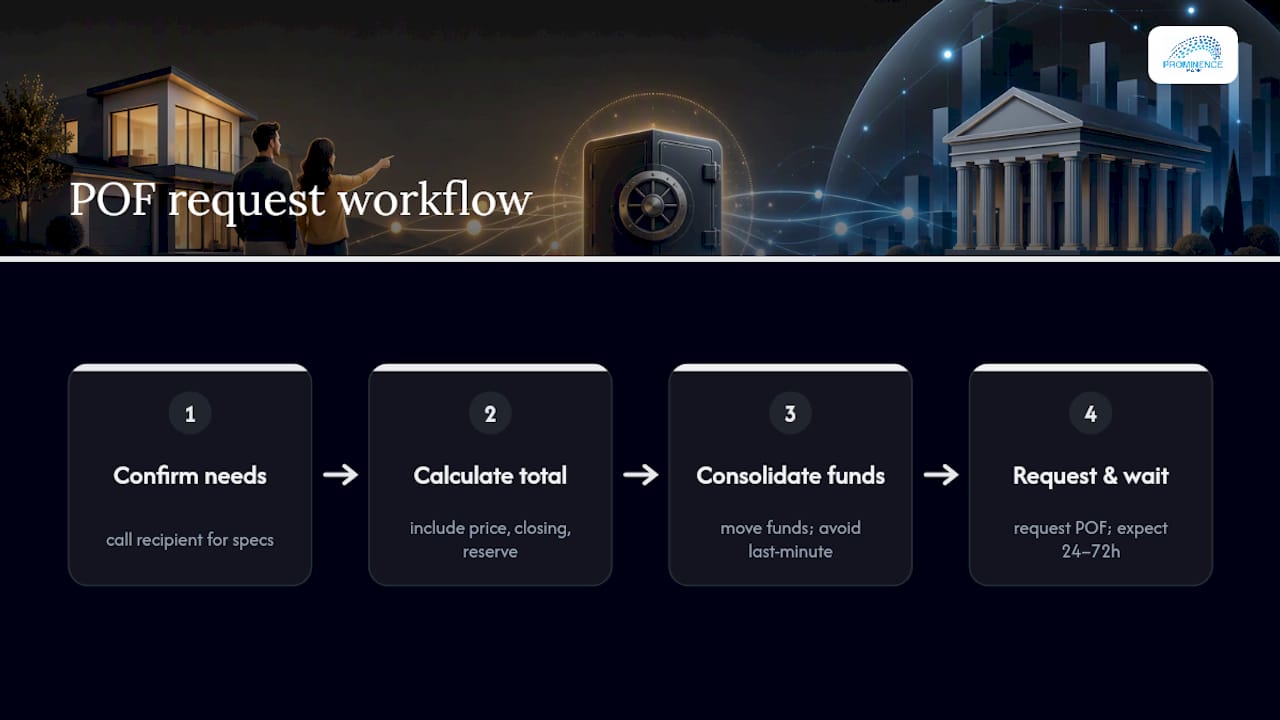
1. Confirm exactly what the recipient wants. Before you contact your bank, call the seller’s agent, the lender, or whoever requested the POF and ask what they need: a specific dollar amount, a threshold phrase, a freshness window, a particular format. This single call saves you from producing a document that gets bounced back for being wrong in some small but critical way.
2. Calculate your total. Add up exactly what you need to show, factoring in your offer price if you’re paying cash, or your down payment plus closing costs and a reserve cushion if you’re financing. Round up slightly rather than cutting it close.
3. Consolidate your funds if they’re spread across accounts. Banks and mortgage professionals commonly recommend pulling money into fewer accounts before requesting verification, since a single clean balance is far easier to verify than five scattered deposits across different institutions.
4. Submit a secure request to your bank. Contact your branch, relationship manager, or online banking support and ask specifically for a proof of funds letter, not a bank statement. A simple request works: “I need a bank-issued proof of funds letter, dated within the last [X] days, confirming funds in excess of $[amount], for a real estate purchase.” Some banks generate this instantly through online banking; others route it through a bank officer who has to review and sign it manually.
5. Expect a wait of 24 to 72 hours for a signed letter. Processing time varies by institution: some produce an automated, printable verification in minutes, while others require an officer to personally generate and sign the document. Ask upfront which category your bank falls into so you’re not caught off guard the week before an offer deadline.
6. Be careful with transfers between accounts right before requesting a letter. Large, unexplained deposits close to your verification date can raise red flags during mortgage underwriting later. Lenders frequently ask about the source of recent large deposits, so keep records of any transfer, wire confirmation, or account statement showing where the money came from, especially if you moved funds between institutions to consolidate.
7. If your bank asks for source-of-funds documentation, have it ready. This might mean a prior sale of a home, an inheritance letter, a business distribution record, or several months of pay stubs. Prominencebank’s guide on auditable source of funds proof walks through what documentation typically satisfies this kind of request.
8. Deliver the letter securely and keep your own copies. Send it through whatever secure channel the recipient’s agent or lender prefers, and hold onto a dated copy along with any transfer records for your own file. If a second request comes later in the process, you’ll already have what you need.
Pro Tip: Ask for the issuing bank officer’s direct name and contact information on the letter itself. A seller’s agent or underwriter who has a real person to call for verification will move faster than one staring at a signature they can’t confirm.
How Licensed Banks Issue Auditable Proof of Funds
A formally issued bank letter carries weight that a self-prepared document never will, because it comes with a paper trail someone can actually check. At Prominence Bank, a Proof of Funds (POF) letter is a published service with a fee of €25,000, issued after review of the client’s account and documentation. That auditability is what shortens closing timelines. Nobody has to chase down a second confirmation when the first document already answers the question.
The practical habit worth carrying into any request: always ask for the issuing officer’s name and direct contact information, and hold onto your own transfer records the moment you consolidate funds. Prominencebank’s documents verification guidance covers what banks typically expect to see when they’re asked to confirm this kind of documentation quickly.
What the Conventional Advice Gets Wrong About Proof of Funds
Most guides treat a proof of funds letter as a box to check the week before closing. That’s backwards. The buyers who move fastest through competitive offers are the ones who request their letter before they need it, not after an accepted offer forces a scramble.
The bigger gap I see is buyers treating a bank statement and a bank-issued letter as interchangeable. They’re not. A statement shows a snapshot; a letter is a bank vouching for that snapshot with a signature attached. Some sellers will accept a statement. Plenty won’t, and you don’t want to find that out during a five-day offer window.
Here’s what actually deserves priority: confirm the recipient’s exact requirements first, consolidate your funds second, and only then request the letter. Skipping straight to step three is how buyers end up with a technically correct document that still gets rejected over formatting or timing. Get the sequence right, and the letter itself becomes the easy part.
— Harold
How Prominence Bank Issues Proof of Funds Letters
Prominence Bank issues banking documents for eligible account holders after review. Published fees include €25,000 for a Proof of Funds (POF) letter, €25,000 for a Reference Letter / Comfort Letter and 1.5% for a Bank Endorsement. Anyone who receives a document presented as issued by Prominence Bank can check it through Document Verification or by writing to verify@prominencebank.com.
All accounts, transactions and services are subject to eligibility, KYC/AML, sanctions screening, due diligence and final bank approval. See the fees page for the current published schedule.
Sources
A few government and industry sources are worth bookmarking if you want to double-check anything in this guide against an official record.
- Proof of funds: What is a POF letter in real estate? – Rocket Mortgage
- Proof of Funds Letter: 9 Things Every Home Buyer Needs … – AmeriSave
- Proof of funds – Investopedia
- Proof of Funds Letter: 7 Steps to Get One – Bankrate
This article is general information, not a substitute for advice from a qualified financial advisor. Consult a qualified financial professional about your own circumstances before acting on anything here.
FAQ
What Does a Proof of Funds Letter Look Like?
A typical example includes the bank’s letterhead, the account holder’s legal name, a masked account number, the verification date, and a statement confirming funds either at a specific balance or “in excess of” a stated amount, signed by an authorized bank officer. Investopedia’s breakdown covers each required field in detail.
Is It Normal for a Realtor to Ask for Proof of Funds?
Yes, it’s standard practice, especially for cash offers or in competitive markets where multiple buyers are bidding on the same property. Agents request it to confirm a buyer can actually close before their seller commits to accepting the offer.
How Long Is a Proof of Funds Letter Good For?
Most sellers and lenders expect a letter dated within 30 to 90 days of the offer, though there’s no single universal rule. Always confirm the specific freshness window with whoever requested the document before you submit it, since a letter that’s too old can get rejected even if the balance is still accurate.
What Is an Alternative to a Proof of Funds Letter?
A recent bank statement sometimes works as a substitute, though acceptability varies significantly by seller and lender. A bank comfort letter is not a reliable alternative for liquidity verification, since it typically confirms a banking relationship without stating actual account balances.