Trade finance instruments are the contracts and bank undertakings that guarantee payment, reduce counterparty risk, or unlock cash flow in cross-border deals. They fall into two practical buckets: documentary instruments that assure payment (letters of credit, bank guarantees, documentary collections) and open-account liquidity tools that free up working capital (factoring, forfaiting, supply chain finance).
Trade finance now underpins roughly 80 to 90% of global trade transactions, which means most cross-border deals rely on one of these tools working correctly. The OCC’s Comptroller’s Handbook frames the core mechanic simply: a bank substitutes its own creditworthiness for the client’s, so two strangers on opposite sides of the planet can trust a transaction neither fully controls. A few quick examples orient the rest of this guide:
- A letter of credit backs a first-time export sale to a buyer with no payment history.
- A standby letter of credit secures a construction bid or performance obligation.
- Factoring converts unpaid invoices into immediate cash for a growing exporter.
Key Takeaways
Choosing the right trade finance instrument comes down to matching payment risk and liquidity needs to the correct documentary or open-account tool.
| Point | Details |
|---|---|
| Two core categories | Documentary instruments (LCs, guarantees, collections) assure payment; open-account tools (factoring, forfaiting, SCF) provide liquidity. |
| Banks substitute credit | The issuing bank’s creditworthiness replaces the buyer’s, per OCC guidance. |
| Documents drive payment | LCs pay only against exact document compliance; a single discrepancy can delay funds for weeks. |
| Insurance unlocks open account | Export credit insurance and EXIM or SBA guarantees let exporters offer open-account terms with reduced risk. |
| Digital execution matters | Prominence Bank issues LCs and SBLCs and provides receivables finance with online tracking for international deals. |
Table of Contents
- What Are the Main Types of Trade Finance Instruments?
- How Do Letters of Credit Work?
- When Should You Use a Bank Guarantee or Standby Letter of Credit?
- Documentary Collections: When Do D/P and D/A Make Sense?
- How Do Factoring, Forfaiting, and Supply Chain Finance Provide Liquidity?
- How Do Export Credit Insurance and Government Programs Reduce Risk?
- What Other Trade Finance Instruments Should You Know?
- What Do Trade Finance Instruments Cost and How Long Do They Take?
- What Should You Expect From a Digital Bank on Trade Finance?
- What Separates a Well-Structured Trade Finance Deal From a Messy One?
- How Prominence Bank Supports Your Trade Finance Needs
- Sources
- FAQ
What Are the Main Types of Trade Finance Instruments?
Every instrument answers one of two business questions: “Will I get paid?” or “Can I get cash now?” Payment assurance questions point toward documentary tools; cash flow questions point toward liquidity tools. That’s the entire decision tree at a high level, though the details matter enormously once you’re structuring a real deal.
A simple mapping helps before you go deeper:
- Need payment certainty from an unfamiliar buyer → letter of credit or bank guarantee.
- Need a bank to shepherd documents without guaranteeing payment → documentary collection.
- Need cash before the buyer pays → factoring, forfaiting, or supply chain finance.
The ICC Academy’s product taxonomy groups instruments this same way, and it’s worth internalizing because vendors and banks use the split constantly. In every documentary case, the issuing bank takes on contingent exposure. It only pays out if specific conditions are met, but it’s on the hook the moment it issues the instrument. Picture a simple flowchart: an exporter and importer sit at either end, a bank sits in the middle as risk substitute, and the trigger for each instrument (shipment, acceptance, demand, invoice sale) determines which tool activates.
How Do Letters of Credit Work?
Use a letter of credit when payment risk is high, the buyer is unfamiliar, or the deal size justifies formal documentary compliance. It’s the workhorse instrument of international trade, and it comes in several flavors:
- Commercial LC: the primary payment mechanism, triggered by presenting compliant shipping documents.
- Standby LC: a backup promise, paid only if the applicant fails to perform (covered in more depth below).
- Confirmed LC: a second bank in the beneficiary’s country adds its own payment guarantee, useful when the issuing bank’s country carries political risk.
- Transferable LC: lets a middleman trader pass rights to a supplier.
- Revolving LC: covers repeat shipments under one facility instead of reissuing paperwork each time.
- Back to back LC: one LC funds the issuance of a second, often used by trading intermediaries.
- Red and green clause LC: allows an advance to the seller before shipment, against a promise to ship.
The process typically flows like this: the importer (applicant) asks its bank to issue the LC, the issuing bank sends it to an advising or confirming bank near the exporter, the exporter (beneficiary) ships goods and presents documents, and the bank pays once those documents match the LC terms exactly.
For the importer, an LC delays payment until goods ship and adds issuance fees, but it protects against paying for goods that never arrive. For the exporter, it converts an unknown buyer’s credit risk into a bank’s credit risk, though it means strict paperwork with zero tolerance for typos or mismatched dates.
Consider a US machinery exporter shipping to a new buyer in Vietnam. The buyer’s bank issues an LC; the exporter’s bank confirms it; the exporter ships, then presents a bill of lading, commercial invoice, and packing list. Payment releases once the documents check out clean.

Pro Tip: Discrepant documents are the single most common reason LC payments stall. Have your freight forwarder and finance team cross-check every date, spelling, and quantity against the LC terms before presentation, not after.
When Should You Use a Bank Guarantee or Standby Letter of Credit?
A bank guarantee or standby letter of credit is a contingent promise to pay if the other party fails to perform. Unlike a commercial LC, which is the expected payment mechanism, a standby only activates when something goes wrong.
- Demand guarantees pay out simply on the beneficiary’s written claim, with minimal proof required.
- Conditional guarantees require documentary evidence of default before the bank pays.
- Commercial LCs pay against successful performance (shipping documents); standbys and guarantees pay against failure.
You’ll see these most often in project contracting (performance bonds), international bidding (bid bonds), advance payment protection, and customs or warranty obligations. Claims processing depends heavily on how the guarantee is worded, so expiry dates, required claim documentation, and issuance fees all deserve scrutiny before you sign a contract that relies on one.
Documentary Collections: When Do D/P and D/A Make Sense?
A documentary collection is a lower-cost alternative where banks exchange shipping documents for payment or a promise to pay, but never guarantee that payment happens.
- D/P (documents against payment): the buyer must pay before receiving the documents needed to claim the goods.
- D/A (documents against acceptance): the buyer signs a promise to pay later and gets the documents immediately, meaning the seller ships on trust in the buyer’s signature.
This fits an exporter selling to a buyer with some established payment history, where a full LC’s cost and paperwork feel like overkill but open account terms feel too risky.
How Do Factoring, Forfaiting, and Supply Chain Finance Provide Liquidity?
Once a sale happens on open account terms, the exporter is sitting on unpaid invoices, and that’s where liquidity instruments come in. Factoring sells short-term receivables to a finance company for immediate cash, usually at a discount reflecting buyer credit risk. Forfaiting does something similar for medium and longer-term export receivables, typically without recourse to the exporter if the buyer defaults. Supply chain finance, sometimes structured as reverse factoring, lets a large buyer’s strong credit rating extend financing terms down to its smaller suppliers.
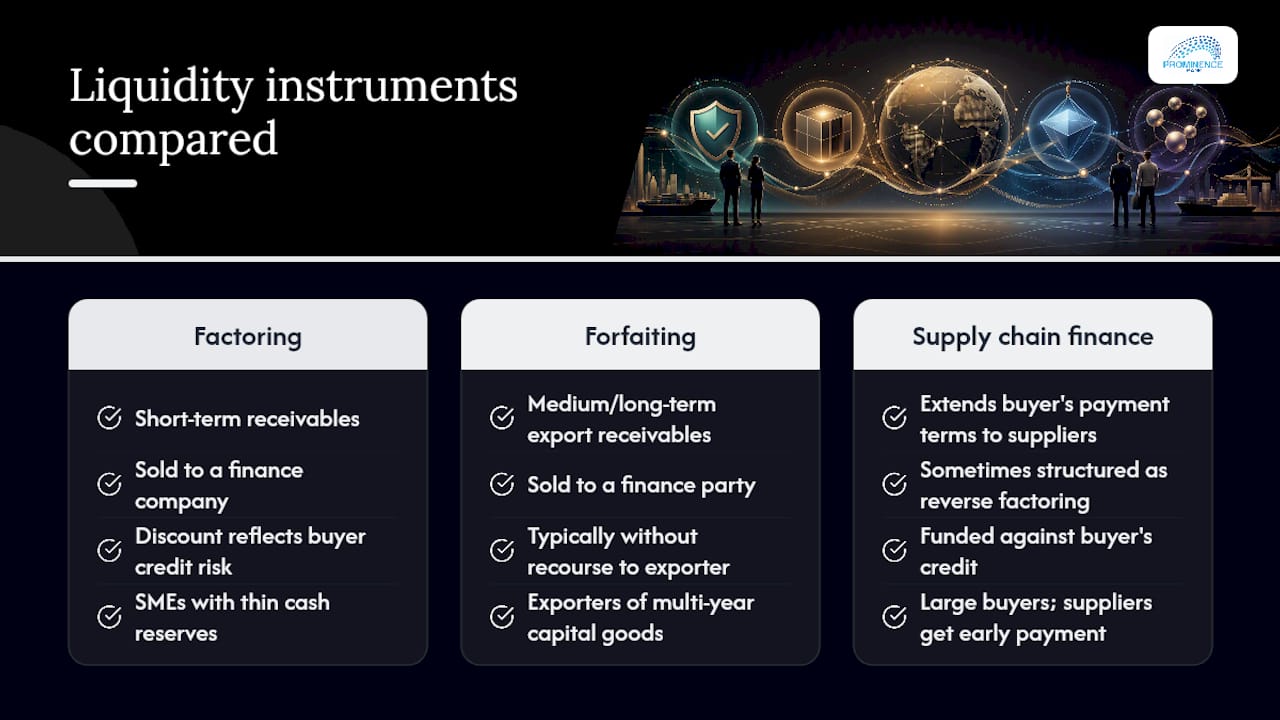
SMEs with thin cash reserves lean on factoring to keep production running while invoices are outstanding. Exporters selling capital goods on multi-year payment terms often turn to forfaiting instead, trading a discount today for certainty and zero collection risk later. Large buyers use supply chain finance programs to stretch their own payment terms while still letting suppliers get paid early, funded against the buyer’s credit rather than the supplier’s. The trade-off across all three comes down to recourse, cost, and whose balance sheet actually carries the risk. Practitioners increasingly combine funded and unfunded instruments in the same deal, pairing an LC for payment security with pre-export finance to cover production costs.
How Do Export Credit Insurance and Government Programs Reduce Risk?
Export credit insurance covers commercial and political nonpayment risk, and it often makes open-account terms viable where a buyer would otherwise demand an LC. It’s frequently cheaper than repeatedly paying for confirmed LCs on every shipment, according to Trade.
US exporters have two go-to government programs worth knowing by name:
- EXIM’s Working Capital Loan Guarantee backs a lender’s loan to an exporter, making banks more willing to extend credit against export orders.
- SBA’s Export Working Capital Program offers a similar guarantee sized for small and medium exporters.
Both programs work by improving a bank’s appetite to lend, often lowering the collateral a bank would otherwise demand. Open account sales without some form of insurance or guarantee leave exporters carrying the full weight of buyer nonpayment risk, which is exactly the gap these programs are designed to close.
What Other Trade Finance Instruments Should You Know?
A handful of other terms come up often enough that they’re worth defining briefly. A banker’s acceptance is a bank-guaranteed, time-dated payment order that trades on secondary markets. A trade acceptance is the same idea without bank backing, just the buyer’s own promise. Trade loans are straightforward short-term financing tied to a specific shipment or purchase order. Promissory notes and bills of exchange are the underlying payment instructions many of these tools rely on to formalize a payment date and amount.
What Do Trade Finance Instruments Cost and How Long Do They Take?
Banks manage trade finance risk through documentary compliance checks, collateral requirements, and standard KYC and AML screening, all consistent with OCC guidance on credit substitution. Expect these fee types:
- Issuance fees (importer pays, LCs and guarantees)
- Confirmation fees (exporter pays, when a second bank adds its guarantee)
- Negotiation or discounting fees (exporter pays, factoring and forfaiting)
- Advising and amendment fees (either party, depending on contract terms)
Timelines vary by instrument: LCs typically run one to two weeks from application to issuance, then payment follows document presentation, usually within five to ten business days of shipment. Guarantees and collections move on similar week-long cycles. Factoring, once a facility exists, can put cash in an exporter’s account within 24 to 48 hours of invoicing.
What Should You Expect From a Digital Bank on Trade Finance?
A modern digital bank should offer online document submission, multi-currency settlement, swift-gpi payment tracking, and real-time visibility into where an instrument sits in its lifecycle. Before requesting an LC or SBLC, prepare the underlying contract, commercial invoice, agreed Incoterms, shipment timeline, and the beneficiary bank’s exact details.
What Separates a Well-Structured Trade Finance Deal From a Messy One?
The deals that go smoothly are the ones where someone matched the instrument to the actual counterparty risk instead of defaulting to whatever was used last time. Documentary clarity beats cleverness every time, and most costly delays trace back to a single mismatched date or misspelled name on a bill of lading rather than any dispute over the underlying trade itself.
How Prominence Bank Supports Your Trade Finance Needs
Choosing between an LC, a guarantee, or a receivables facility is only half the job. Getting a bank that can actually issue and track the instrument digitally, in the right currency, without weeks of back and forth, is the other half. Prominence Bank issues letters of credit and standby letters of credit, arranges receivables finance, and provides trade advisory support for international businesses structuring cross-border deals.
To get a request moving, send your relationship manager the underlying contract, the buyer’s credit profile, the commercial invoice, agreed Incoterms, and your shipment ETA. If your business also needs to settle in multiple currencies alongside the instrument itself, Prominence Bank’s multi-currency business account can run alongside your trade finance facility. Start by reviewing corporate banking solutions for global businesses and requesting a consultation on the instrument that fits your deal.
Sources
- UNCTAD news: Over 90% of global trade now depends on finance, reshaping opportunities and deepening vulnerabilities
- Key trade finance products: Definitions and use cases — ICC Academy
- Trade
This article is general information, not a substitute for advice from a qualified financial advisor. Consult a qualified financial professional about your own circumstances before acting on anything here.
FAQ
What Are Trade Finance Instruments?
They are the contracts and bank undertakings, such as letters of credit, guarantees, documentary collections, and factoring, that assure payment or provide liquidity in cross-border trade.
What Are the Four Pillars of Trade Finance?
Definitions vary across institutions, but a common framing groups instruments around payment assurance, risk mitigation, financing or liquidity, and information or documentation services.
What Are the Five Financial Instruments Used in Trade?
Practitioners most often cite letters of credit, bank guarantees or standby LCs, documentary collections, factoring, and forfaiting as the core set, though specific lists vary by source.
What Are the Instruments of Trade?
The main instruments are letters of credit, bank guarantees and standby LCs, documentary collections (D/P and D/A), and open-account liquidity tools like factoring, forfaiting, and supply chain finance.
Can a Digital Bank Issue Letters of Credit?
Yes. Prominence Bank issues letters of credit and standby letters of credit alongside receivables finance for international business clients.