
A corporate treasury investment policy is a short, written rulebook for what your company may do with cash it does not need right now. It names the objectives, the instruments you may buy, the limits on each, who decides, and how you check. Write it before you need it, get the board to approve it, and review it on a schedule. The rest of this guide walks through each part, with an outline you can adapt.
TL;DR
- Rank your objectives in order: safety of principal first, liquidity second, yield third. Every other rule follows from that ranking.
- List permitted investments, counterparty limits and maturity limits in plain numbers. Anything not listed is not allowed.
- Assign roles by name: who proposes, who approves, who executes, who reconciles. Keep execution and reconciliation apart.
- Treat the policy as a living document. Review it at least yearly and whenever your business, banks or markets change.
- Test the policy against reality: bank access, user permissions and reporting should make the rules easy to follow, not easy to break.
Table of Contents
- What a treasury investment policy does
- Start with ranked objectives
- Scope: which cash the policy covers
- Permitted investments and how to limit them
- Counterparty and vendor risk
- Roles, authority and controls
- A one-page outline to start from
- Keeping the policy alive
- Our perspective
- Where Prominence Bank fits
- FAQ
- Sources
What a treasury investment policy does
The policy turns a vague intention (“keep our cash safe and earn something on it”) into rules a new analyst, an auditor and a board member would all read the same way.
The board has a duty here. A comment letter to the SEC from the Corporate Capital Markets Committee (as summarized in the research we reviewed) notes that a company’s board has a fiduciary obligation to see that available cash goes into vehicles with appropriate liquidity and safety. A written policy is the evidence that you took that duty seriously.
The AFP’s list of treasury policies every company should have makes a related point: written policies set a baseline for acceptable practice and keep treasury activity consistent across employees and contractors. Investment is only one of those policies, next to banking, borrowing, FX and counterparty risk, so decide early whether yours stands alone or sits inside one combined treasury policy.
Stand-alone policy or one combined document
A startup or small company usually does better with one combined treasury and investment policy of three to six pages. Burkland’s sample treasury and investment policy follows this pattern, opening with objectives for investing excess cash, in order of importance. A multinational with several banks, entities and currencies typically separates the investment policy from FX, debt and banking policies, because each has different owners and approval paths.
The test is simple: if the person approving the document would have to read pages that do not concern them, split it.
Start with ranked objectives
The most useful sentence in any investment policy is the one that says what wins when goals conflict. Public-sector policies state this plainly. The City of Grand Prairie’s 2026 investment policy lists three objectives in order of priority: preservation and safety of principal, liquidity, and yield. The Burkland sample begins with preservation of principal too.
A company is not a city, but the logic carries over. Cash on the balance sheet exists to pay payroll, suppliers and debt. It is not the place to take equity-like risk for an extra half point.
A working objectives clause can be three lines:
- Preserve principal. No investment may be expected to lose nominal value if held to maturity.
- Maintain liquidity. Enough funds to cover the next [X] weeks of forecast outflows must be available within one business day.
- Earn a reasonable return consistent with the first two, measured against a stated benchmark.
Fill in [X] from your own cash forecast, not from a template. A seasonal retailer and a software company with annual contracts will not land on the same number.
Scope: which cash the policy covers
Split your cash into tiers before you write limits. A common structure:
| Tier | Purpose | Typical horizon | Policy emphasis |
|---|---|---|---|
| Operating cash | Daily payments, payroll | Same day to a few days | Bank access, no investment risk |
| Liquidity reserve | Forecast needs plus buffer | Days to 3 months | Daily or weekly access, high credit quality |
| Strategic cash | Surplus beyond the forecast horizon | 3 to 12+ months | Slightly longer maturities, still strict credit limits |
The tiers matter because each can carry different instruments and maturities. They also make the policy readable: a board member can see at a glance that most cash is deliberately boring.
State what is out of scope. Pension assets, restricted cash held under loan covenants, employee funds and strategic equity stakes usually follow separate rules. Say so in one sentence so nobody assumes they are covered.
Permitted investments and how to limit them
This is the section people argue about, and the one auditors read first. Use a closed list: if an instrument is not named, it is prohibited.
Common categories for corporate cash include:
- Insured or collateralized bank deposits and time deposits
- U.S. Treasury bills and notes, and government agency securities
- Government and prime money market funds
- High-grade commercial paper and certificates of deposit
- Repurchase agreements backed by government collateral
Money market funds deserve a specific rule. The CCMC letter reports that corporate treasurers hold upwards of 50% of their cash in money market funds, valuing the stability, liquidity and professional management they provide compared with running individual securities in-house. If you permit funds, say which types (government only, or prime too), require a minimum credit rating from a recognized agency, and cap exposure to any one fund family.
Limits that do the real work
Avoid the personal-finance habit of fixed percentage splits. The 70-20-10 rule people search for is a household budgeting idea (spending, saving, investing), and corporate policies do not use it. As the Grand Prairie policy illustrates, institutional documents rely on diversification across issuers and maturities and on maturity guardrails instead of a static allocation formula.
A practical limits table looks like this:
| Control | Example form (set your own numbers) |
|---|---|
| Minimum credit quality | Short-term rating of the top two categories at purchase |
| Issuer concentration | No more than a stated share of the portfolio with any one issuer, except U.S. government obligations |
| Counterparty concentration | Cap per bank, per fund family, per dealer |
| Maximum maturity | Single instrument maximum, and a weighted average maturity ceiling |
| Liquidity floor | Minimum share available within one business day |
| Currency | Investments only in currencies where you have liabilities, unless FX policy says otherwise |
Write each limit as a number, a unit and a measurement date. “Diversified” is an opinion; “no more than 20% with any one issuer, measured at purchase and monthly” is a rule.
What to do when a limit is breached
Breaches happen: a downgrade, a maturity that rolls into a different tier, a deposit that swells at quarter end. The policy should say who is told, how fast, and whether the position must be cured within a set number of days or may be held with approval. Without that clause, staff either hide the breach or sell at a bad moment.
Counterparty and vendor risk
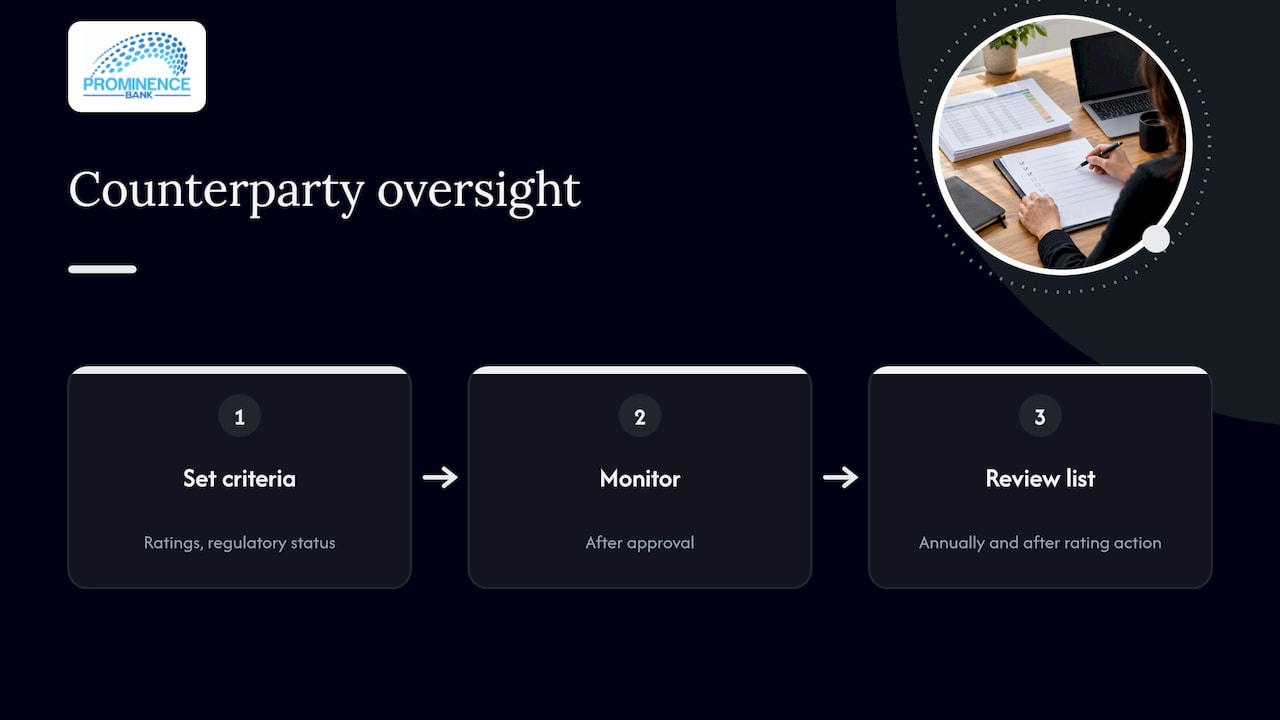
Your risk is not only the instrument but whoever holds it. Set approval criteria for banks, funds, custodians and dealers: credit rating floors, regulatory status, and how the provider is monitored after approval. Review the approved list at least annually and after any rating action.
The same discipline applies to service providers that touch treasury workflows, such as payment platforms and data feeds. A structured approach to vendor risk management helps you tier suppliers by how much damage a failure could do and decide how closely each one needs watching.
If your surplus cash is large and you are tempted to look at less liquid assets, keep that conversation outside the cash policy. Property and similar holdings sit in a different risk bucket, and an investment strategy workbook can help frame that separate decision. The cash policy should still say plainly that illiquid assets are not permitted for operating or reserve cash.
Roles, authority and controls
Treasury professionals describe controls as preventative, detective and corrective, and expect the policy to define all three. The Treasurers’ Hub guide to designing the investment policy stresses that the policy must stay aligned with the organization’s risk appetite as the business changes.
A roles section can be a short table:
| Role | Responsibility |
|---|---|
| Board or audit committee | Approves the policy and material changes; receives annual report |
| CFO | Owns the policy; approves exceptions |
| Treasurer | Proposes strategy; executes within limits |
| Treasury analyst | Prepares forecasts and compliance reports |
| Accounting or controller | Reconciles balances independently |
Two rules matter more than the rest. First, nobody who can move money also reconciles it. Second, no single person can both create and release a payment above a stated threshold.
Bank access and user management
Policies fail in the banking portal more often than in the document. Many readers who search this topic also ask how to handle user management in corporate online banking, and the answer belongs in the policy as a short access clause:
- Every user has a named, individual login. No shared credentials.
- Roles map to the table above: initiators, approvers, view-only users.
- Dual approval applies to payments and investment trades above a set amount.
- Access is reviewed at least quarterly and removed the day someone leaves or changes role.
- Any change to beneficiaries or standing instructions requires a second approver and a call-back.
Our own guide on securing corporate banking step by step goes deeper on the setup side.
Reconciliation and reporting
Cash held outside your main operating accounts is easy to lose track of. The U.S. Treasury’s guidance for federal entities, Chapter 3400 of the Treasury Financial Manual, describes accounting and reporting rules for cash and investments held outside the Treasury General Account. It is written for government, not companies, but the habit transfers: reconcile what sits at funds, custodians and secondary banks to your books at least monthly, and escalate discrepancies fast.
Your reporting clause should name the report (holdings, maturities, credit ratings, limit compliance, yield versus benchmark), its owner, its frequency (monthly to management, quarterly or annually to the board) and who receives it.
A one-page outline to start from
Use this skeleton and fill each heading with your own numbers:
- Purpose and scope. Which entities and which cash tiers.
- Objectives. Safety, liquidity, yield, in that order.
- Roles and authority. Table of who does what, with approval thresholds.
- Permitted investments. Closed list with rating minimums.
- Limits. Issuer, counterparty, maturity, liquidity floor, currency.
- Approved counterparties. Criteria and review cycle.
- Controls. Segregation of duties, dual approval, bank access reviews.
- Reporting and reconciliation. Content, frequency, recipients.
- Breaches and exceptions. Escalation path and cure period.
- Review. Annual review date, owner, change log.
Start conservative. Loosening a limit after a year of clean operation is easy. Explaining a loss to the board because the limits were loose is not.
Keeping the policy alive
A policy that nobody reopens is a liability. The Treasurers’ Hub guidance cited above says these documents should be regularly reviewed and updated as the business model evolves, complexity grows or markets shift. Put three triggers in the document:
- A fixed annual review, with the date and owner named.
- A forced review after an acquisition, a new entity or a new banking relationship.
- A review after any limit breach or counterparty downgrade.
Keep a change log at the end of the document with the date, the change and the approver. Auditors like it, and so will your successor.
If you operate across borders, the policy also has to cope with several currencies, entities and regulators. Our guides to international treasury management, treasury cash pooling and centralizing or decentralizing treasury cover how structure shapes the limits you set. For a broader primer, see what corporate treasury covers.
Our perspective
We see treasury policies from the banking side, and the pattern is consistent: the document is rarely the problem. The mismatch is between the policy and the accounts underneath it.
A policy that demands dual approval, segregated duties and monthly reconciliation only works if the bank lets you configure roles that way, gives you multi-currency visibility in one place and produces statements your accounting team can reconcile without chasing. So when a finance team drafts its policy, we suggest writing the operational requirements in the same sitting: how many users, which approval tiers, which currencies, which reports. Then test any prospective banking relationship against that list.
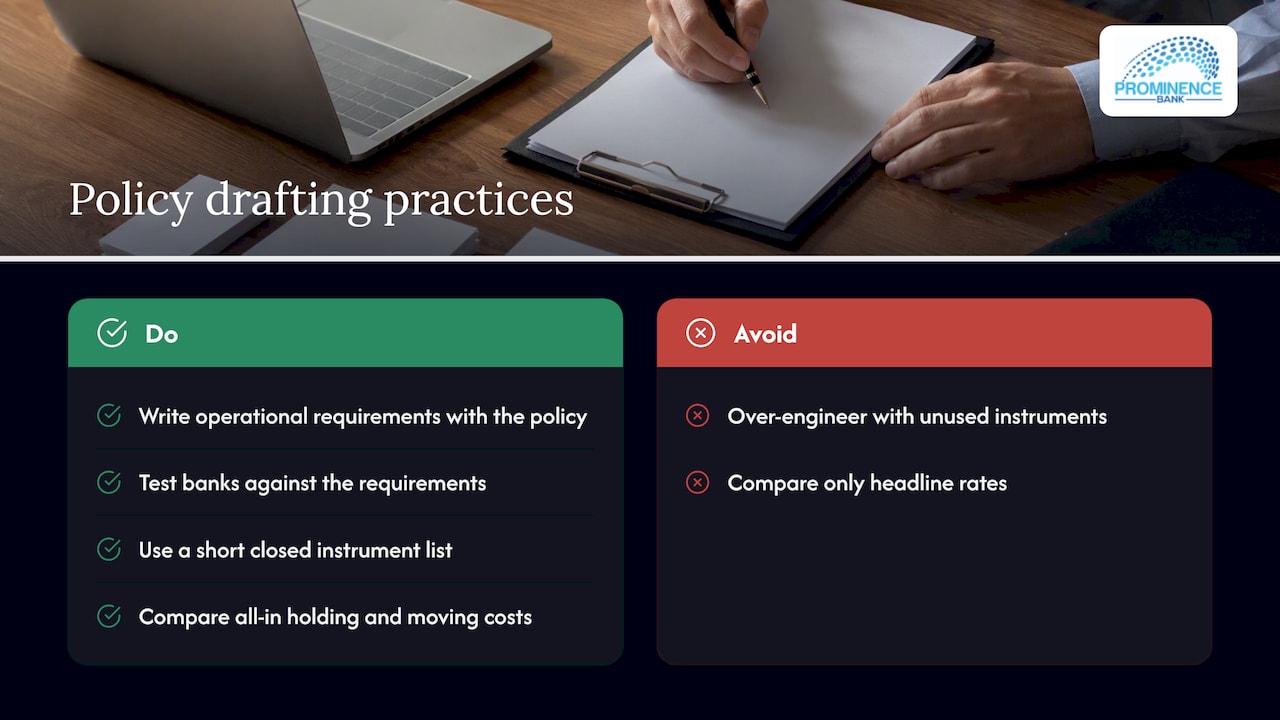
The second pattern is over-engineering. Companies with modest surplus cash write forty-page documents with instruments they will never buy. A shorter closed list that people follow beats a long one nobody reads.
The third is documentation of costs. Account opening, transfer, conversion and due diligence fees all affect net yield on surplus cash, so the policy should require treasury to compare the all-in cost of holding and moving funds, not only the headline rate.
— Harold
Where Prominence Bank fits
If your policy calls for multi-currency accounts, structured approval roles and institutional-grade custody, we can help. Prominence Bank is a digital bank serving international businesses and institutions, with business banking and corporate banking for more complex structures. Our published fees are on the fees page: for example, bank account opening is 25000 $/€ one-off, and internal transfers between Prominence Bank accounts are 0.2%. Currency conversion is 4%, which is worth modeling in your yield comparison. Businesses ready to apply can start with the business account application.
FAQ
What is the purpose of an investment policy statement?
It documents your objectives, risk tolerance, permitted instruments and decision rights so that cash is invested consistently whoever is in the seat. It also gives the board and auditors a standard to measure actual behavior against.
What are the responsibilities of corporate treasury?
Treasury manages cash, invests idle funds, assesses financial risk and oversees internal controls, as reflected in the Grand Prairie policy’s framework of authorized instruments. In companies it also covers banking relationships, funding and FX exposure. The investment policy governs the first two of those.
Does the 70-20-10 rule apply to corporate cash?
No. It is a personal budgeting guideline. Corporate policies set limits by issuer, counterparty, rating and maturity, which fit the company’s actual liquidity needs far better than a fixed split.
How often should we update the policy?
Review it at least once a year, and again after an acquisition, a change of banks, a downgrade of an approved counterparty or a limit breach. Record each change and its approver in a log.
Sources
- Fundamentals of investment management: Design of the investment policy, Treasurers’ Hub
- Comment letter to the SEC (File S7-03-13)
- City of Grand Prairie Investment Policies, 2026
- Burkland sample treasury and investment policy
- 10 Treasury Policies Every Company Should Have, AFP
- Treasury Financial Manual, Chapter 3400