
A bank signatory matrix is a one-page record of who may sign for each of your company’s bank accounts, what each person may do (view, initiate, approve, release, close), up to what dollar limit, and in what combination. It is an internal control document. The bank does not issue it. The bank holds its own version, the account mandate and signature cards, and the two must say the same thing.
This guide shows what goes into the matrix, how it differs from a delegated-authority matrix, how a signatory change works in practice, and where cross-border accounts add duties.
TL;DR
- A signatory matrix maps people to bank-account powers: initiate, approve, release, sign checks, change users, close accounts. It also records limits and signing combinations such as “any two” or “all to sign”.
- It is narrower than a delegated-authority matrix, which covers who may approve commitments such as contracts and spend across the whole company.
- Your board or manager resolution comes first. The bank mandate should then match it exactly, and the matrix should mirror both.
- A change of signatory takes effect only after company approval and the bank’s own process. Until then, the old authority stands.
- U.S. persons with signature authority over foreign accounts may have FBAR duties, even if they own nothing in the account.
Table of Contents
- What a bank signatory matrix actually is
- Types of signatories and what each can do
- What to put in the matrix
- How to authorize a corporate account signatory change
- Identity checks behind a signatory change
- Keeping the matrix current and secure
- Signatories on foreign accounts: the FBAR angle
- Perspective: the matrix is a design decision, not paperwork
- Setting up accounts that fit your matrix
- A one-page checklist
- FAQ
- Sources
What a bank signatory matrix actually is
Think of three layers, each answering a different question.
- Corporate authority: who can bind the entity. This comes from the articles, bylaws or operating agreement, and from board or member resolutions.
- Bank mandate: which individuals may operate a particular account, and under which signature rules. A mandate is the instruction your company gives the bank. Authorized-signatory guidance describes combinations such as “any two” or “all to sign” as part of it.
- The matrix: your own working summary of layers one and two, by account, person, action and limit.
The Federal Reserve Banks use the same layered logic for their own account holders. They require board resolutions and an official authorization list before a customer changes services or gets access to new ones. The documents establish who may transact business and issue instructions. Commercial banks run lighter versions of the same idea.
Signatory matrix vs. delegated-authority matrix
People mix these up, and the search results for this keyword mix them up too. Many top pages are really about contract signing authority.
| Bank signatory matrix | Delegated-authority matrix | |
|---|---|---|
| Question answered | Who can move money or instruct the bank? | Who can approve commitments and decisions? |
| Typical owner | Treasury or finance | Legal, board secretary, or the CFO’s office |
| Scope | Bank accounts, payment channels, instruments | Contracts, purchases, hiring, loans, litigation |
| Limits expressed | Per payment, per day, per channel | Per transaction or contract value, by category |
| Counterparty sees it | Yes, in the form of the bank mandate | Rarely |
The FDIC publishes its own delegation-of-authority matrix, which summarizes authority reserved to the board, authority delegated to committees and officers, and the restrictions and conditions on using it. That is the broader document. Your bank signatory matrix is a treasury-level slice of it.
The two must not contradict each other. If your delegation matrix says only the CFO may approve payments above $250,000 but the bank mandate lets a controller release them alone, the weaker document wins in practice, because the bank follows the mandate.
Types of signatories and what each can do
Banks use different labels, so define the powers in the matrix rather than relying on the title. Common roles include:
- Account owner or principal: the entity itself, acting through its officers or managers.
- Primary signer: may sign checks, authorize wires and often change other users.
- Secondary or joint signer: usually required as the second approver above a threshold.
- Limited signer: may sign up to a cap, or only through certain channels.
- View-only or initiator: prepares payments but cannot release them.
- Administrator: manages online-banking users and entitlements.
Two cautions matter here. First, signing power on an account is not general corporate power. UpCounsel notes that it does not automatically let someone sign company contracts, tax filings or loan documents. Second, a signer is not an owner. Cygnetise explains that LLC signers may approve or spend funds without carrying the same legal responsibilities as the owners.
Do not assume a standard signature card gives or withholds any particular power. Read the deposit agreement, the business terms and the electronic-access rules your bank gave you, and note in the matrix which document each power comes from.
What to put in the matrix
A useful matrix is short. Anything a treasury analyst cannot read in two minutes will not be maintained. Include these columns and rows.
Account-level fields
- Legal entity name and account number (last four digits are enough in a circulated copy)
- Bank, account type and currency
- Date the mandate was signed and the resolution it relies on
- Signing rule: single, any two, one from group A plus one from group B, or all
Person-level fields
- Full name, title and employer entity
- Role: initiator, approver, releaser, administrator
- Powers by channel: checks, wires, ACH, card, online banking, in-branch
- Dollar limit per transaction and per day
- Start date, review date and end date
- Specimen signature on file: yes or no
Approval tiers
The official examination guidance for banks expects an approval process for checks above a specified dollar amount, and controls so that blank checks are not handled by someone without signature authority. Your matrix can borrow that logic. A sample structure, with illustrative figures that you should replace with your own risk appetite:
| Payment size | Required approvals | Example approvers |
|---|---|---|
| Up to $10,000 | One authorized signer | Controller or treasury manager |
| $10,001 to $100,000 | Two signers, one from finance | Treasury manager plus CFO |
| Above $100,000 | Two signers, one an officer | CFO plus CEO |
| Any change to wire instructions or users | Two officers, written | CEO plus board designee |
The figures are examples, not a standard. What matters is that the tiers are written down, tied to roles rather than names, and enforced through the bank’s own entitlements and not merely by internal policy.
Keep the signer list short
FFIEC procedures for wholesale payment systems say banks should advise commercial customers to limit authorized signers and to keep dual-control protections over signature records. Every extra name is another credential to protect and another person to remove when they leave.
How to authorize a corporate account signatory change
The answer is always the same two-step sequence: company approval first, bank process second. UpCounsel’s guidance puts it that way, noting that a bank may require an authorized officer, member, manager or existing account representative to make the request. For an LLC, it suggests reviewing the operating agreement, resolutions and existing banking authority before you start.
- Check who may approve the change. Read the bylaws or operating agreement. Some require a board vote. Others let a managing member act.
- Adopt a resolution. Name the person added or removed, the accounts affected, the powers granted, the limits and the signing combination. Date it.
- Get the bank’s forms. Most banks want a new signature card or mandate, a certified copy of the resolution, and identification for any new signer.
- Complete identity checks on the new signer. Expect government ID, address and sometimes a Social Security or tax number.
- Confirm the effective date in writing. Do not treat the signer as active, or the departing one as removed, until the bank confirms.
- Update online-banking users and cards. The signature card and the digital entitlements are often separate. A removed signer who keeps a token or card is still a risk.
- Update the matrix and file the evidence. Store the resolution, the bank’s confirmation and the new matrix together.
When someone leaves on bad terms, shorten the sequence: call the bank first, request an immediate hold on that person’s channels, then follow with the paperwork the same day.
Documents banks lean on
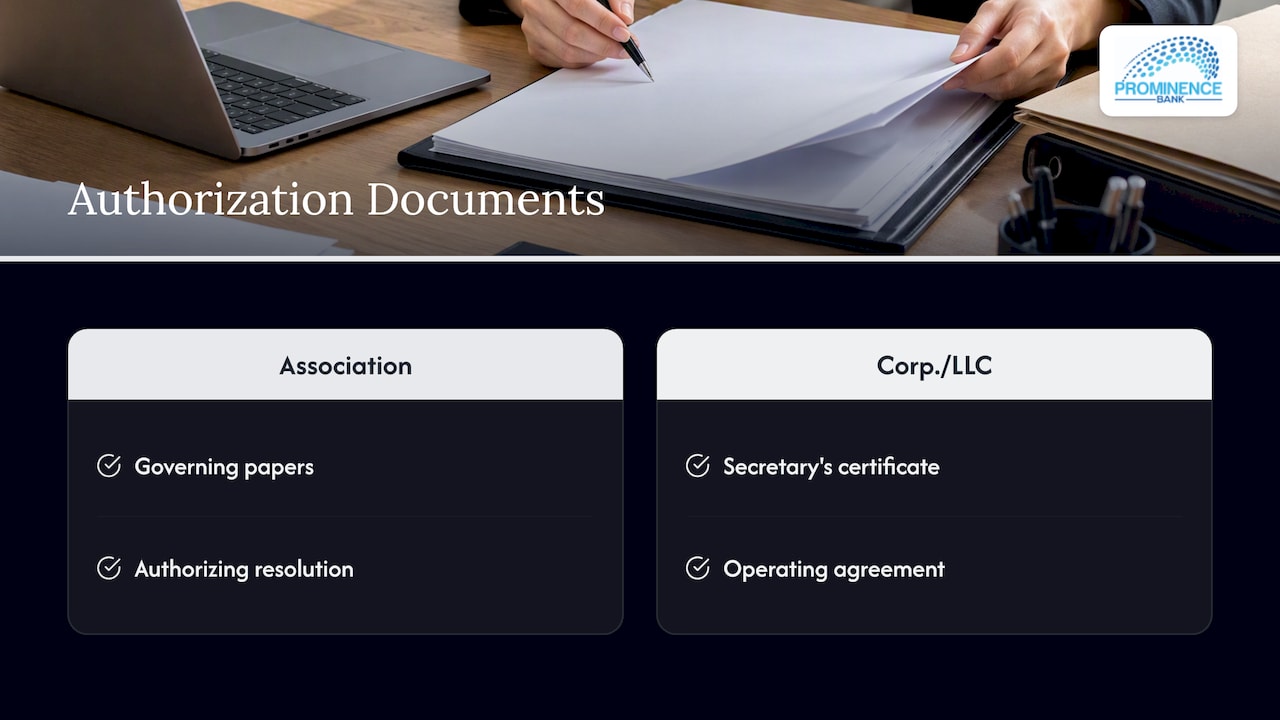
The exact set varies by entity type. For the kinds of documents banks ask for when they need to confirm who may give account instructions, an association’s governing papers and a resolution authorizing named individuals are typical. Corporations and LLCs usually substitute a secretary’s certificate or operating agreement.
For the Federal Reserve Banks, the official authorization list needs a notarized signature from an authorizing officer, and its effective date cannot come before the board adopted the related resolution. Commercial banks are not bound by that rule, but the principle is sound: the mandate should never claim authority the company had not yet granted.
Identity checks behind a signatory change
Banks do not add signers on trust. Under the federal customer identification rule, a bank’s risk-based program must address when to collect information on individuals with authority or control over a non-individual customer’s account, including signatories, where other methods cannot verify the customer’s identity. In plain terms: the bank may ask about the people behind the company, not only the company.
If you wonder why a bank keeps asking for old paperwork, retention is part of the answer. FFIEC guidance says banks must keep customer identifying information for five years after the account closes, and records of verification methods and results for five years after they are made.
Keeping the matrix current and secure
A matrix is only as good as its last review. Practical habits:
- Review on a schedule and on every trigger. Quarterly is common. Also review when someone changes role, leaves, or when a new account opens.
- Match the mandate to the resolution. One governance writer puts it simply: the bank mandate should mirror the board resolution. Compare them line by line at each review.
- Prefer automated dual control. The bank-examination handbook says automated dual-control methods beat manual procedures, and that exception reports should be reviewed by someone not involved in the transaction.
- Require time away. The same handbook says policies should require staff with cash approval or disbursement authority to take annual vacations, so irregularities can surface while someone else covers.
- Separate preparing from releasing. Nobody should be able to create a payee and approve a payment to that payee alone.
- Use alerts and limits. Daily caps and out-of-band confirmation on wire changes close the most common fraud paths.
For more on layered controls, see our pieces on how to secure corporate banking and research-backed controls for complex corporate structures.
Signatories on foreign accounts: the FBAR angle
If your matrix includes accounts held outside the United States, a signatory is not just an operational role. Under the draft FBAR instructions, U.S. persons must file annually for foreign accounts in which they have a financial interest or over which they hold signature authority, if the combined value of those accounts exceeds $10,000 at any time during the year, subject to exceptions. A finance director with signing power over a subsidiary’s overseas account can be caught even though the money is not theirs.
Add a column to the matrix: “U.S. person with foreign signature authority?” Then take the list to a CPA or tax attorney who handles FBAR work, because exceptions turn on facts we cannot assess from here. We cover the mechanics in international bank account signatory rules.
Banks also care about who can direct activity. Examiners reviewing payable-through account arrangements are told to check whether a bank validates details about the people authorized to direct transactions, including name, address, expected activity and business description. A tidy matrix makes that conversation short.
Perspective: the matrix is a design decision, not paperwork
We see the same pattern in complex structures. A holding company, two operating subsidiaries and a family office each get accounts, and each account gets a slightly different signing rule because it was opened at a different time by a different person. Years later nobody can say who may release a wire from which entity.
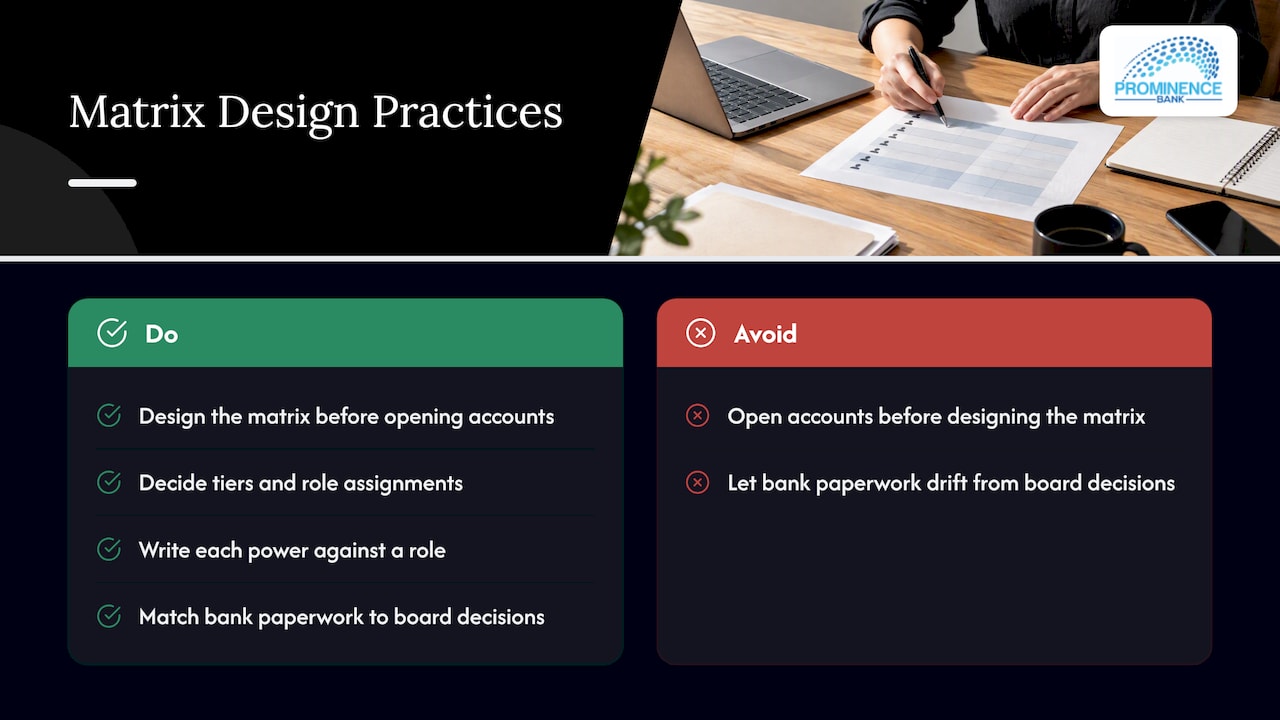
Our view is that you should design the matrix before you open accounts, not after. Decide the tiers, decide who holds which role, and choose banking arrangements that can enforce them: multi-signatory setups, role-based limits, and clear approval trails. Where privacy matters, as it does for many of our clients, the discipline matters even more, because fewer people should hold power and each should be documented precisely.
Two habits pay off. Write every power against a role, then assign names. And never let the bank’s paperwork drift from the board’s decision. If you are structuring across jurisdictions, our corporate account structuring checklist and guide to multi-signatory corporate accounts walk through the choices.
— Harold
Setting up accounts that fit your matrix
If you are building a multi-entity or international structure, we can help you map the matrix to the account design from day one. Prominence Bank offers business banking and corporate banking for international companies and institutions. Account opening is listed at 25000 $/€ one-off, and the full schedule, including enhanced due diligence tiers, is on our fees page. When you are ready, start with the business account application.
A one-page checklist
Before you file your matrix, confirm each of these:
- Every signer appears in a resolution, and the resolution matches the bank mandate.
- Limits and combinations are written per account and per channel.
- Roles are separated: initiate, approve, release, administer.
- Departed staff are removed from signature cards and from online banking and cards.
- Review dates are set, with an owner named in treasury or legal.
- U.S. persons with foreign signature authority are flagged for tax review.
- The evidence pack (resolution, bank confirmation, ID records) sits next to the matrix.
FAQ
What is a signing matrix?
It is a table that lists who may sign or approve what, usually by role, category and dollar threshold. A bank signatory matrix applies that idea to bank accounts and payment channels. A contract signing matrix applies it to agreements.
What are the different types of bank signatories?
Common types are primary signers, joint or secondary signers, limited signers, view-only or initiating users, and administrators who manage online access. Banks name these differently, so define each power in your matrix and check it against the deposit agreement. A signer is not automatically an owner.
Who signs the authorized signatory?
An authorized officer, manager or member signs the resolution or mandate that names the signatories, depending on your governing documents. The new signer then signs the bank’s signature card. Some institutions also require the authorizing signature to be notarized or certified.
How long does a corporate signatory change take?
It depends on the bank and on how complete your documents are. The change takes effect only once the bank confirms it, so ask for that confirmation in writing and keep the old arrangement in force until you have it.
Sources
- Authorized Signatory Lists Explained
- Delegations of Authority, FDIC
- Board Resolutions and Official Authorization List, Federal Reserve Banks
- Authorized Signer on Bank Account: Authority and Access, UpCounsel
- Types of authorized signatories, Cygnetise
- Examination Handbook 340 Appendix A
- FFIEC IT Examination Handbook, Wholesale Payment Systems
- 31 CFR 1020.220
- FFIEC BSA/AML Appendix P, Record Retention
- Authorized Signatories and Signing Mandates for Bank Accounts
- Draft FBAR Instructions, IRS
- FFIEC BSA/AML: Risks Associated with Money Laundering and Terrorist Financing
- 4 Documents to Open an Unincorporated Association Bank Account