
Discreet banking for an executive means a bank that protects your information through tight internal access, a dedicated contact and strong security. It does not mean a bank that hides you from regulators. Secrecy ended years ago. What remains is confidentiality, meaning who inside the bank sees your affairs, how they are protected, and who else is told. If you are a U.S. person, the IRS still sees your foreign accounts.
This guide explains what you can reasonably expect, the rules that apply to you, what discretion costs, and how to tell a serious provider from a scam.
TL;DR
- Discretion today is confidentiality plus security. It is not secrecy. Banks must still verify who owns an account and where the money came from.
- U.S. persons must report foreign accounts on an FBAR once the combined balance passes $10,000 at any point in the year, whatever bank they use.
- Expect enhanced due diligence at the private-banking level. A provider that waves it away is a warning sign.
- Judge a bank on five things: licensing, security, who can see your file, fees in writing, and how it handles correspondent banking.
- Prominence Bank publishes its fees and offers numbered, private and business accounts opened fully online.
Table of Contents
- What executives actually mean by “discreet”
- What the law still requires of you and your bank
- Why the bank’s own compliance protects your privacy
- Your options: four types of provider
- How to judge a discreet bank in six questions
- Red flags: instruments sold as magic
- Our perspective
- What it costs: our published fees
- Matching the account to your situation
- Opening an account with us
- FAQ
- Sources
What executives actually mean by “discreet”
Executives rarely want to hide money. They want to avoid the side effects of visibility. A named chief executive with a public salary, equity grants and board seats is an attractive target for phishing, social engineering and unwanted solicitation. Others are in the middle of a divorce, a sale of the company, a relocation or a dispute, and need their finances out of casual view.
In practice, discretion usually breaks down into four things:
- Limited internal access. Few staff can open your file, and access is logged.
- A named contact. You deal with one banker, not a call center that asks you to repeat your history each time.
- Security. Strong authentication, controlled payment approvals and protection against account takeover.
- Separation. Personal, holding-company and business accounts are kept apart, so one does not reveal the others.
None of these require breaking a rule. All of them are things a well-run bank can offer, and they are what to look for before you look at branding.
What the law still requires of you and your bank
The tension in this topic is simple. Privacy from the public is legitimate. Privacy from regulators is not available to U.S. persons, and a bank that suggests otherwise is a risk to you.
Foreign accounts and the FBAR
A U.S. person with a financial interest in, or signature authority over, foreign financial accounts must file a Report of Foreign Bank and Financial Accounts when the aggregate value exceeds $10,000 at any time during the calendar year. Signature authority matters for executives: if you can sign on a company’s overseas account, you may have to report it even though the money is not yours. The IRS warns that failure to report can bring civil penalties or even criminal prosecution.
Two practical points. First, keep records. The IRS says you should keep account records for five years from the FBAR due date. Second, the threshold counts all your foreign accounts together, so several small accounts can add up. Our own guides cover FBAR for offshore accounts and the signatory rules for international accounts. A U.S. tax attorney or CPA who handles foreign reporting should confirm how this applies to your situation.
Cash and the $3,000 and $10,000 rules
One of the most common questions is about the “$10,000 rule.” Under the Bank Secrecy Act, banks must keep records when someone buys negotiable instruments with cash in amounts between $3,000 and $10,000, and several purchases on the same business day are treated as one. Splitting transactions to stay under a limit is itself a problem. For an executive moving money by wire, the rules matter less than the monitoring that sits behind every transfer.
Private banking due diligence
Private-banking accounts get closer scrutiny. Under Section 312 of the USA PATRIOT Act, covered accounts include those with a minimum of $1 million in funds or assets, and the required procedures include verifying the nominal and beneficial owners and documenting the source of funds. FINRA’s guidance on the same rule describes it as covering accounts of non-U.S. persons with an assigned liaison above the same threshold.
In plain terms: the more discretion and service you ask for, the more documentation you should expect to provide. That is how you can tell a legitimate bank from an illegitimate one.
Why the bank’s own compliance protects your privacy
It seems backwards, but a bank with strong compliance is better for discretion. Banks that cannot show clean controls lose their correspondent relationships, and then your payments stall.
The Bank for International Settlements has documented how correspondent banking is under pressure, with banks de-risking by closing relationships they cannot adequately monitor. Opaque ownership and unclear transaction patterns are the usual triggers. For an executive, the consequence is real: a frozen or returned wire exposes your affairs to more people than a clean, documented one ever would. We explain the mechanics in our piece on correspondent banking and dollar access.
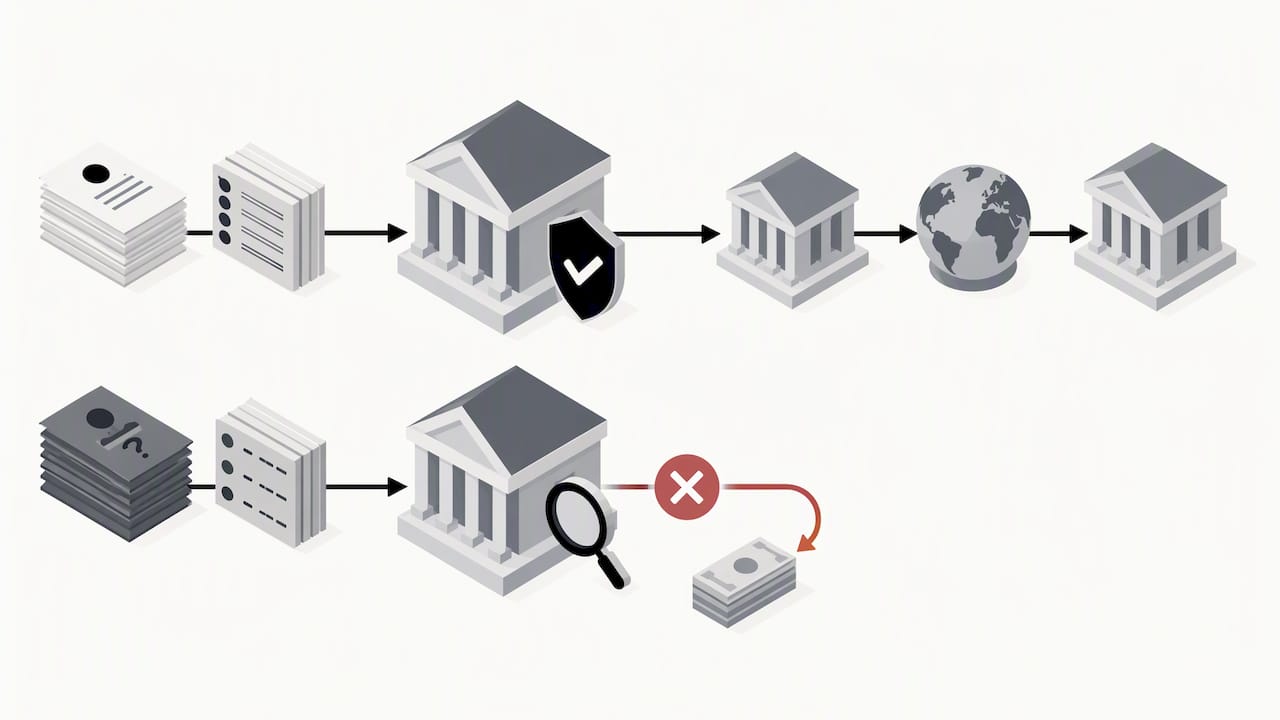
Sanctions screening is the other side. OFAC settlements show that weak screening, such as relying on a country-of-residence field while ignoring address data, can lead to severe penalties for the institution. A bank that takes this seriously will ask you more questions at onboarding. See how screening works in our step-by-step walkthrough and why compliance teams fail OFAC screening.
The same logic applies inside your own company. Institutions that expect to be trusted with sensitive client data also need a safe way for employees to raise concerns, and a dedicated whistleblowing software for financial services is one way a firm can offer an anonymous reporting channel with an audit trail.
Your options: four types of provider
There is no single best answer. The right type depends on where your money and your life are.
| Type of provider | Strength | Trade-off |
|---|---|---|
| Large U.S. private bank | Lending, wealth planning, FDIC-insured deposits up to limits | Minimums are high, and your information sits in a large organization |
| Premium business checking at a national bank | Familiar, easy for a solo consultant or fractional executive | Little real privacy service, and personal and business profiles can overlap |
| Boutique or regional private bank | Personal attention | Narrower international reach |
| International digital bank | Multi-currency accounts, remote onboarding, privacy-focused structures such as numbered accounts | Not a U.S. deposit-insured bank, and U.S. reporting still applies to you |
A note on insurance. FDIC coverage is capped at $250,000 per depositor, per insured bank, per ownership category. Business accounts are insured separately from personal ones, but balances above the limit at one bank are generally not covered. Executives with larger cash positions should plan for that wherever they bank, and should ask any bank, including ours, exactly how client assets are held and protected.
How to judge a discreet bank in six questions
- Is it licensed, and by whom? Ask for the licence and the regulatory framework in writing, then verify it through an independent channel.
- What are the fees, in writing? Real private banks publish or quote fees plainly. Vague pricing is a warning.
- Who can see my file? Ask about internal access controls and what happens when a legal request arrives.
- How is the account secured? Look for strong authentication and payment approval controls. Hardware security keys are a common choice, and a corporate authentication guide can help you decide what your team should use.
- How does it keep dollar and euro access? Ask about correspondent relationships.
- Will it help me comply? A bank that talks about FBAR and source-of-funds documentation is on your side.
Red flags: instruments sold as magic
Discretion attracts fraud. The classic example is the safekeeping receipt. A genuine SKR is a custodial receipt. It creates no payment obligation, is not a guarantee, and cannot be monetized for loans or trade programs. Anyone who offers to do so is describing advance-fee fraud. LegalClarity notes that safekeeping receipts show up frequently in fraud schemes, often with official-looking documents attributed to well-known banks.
Two habits protect you:
- Never rely on contact details printed on the document itself. Find the issuing institution’s number independently and call it.
- Be wary of any promise of guaranteed returns, secrecy from tax authorities or a fast “instrument” in exchange for an upfront fee.
The same caution applies to crypto custody, where banks are under scrutiny. The BIS notes that distributed ledger payments still face identity verification and legal interoperability challenges and do not replace compliance. Our article on institutional crypto custody covers what good governance looks like.
Our perspective
We see two kinds of executives. The first wants fewer people to know their business. The second wants nobody to know, and that second request is the one we decline to promise.
Prominence Bank is a licensed digital financial institution operating within the Extraterritorial Trade Mission Office (ETMO) framework. Our clients are high-net-worth individuals, international businesses and institutions, and what they value is confidentiality, security and speed, not invisibility. We run international AML and KYC standards because a bank that cannot pass its own checks cannot protect its clients’ payments.
We also think pricing should be visible. Discreet banking is expensive because it involves heavy due diligence, secure systems and personal service. We publish our fees so you can judge the cost before you apply, and we would rather lose a client who expected something unlawful than keep one who will create a problem for everyone else.
If you are a U.S. person, our advice is the same as the IRS’s: report your foreign accounts, keep your records, and let a tax professional confirm the details.
— Harold
What it costs: our published fees
Here is what a Prominence Bank account costs, as published on our fees page.
| Service | Fee |
|---|---|
| Bank account opening | 25,000 $/€ one-off |
| Numbered bank account opening | 50,000 € one-off |
| Numbered account monthly fee | 100 $/€ per month |
| Savings account monthly fee | 40 $/€ per month |
| KTT (e-telex) transaction, incoming or outgoing | 1.5% |
| Internal transfer within Prominence Bank | 0.2% |
| Currency conversion | 4% |
| Reference or comfort letter | 25,000 € one-off |
| Proof of funds | 25,000 € one-off |
| Bank endorsement | 1.5% |
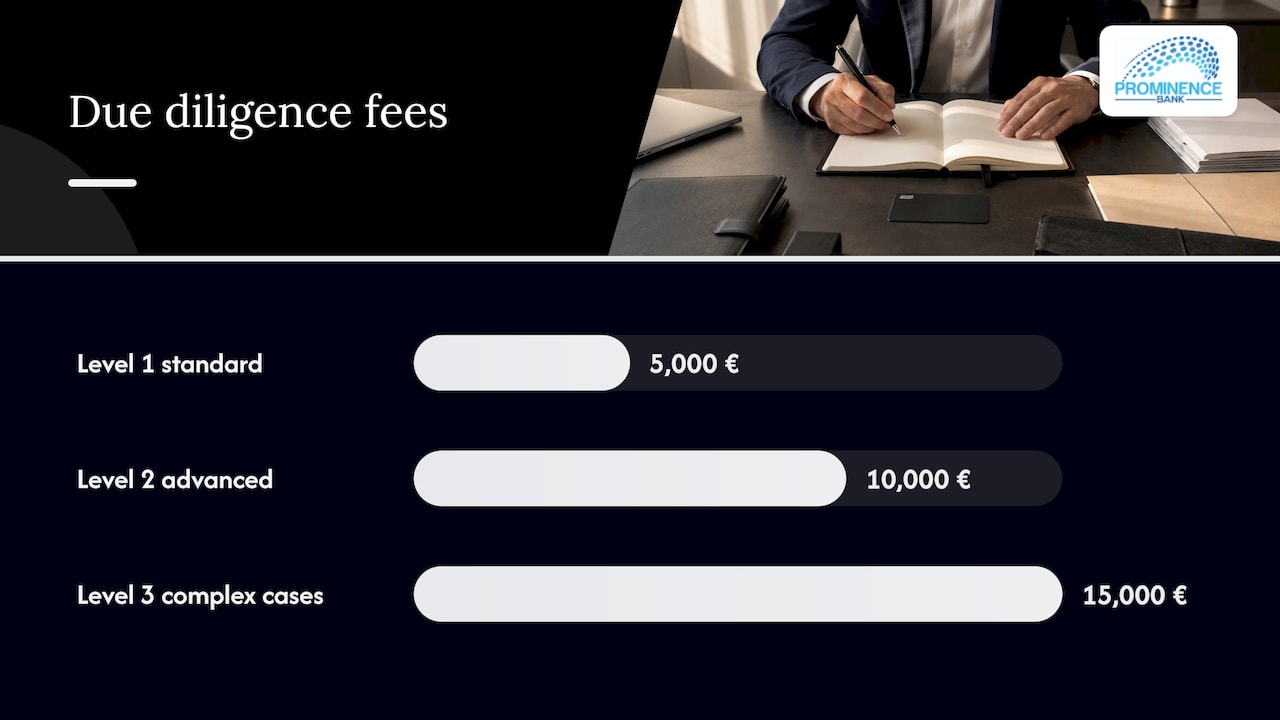
| Enhanced due diligence, Level 1 | 5,000 € one-off |
| Enhanced due diligence, Level 2 | 10,000 € one-off |
| Enhanced due diligence, Level 3 | 15,000 € one-off |
SWIFT and IBAN wire transfers are published at 1% (minimum $/€100), and outgoing transfers also carry applicable SWIFT/SEPA charges. The published fee for the Safekeeping Receipt (SKR) / custody service is €25,000 for the custody account plus 2%. The $/€25,000 account opening fee is refunded in full if an application is declined, and it is non-refundable once the account has been approved and opened. Read the terms first.
The due diligence tiers deserve a word. Level 1 is the enhanced standard, Level 2 is advanced, and Level 3 covers critical or complex cases such as layered ownership structures. The more complicated your structure, the more it takes to verify, which is why it costs more.
Matching the account to your situation
An executive with personal wealth and privacy needs. A private account, or a numbered account if you want your name kept off day-to-day records. Our private banking page explains the service, and our setup guide walks through the steps.
A founder with a holding company. Separate the structure from yourself. Our business banking and corporate banking pages cover multi-currency accounts and structures, and our guide to corporate banking structures explains roles and risks.
An expat executive. Currency flexibility and reliable cross-border payments matter most. Read our overview of private financial services for high-net-worth clients and what to know about online bank compliance.
Opening an account with us
If you want a discreet, fully online account with published fees, you can start with our business account application or review the full fee schedule first. Onboarding is digital, accounts are multi-currency, and every application goes through KYC and due diligence. Have your identity documents, source-of-funds evidence and ownership structure ready, because that is what moves an application forward.
FAQ
What is the most secretive bank?
No legitimate bank is secretive toward regulators. Swiss and Caribbean secrecy largely ended once the U.S. enforced reporting, and banks now verify owners and report as required. The better question is which bank protects your information from everyone else, and that comes down to access controls, security and a careful contact.
Do I have to report a foreign account if the money belongs to my employer?
Possibly. If you have signature authority over a foreign account, you can have an FBAR obligation even without owning the funds, once the combined value exceeds $10,000 at any time in the year. Check with your company’s tax advisor or a CPA who handles foreign reporting.
Is a numbered account anonymous?
No. A numbered account replaces your name with a number in routine records, but the bank still knows and verifies the account holder and beneficial owner. It is a privacy measure inside the bank, not a way to avoid reporting or due diligence.
Can a safekeeping receipt be used as collateral for a loan?
A genuine SKR only confirms that a custodian holds specified assets. It is not a payment instrument or guarantee, and offers to monetize one are a recognized fraud pattern. Verify any SKR by contacting the issuing bank through details you found yourself.
Sources
- IRS: Understand how to report foreign bank and financial accounts
- IRS: Report of Foreign Bank and Financial Accounts (FBAR)
- FinCEN: Bank Secrecy Act reference for banks
- FDIC: Bank Secrecy Act, AML and OFAC examination manual
- FINRA: Notice to Members 02-21
- BIS: Correspondent banking consultative report
- OFAC: Enforcement release on sanctions screening
- FDIC: Employees guide to deposit insurance
- ERGO: What is an SKR
- LegalClarity: What is a safekeeping receipt
- BIS: Distributed ledger and cross-border payments