
A back to back LC is two separate, legally independent letters of credit that let an intermediary use a buyer’s credit as collateral to open a second credit in favor of its own supplier, so it never has to reveal the buyer or to tie up its own cash. Banks approve them reluctantly because the intermediary’s bank takes on a payment obligation to the supplier that does not depend on ever getting paid under the master credit. That mismatch between risk and reward is the entire story of this instrument.
TL;DR:
- Banks see back to back LCs as risky because the secondary bank’s payment obligation is independent of the master LC’s payment, risking payout even if the master defaults.
- Proper timing planning, including setting the secondary LC to expire well before the master LC, is critical to avoid late document presentation and deal failure.
- The cost of a back-to-back LC can double typical fees, including issuing, confirmation, amendment, and discrepancy charges, which can significantly erode margins.
- These structures are not explicitly regulated by UCP 600, so each credit is governed independently, increasing risks related to discrepancies and compliance.
- Success relies on thorough due diligence, aligning all terms before issuance, and building relationships with banks that treat the structure as a single risk profile.
Table of Contents
- What Is a Back to Back LC and How Does the Structure Work?
- Who’s Involved and When Do the Clocks Start Running?
- Where the Real Risk Sits, and How to Make a Deal Bankable
- Back to Back LC vs Transferable LC: Which Instrument Fits?
- A Working Checklist for Structuring the Deal
- What a Back to Back LC Actually Costs
- UCP 600 and the Legal Rules Behind the Structure
- The Discrepancies That Sink Back to Back Deals
- Cash Flow Effects Intermediaries Often Underestimate
- Handling Amendments and Extensions Without Breaking the Structure
- Two Scenarios: When It Works and When It Doesn’t
- Prominence Bank’s View on Structuring Back to Back LCs Safely
- Getting Trade Finance Support for a Back to Back LC Deal
- Why the Conventional Playbook on Back to Back LCs Undersells the Risk
- Sources
- FAQ
What Is a Back to Back LC and How Does the Structure Work?
The mechanics start with a master letter of credit, issued by the buyer’s bank in favor of the intermediary. The intermediary, now holding a credit as security, asks its own bank to issue a second, separate credit in favor of the actual supplier. That second instrument is the back-to-back letter of credit, and it is not an amendment or extension of the first one. It is a brand new documentary credit governed by its own terms, its own expiry, and its own set of required documents.
Here is the sequence most deals follow:
- The buyer’s bank issues the master LC to the intermediary as beneficiary, often transmitted via a SWIFT MT700 message.
- The intermediary’s bank reviews the master LC’s terms, assesses the intermediary’s creditworthiness, and decides whether to issue a secondary credit against it.
- The intermediary’s bank issues the secondary LC to the supplier, typically for a lower amount and an earlier expiry date.
- The supplier ships the goods and presents documents (invoice, bill of lading, packing list) under the secondary LC.
- The intermediary’s bank pays the supplier, then swaps the supplier’s invoice for the intermediary’s own invoice at the higher master LC price.
- The intermediary’s bank presents the substituted document set to the buyer’s bank under the master LC and collects payment.
Because each credit stands entirely on its own under UCP 600 rules, a discrepancy on one side does not automatically excuse payment on the other. If the supplier’s documents contain an error the intermediary’s bank misses, that bank still owes the supplier, whether or not the buyer’s bank ever honors the master LC. That single fact drives most of the caution banks show toward this structure.
Who’s Involved and When Do the Clocks Start Running?
Five parties typically sit inside a back to back LC arrangement, each with a distinct job:
- The buyer, who applies for the master LC and ultimately pays for the goods.
- The intermediary (also the beneficiary of the master LC and the applicant on the secondary LC), who profits on the price spread while shielding the supplier’s identity.
- The intermediary’s bank, which issues the secondary LC and absorbs the credit risk of the whole structure.
- The supplier, who ships against the secondary LC and never sees the master LC’s terms.
- The advising and, where used, confirming banks, who authenticate messages and may add their own payment guarantee.
The independence of the two credits means a discrepancy in the supplier’s documents doesn’t get waived just because the master LC would otherwise pay cleanly, so document alignment between the two instruments has to be treated as a distinct compliance exercise rather than an afterthought.
Timing is where deals actually fail. Three deadlines run at once: the secondary LC’s presentation and expiry dates, the time needed to substitute documents, and the master LC’s own presentation deadline. Under UCP 600, each issuing bank has up to five banking days to examine presented documents, and that examination window has to fit comfortably inside the gap between the two LCs. Practitioners generally build the secondary LC to expire and permit presentation well before the master LC, leaving enough runway to swap documents and still meet the master LC’s own deadline.
Where the Real Risk Sits, and How to Make a Deal Bankable
Banks don’t shy away from back to back LCs out of habit. The risk is structural, and it shows up in four distinct places.
- Independent payment obligation. The intermediary’s bank must pay the supplier under the secondary LC even if the buyer’s bank later refuses the master LC for any reason, discrepancy or insolvency included.
- Discrepancy and expiry mismatch risk. Two separate document sets, two separate deadlines, and one document substitution step in between create several points where a technical error can stall or kill payment.
- Compliance exposure. Rulebooks like the CBUAE’s flag back-to-back structures as a recognized red flag for trade-based money laundering and sanctions evasion, largely because they can obscure the ultimate buyer and seller behind an intermediary layer.
- Credit risk on the intermediary itself. The intermediary’s bank assumes an obligation to pay the supplier that survives even if the master LC fails, so the bank is effectively lending its own balance sheet against the intermediary’s reliability.
Mitigation tactics that make these deals underwritable include requiring confirmation on the secondary LC, holding a cash margin or collateral against the intermediary’s exposure, taking an indemnity from the intermediary, deliberately setting an earlier expiry on the secondary LC, and building documentary buffers into every timeline.
Pro Tip: Push for the secondary LC to be sized below the master LC amount, commonly less than the master LC value, so there’s a built-in margin that absorbs small pricing or currency discrepancies without threatening the intermediary’s payout.
Enhanced due diligence on the ultimate buyer and supplier, not just the intermediary, is now close to standard practice for banks handling back-to-back structures.
Back to Back LC vs Transferable LC: Which Instrument Fits?
A back to back LC only makes sense when a transferable LC won’t do the job. Reach for it when:
- The master LC is explicitly marked non-transferable, closing off the simpler route entirely.
- The intermediary needs to change currency, shipping port, or the required document set between the buyer-facing credit and the supplier-facing credit.
- Confidentiality matters enough that the supplier and buyer must never see each other’s names or pricing.
Transferable LCs remain the preferred choice whenever the master LC allows it, because they involve one credit, one set of bank fees, and far less exposure for the issuing bank. A back to back LC costs more, takes longer to arrange, and asks a bank to underwrite a second independent obligation. Alternatives worth weighing before committing to a back-to-back structure include assignment of proceeds under the master LC, a standby letter of credit backing a separate payment arrangement, or a red clause LC, which advances funds to the supplier before shipment and carries its own repayment risk if goods never arrive. Each trades cost, speed, or confidentiality against a different flavor of credit risk.
A Working Checklist for Structuring the Deal
Before either credit gets issued, verify the following:
- Confirm the intermediary’s bank has actually reviewed the master LC’s full terms, not just the face amount, and screened all named parties against sanctions lists.
- Align amounts, expiry dates, shipment terms, and bill of lading specifications between the two credits before either one is finalized.
- Build a presentation deadline for the secondary LC that leaves real time, not a token day or two, for document substitution and courier transit.
- Size the secondary LC below the master LC value to protect margin and reduce the intermediary bank’s exposure.
- Pre-draft the substitute invoice and any other documents the intermediary will swap in, so the substitution step doesn’t become the bottleneck.
Pro Tip: Ask the intermediary’s bank for a written document-substitution protocol before shipment, not after. Banks that improvise this step under deadline pressure are where discrepancies turn into non-payment.
What a Back to Back LC Actually Costs
Every credit carries a fee, and a back to back structure carries two full sets of them. Issuing banks typically charge issuing fees in the range of 0.75 to 2 percent of the credit amount, and if either credit is confirmed by a second bank, add roughly another 0.5 to 1 percent for that confirmation. Because a back to back deal involves two separate credits, the intermediary is effectively paying issuing fees, advising fees, and possibly confirmation fees twice over, once on the master LC side and again on the secondary LC.
Amendment fees compound the problem in a way flat-fee thinking misses. Change one term, a shipment date, a quantity, a port, and it often has to be mirrored across both credits to keep them aligned. That means two amendment fees instead of one, plus the bank time required to re-check that the amended terms still line up on both sides of the structure. Intermediaries who negotiate pricing only on the headline issuing fee routinely get surprised by how amendment costs stack up over a deal that runs into shipping delays or last-minute buyer requests.
Document discrepancy fees add a third layer. If a presentation comes in with an error, banks typically charge a discrepancy handling fee on top of everything else, whether or not the discrepancy is eventually waived. Budgeting for a back to back LC means pricing in the master LC’s fees, the secondary LC’s fees, at least one likely amendment, and a contingency discrepancy charge, not just the headline issuing percentage quoted at the start of the deal.
UCP 600 and the Legal Rules Behind the Structure
Back to back LCs are not defined or explicitly regulated as a named instrument under the ICC’s Uniform Customs and Practice for Documentary Credits, known as UCP 600. Instead, each of the two credits is simply a standard documentary credit governed independently by UCP 600’s rules on issuance, examination, and payment. That absence of a dedicated back-to-back article is precisely why the structure carries the risk it does: no single set of ICC rules ties the two credits together or guarantees that payment under one obligates payment under the other.
The ICC Academy’s own guidance on transferable and back-to-back credits treats the back-to-back structure as a bank-arranged workaround rather than a codified product, built entirely from two ordinary UCP 600 credits stacked against each other by agreement between the intermediary and its bank. UCP 600’s five-banking-day examination rule, its standards for document conformity, and its rules on discrepancy notice all apply separately to each credit.
Beyond UCP 600, banks layer their own internal risk policies and, increasingly, regulatory guidance on top of the private rules. Central bank rulebooks that flag back-to-back structures for enhanced due diligence, such as the CBUAE’s rulebook provisions, sit alongside UCP 600 rather than replacing it. A practitioner structuring one of these deals needs to satisfy both the private contractual rules of the credits themselves and the public regulatory expectations of the banks involved.
The Discrepancies That Sink Back to Back Deals
Most back to back LC failures trace back to one of a handful of avoidable errors. The most common is a mismatch between the goods description, quantity, or unit price on the supplier’s invoice and what the substituted intermediary invoice claims, an inconsistency that examiners under UCP 600 are trained to catch immediately.
A second frequent pitfall is expiry sequencing that leaves no real buffer. When the secondary LC’s presentation deadline sits too close to the master LC’s, any shipping delay, courier delay, or bank processing lag eats the entire margin and forces a late presentation that can be rejected outright.
Bill of lading specifications cause a third category of trouble. If the secondary LC calls for a different named vessel, port of loading, or shipment date range than the master LC ultimately requires, the intermediary can end up holding compliant documents under one credit that don’t satisfy the other.
Best practice against all three starts with a single document, often called a cross-reference checklist, that lines up every data field, amount, description, dates, ports, document types, side by side across both credits before either one is issued. Banks that require this comparison as a condition of issuing the secondary LC catch the majority of these mismatches before goods ever ship. Building in a genuine time buffer, treating the master LC’s terms as the fixed reference point rather than an afterthought, and pre-clearing the substitute invoice format with the intermediary’s bank round out the practices that keep discrepancy rates down on repeat back-to-back business.
Cash Flow Effects Intermediaries Often Underestimate
A back to back LC changes an intermediary’s working capital position in ways that a straightforward trade doesn’t. The intermediary’s bank generally requires collateral, a cash margin, or a strong credit relationship before issuing the secondary LC, which means capital gets tied up before the intermediary has collected a cent from the buyer side.
Payment timing adds a second squeeze. The intermediary’s bank must pay the supplier promptly once compliant documents are presented under the secondary LC, but collection from the buyer’s bank under the master LC can lag by days or weeks depending on shipping documents, examination time, and any discrepancy resolution. That gap has to be funded from somewhere, whether that’s the intermediary’s own cash reserves or a credit facility the bank extends alongside the LC issuance.
The margin between the master LC value and the secondary LC value is where the intermediary actually makes money, but that margin also has to absorb every fee on both sides of the structure, issuing fees, confirmation fees, discrepancy charges, and amendment costs. An intermediary running several back-to-back deals simultaneously can find working capital locked up across multiple transactions at once, which is why banks increasingly ask for a clear view of an intermediary’s overall LC exposure, not just the deal in front of them, before extending secondary LC facilities. Holding funds across multiple currencies without needless conversion friction, something a multi-currency account structure is built for, becomes a meaningful lever for managing that exposure.
Handling Amendments and Extensions Without Breaking the Structure
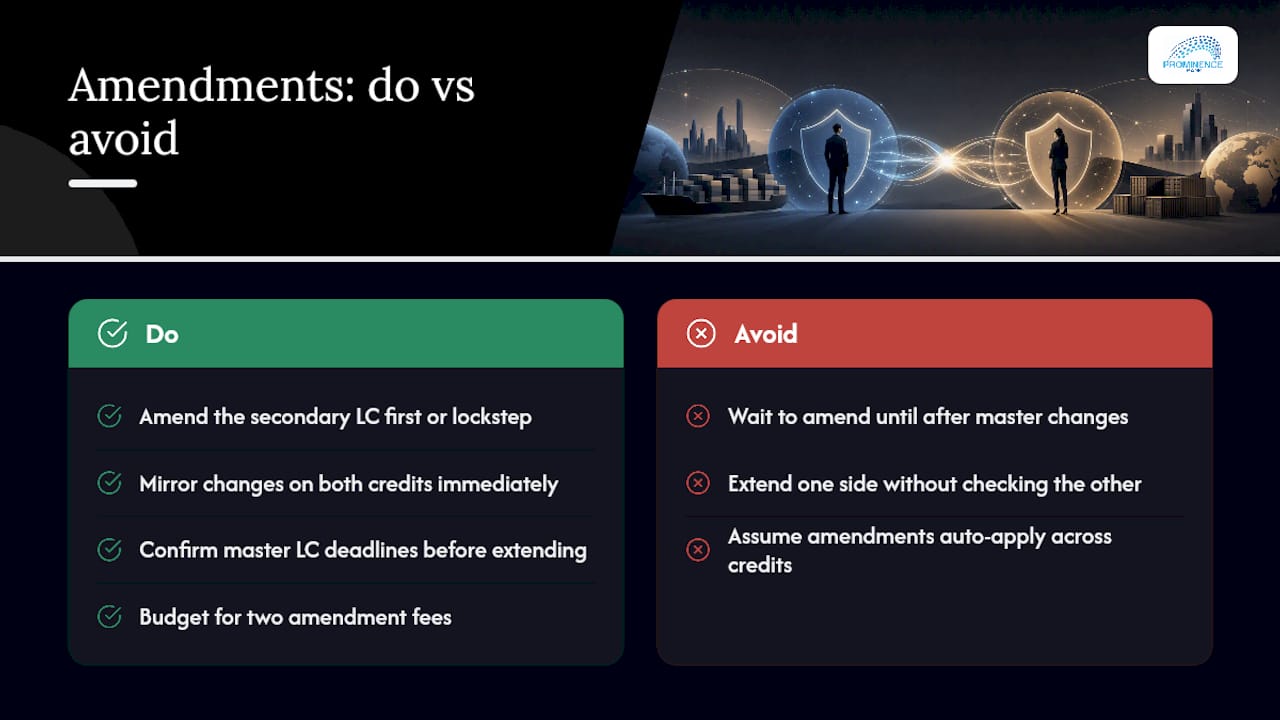
Amendments are where the two-credit structure gets fragile. Because the master LC and secondary LC are separate instruments, an amendment to one doesn’t automatically apply to the other, and the intermediary’s bank has to actively manage that gap rather than assume it will resolve itself.
The standard approach is to amend the secondary LC first, or in lockstep, whenever the master LC changes in a way that affects shipment terms, quantities, or dates. Waiting to amend the secondary LC until after the master LC changes are confirmed creates a window where the two credits are misaligned, and any shipment or presentation that happens during that window risks a discrepancy that neither credit’s terms actually support.
Extensions of expiry follow the same logic in reverse. If the supplier needs more time to ship, the secondary LC’s expiry has to move, but that extension only helps if the master LC’s own deadline, or a matching extension on that side, gives the intermediary enough room afterward to substitute documents and present under the master LC before it lapses. Extending one side without checking the other is a common, and entirely avoidable, way to end up holding a compliant secondary LC presentation that arrives too late to be used under the master credit.
Each amendment on either credit typically triggers its own bank fee, and because changes often have to be mirrored across both instruments, a single shipment delay can generate two amendment charges instead of one. Building amendment costs into the original fee budget, rather than treating them as an exception, keeps the economics of the deal from eroding deal by deal.
Two Scenarios: When It Works and When It Doesn’t
Consider an apparel trading company that receives a master LC from a European retailer for finished garments, but sources the actual production from a factory in a different country under different payment terms. The intermediary’s bank issues a secondary LC to the factory for 85 percent of the master LC value, with an expiry set three weeks ahead of the master LC’s deadline. The factory ships on time, documents come in clean, the intermediary substitutes its own invoice at the higher contract price, and the master LC pays out within the examination window. The margin, plus the buffer built into the expiry dates, covers every fee on both sides with room to spare. That’s the structure working exactly as designed.
Now consider a similar deal where the secondary LC’s expiry was set only five days ahead of the master LC’s deadline, and the factory’s shipment landed at the port three days late due to a customs hold. By the time the intermediary’s bank received and examined the supplier’s documents, there wasn’t enough runway left to substitute the invoice and present under the master LC before it expired. The buyer’s bank rejected the late presentation, and the intermediary was left holding a paid-out secondary LC with no corresponding payment coming in under the master LC. The failure wasn’t a discrepancy in the documents themselves. It was a timing buffer that never accounted for a routine customs delay, exactly the kind of gap that a wider expiry margin between the two credits is supposed to absorb.
Prominence Bank’s View on Structuring Back to Back LCs Safely
Structuring a back to back LC well starts with underwriting the intermediary, not just the paperwork. Prominencebank evaluates appetite for these deals by reviewing the master LC’s full terms, the intermediary’s track record, and the sanctions exposure of every named party, then advises on confirmation and documentation requirements before either credit gets issued. Trade finance professionals working through a live structure can bring their master LC terms and counterparty details to Prominencebank’s trade finance team for an early read on bankability.
Getting Trade Finance Support for a Back to Back LC Deal
Prominencebank works with intermediaries and trade finance professionals who need a bank willing to actually underwrite the credit risk a back to back LC carries, not just process the paperwork.
Getting a deal evaluated starts with the master LC itself: bring its full terms, the intermediary’s financial standing, and details on every named party in the chain, buyer, supplier, and any confirming banks involved. Prominencebank’s trade finance services cover secondary LC issuance, confirmation arrangements, and the sanctions and KYC screening that makes these structures bankable in the first place, backed by multi-currency account infrastructure that keeps proceeds in the currencies a deal actually requires instead of forcing unnecessary conversions. Professionals ready to move on a live transaction can start by reviewing account setup requirements or reaching out directly through Prominencebank’s full range of services to get a specific deal in front of a trade finance underwriter.
Why the Conventional Playbook on Back to Back LCs Undersells the Risk
Most explainers treat a back to back LC as a documentation exercise: get the terms to match, get the dates to align, done. That framing misses the actual decision a bank makes when it agrees to issue the secondary credit. It isn’t underwriting a transaction. It’s underwriting an intermediary’s reliability across every deal that intermediary might bring in the future, because the independent obligation to pay the supplier doesn’t care whether this particular master LC ever pays out.
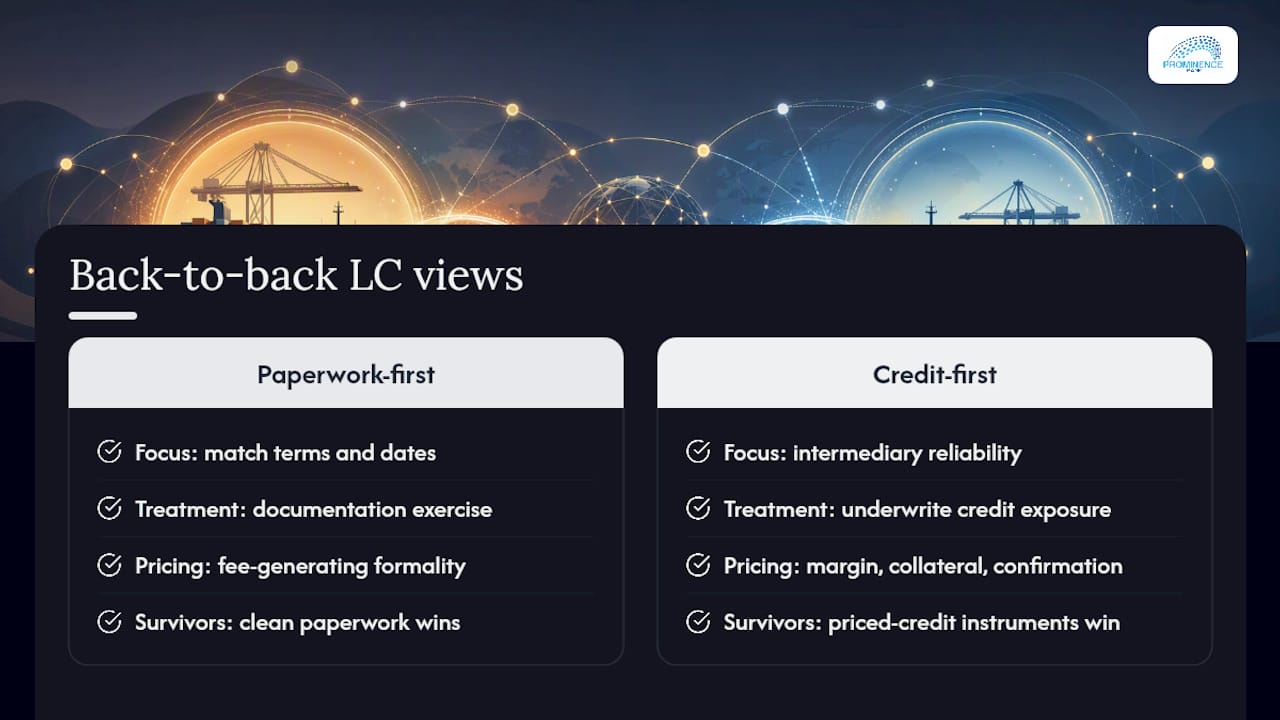
The instruments that survive repeated use aren’t the ones with the cleanest paperwork. They’re the ones where the bank on the secondary side priced the deal like a credit exposure from day one, margin, collateral, confirmation, rather than treating it as a fee-generating formality bolted onto a bigger trade. Intermediaries who show up asking only “how fast can you issue this” tend to get worse terms, longer scrutiny, and less flexibility on timing buffers than the ones who show up with a cross-referenced document checklist and a clear answer to why a transferable LC wouldn’t have worked instead.
The honest takeaway for anyone structuring one of these deals is that the mechanics are the easy part. The hard part is building a relationship with a bank willing to treat the intermediary’s overall exposure as a single risk picture rather than deal by deal, which is exactly the kind of underwriting conversation worth having before the master LC even lands.
— Harold
This article is general information, not a substitute for advice from a qualified financial advisor. Consult a qualified financial professional about your own circumstances before acting on anything here.
Sources
- Transferable vs. back-to-back letters of credit (LCs): Key risks and mitigation strategies for banks
- Back-to-Back LC Explained: Process, Risks, and Costs – LegalClarity
FAQ
What Is a Back to Back LC in B2B Trade?
A back to back LC is a pair of separate documentary credits used when an intermediary sits between a buyer and a supplier: the buyer’s master LC backs a second, independent LC the intermediary’s bank issues to the supplier.
What Do BL and LC Mean in a Trade Transaction?
BL refers to the bill of lading, the shipping document proving goods were loaded for transport, while LC refers to the letter of credit, the bank’s payment guarantee; a bill of lading is typically one of the documents required for payment under an LC.
What Does LC Mean in Payment Terms?
In payment terms, LC stands for letter of credit, a bank’s conditional promise to pay a seller once specified documents proving shipment are presented and found compliant.
How Many Times Can a Transferable LC Be Transferred?
A transferable LC can generally be transferred only once in full or in part to one or more second beneficiaries, unless the credit expressly allows further transfers; a back to back LC is often used instead when the master LC is marked non-transferable or when terms need to change beyond what a transfer permits.