
Correspondent banking is the arrangement that lets one bank hold accounts for and process payments on behalf of another bank in a different country, so the second bank can serve customers abroad without opening a single foreign branch. It matters because almost every cross-border wire, trade payment, or foreign currency transfer touches this network at some point. The catch is that it’s also one of the most heavily regulated corners of finance, because it moves money across borders that regulators can’t fully see into.
TL;DR:
- Smaller or high-risk respondent banks often face termination or de-risking due to escalating compliance costs and the difficulty of verifying underlying customer identities.
- Innovations like blockchain and digital currencies aim to shorten or bypass traditional correspondent chains, but regulatory and governance challenges remain unresolved.
- Maintaining complete, up-to-date ownership and transaction data is crucial for banks to ensure ongoing access and prevent sudden relationship exits.
Table of Contents
- What Is Correspondent Banking, Exactly?
- How Does Correspondent Banking Work in Practice?
- What Services Do Correspondent Banks Provide?
- Why Do Respondent Banks Rely on Correspondents?
- Why Is Correspondent Banking Considered High Risk?
- What Are Nested Accounts and Payable-Through Accounts?
- A Walkthrough: Following a Payment Through the Chain
- How Prominencebank Approaches Correspondent-Style Connectivity
- How Did Correspondent Banking Become the Backbone of Global Finance?
- Why Does Correspondent Banking Matter to Global Trade?
- How Is Fintech Changing Correspondent Banking?
- What Does De-Risking Actually Cost Financial Inclusion?
- What Comes Next for Correspondent Banking?
- Editorial Take: What This Framework Actually Demands
- Sources
- FAQ
What Is Correspondent Banking, Exactly?
The Financial Action Task Force defines correspondent banking as one bank (the correspondent) providing deposit, payment, and other services to another financial institution (the respondent) in a different jurisdiction, so the respondent can conduct international business without a physical presence there. In plain terms: a bank in Singapore needs to pay a supplier in Brazil, but it has no branch in Brazil. It uses a correspondent bank that does.
The relationship runs on two account types. A nostro account is “our money, held by you” from the respondent’s point of view. A vostro account is “your money, held by us” from the correspondent’s side. Same account, two names, depending on who’s talking.
The structural elements that hold this together include:
- A signed correspondent banking agreement defining services, fees, and liability
- Nostro and vostro accounts funded to cover expected transaction volume
- SWIFT connectivity for message exchange and payment instructions
- A fee schedule covering wire processing, FX conversion, and account maintenance
- Ongoing due diligence documentation, refreshed on a set schedule
How Does Correspondent Banking Work in Practice?
A cross-border payment through a correspondent chain follows a fairly predictable sequence, even though the number of hops can vary depending on which currencies and countries are involved.
- The originating bank receives a payment instruction from its customer and checks the beneficiary’s bank details.
- It sends a SWIFT message, commonly an MT103, containing payment instructions, amounts, and originator/beneficiary information.
- The message routes through one or more correspondent banks, identified by their BIC (Bank Identifier Code) and increasingly cross-referenced against LEI (Legal Entity Identifier) data for screening.
- Each correspondent in the chain debits or credits the relevant nostro/vostro account and screens the transaction against sanctions lists.
- The beneficiary’s bank receives final credit and posts funds to the customer.
Fees and delays tend to cluster at two points: the correspondent hops in the middle of the chain, where each institution may deduct a processing fee, and the compliance screening step, where incomplete originator data triggers a hold. The BIS/CPMI technical report notes that missing or truncated originator and beneficiary fields are a frequent cause of payment rejects in higher-risk corridors, which is why banks increasingly demand full data fields upfront rather than shorthand references.
What Services Do Correspondent Banks Provide?
Correspondent relationships aren’t limited to wire transfers. They’re the backbone for several distinct service lines that respondent banks would otherwise struggle to offer at all.
- Payments and settlement. Correspondents process both retail remittances and large wholesale interbank transfers, settling through nostro/vostro balances.
- Trade finance processing. Letters of credit, documentary collections, and guarantees often route through a correspondent that can confirm or negotiate documents locally. Prominencebank’s own trade finance operations rely on this kind of cross-border document handling.
- Liquidity management and FX. Correspondents provide short-term funding lines and foreign exchange conversion so respondents don’t need to hold every currency themselves.
- Check clearing, safekeeping, and messaging. Older instruments like check clearing persist in some corridors, alongside secure message relay and custody services for securities.
Why Do Respondent Banks Rely on Correspondents?
The core appeal is market access without capital expenditure. Building a licensed branch network in a dozen countries is expensive and slow. Correspondent banking rents that access instead.
- Local clearing and currency liquidity without the cost of a branch, a subsidiary, or a local banking license.
- Faster market entry. A respondent bank can start offering US dollar or euro settlement to its customers within months rather than years.
- Lower fixed costs, though this trades off against per-transaction fees and the compliance overhead of maintaining the relationship itself.
The trade-off is real: correspondent access is cheaper than a branch, but it’s not free, and the compliance burden on both sides has only grown heavier over the past decade.
Why Is Correspondent Banking Considered High Risk?
Correspondent banking exposes the correspondent to a problem it can’t fully control: it’s underwriting risk for customers it never meets. The correspondent has a direct relationship with the respondent bank, but the respondent’s own customers, the people actually sending and receiving money, are invisible to it. That’s the entire reason KYCC (Know Your Customer’s Customer) exists as a distinct discipline from standard KYC.
The Wolfsberg Group calls for enhanced, risk-based due diligence, including its Correspondent Banking Due Diligence Questionnaire (CBDDQ), specifically because correspondents can’t inspect every underlying transaction the respondent processes for its own clients. FATF’s guidance reinforces this: correspondents are expected to understand the nature of the respondent’s business, its customer base, and its own AML controls before opening the relationship, not just check a box at onboarding.
When compliance costs rise faster than the revenue a relationship generates, banks don’t fix the risk. They exit it. That’s the mechanic behind de-risking, and it’s a policy failure with real victims, not a neutral business decision.
The consequence, documented in FATF’s own guidance, is wholesale “de-risking”: correspondents terminating entire categories of relationships rather than managing them individually, which can cut off legitimate remittance corridors and push money into less transparent channels.
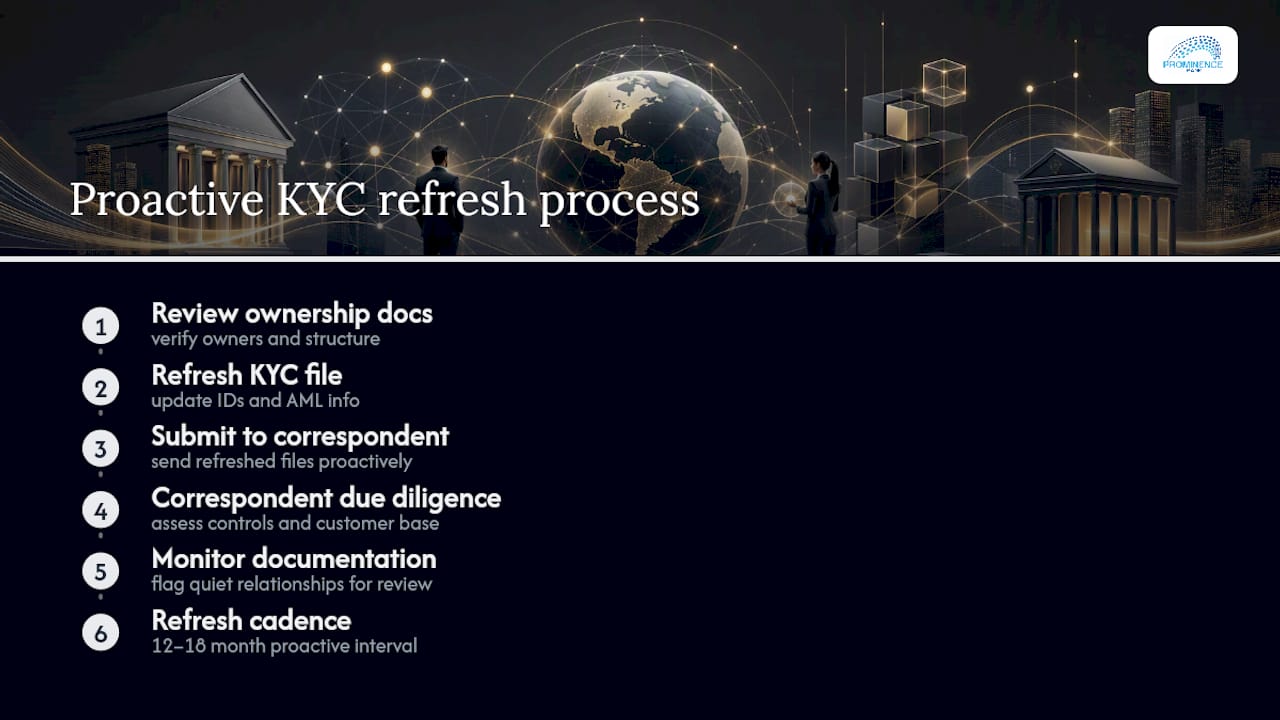
Pro Tip: Don’t wait for your correspondent to ask for updated ownership documents. Push refreshed KYC files to them proactively every 12 to 18 months. Relationships that go quiet on documentation are the first ones flagged for review.
For a deeper look at how due diligence programs are actually structured, AML Guard’s guidance on customer due diligence walks through the practical mechanics of building a defensible program.
What Are Nested Accounts and Payable-Through Accounts?
Some of the riskiest structures in correspondent banking aren’t the direct relationships. They’re the indirect ones.
Nested correspondent banking happens when a respondent bank lets a third bank, one with no direct relationship to the correspondent, access the correspondent account through it. The correspondent may never even know the third bank exists. The BIS/CPMI report flags nesting as a major source of supervisory concern because it adds a layer of opacity the correspondent has no visibility into.

Payable-through accounts let a respondent’s customers write instructions directly against the correspondent account, effectively giving foreign customers quasi-direct access to a bank they have no relationship with.
Common red flags include:
- Transaction volumes that don’t match the respondent’s stated business profile
- Repeated requests to process payments for entities not named in onboarding documents
- Reluctance to identify the ultimate customer behind a transaction
- Sudden volume spikes from a previously dormant account
A Walkthrough: Following a Payment Through the Chain
Picture a manufacturer in Vietnam invoicing a buyer in Poland, settling in US dollars, with neither party’s bank holding a direct account with the other.
- The Vietnamese bank sends an MT103 instruction to its US dollar correspondent, a large US bank where it holds a nostro account.
- The US correspondent checks the payment against sanctions and watch lists, this is where KYCC obligations bite, since the correspondent is really screening the Vietnamese bank’s customer, not its own.
- The US correspondent has its own relationship with the Polish bank’s US dollar correspondent and forwards the payment.
- The Polish bank receives final credit, converts to zloty if needed, and pays the buyer.
The most common failure point isn’t fraud. It’s incomplete originator data causing a hold at step two, or a fee deducted at each hop that leaves the beneficiary short and triggering a reconciliation dispute over who absorbs the difference.
How Prominencebank Approaches Correspondent-Style Connectivity
Licensed digital banks face the same underlying question correspondents do: how do you extend multi-currency reach without inheriting risk you can’t see? Prominencebank operates under this logic directly, offering multi-currency business accounts built with AML/KYC controls aligned to international standards rather than a single jurisdiction’s minimum bar.
Governance follows the same principles Wolfsberg outlines for correspondents generally: senior sign-off on higher-risk account openings, documented due diligence, and scheduled reviews rather than one-time onboarding checks.
Before engaging any correspondent-style service, prepare:
- Clear ownership and beneficiary documentation, ready before it’s requested
- A written description of your expected transaction volume and countries served
- Your own AML/CFT policy, available on request
Pro Tip: Correspondents move faster on applications that arrive complete. Half-finished due diligence files are the single biggest cause of onboarding delay industry-wide.
How Did Correspondent Banking Become the Backbone of Global Finance?
Correspondent banking predates modern regulation by centuries. Merchant banks in medieval Italy used networks of trusted agents in foreign cities to settle trade debts without physically shipping gold across borders, which is functionally the same problem correspondent banking solves today. The practice formalized as international trade expanded in the 19th century, with major banks in London, New York, and later Tokyo building out networks of foreign correspondents to support colonial and industrial trade.
The real inflection point came in 1973, when SWIFT launched as a shared messaging standard, replacing telex and mail-based instructions with a common electronic format banks worldwide could rely on. That single change did more to standardize correspondent banking than any regulation before it, because it gave every bank in the network the same message structure and identifiers to work from.
Regulation caught up much later. The Bank Secrecy Act framework in the United States existed earlier, but correspondent banking specifically drew intense regulatory attention after the September 11, 2001 attacks, when investigators traced financing partly through correspondent accounts with weak oversight. FATF’s correspondent banking guidance and the Wolfsberg Group’s principles both emerged from that period of tightened scrutiny, transforming what had been a largely commercial, relationship-driven business into one governed by formal, documented risk assessments. The 2008 financial crisis added another layer, pushing banks to scrutinize counterparty risk in correspondent relationships as closely as credit risk anywhere else in their balance sheet.
Why Does Correspondent Banking Matter to Global Trade?
Strip correspondent banking out of the global financial system and international trade doesn’t just slow down, large parts of it stop functioning. A letter of credit issued by a bank in Lagos for a buyer purchasing equipment from a supplier in Germany depends entirely on a correspondent relationship that lets the German bank trust the Lagos bank’s undertaking to pay.
This is the invisible infrastructure underneath every trade statistic that gets reported. When a country’s exports grow, correspondent banking capacity has to grow with it, because someone has to convert currencies, settle across time zones, and confirm documentary credits along the way. Smaller economies and frontier markets feel this most acutely: a bank in a country with limited correspondent access effectively has a ceiling on how much international trade its customers can transact, regardless of how much demand exists.
The US dollar’s role as the dominant settlement currency compounds this. Most global trade, even transactions between two non-US countries, settles in dollars at some point, which means most trade finance chains pass through a US dollar correspondent somewhere. That concentration is efficient when it works and fragile when a bank loses dollar correspondent access, which can effectively cut it off from large parts of global trade overnight. This is precisely why the BIS/CPMI report treats correspondent banking concentration as a systemic payments issue, not just a compliance question.
How Is Fintech Changing Correspondent Banking?
The correspondent model built on bilateral nostro/vostro accounts and SWIFT messaging is under real pressure from technology that didn’t exist when the current rulebook was written.
SWIFT’s own gpi (Global Payments Innovation) initiative addressed one of the oldest complaints about correspondent chains, that nobody could track a payment once it left the originating bank, by adding end-to-end tracking across the correspondent network. That doesn’t eliminate the chain; it makes the chain visible, which is a meaningfully different problem to solve.
More disruptive are the alternatives trying to bypass parts of the chain entirely. Bilateral real-time payment links between countries, direct API connections between banks, and specialized payment infrastructure providers are all attempts to shorten the correspondent chain from four or five hops down to one or two. Fewer hops mean fewer fees, faster settlement, and fewer points where compliance screening can create a bottleneck.
Digital currencies and central bank digital currency (CBDC) pilots are the more speculative end of this shift. The appeal is straightforward: if two central banks settle directly on a shared ledger, you remove the need for a chain of commercial correspondents entirely for that corridor. Whether that scales beyond pilot programs is still an open question, but the direction of travel, toward shorter chains and more direct settlement, is consistent across almost every serious fintech initiative touching cross-border payments right now.
What Does De-Risking Actually Cost Financial Inclusion?
De-risking sounds like a risk management success story. It isn’t one. It’s what happens when a bank decides the cost of managing a relationship’s risk exceeds what that relationship is worth, and terminates it wholesale rather than managing it case by case.
The BIS/CPMI technical report documents measurable concentration in correspondent banking, fewer active relationships, with the remaining correspondents handling a larger share of global volume. Compliance costs and uncertainty around KYCC obligations are cited as primary drivers. A large correspondent bank facing the same due diligence burden for a $2 million-a-year relationship as for a $200 million one will often just exit the smaller one.
The people who pay for that decision aren’t usually the banks. They’re the customers of respondent banks in smaller markets, particularly in the Caribbean, Pacific Islands, and parts of Africa, where entire countries have seen correspondent access shrink to a handful of remaining relationships. Remittance corridors, often a lifeline for households dependent on money sent from relatives working abroad, are especially exposed, since remittance flows carry a reputation for higher fraud and money-laundering risk even when the individual transactions are entirely legitimate.
FATF’s own position is unambiguous on this point: wholesale de-risking isn’t what risk-based regulation is supposed to produce, and indiscriminate termination of correspondent relationships can push transactions into informal, unregulated, and far less transparent channels instead of eliminating the underlying risk. That’s a worse outcome for everyone, including the regulators trying to track illicit finance in the first place.
What Comes Next for Correspondent Banking?
Three forces are reshaping this industry at once, and none of them point toward the traditional bilateral correspondent model getting simpler.
Blockchain-based settlement is the most talked-about, and the least proven at scale. Distributed ledger pilots between central banks and select commercial banks have shown that near-instant, 24/7 cross-border settlement is technically achievable without a chain of nostro/vostro accounts. What’s unresolved is governance: who’s liable when a smart contract executes a payment incorrectly, and how does AML screening happen on a ledger designed for speed rather than intermediated review.
Stablecoins and tokenized deposits are pushing into the same space from a different angle, offering near-instant settlement in a digital dollar equivalent without touching the traditional correspondent chain at all for certain corridors. Regulators are still working out how existing AML/CFT frameworks apply to this kind of value transfer, which means adoption for anything beyond niche use cases will likely lag the technology itself.
The more immediate, less flashy trend is consolidation around fewer, larger correspondents equipped to absorb the compliance cost that’s driving smaller players out. That’s good for stability in the corridors that keep their access and bad for financial inclusion in the ones that don’t. Expect the gap between well-served and underserved corridors to widen before any of the newer technologies close it.
Editorial Take: What This Framework Actually Demands
The research here supports one conclusion clearly: correspondent banking’s biggest problem isn’t complexity, it’s asymmetric information. A correspondent is being asked to underwrite risk for people it will never meet, using documentation that’s only as good as the respondent’s own compliance program. Every framework from FATF to Wolfsberg to BIS is really just an attempt to manage that blind spot, not eliminate it, because it can’t be eliminated.
Where conventional coverage of this topic falls short is treating de-risking as an unfortunate side effect. It’s a rational response to a system that doesn’t price compliance cost accurately against relationship size. Until that pricing problem gets solved, at the policy level or the technology level, smaller respondents will keep losing access regardless of how clean their books are.
If there’s one thing readers evaluating their own banking setup should prioritize first, it’s documentation discipline. Not marketing claims, not relationship history. Clean, current, complete ownership and transaction data is what determines whether a correspondent renews you or exits you when the next compliance review comes around.
— Harold
This article is general information, not a substitute for advice from a qualified financial advisor. Consult a qualified financial professional about your own circumstances before acting on anything here.
Sources
- FATF — Guidance on Correspondent Banking Services
- Wolfsberg Group — Financial crime principles for correspondent banking
- BIS/CPMI — Correspondent banking technical report
- Investopedia — What is a correspondent bank?
FAQ
What Is Correspondent Banking in Simple Words?
It’s an arrangement where one bank (the correspondent) holds accounts and processes payments for another bank (the respondent) in a different country, letting the respondent serve customers abroad without a local branch.
What Are the Disadvantages of Correspondent Banking?
The main disadvantages are compounding fees at each hop in the chain, settlement delays from compliance screening, and exposure to sudden relationship termination if the correspondent decides the compliance risk outweighs the revenue.
How Does a Correspondent Bank Work?
A correspondent bank maintains nostro and vostro accounts for the respondent, routes payment instructions via SWIFT messages like MT103, screens transactions against sanctions lists, deducts applicable fees, and reconciles final settlement.
Why Is Correspondent Banking Considered High Risk?
It’s high risk because the correspondent is effectively underwriting the respondent’s own customers, people it never directly identifies or verifies, which is why enhanced due diligence practices like KYCC exist specifically for these relationships.