
A private equity custody account is an account at a custodian that holds the cash and securities of a private equity fund, or of an investor in one, in the fund’s or investor’s name and apart from the manager’s own assets. In the US, when the manager is an SEC-registered adviser with custody, the account generally must sit with a “qualified custodian” such as a bank or registered broker-dealer. The details change depending on whether you are the fund, the manager or the investor.
This guide covers what the account is, what the SEC custody rule asks for, where the audit shortcut fits, what changed in 2024, and how to open an account with us.
TL;DR
- A private equity custody account holds fund or investor assets with a custodian, separate from the manager’s own balance sheet.
- Under SEC Rule 206(4)-2, an SEC-registered adviser with custody generally keeps client funds and securities with a qualified custodian.
- Pooled funds that are audited annually by a PCAOB-registered, inspected accountant can use the audit approach in place of several other requirements.
- The 2023 Private Fund Adviser Rules were vacated in June 2024, so the existing custody rule is what applies today.
- We offer custody accounts, safekeeping receipts (SKR) and numbered accounts for high-net-worth clients, funds and institutions, with published fees.
Table of Contents
- What a private equity custody account is
- Who can hold the assets: the qualified custodian
- What the custody rule asks of an adviser
- What changed in 2023 and 2024
- Crypto in a private equity portfolio
- Safekeeping receipts (SKR) in plain terms
- KTT and numbered accounts
- How we can serve a private equity structure
- A checklist for setting up the account
- Open a custody account with us
- FAQ
- Sources
What a private equity custody account is
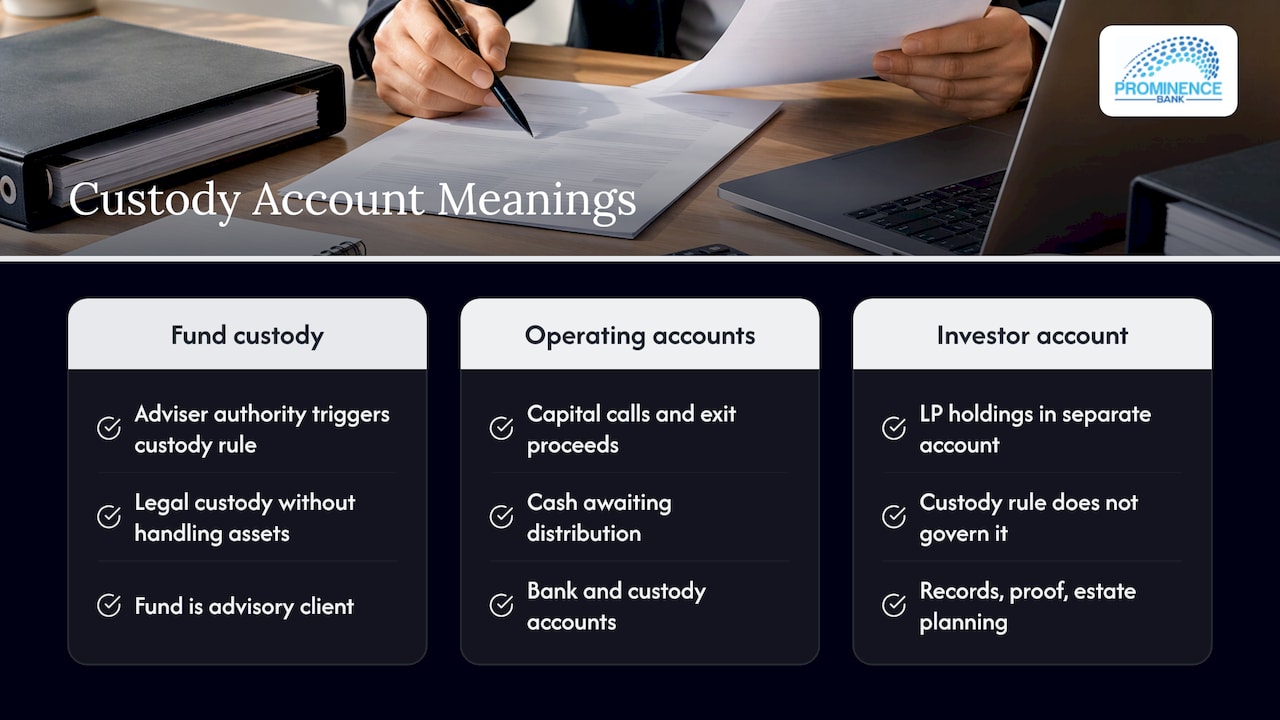
Three things are often called by the same name, and mixing them up causes most of the confusion.
The fund’s custody arrangement. A private equity fund is generally a pooled vehicle that is an advisory client of its registered investment adviser. Because the adviser holds general-partner or comparable authority over the fund, it usually has custody of fund assets in the legal sense, even if it never touches a dollar. That triggers the custody rule.
The fund’s operating accounts. Capital called from limited partners, proceeds from exits and cash awaiting distribution all pass through bank and custody accounts. Those accounts are what most people mean by a private equity custody account.
An investor’s own custody account. A limited partner, family office or wealth manager may hold fund interests, co-investment stakes, listed securities and cash in a separate custody account. The rule does not govern it, but it matters for record keeping, proof of holdings and estate planning.
Private equity differs from listed assets in one practical way. A fund interest is often a contractual right recorded in a partnership agreement and a register, not a certificate sitting in a vault. So custody for private equity is largely about records, authority over cash and who can sign, not only physical safekeeping.
Who can hold the assets: the qualified custodian
The SEC says that custody means an adviser holding client funds or securities, directly or indirectly, or having authority to obtain possession of them. The rule exists to protect against theft and misappropriation, as the SEC’s investor bulletin on custody explains.
For an SEC-registered adviser with custody, a qualified custodian generally holds the client funds or securities. The SEC’s adopting release identifies these as qualified custodians:
- banks and savings associations
- registered broker-dealers
- registered futures commission merchants
- certain foreign financial institutions
The assets must be kept either in a separate account for each client, or in an account that contains only client assets and is held in the adviser’s name as agent or trustee. For a fund, the “client” is the fund itself.
When you choose a custodian, ask your fund counsel which category your structure needs. The answer depends on your adviser’s registration status, where the fund is organized and what the fund holds.
What the custody rule asks of an adviser
Rule 206(4)-2 under the Advisers Act is the core of US custody regulation for advisers. For an SEC-registered adviser with custody, the SEC summarizes the requirements this way:
- Maintain client funds and securities with a qualified custodian.
- Give clients written notice if the adviser opens the custodial account on their behalf.
- Have a reasonable belief that the custodian sends account statements directly to clients at least quarterly.
- Arrange an annual surprise examination by an independent public accountant.
There is an exception when custody arises solely from authority to deduct advisory fees. Fee deduction alone does not trigger the surprise examination.
The audit approach for pooled funds
Most private equity funds do not run through steps 2 to 4. They use the audit approach. For pooled vehicles, the SEC’s exam staff risk alert explains that annual audits can replace the notice, direct-statement and surprise-examination requirements when two conditions are met:
- The fund is audited annually by an independent accountant registered with, and subject to regular inspection by, the PCAOB.
- Audited financial statements go to investors within the deadline.
That deadline is 120 days after fiscal year-end, or 180 days for a fund of funds. A missed deadline is one of the most common findings in custody examinations, so build the date into your annual calendar.
The same audit approach underpins the rule’s private-securities exception. The adopting release ties the exception to a pooled vehicle that is audited annually, with audited statements distributed as required. Privately offered securities that cannot be delivered to a custodian are the typical case: the shares of a portfolio company bought directly from the issuer, for example.
SPVs and post-sale escrows
Private equity deals create awkward corners. The SEC’s 2014 guidance addresses special purpose vehicles and escrows set up after the sale of a portfolio company. A commingled escrow can qualify under specified conditions, including:
- reliance on the audit approach
- a portfolio-company sale or merger
- bona fide negotiation of the amount and duration
- maintenance by a qualified custodian
- a contractual formula for distributing the proceeds
If you run deal-specific vehicles or holdbacks, read the guidance with your counsel before you set up the account structure.
What changed in 2023 and 2024
In 2023 the SEC adopted Private Fund Adviser Rules that included quarterly statement and mandatory audit provisions. Searches for this topic still surface articles written when the changes were pending. The status now is clear. The Fifth Circuit vacated the rules on June 5, 2024, and those rules and related amendments are no longer in effect.
Older commentary on a broader safeguarding rule is also worth reading with the date in mind. The SEC published a 2026 proposal on adviser and regulated-fund custody rules. It is a proposal. Until it is finalized, the existing custody rule and its audit approach are what you plan around. Check the SEC’s private fund adviser page for the current status before you finalize a custody design.
Crypto in a private equity portfolio
More funds now hold digital assets, either directly or through portfolio companies. Crypto custody is not the same as holding a stake in a private company. The SEC’s proposal describes private keys that control transfers, ownership recorded on distributed ledgers, and on-chain transfers that generally cannot be restored once made.
The SEC has also sought comment on whether digital assets are funds or securities for custody-rule purposes, and flagged difficulty of independent examination and pseudonymity as distinct issues. Under the 2026 proposal, the custody amendments would cover crypto assets only when they are funds or securities, or regulated-fund securities or similar investments. Proposed adviser self-custody would need conditions such as a written finding that no permitted custodian is available, plus documented safeguarding expertise and controls.
In practice: keep crypto holdings in a custody account that is clearly separate from operating cash, document who controls the keys, and make sure your auditor can verify balances. Our guides on cold storage custody banking and making crypto auditable go through the controls in more detail.
Safekeeping receipts (SKR) in plain terms
A safekeeping receipt is a document issued by a custodian confirming that it holds a specified asset for a named party. It is a contractual instrument. It is not a mandatory SEC custody document. One custody agreement filed with the SEC, for instance, says the custodian may assign an identifying number to an investment file and safekeep it but is not required to issue a trust receipt or similar instrument.
What does that mean for you? Read the receipt together with the custody agreement. The two documents together say what is held, in whose name, under what terms, and how it can be released. For private equity, an SKR can document a fund interest, a stock certificate or a bond held for a fund or an investor. We issue SKRs as part of our custody service.
KTT and numbered accounts
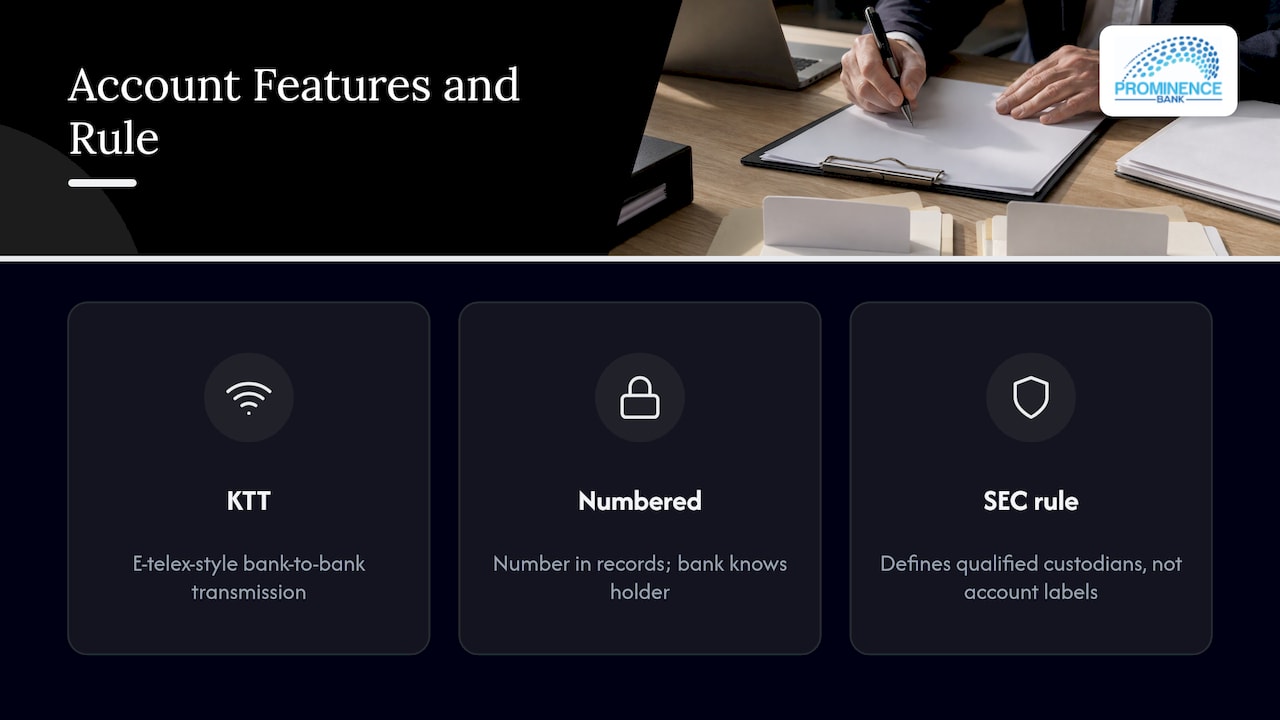
Two terms come up in offshore custody conversations. A KTT is an e-telex style bank-to-bank transmission, and we offer KTT-enabled accounts. A numbered account is an account where the name is replaced by a number in day-to-day records, with the holder’s identity known to the bank under its compliance procedures. We offer both.
These are our account types and services. They are not categories defined in the SEC’s custody rule, which speaks of qualified custodians, not account labels. If your fund has US adviser obligations, treat the custody rule as the test for who holds fund assets, and use account features such as numbering or KTT for the discretion and settlement needs of your structure. Our article on confidentiality in private banking explains how discretion and compliance sit together.
Our perspective
Most managers think of custody as paperwork they must file. We think of it as the part of the structure that investors trust first. When a limited partner asks where the money sits, a clear answer about separation, signing authority and records ends the conversation faster than any pitch deck.
That is why our custody accounts are built around separation of assets, instant online access and documentation that stands up to review. Our approach to private equity clients is simple: keep fund cash, holdings and receipts in clearly labeled accounts, document every release, and use multi-currency accounts so that capital calls and distributions settle without friction.
We also see value in discretion. High-net-worth investors and international sponsors often want their holdings kept confidential, and our numbered and KTT-enabled accounts are designed for that, within international AML/KYC standards. Our view is that privacy and rigorous compliance belong together, and our clients should not have to choose between them.
Harold
How we can serve a private equity structure
We are a licensed digital bank operating under the Extraterritorial Trade Mission Office (ETMO), serving high-net-worth individuals, international businesses and institutions. For private equity participants, these services are the relevant ones:
- Custody accounts and SKR for holding and documenting assets. See our explainer on custody accounts for wealth clients.
- Multi-currency business and corporate accounts for management companies, holding companies and fund-related entities. See our corporate banking page.
- Private banking for the individuals behind the structure, including private banking for investors and sponsors.
- Investment banking and institutional services for deal-related work.
- Separation of accounts for people who mix personal, family and business assets. See why account separation matters.
If you also hold assets abroad, our guide to international custody account procedures covers the steps.
Published fees
Our fee schedule is public on our fees page. These are the figures most relevant to a custody and fund-related setup:
| Item | Fee |
|---|---|
| Bank account opening | 25,000 $/€ one-off |
| Numbered bank account opening | $/€ 50,000 one-off |
| Numbered account monthly fee | 100 $/€ per month |
| Savings account monthly fee | 40 $/€ per month |
| KTT (e-telex) transaction, incoming or outgoing | 1.5% |
| Bank endorsement | 1.5% |
| Internal transfer between Prominence Bank accounts | 0.2% |
| Currency conversion | 4% |
| Reference or comfort letter | €25,000 one-off |
| Proof of funds (POF) | €25,000 one-off |
| Enhanced due diligence, Level 1 | €5,000 one-off |
| Enhanced due diligence, Level 2 | €10,000 one-off |
| Enhanced due diligence, Level 3 | €15,000 one-off |
SKR and custody service pricing, and SWIFT or IBAN wire fees, are not published on the schedule. Ask us for those when you apply. Enhanced due diligence levels reflect the complexity of the structure, from enhanced standard to critical or complex.
A checklist for setting up the account
- Define who the account is for. The fund, the management company, a deal SPV or an investor each need a distinct account.
- Confirm your regulatory position. Ask your counsel whether your adviser is SEC-registered, whether it has custody and which custodian category the rule requires.
- Decide on the audit approach. If the fund relies on it, line up a PCAOB-registered, inspected auditor and put the 120-day or 180-day deadline in your calendar.
- Map the cash flows. List capital calls, distributions, fees and currencies, and decide which account handles each.
- Separate crypto from operating cash if the fund holds digital assets, and document key control.
- Prepare KYC documents. Ownership charts, source of funds and identification for every principal speed up onboarding. Complex structures may need an enhanced due diligence level.
- Agree on documents. Settle the custody agreement, any SKR terms and signing authorities before assets move.
A step-by-step guide to corporate banking and our corporate account structuring checklist can help with the documents.
Open a custody account with us
If you are a sponsor, wealth manager or investor who wants a custody account with discretion, multi-currency access and fully online onboarding, we can help you structure it. Our business and corporate accounts suit management companies and holding entities, and our private banking suits the individuals behind them.

Start with the business account application, or review the full fee schedule and our services at prominencebank.com.
FAQ
Does a private equity fund need a custodian?
If the fund’s adviser is SEC-registered and has custody, client funds and securities generally must be held by a qualified custodian. Funds audited annually under the audit approach avoid several other custody requirements, but not the underlying framework. Confirm your position with fund counsel.
What is a qualified custodian?
The SEC lists banks and savings associations, registered broker-dealers, registered futures commission merchants and certain foreign financial institutions. The assets are held in separate client accounts, or in accounts containing only client assets under the adviser’s name as agent or trustee.
Are the 2023 private fund rules in force?
No. The Fifth Circuit vacated the SEC’s 2023 Private Fund Adviser Rules on June 5, 2024. The existing custody rule and its audit approach remain the framework. A separate 2026 SEC proposal on custody has not been finalized, so check the SEC’s page for updates.
What is a safekeeping receipt?
It is a custodian’s contractual confirmation that it holds a specified asset for a named party. It is not a mandatory SEC document, so read it with the custody agreement to see what it covers. We issue SKRs as part of our custody service.
Can I hold crypto in a private equity custody account?
Crypto raises distinct issues such as private keys and irreversible transfers. Keep digital assets in a separate custody account, document key control and make sure your auditor can verify balances. Our custody and cold storage guides explain the controls.
Sources
- SEC Investor Bulletin: Custody of Your Investment Assets
- SEC Final Rule: Custody of Funds or Securities of Clients by Investment Advisers
- SEC: Private Funds and the Application of the Custody Rule (2014)
- SEC National Exam Program Risk Alert on custody
- McGuireWoods: SEC Guidance on Applying the Custody Rule to Private Equity
- SEC: Private Fund Advisers
- SEC 2026 proposed rule: Adviser and Regulated Fund Custody Rules
- SEC: Engaging on Non-DVP Custodial Practices and Digital Assets
- SEC-filed custody agreement, Exhibit 10.5