
Offshore account due diligence is the set of checks a bank runs before it opens your account and for as long as it stays open: who you are, who owns and controls the structure, what the account is for, and where the money comes from. Expect identity documents, ownership records and proof of funds up front, then periodic reviews. Higher-risk profiles get a deeper review called enhanced due diligence (EDD). If you are a U.S. person, you also have your own reporting duties to the IRS and FinCEN, whatever the bank does.
TL;DR
- Every regulated bank verifies identity, beneficial owners, the purpose of the account and the source of funds. The depth depends on risk, not on a fixed checklist.
- EDD applies to complex structures, higher-risk jurisdictions, large flows and politically exposed people. It means more documents and more time.
- At Prominence Bank, EDD is a priced step: €5,000, €10,000 or €15,000 depending on the level. Account opening itself starts at 25,000 in USD or EUR.
- U.S. persons must report foreign accounts on FBAR above $10,000 in aggregate, and may also owe Form 8938 under FATCA. Missed filings carry real penalties.
- Prepare your file before you apply. A complete, consistent package is the fastest route through review.
Table of Contents
- What due diligence means for an offshore account
- The documents banks ask for
- When enhanced due diligence applies
- Different accounts, different scrutiny
- Can a U.S. person open an account abroad without living there?
- A note for U.S. persons
- How to prepare a file that clears review
- Spotting legitimate providers and warning signs
- Prominence’s perspective
- Start your application with a complete file
- FAQ
- Sources
What due diligence means for an offshore account
The term covers two moments. The first is onboarding: the bank establishes who you are and what risk you bring. The second is ongoing monitoring: the bank watches activity and keeps your information current.
U.S. rules describe the same logic. Banks must apply risk-based customer due diligence to understand the nature and purpose of each customer relationship, monitor it, and update customer information on a risk basis. The CDD Rule does not set a fixed schedule for refreshing customer information, so reviews are triggered by risk and by what the account does, not by the calendar alone.
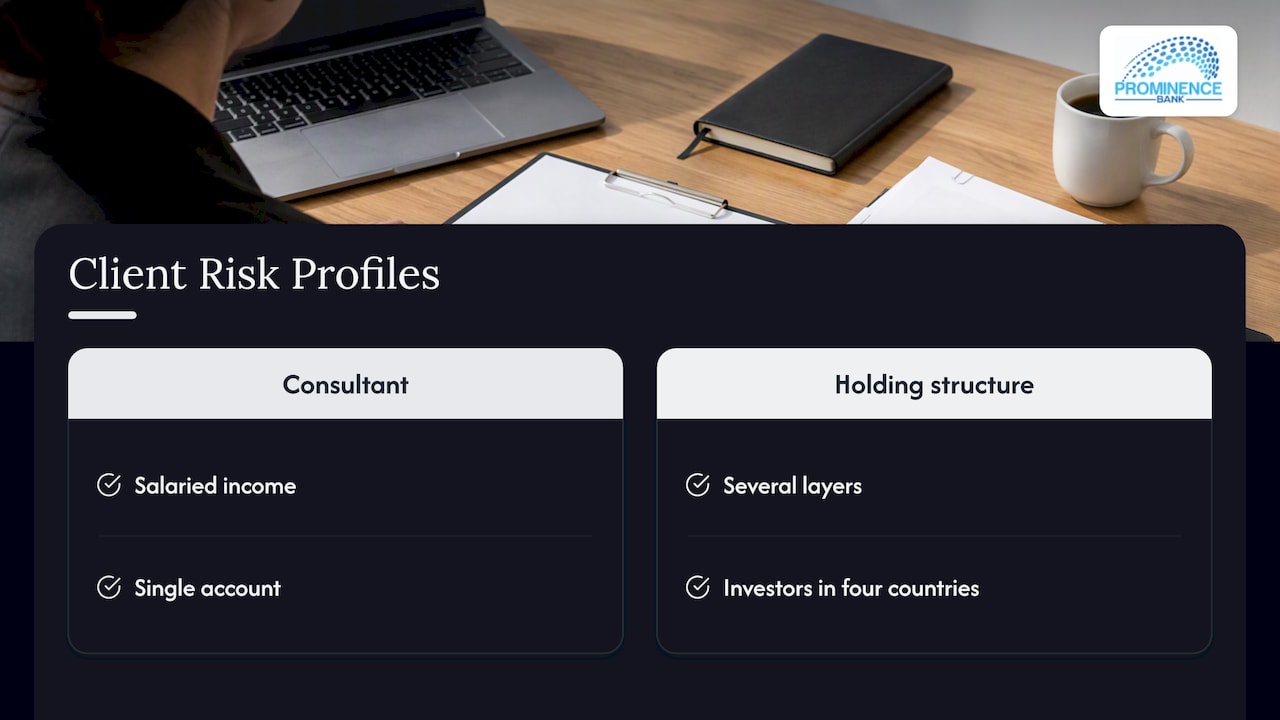
FinCEN has also made clear that due diligence is meant to vary case by case, and that no product or customer type is automatically high risk. For you, that means two clients with the same account type can face very different questions. A salaried consultant paid into a single account looks different from a holding structure with several layers and investors in four countries.
For banks that hold correspondent accounts for foreign institutions, U.S. rules go further and require a risk-based due diligence program to detect and report money laundering on an ongoing basis. That is one reason an offshore bank that wants to keep dollar access is strict with its own clients. Our guide to correspondent banking and 12 to 18 month KYC cycles explains how that pressure reaches you.
The documents banks ask for
The core list is short and predictable. What changes is how much proof stands behind each item.
Identity
Under the U.S. customer identification rule, a bank must collect a name, date of birth, address and identification number before opening an account, and verify identity within a reasonable time afterward. Offshore banks typically ask for a certified passport copy, proof of address such as a recent utility bill or bank statement, and a second form of ID. Certification and recency requirements differ by institution, so confirm them before you pay for notarization or apostilles.
Beneficial ownership
For companies, the bank looks through the entity to the people behind it. The U.S. standard collects information on any natural person who owns 25% or more of the entity, plus one person with significant control responsibility. Foreign banks may set a lower threshold or ask for every shareholder. Prepare:
- Certificate of incorporation and articles
- A current register of directors and shareholders
- A structure chart showing every layer down to the individuals
- Identity documents for each beneficial owner and director
FFIEC examiners list higher-risk jurisdictions, circular fund transfers and bearer shares among the risk factors in business-entity accounts. If your structure includes any of these, say so early and explain why.
Purpose and expected activity
Banks want to know what the account is for, which currencies and countries it will touch, and the expected monthly volume. Vague answers slow everything down. A one-page business description with named counterparties, typical invoice sizes and the countries involved is usually enough to start.
Source of funds and source of wealth
Source of funds is where the money in this account comes from. Source of wealth is how you built your overall net worth. For private banking accounts, U.S. rules specifically require banks to identify all nominal and beneficial owners, determine whether any is a senior foreign political figure, and establish the source of funds. Typical evidence includes:
- Sale agreements for a business or property, with proof of receipt
- Audited accounts or tax returns for operating companies
- Dividend vouchers, payslips or a trust deed for inherited or distributed wealth
- Statements from the account the funds are moving from
Keep the story consistent across documents. Mismatched dates, names or amounts cause more delays than missing paperwork.
When enhanced due diligence applies
Standard review is sufficient for many clients. EDD applies when something raises the risk. Regulators expect it where a bank identifies heightened risks such as certain business types, geographic locations or high-risk customer profiles, so it can better understand the purpose of the account and the source of funds.
In practice, these triggers recur:
- Ownership chains with several jurisdictions or nominee layers
- Politically exposed persons and their relatives or close associates
- Large or irregular transfers compared with the stated profile
- Cash-intensive or trade-finance activity
- Instruments such as numbered accounts, KTT transactions or safekeeping receipts, where the paper trail matters more
EDD is not an accusation. It is the bank documenting that it understands an unusual profile. Clients who arrive with a clean file often clear it faster than those who offer short answers.
How we structure EDD at Prominence Bank
We publish our EDD fees so you can budget before you apply. According to our fee schedule, the review comes in three levels:
| EDD level | Typical use | Fee (one-off) |
|---|---|---|
| Level 1, Enhanced Standard | Profiles with a few elevated risk factors | €5,000 |
| Level 2, Advanced | Multi-entity or multi-jurisdiction structures | €10,000 |
| Level 3, Critical / Complex | The most complex or highest-risk files | €15,000 |
The same schedule lists bank account opening at 25,000 (USD or EUR) one-off, numbered account opening at €50,000 one-off, and a monthly fee of 100 (USD or EUR) for a numbered account and 40 (USD or EUR) for a savings account. Fees are charged as published, so read the schedule before you submit anything. The $/€25,000 account opening fee is refunded in full if an application is declined, and it is non-refundable once the account has been approved and opened.
Different accounts, different scrutiny
Corporate accounts
The heaviest document load sits here: constitutional documents, ownership, directors, financial statements and contracts that explain the flows. Complex groups benefit from a structure chart prepared before the first call. Our corporate account structuring checklist walks through what to assemble.
Numbered accounts
A numbered account hides the name on day-to-day records, not from the bank. The institution still verifies the holder and the beneficial owners in full. Privacy applies to who inside and outside the bank can see the name, never to whether the checks happen.
Cryptocurrency and custody accounts
U.S. banking regulators state that banking organizations providing crypto-asset safekeeping must control the cryptographic keys and comply with BSA/AML requirements, including customer identity verification and due diligence. Expect questions about wallet addresses, the origin of the crypto holdings and the exchanges used.
KTT accounts and safekeeping receipts
KTT (key tested telex) transfers and safekeeping receipts (SKRs) are instruments used in trade, custody and financial structuring. Because they can move or evidence large value, a bank reviews the underlying asset, the counterparties and the purpose before issuing or accepting them. Our fee schedule lists the KTT (E-Telex) transaction fee at 1.5% of face value on every KTT received, of any type, even when no settlement follows, bank endorsement at 1.5%, and the SKR / custody service at €25,000 for the custody account plus 2%.
Can a U.S. person open an account abroad without living there?
Yes, in general. Many international banks onboard non-resident clients remotely, and digital institutions are built for it. The checks are the same as above, delivered through certified copies and video or document verification instead of a branch visit. Some banks restrict U.S. persons because of the reporting burden, so ask early whether the bank accepts U.S. clients and whether it will request a W-9. Our overview of global account opening requirements for high-net-worth clients lists the usual items.
A note for U.S. persons
If you are a U.S. person, holding a foreign account can create separate tax and reporting obligations in the United States. Those obligations depend on your own circumstances and are outside the scope of this article. Confirm them with a qualified U.S. tax adviser before you open an account.
How to prepare a file that clears review
- Build the ownership map first. One chart, every layer, percentages and countries.
- Gather identity and address proof for each individual, certified as the bank requires.
- Write the account purpose in one page. Currencies, counterparties, expected volumes.
- Document the money. Pair each major source with the paper that proves it.
- Disclose sensitive facts early, such as political exposure or past account closures.
- Agree your tax position with your adviser before funds move.
- Keep the file current. Update the bank when ownership, address or activity changes.
Records also matter on the bank’s side: U.S. rules require banks to keep identification records for five years after an account is closed. Assume your file will exist, and be read, for a long time.
Spotting legitimate providers and warning signs
Due diligence runs both ways. Before you send passports and financial statements, check the provider. Confirm the licensing authority and ask for it in writing, look up the regulator’s register yourself, and compare the fee schedule with what you are being told. Be cautious if you are pressured to move quickly, asked to pay through unusual channels, or told that no checks apply. Government warnings show the pattern: scammers posing as officials may demand money be moved for “safekeeping”, and the Justice Department’s senior scam alert describes threats that accounts will be frozen and requests for payment in unusual forms. A real bank explains its checks and prices, and asks for more documents, not fewer.
Prominence’s perspective
We see due diligence as the price of a bank you can rely on, and we would rather make it predictable than hide it. Clients with international structures usually know the compliance questions are coming. What frustrates them is not knowing the cost, the order or the timeline.
That is why our fees are published, including the three EDD levels. Our model is built around fully digital onboarding, multi-currency accounts, numbered and KTT-enabled options, and a compliance framework designed for discretion with AML/KYC standards intact. Privacy and compliance are not opposites. The more complete your file, the more privately and quickly the account can run afterward.
Our advice is to treat the review as part of the product. Bring the ownership map, the source-of-funds evidence and a clear account purpose, and we can match you to the right level of review instead of the heaviest one by default.
Harold
Start your application with a complete file
Prominence Bank offers Personal and Business/Corporate accounts opened through a digital application, with multi-currency banking and 24/7 Internet Banking. The published account opening fee is $/€25,000. It is refunded in full if an application is declined and no account is opened, and it is non-refundable once the account has been approved and opened. Minimum balances are $/€5,000 for a Personal account and $/€10,000 for a Business/Corporate account.
Complete applications are normally reviewed within 48 to 72 hours after all requested information, documents and verification steps have been completed and accepted. This is an estimate, not a guarantee, and additional review may take longer. All accounts, transactions and services are subject to eligibility, KYC/AML, sanctions screening, due diligence and final bank approval. See the fees page for the current published schedule.
FAQ
What is due diligence for banks?
It is the process of verifying a customer’s identity, ownership, purpose of account and source of funds, then monitoring activity afterward. U.S. guidance frames it as risk-based, with more focus on higher-risk customers. Lower-risk clients get lighter reviews, and complex ones get EDD.
Do I have to report an offshore account to the U.S. government?
If you are a U.S. person and your foreign accounts together exceed $10,000 at any point in the year, you generally must file an FBAR. Form 8938 may apply too under FATCA. Ask a U.S. tax professional which forms fit your situation.
How long does enhanced due diligence take?
It depends on how complete your documents are and how many entities and jurisdictions are involved. Simple files can move quickly, while multi-layer structures take longer. Submitting the ownership map, source-of-funds evidence and a written account purpose together is the best way to shorten it.
Can a numbered account avoid due diligence?
No. A numbered account limits who can see the holder’s name in routine records, but the bank still verifies the holder and the beneficial owners in full. Any provider that promises no checks should be treated as a warning sign.
Sources
- Section 1010.610, due diligence programs for correspondent accounts (Federal Reserve)
- Customer Due Diligence overview (FDIC)
- Joint statement on the risk-based approach to CDD (Federal Reserve)
- FinCEN guidance FIN-2020-G002
- Section 1020.220, customer identification program (Federal Reserve)
- Testimony of FinCEN Director Kenneth Blanco
- Section 1010.620, private banking accounts (Federal Reserve)
- FFIEC BSA/AML manual, business entity risks
- IRS Office of Professional Responsibility, 2025-10
- Summary of FATCA reporting for U.S. taxpayers (IRS)
- IRM 4.26.16, Report of Foreign Bank and Financial Accounts (IRS)
- U.S. Attorney’s Office, Southern District of Florida, 2010 press release
- Senior scam alert (Justice Department)