
Keeping documents in safe custody with a bank usually means one of two things. For paper you rarely need, such as a deed or a birth certificate, it means renting a safe deposit box. For securities, digital assets and bank instruments, it means a custody account or a safekeeping receipt (SKR). The two are built differently, protected differently and priced differently. This guide explains both, so you can match each item you own to the right kind of custody.
TL;DR
- A safe deposit box is a locked container in a bank vault that you rent. The bank controls the vault, and you control what goes in the box.
- Neither the bank nor the FDIC insures what is inside a box. Ask your homeowner’s or renter’s insurer about adding coverage.
- Good fits are original deeds, titles, birth certificates and irreplaceable photos. Keep passports and powers of attorney where you can reach them quickly.
- Securities, crypto and instruments belong in a custody account or an SKR, which is a different structure from a box.
- Annual box rent in the U.S. runs from about $15 to $350, depending on size and branch.
Table of Contents
- What “safe custody” with a bank actually means
- How a safe deposit box works
- What to store in a bank box and what to keep close
- Are box contents fireproof or insured?
- What a safe deposit box costs in the U.S.
- When documents need custody rather than a box
- A checklist before you choose
- Our perspective
- Custody and safekeeping receipts at Prominence Bank
- FAQ
- Sources
What “safe custody” with a bank actually means
Banks hold things for customers in two very different ways.
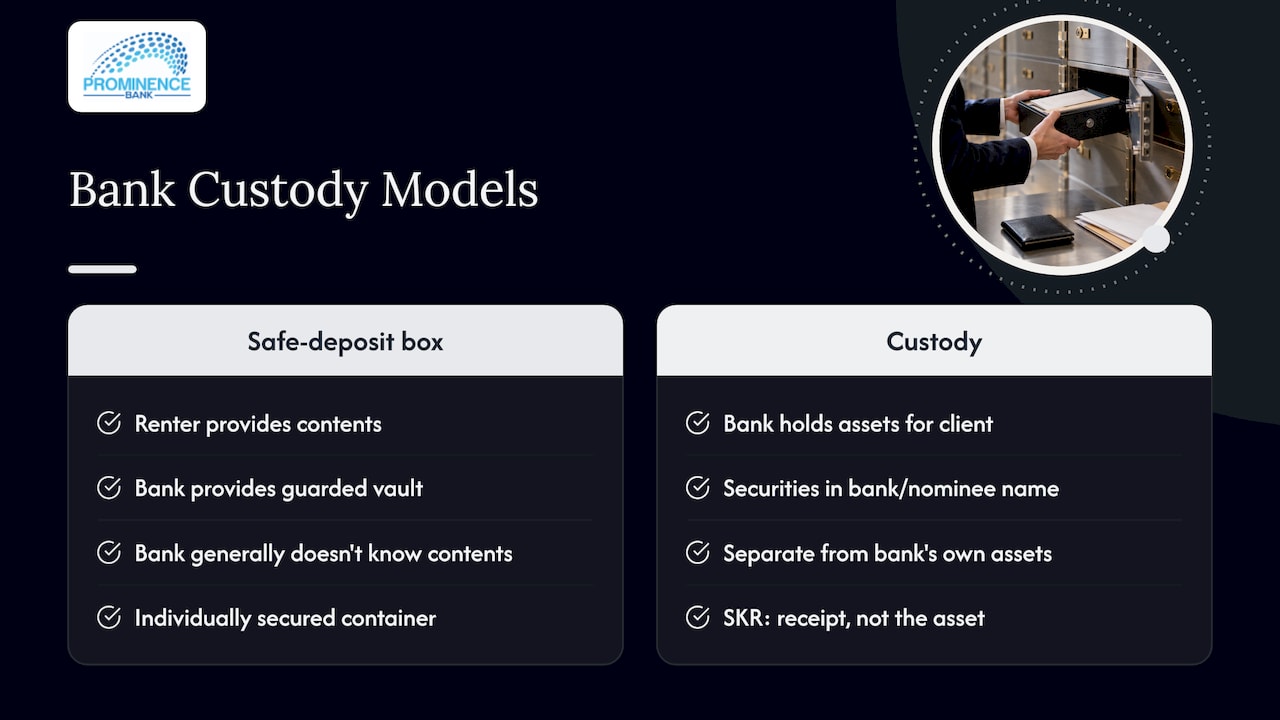
The first is physical. A safe deposit box is an individually secured container inside a bank’s vault, and customers rent it to store valuable items, as the OCC’s Comptroller’s Handbook describes it. The bank provides the vault, the guard procedures and the access records. You provide the contents, and the bank generally does not know what they are.
The second is a custody relationship. Here the bank holds assets on your behalf: securities, funds, digital assets or documents that represent value. Custody securities are generally registered in the bank’s or its nominee’s name and kept separate from the bank’s own assets. U.S. Bank explains that they should be returned to the client if the bank becomes insolvent. An SKR sits in this second family. It is a receipt that evidences assets held in safekeeping, so the paper itself is not the thing of value.
Most people searching this phrase have the first meaning in mind. Many high-net-worth households and companies need both.
How a safe deposit box works
Renting and access
You usually need an account with the bank to rent a box. The bank issues a key, and sometimes adds a bank-held guard key as well. Access follows a routine: you sign in, the bank checks your signature card, and two keys or two people open the box. The OCC notes that banks use dual control and authorized signature cards so that only authorized people can remove contents.
That routine is an access-control system, and the same logic applies online. If your custody account has a web portal, the login is the new vault door. A hardware security key is a common way to make sure only the people on your signature card can get in.
When someone else can open the box
Your box is not off-limits to everyone else. The OCC’s consumer guidance says a box may be opened without the renter’s permission under a court order, search warrant, rental delinquency or branch closure. If a customer stops paying, rental agreements disclose that the bank may open the box under its agreement terms.
Long neglect has a legal endpoint too. A box can become dormant after roughly three to five years without fee payment or other activity, depending on state law. If it is abandoned, the contents may be transferred to the state under escheat procedures, usually after required notice. Keep your mailing address current with the bank, and pay the rent on autopay if the bank allows it.
If you lose the key or the renter dies
A lost key means the bank arranges for the lock to be drilled and replaced, usually at your cost, with identity checks first. Death is more complicated. Access by heirs depends on the rental agreement, whether there is a co-renter or authorized deputy, and state law. The IRS treats a box as part of the estate picture: Schedule F of Form 706 asks whether the decedent owned or had access to a safe deposit box and where it is located. Tell your executor which bank and branch holds the box, and name a co-renter or deputy if you want smooth access.
What to store in a bank box and what to keep close
The FDIC’s guidance gives a practical sorting rule: put things in a box that are hard to replace and not needed often. Its list of good candidates includes original birth certificates, property deeds, car titles, family keepsakes, valuable collections and irreplaceable photos. The same page suggests photos or videos of your home’s contents, which are useful for insurance claims.
Some items are better kept within reach:
- Passports and original powers of attorney. The FDIC says to keep these accessible, because you may need them outside bank hours or in an emergency.
- An original will. The FDIC advises asking an attorney where to keep it, because the right answer depends on state law. A box that is sealed after death can slow down the very process the will starts.
- Cash. Rental agreements may limit it, and the FDIC says cash in a box is not insured and earns no interest. It recommends keeping cash in a deposit account instead.
A simple habit helps: scan every document before it goes into the box, and store the scans in an encrypted location. If the box is ever inaccessible, you still have working copies.
Are box contents fireproof or insured?
This is the question most readers ask, and the answer needs care.
Insurance. The FDIC does not insure box contents, because they are not deposits, and financial institutions generally do not insure them either. The FDIC’s list of insured products covers checking, savings, money market deposit accounts and CDs, and it excludes safe deposit boxes and their contents. The FDIC suggests asking your homeowner’s or renter’s insurance agent whether you can add coverage for valuables kept in a box.
Bank responsibility. The bank is expected to use reasonable care against loss from unauthorized entry, fire, water damage or forces of nature. It does not insure the contents, according to the OCC handbook. If something goes missing, the outcome depends on the agreement, state law and whether access controls were followed.
Fire and water. A vault is not a fireproof or waterproof promise. The FDIC’s disaster guidance notes that most boxes are not waterproof and recommends sealing documents in waterproof bags or containers.
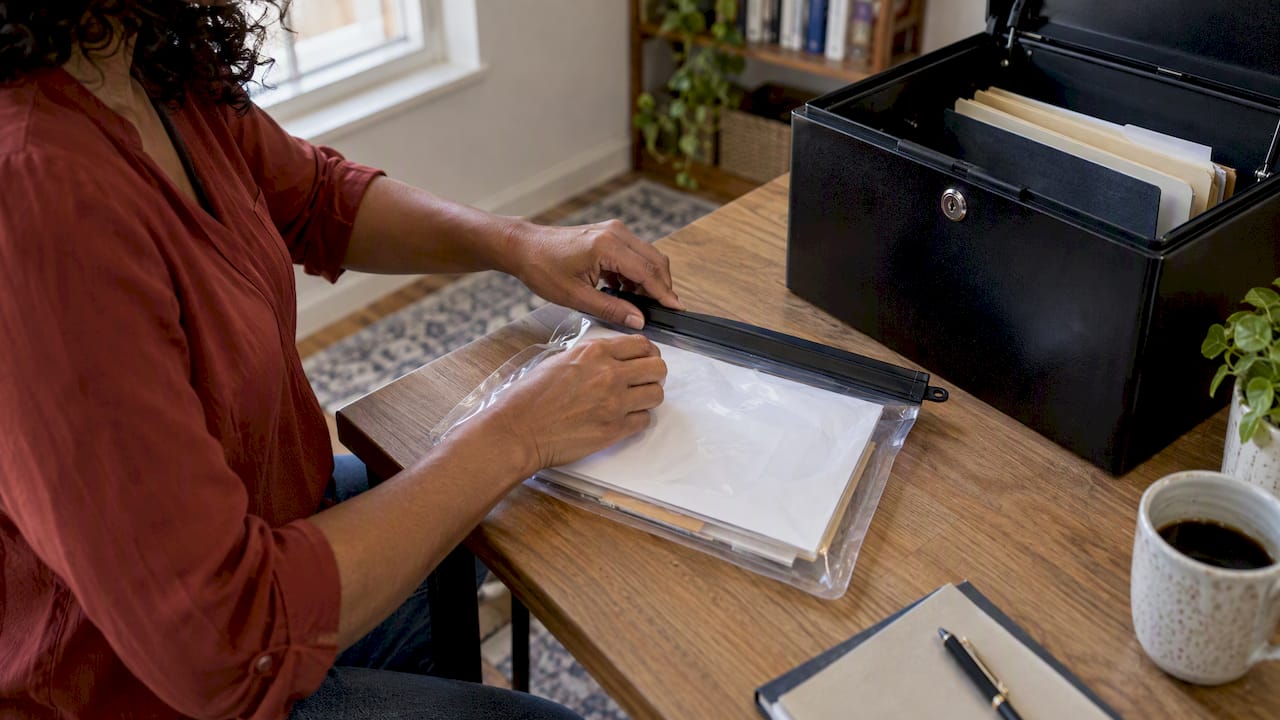
The practical conclusion: before you store anything of high value, write down its worth, photograph it, and confirm with your insurer what is covered while it sits in the box.
What a safe deposit box costs in the U.S.
There is no national price. Size and branch drive the rent, and one bank can charge differently from branch to branch. A 2026 price guide from MyBankTracker found annual fees from $15 to $350. Its sample of large and regional banks, drawn mostly from the New York area and customer forums, shows the spread:
| Box size | Low end in the sample | High end in the sample |
|---|---|---|
| 3" x 5" | $15 | $80 |
| 3" x 10" | $30 | $125 |
| 10" x 10" | $80 | $350 |
Treat these as ranges, not quotes. Ask the branch you plan to use for its current schedule, and ask about discounts. Some banks reduce or waive rent for customers with premium checking tiers. Also ask what happens if you pay late, since late fees and drilling charges can add up.
When documents need custody rather than a box
A box is a good home for the paper itself. Many documents that matter to wealthy families and companies are not valuable as paper, though. What matters is the asset or right they represent. In those cases custody is the better frame.
| Need | Typical fit |
|---|---|
| Original deed, title, birth certificate, keepsakes | Safe deposit box |
| Securities, funds, bonds | Custody account |
| Digital assets and keys | Crypto or cold storage custody |
| Evidence of assets held in safekeeping | Safekeeping receipt (SKR) |
| Proof that funds exist | Bank-issued proof of funds or reference letter |
Two points explain why this split matters. First, custody assets are held apart from the bank’s own balance sheet, and institutional custody is designed to keep them out of reach of the bank’s creditors. Second, a custodian keeps records, handles settlement and reports on what it holds. A box does none of that.
If you want the mechanics, our guide to custody accounts for wealth clients walks through account structure, and the piece on international custody account procedures covers cross-border onboarding. For digital assets, see cold storage custody banking. For fee structures, read our note on avoiding overpaid custody fees.
A checklist before you choose
- List what you hold. Split it into paper you need to keep, assets the paper represents, and digital items.
- Rate each by replacement difficulty and frequency of use. Hard to replace and rarely needed points to a box. Valuable and active points to custody.
- Check the insurance. Call your insurer about box contents. For custody, ask how assets are segregated and reported.
- Name your people. Add a co-renter, deputy or authorized signatory, and tell your executor where everything sits.
- Plan for access. Know the branch hours, the key rules and the online security. Use strong authentication on any online custody portal.
- Keep copies. Scan documents and store the files securely, separately from the originals.
Our perspective
Most people think of safe custody as a locked door in a basement. That picture is right for a deed or a family album. It is incomplete for a client whose wealth sits in securities, treasury positions, digital assets or bank instruments.
We built Prominence Bank for clients who need discretion and a fully online relationship, so we treat custody as a service, not a container. The point is not only where an asset sits. It is who can instruct on it, how it is segregated, how it is reported and how quickly an authorized person can act from anywhere in the world.
Our approach is to pair strong access controls and international AML/KYC compliance with the structures clients actually use: custody accounts, safekeeping receipts, multi-currency accounts and, for those who want it, numbered accounts. We would rather a client ask hard questions about segregation, signatories and fees before opening an account than after.
Our advice: map your documents to the assets behind them first. Then choose the custody that fits each one.
Harold
Custody and safekeeping receipts at Prominence Bank
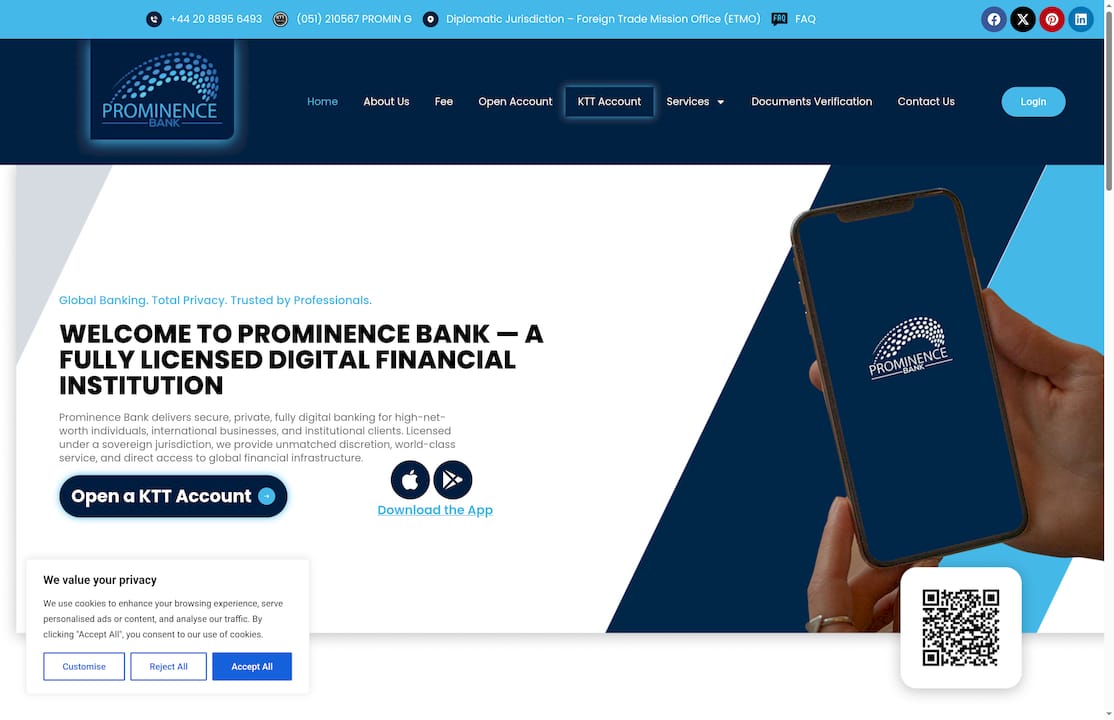
If your documents represent significant assets, we offer a fully online banking relationship built for high-net-worth individuals, international businesses and institutions. That includes asset custody, safekeeping receipts (SKR), private numbered accounts, multi-currency business accounts and KTT-enabled accounts. The published fee for the Safekeeping Receipt (SKR) / custody service is €25,000 for the custody account plus 2%.
Some published fees, from our fee schedule:
| Service | Published fee |
|---|---|
| Bank account opening | 25,000 (USD or EUR), one-off |
| Numbered account opening | €50,000, one-off |
| Numbered account monthly fee | 100 (USD or EUR) per month |
| Proof of funds | €25,000, one-off |
| Bank endorsement | 1.5% |
| Enhanced due diligence | €5,000 to €15,000, one-off, by level |
These are institutional-grade services priced accordingly. To see whether our private banking or corporate banking offering suits your structure, start on the Prominence Bank homepage.
FAQ
Is it safe to keep documents in a bank safe deposit box?
For documents that are hard to replace and rarely needed, yes, it is a widely used option. Banks use dual control and signature cards to limit access. The contents are not insured by the bank or the FDIC, so confirm coverage with your insurance agent and keep scans of everything.
Can someone else open my safe deposit box?
Only people on your signature card should get in during normal operations. A court order, search warrant, unpaid rent or a branch closure can lead to the bank opening a box without you. After a death, access depends on the rental agreement and state law, so name a co-renter or deputy in advance.
How much does a bank safe deposit box cost?
U.S. annual rent runs from about $15 for a small box to $350 for a large one, and it varies by bank and even by branch. Ask your branch for its current schedule and any account-based discounts.
What is the difference between a safe deposit box and a custody account?
A box stores physical items that you control. A custody account holds assets such as securities with a custodian that keeps them separate from its own assets, records them and reports on them. An SKR evidences assets held in safekeeping.
Sources
- OCC Comptroller’s Handbook: Consigned Items and Other Customer Services
- FDIC: Five Things to Know About Safe Deposit Boxes, Home Safes and Your Valuables
- FDIC: Preparing Your Finances for an Unanticipated Disaster
- FDIC: How Does the FDIC Protect Consumers?
- HelpWithMyBank.gov: Missing items from a safe deposit box
- HelpWithMyBank.gov: Lost safe deposit box contents
- IRS: Schedule F (Form 706)
- U.S. Bank: Bank Custody vs Brokerage Custody
- MyBankTracker: Safe deposit box price guide