
A numbered account goes through the same know-your-customer (KYC) checks as any other bank account. The bank verifies who you are, who owns the entity and where the money comes from. Only after that does it replace your name with a number on day-to-day records. The number is a privacy layer for internal handling. It is not a way around identification.
This guide explains what that means in practice: what a bank collects, which U.S. rules shape the process, how Switzerland compares, and how to prepare an application that moves without back-and-forth.
TL;DR
- A numbered account replaces your name with a code on routine records, but the bank still knows and verifies the holder’s identity.
- U.S. banks must run a written, risk-based customer identification program: at minimum name, date of birth, address and an identification number.
- Legal entities also face beneficial-owner checks, typically for anyone holding 25% or more and for one person with control.
- Numbering does not limit lawful disclosure to regulators or tax authorities, so prepare for full documentation and source-of-funds questions.
- At Prominence Bank, a numbered account carries a published opening fee of $/€ 50,000 and $100 or €100 per month, plus optional enhanced due diligence tiers.
Table of Contents
- What a numbered account actually is
- The KYC checks behind every numbered account
- Does a number limit disclosure? Not to authorities
- How Switzerland compares
- Related account types and what KYC applies
- Preparing documents that clear review the first time
- Perspective: why we treat KYC as part of the product
- What it costs at Prominence Bank
- Open a numbered account with us
- FAQ
- Sources
What a numbered account actually is
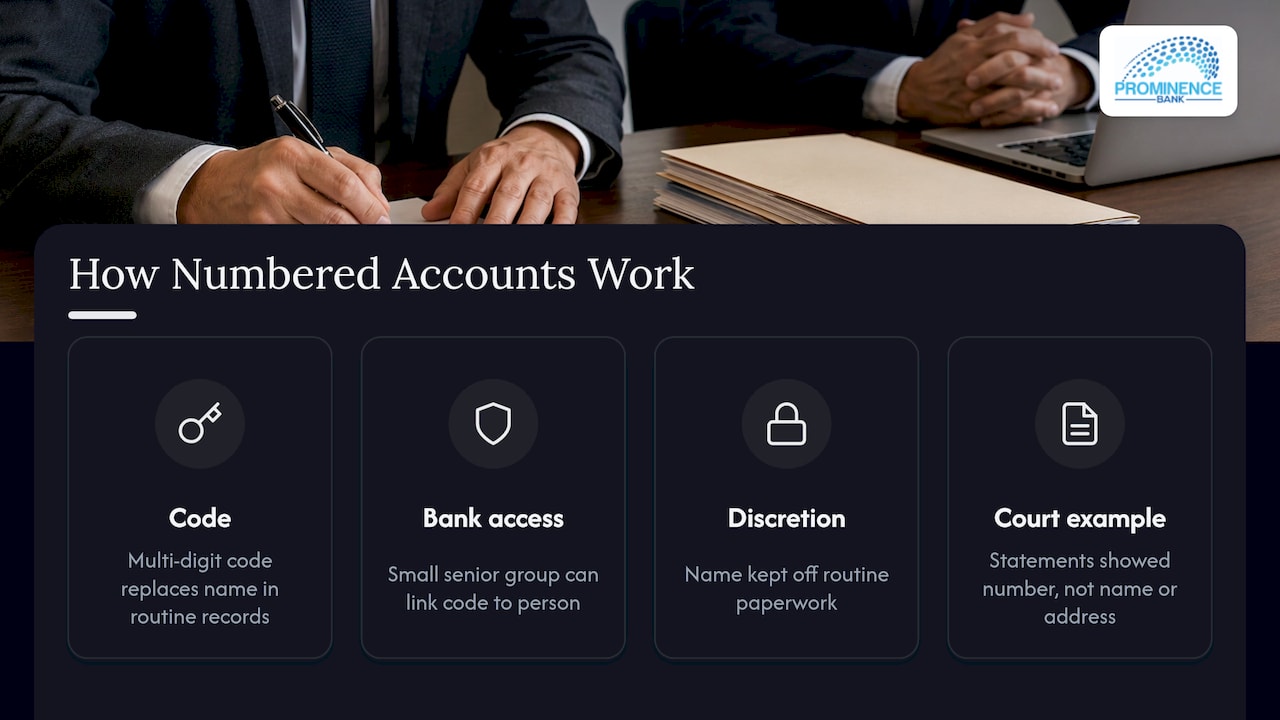
In a numbered account, the holder’s name is replaced by a multi-digit code in routine transactions and internal records. The bank still knows who owns it, but only a small group of senior officials can connect the code to a real person, as one 2026 explainer on numbered accounts puts it.
The practical benefit is discretion. The same explainer notes that the structure keeps a holder’s name away from rank-and-file staff and off routine paperwork, which lowers exposure to leaks, social engineering and idle curiosity. That is why numbered accounts suit people whose names are easily recognized: public figures, founders, families with visible wealth.
Academic work on Swiss practice points the same way. A law-journal study of Swiss bank secrecy found that no Swiss account is purely anonymous and that at least one bank official can access each holder’s name.
A real example from U.S. courts shows how this looks from the holder’s side. In Norman v. United States, decided by the Federal Circuit on November 8, 2019, a school teacher had opened a UBS numbered account in 1999. Her statements showed only the account number, not her name or address. The account existed, the bank knew her, and the number simply kept her identity off the page.
The KYC checks behind every numbered account
KYC is not one check. It is a stack: identity verification at opening, beneficial-owner identification for entities, risk assessment, source-of-funds questions, and monitoring afterward. Numbering sits on top of that stack and changes none of it.
Customer identification
U.S. banks operate under the Customer Identification Program (CIP) rule. 31 CFR 1020.220 requires risk-based procedures for verifying each customer’s identity, enough for the bank to form a reasonable belief that it knows who the customer really is. Before opening the account, the bank must obtain at a minimum:
- the customer’s name;
- date of birth, for an individual;
- a residential or business address;
- an identification number: a taxpayer identification number for U.S. persons, or specified government ID information for non-U.S. persons.
The rule allows documentary verification, non-documentary verification, or both, within a reasonable time after the account is opened. It also requires procedures for cases where the bank cannot form that reasonable belief, and CIP records must be kept for five years after the account closes.
The standard is “reasonable belief,” not perfection. As the FFIEC BSA/AML examination manual explains, a bank need not verify every element exhaustively as long as it verifies enough to form that belief. In practice, banks serving complex or high-value clients verify more, not less.
Beneficial owners of entities
If the account holder is a company, trust or other legal entity, the bank looks through it. FinCEN’s CDD Rule FAQs state that covered institutions must keep written procedures to identify and verify beneficial owners of legal entity customers when a new account opens, unless an exclusion or exemption applies. The FAQs describe the data collected for each person: name, date of birth, address and an SSN, or a passport number and similar details for foreign persons. The people covered are each individual who owns 25% or more of the equity, and one individual with significant responsibility to control or manage the entity.
For a holding structure with layers, expect to document every layer until you reach the natural persons. Our own guide to corporate banking structures walks through roles and ownership chains, and the corporate account structuring checklist lists what to have ready.
Source of funds and wealth
Beyond identity, a bank needs to understand where the money comes from. One explainer on numbered accounts describes the standard intake: name, address, date of birth, government-issued ID and documentation showing the origin of the funds, applied whether the account carries a name or a number. For a high-net-worth applicant, that usually means evidence such as a sale agreement, audited accounts, dividend records, an inheritance document or a tax return. Match each document to the specific deposit it explains. A clear paper trail is the fastest way through review.
Does a number limit disclosure? Not to authorities
This is the question behind most searches for this topic. The honest answer is that a number protects against casual exposure, not against lawful requests.
Tax reporting. Under FATCA and the U.S.-Switzerland intergovernmental agreement of February 2013, Swiss institutions report U.S. clients’ identity, account number, balance and income to the IRS, and that obligation does not depend on whether the account is numbered. Reporting is about the person, not the label.
U.S. law. U.S. banking law does not give customers a right of secrecy over financial records. The 1988 academic analysis cited above notes that the Right to Financial Privacy Act of 1978 creates procedures federal agencies must follow to reach records, which is a different thing from secrecy. The Bank Secrecy Act of 1970 was built so that large sums could not move anonymously between U.S. and foreign banks, and it requires institutions to record the identity of anyone with a financial interest in foreign accounts.
Privacy law. What privacy law does give you is control over commercial sharing. The FDIC privacy rule handbook covers when a bank may share nonpublic personal information with nonaffiliated third parties under notice and opt-out principles. Under the Gramm-Leach-Bliley limitation described in the FDIC examination manual, a bank must not disclose an account number or access code to a nonaffiliated third party for marketing.
Put together: a numbered account keeps your name away from curious employees and commercial data flows. It does not remove the account from the reach of tax authorities, regulators or criminal investigators acting lawfully. If you hold U.S. tax status, plan your reporting (FBAR and related forms) as you would for any foreign account. Our article on FBAR signatory rules covers the $10,000 threshold and who counts as a signatory.
How Switzerland compares
Switzerland made the product famous, and the reality there is stricter than the legend. The Local reports that Swiss numbered accounts are legal and carry the same due-diligence and anti-money-laundering obligations as any other Swiss account. They can only be opened in person at a branch, and the bank needs the customer’s express permission before sharing identity with third parties.
A Basel Institute on Governance paper goes further, calling “banking secrecy” a misnomer in jurisdictions such as Switzerland and Singapore and describing KYC as having grown from routine documentation of identity into a process of understanding the client’s business. That shift matters for you as an applicant: expect questions about what you do and why you need the account, not just a passport scan.
The same academic study adds that only a small share of Swiss accounts are numbered, usually for people whose names would draw attention. The product is a discretion tool for a minority of clients, not a mass-market feature.
Related account types and what KYC applies
Several products come up alongside numbered accounts. The labels differ, the KYC logic is similar.
| Product | What it is | KYC angle |
|---|---|---|
| Numbered account | Name replaced by a code on routine records | Full identity, ownership and source-of-funds checks |
| Custody account | Assets held for the client | CIP treats safekeeping and custodian relationships as accounts |
| Safekeeping receipt (SKR) | Document evidencing assets held in safekeeping | Tied to a verified account holder and the assets’ provenance |
| KTT (E-Telex) account | Account enabled for bank-to-bank telex transfers | Verified holder, plus counterparty and transaction review |
| Cryptocurrency account | Banking relationship involving digital assets | Same identity checks, with heightened attention to origin of funds |
On the U.S. side, the FFIEC manual’s section on trust and asset management confirms that for CIP purposes an “account” includes relationships such as cash management, safekeeping, custodian and trust arrangements. It also explains that CIP focuses on the named accountholder (the trust itself, for a trust account), while the bank may collect information on people with authority or control based on risk. For the corporate case, see our explainer on corporate trust accounts.
Preparing documents that clear review the first time
Most delays come from documents that do not match each other, not from the rules themselves. A short routine saves weeks.
- Identity. A current passport or government ID for every individual involved, with names spelled identically across all papers.
- Proof of address. A recent utility bill or official letter in the same name and address you declare.
- Entity papers. Certificate of incorporation, registers of directors and shareholders, and an ownership chart down to the natural persons.
- Source of funds. One document per major source, linked to the amounts you plan to deposit.
- Purpose of the account. A short written description of expected activity, currencies and counterparties.
Banks accept different forms of proof and sometimes fall back on alternative verification when a standard document is missing. A guide to which documents lenders and banks accept shows how commonly requested business paperwork is weighed, which helps when assembling an entity file.
For our own process, see documents verification, the global account opening requirements for HNW clients and the walkthrough on remote bank onboarding.
Perspective: why we treat KYC as part of the product
We hear the same assumption from new clients: that a numbered account means fewer questions. We see it the other way. The number protects your name inside the bank and on routine paperwork. The checks behind it are what make the account credible to correspondent institutions, counterparties and every bank your money later touches.
Prominence Bank is a licensed digital bank built for high-net-worth individuals, international businesses and institutional clients. Our model is fully online onboarding, multi-currency accounts and high discretion, with compliance to international AML/KYC standards. We think a client with a clean, complete file gets the best version of that: fast onboarding, a private account and no surprises later.
Our advice is to treat the file as an asset. Document your wealth the way you would for an audit, keep ownership charts current and decide up front whether your situation calls for an enhanced due diligence tier. Clients who do this move faster, and the account they end up with is easier to use for real business, from trade finance to custody and treasury.
Harold
What it costs at Prominence Bank
Our published fee schedule is on the fees page. Figures below are as listed when we last read it, so confirm current terms there before you apply.
| Item | Published fee |
|---|---|
| Bank account opening | $25,000 or €25,000, one-off |
| Numbered bank account opening | $/€ 50,000, one-off |
| Numbered bank account monthly fee | $100 or €100 per month |
| Savings account monthly fee | $40 or €40 per month |
| Enhanced due diligence, Level 1 (Enhanced Standard) | €5,000, one-off |
| Enhanced due diligence, Level 2 (Advanced) | €10,000, one-off |
| Enhanced due diligence, Level 3 (Critical / Complex) | €15,000, one-off |
| KTT (E-Telex) transaction, incoming or outgoing | 1.5% |
| Bank endorsement | 1.5% |
| Internal transfer | 0.2% |
| Currency conversion | 4% |
| Proof of funds, or reference / comfort letter | €25,000 each, one-off |
The EDD tiers scale with complexity: a simple profile sits at the lower level, while layered structures, unusual asset types or multiple jurisdictions point to the higher ones. SWIFT and IBAN wire transfers are published at 1% (minimum $/€100), and outgoing transfers also carry applicable SWIFT/SEPA charges. The published fee for the Safekeeping Receipt (SKR) / custody service is $/€ 25,000 for the custody account plus 2%.
Open a numbered account with us
If you want the discretion of a numbered account with a bank that handles KYC fully online, we can take you from application to a verified file. Our private banking team works with individuals, and our business banking and corporate banking teams handle entities and complex structures.
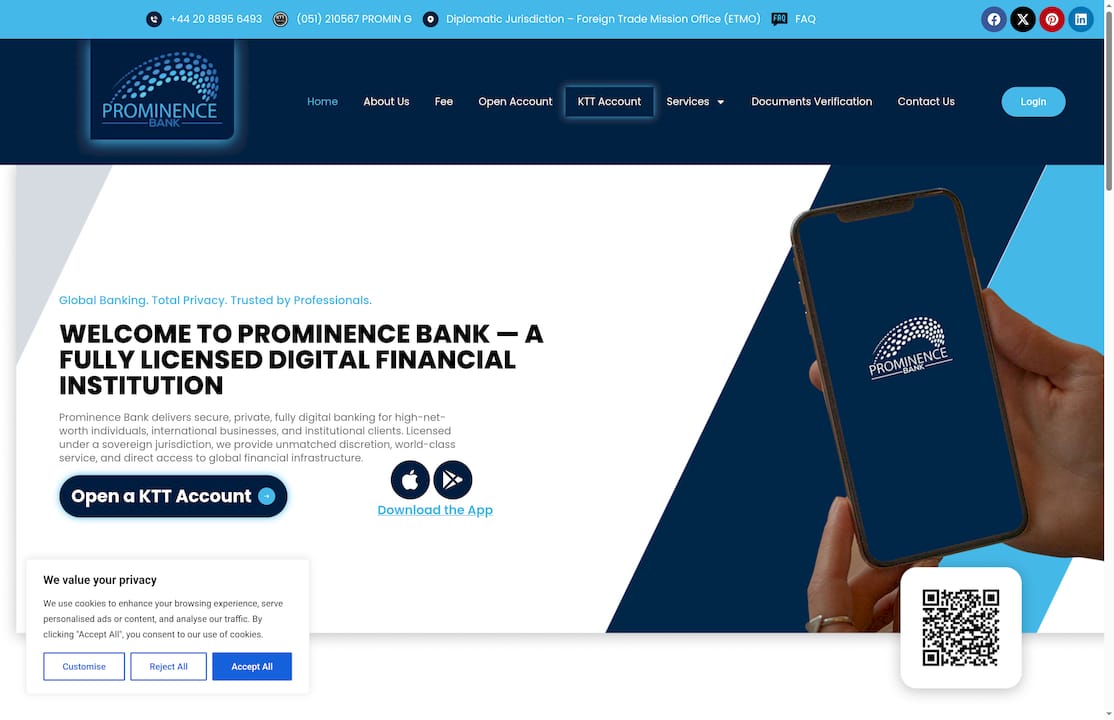
Start on the Prominence Bank fees page to see every published cost, then read our guide to online account opening before you apply.
FAQ
Is a numbered account anonymous?
No. The bank records and verifies the holder’s identity, and a limited group of senior staff can link the number to the name. The number keeps your name off routine records and away from most employees, but lawful requests from regulators, tax authorities and investigators still reach the underlying identity.
Is KYC required for a numbered account?
Yes. U.S. banks must apply their customer identification program to every customer, and 31 CFR 1020.220 makes no exception for the way an account is labeled. Entities also go through beneficial-owner identification, and source-of-funds documentation is standard for large balances.
What documents should I prepare?
Bring government ID, proof of address, and for a company its incorporation papers, ownership register and a chart down to the individuals. Add evidence for the origin of your funds and a short note on expected activity. Consistent names and addresses across every document speed up review.
Does a numbered account change my U.S. tax reporting?
No. FATCA reporting and FBAR obligations depend on who you are and what you hold, not on the account’s label. Speak with a U.S. tax professional about your own filings before you open any foreign account.
Sources
- 31 CFR 1020.220, Customer identification program (eCFR)
- FinCEN CDD Rule FAQs
- FFIEC BSA/AML manual, assessing compliance with BSA requirements
- FFIEC BSA/AML manual, trust and asset management services
- Norman v. United States, Federal Circuit opinion, November 8, 2019
- Agreement between the United States and Switzerland on FATCA, 2013
- FDIC Privacy Rule Handbook
- FDIC Gramm-Leach-Bliley Act examination manual
- Swiss Bank Secrecy Laws and the U.S. Internal Revenue Service
- Can anyone open a numbered bank account in Switzerland?
- Basel Institute on Governance, Anti-Money Laundering working paper
- What Is a Numbered Account? Tax and Reporting Rules