
Custody for digital securities means safekeeping the private keys that control tokenized stocks, bonds and fund interests, under a legal arrangement that says who owns the assets and who can move them. In the U.S., the custodian’s type matters as much as its technology. Registered investment advisers must generally hold client securities with a qualified custodian, and broker-dealers must follow the SEC’s possession-or-control rules. This guide covers the models, the rules, the due diligence questions, and how we approach custody at Prominence Bank.
TL;DR
- Digital securities (tokenized securities) are stocks, bonds or fund interests recorded on a blockchain. Custody of them comes down to protecting the private keys and having a clear legal basis for how assets are held.
- U.S. custody rules, including the Advisers Act custody rule and Rule 15c3-3, apply when a digital asset is a security under federal law.
- Advisers must use a qualified custodian: a bank, savings association, registered broker-dealer, registered futures commission merchant, or certain foreign financial institutions.
- Before choosing a provider, examine key management, segregation, insurance, service terms, and the legal framework the provider operates under.
- The published fee for the Safekeeping Receipt (SKR) / custody service is €25,000 for the custody account plus 2%. We publish the fees around it, such as account opening and due diligence.
Table of Contents
- What custody for digital securities actually means
- Examples of digital securities
- Custody models: from wallet services to institutional custody
- When U.S. custody rules apply
- What “qualified custodian” means
- Due diligence: what to examine before you choose
- Balancing protection and innovation
- Our perspective: custody should be boring in the best way
- Working with Prominence Bank on custody
- A practical checklist for a first conversation
- FAQ
- Sources
What custody for digital securities actually means
A digital security, also called a tokenized security, is a financial instrument such as a stock, bond or fund interest that is formatted as, or represented by, a crypto asset recorded on a blockchain or distributed ledger, according to Investor.gov. Custody is what keeps that holding safe and legally attributable to you.
In traditional markets, a custodian holds certificates or book entries at a depository. In digital markets, the thing that proves control is a cryptographic key. The AIMA guide to digital asset custody puts it plainly: digital asset custody revolves around safekeeping a private key. That is why custody has become a distinct specialist service, with its own frameworks.
Two things sit inside any real custody arrangement:
- Technical control. Who holds the keys, how they are generated, stored, backed up and used to authorize transfers.
- Legal basis. On what terms the assets are held, whether they are segregated from the custodian’s own balance sheet, and what happens if the custodian fails.
A product that offers only the first is a storage tool. A product that offers both is custody.
Examples of digital securities
Readers often ask what actually counts. Investor.gov lists tokenized stocks or company equity interests, bonds or debt instruments, and fund shares, including money market and real estate funds, as examples of tokenized securities.
There are two broad structures. FINRA explains that tokenized securities may be issued and transferred on a blockchain, with the issuer or transfer agent maintaining the registry on-chain. Alternatively, they may exist in traditional form and be tokenized by an intermediary acting as the registered owner. The structure changes what you are actually holding and who your custodian answers to, so confirm which one applies before you move assets.
A16z’s research team gives more unusual examples, including profits interests in LLCs and a fractional interest in a resort property. The category is wider than listed equities and bonds.
Custody models: from wallet services to institutional custody
The AIMA guide describes a spectrum. At one end are custodial wallet services, often built around user access. At the other are institution-focused custody services with multi-user access controls and high-grade security. Some providers act as direct custodians that store the keys. Others give clients the means to authenticate their own transactions.
For a fund, family office or corporate treasury, the questions that separate these models are practical:
| Question | Why it matters |
|---|---|
| Who can authorize a transfer? | Multi-user approval limits the damage from one compromised credential. |
| Who physically controls the keys? | It decides whether the provider or you carries key-loss risk. |
| Are client assets segregated? | Segregation shapes your position if the provider becomes insolvent. |
| What are the service terms? | Liability, withdrawal timing and termination rights live here. |
| What regulatory framework applies? | It determines who supervises the provider and what reporting you can rely on. |
The SEC has also described its expectations on the broker-dealer side. In its 2020 statement and request for comment, the Commission envisioned broker-dealers performing full custodial functions for digital asset securities in a way that addresses their unique attributes while minimizing risk to investors and market participants.
When U.S. custody rules apply
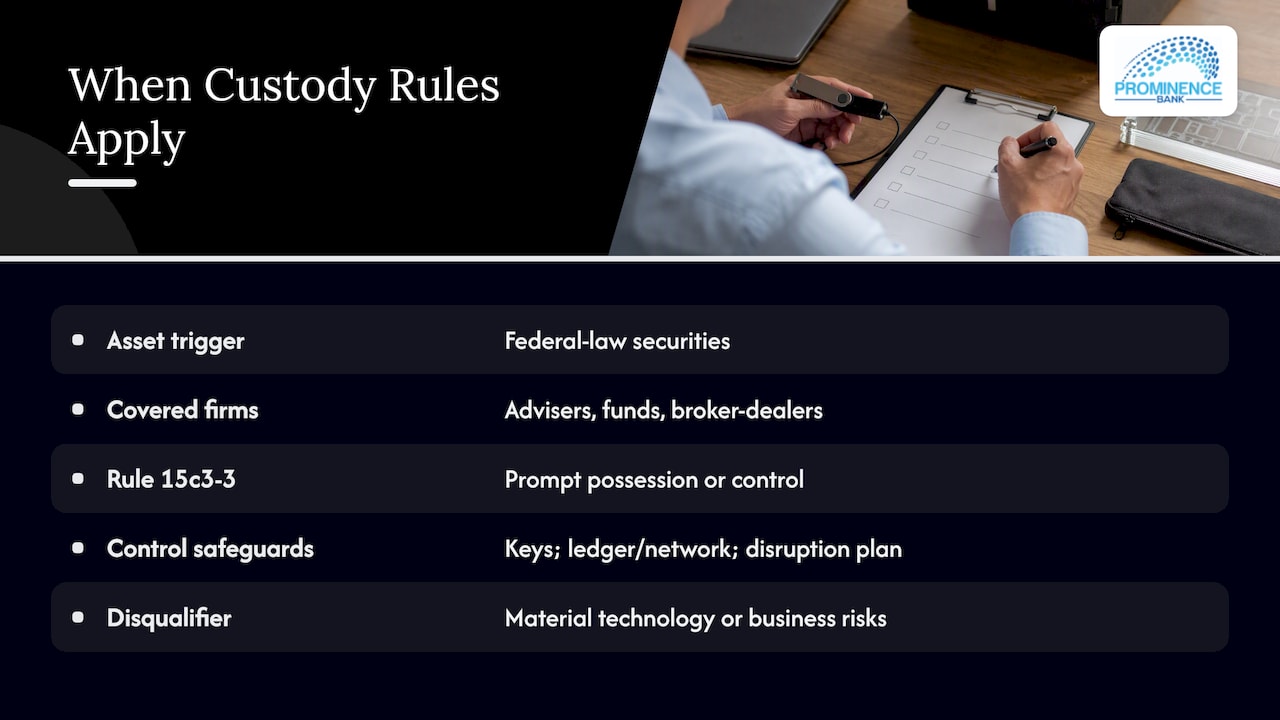
The rules attach to the legal character of the asset, not the technology. Custody rules such as the Advisers Act custody rule and the Customer Protection Rule (Rule 15c3-3) apply to digital assets that qualify as securities under federal securities laws. Registered investment advisers, regulated funds and broker-dealers must comply when they hold client funds or securities, as stated in the October 2026 Federal Register document on adviser and regulated fund custody.
For broker-dealers, Rule 15c3-3 requires prompt physical possession or control of fully paid and excess margin securities carried for customer accounts, per an SEC statement from December 2025. The practical question is how a broker-dealer shows possession or control of a token. The same statement says the SEC’s Division will not object to broker-dealers deeming themselves to possess crypto asset securities when they protect private keys, assess the ledger and network, and plan for disruptions.
The statement also draws a line. A broker-dealer cannot deem itself in possession if it knows of material security or operational problems with the technology, or if other material risks to its business are present. Inspect a custodian’s operational record accordingly.
What “qualified custodian” means
If you advise clients, this is the term that decides your custodian shortlist. Under the Advisers Act custody rule (Rule 206(4)-2), a registered adviser with custody of client funds or securities must keep them with a qualified custodian. The Federal Register describes this group as banks, savings associations, registered broker-dealers, registered futures commission merchants, and certain foreign financial institutions.
Two practical consequences follow:
- Being able to hold keys securely does not by itself make a provider a qualified custodian. The status comes from the entity’s regulated category.
- Ask any provider, in writing, which category it falls into and which authority supervises it. A serious custodian answers that directly and shows you the documents.
For advisers, funds and counsel, confirm the details against the current rule text before onboarding. The rules are in active development, and AIMA advises institutions to follow the specific requirements of their own jurisdictions, noting that general guidance does not replace legal advice.
Due diligence: what to examine before you choose
Private keys are a single point of failure. AIMA notes they are used to store, manage and transfer digital assets and to authenticate transactions, so they demand sophisticated technology to prevent theft, loss or destruction. Build your checklist around that fact.
Key management and access control
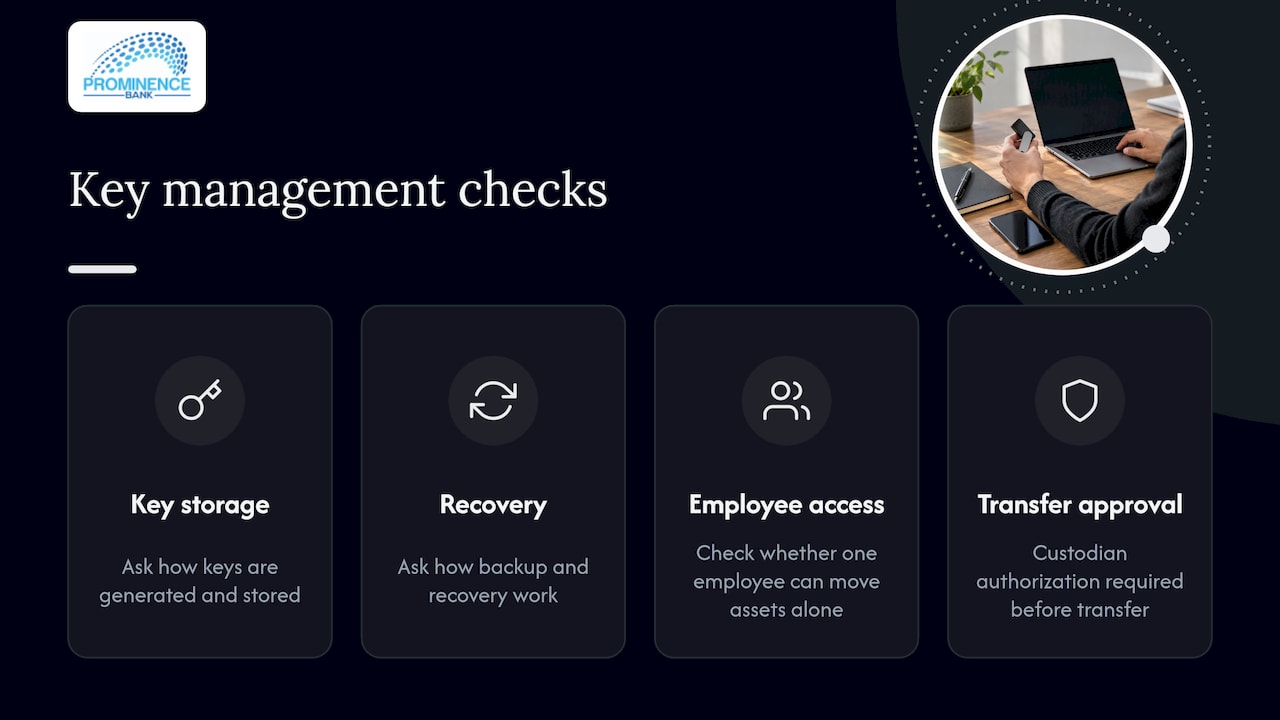
Ask how keys are generated and where they live. Ask how backup and recovery work and whether any single employee can move assets alone. The SEC’s broker-dealer guidance gives a useful benchmark: policies and procedures that protect private keys against theft, loss, or unauthorized or accidental use, so that no other person can access the keys and transfer the asset without the custodian’s authorization.
Our article on cold storage custody banking goes deeper on offline key storage and what institutions should expect from it.
Segregation, recordkeeping and audit trail
Your assets should be identifiable as yours in the custodian’s records. You should also be able to reconcile on-chain positions against the custodian’s books at any time. For governance structure, see our piece on making institutional crypto custody auditable.
Insurance and legal terms
AIMA lists insurance provisions among the points to weigh. Read what the cover applies to, what it excludes, and who the beneficiary is. Then read the service agreement for liability limits, withdrawal timing and termination procedures. Do this before funding the account, not after.
Operational resilience
Custody does not stop at the vault. Outages, failed approvals and network disruption all affect your ability to settle or post collateral. The SEC’s guidance explicitly asks custodians to plan for disruptions. Reading about institutional-grade tools and resilience gives a useful market-side view of why execution quality and robustness belong in the same conversation as safekeeping.
Fees
Compare schedules line by line: opening, ongoing, transfer, and document fees. Complex portfolios can be overcharged through unclear schedules, which is why we wrote a guide on reading asset custody fee schedules.
Balancing protection and innovation
The SEC has said that frameworks for digital asset security custody try to balance investor protection with the wish to foster innovation in capital formation. For you as an allocator or adviser, this means the rules will keep moving. Pick a custodian that treats compliance as a standing function, with documented procedures, rather than as a one-time application.
That also means keeping your own records tidy. Maintain a clear register of which assets are securities, which custodian holds each, and under what agreement. When a rule changes, you can see immediately which positions it touches.
Our perspective: custody should be boring in the best way
We see custody as the part of a financial relationship that should never be exciting. When assets are tokenized, the temptation is to focus on the technology: the chain, the wallet, the interface. Our view is that the order of questions should be reversed. Start with legal basis and accountability, then move to controls, then to convenience.
At Prominence Bank, we are a licensed digital banking institution serving high-net-worth individuals, international businesses and institutional clients. Our model is built around discretion, security and online access, with compliance to international AML/KYC standards. Our custody and safekeeping offering, including safekeeping receipts (SKR), sits alongside multi-currency accounts, treasury and private banking. That means a client does not have to run custody as an island. Safekeeping, settlement currencies and reporting can sit with one institution.
We operate within the Extraterritorial Trade Mission Office (ETMO) framework under Foreign Jurisdiction License No. 05052025-A. We encourage you to read that framework, ask us for the documents, and have your counsel confirm how it fits your own obligations. That is the same diligence we recommend for any custodian.
What we offer in return is a structure aimed at clients who value privacy and who want account opening and access to run digitally. If you want to see how custody accounts work in our model, our guide to custody accounts and secure asset management is the place to start.
— Harold
Working with Prominence Bank on custody
If you hold, or plan to hold, tokenized or traditional securities and want a custodian that pairs safekeeping with banking, we can walk you through the options. We publish our fee schedule openly. Account opening is 25,000 (USD or EUR) one-off, and a numbered account is €50,000 one-off with a monthly fee of 100 (USD or EUR). Enhanced due diligence runs from €5,000 to €15,000 depending on complexity. The published fee for the Safekeeping Receipt (SKR) / custody service is €25,000 for the custody account plus 2%. Everything else is on our fees page.

If you are an adviser, fund or corporate treasury, our investment banking and private banking teams are the right starting points. Business and corporate clients can go to business banking.
A practical checklist for a first conversation
Bring these questions to any custodian, including us:
- Which regulatory category are you in, and which authority supervises you?
- Are you a qualified custodian for the type of client I am, and can you document it?
- How are keys generated, stored, backed up and recovered?
- Can one person move assets, or does every transfer need multiple approvals?
- Are my assets segregated, and how do I reconcile them against your records?
- What does your insurance cover, and what does it exclude?
- What does your service agreement say about liability, withdrawals and termination?
- What is the complete fee schedule, and which items are unpublished?
- What is your disruption plan if the underlying network has problems?
- Which jurisdictions’ rules do you design around, and how do you handle changes?
If an answer is vague, ask for it in writing. Strong custodians are comfortable being specific.
For related settlement questions, our article on treasury securities custody venues covers where settlement and collateral assets sit. If you are a U.S. person with accounts abroad, read our note on FBAR and expat offshore banking as well.
FAQ
What are digital asset custody services?
They are the systems and processes that protect and control access to blockchain-based assets, centered on the private keys that authorize transactions. A commercial service adds service terms, a regulatory framework, insurance provisions and a legal basis for how assets are held. AIMA recommends weighing each of these before relying on a provider.
What are some examples of digital securities?
Tokenized stocks or company equity interests, bonds and other debt instruments, and fund shares such as money market or real estate funds are common examples. Investor.gov lists these categories. Some structures also include LLC profits interests or fractional property interests.
Who can act as a qualified custodian for an investment adviser?
The Advisers Act custody rule limits qualified custodians to banks, savings associations, registered broker-dealers, registered futures commission merchants, and certain foreign financial institutions. A provider’s technical security alone does not qualify it. Ask for written confirmation of its category and supervisor, and check it with your counsel.
Do U.S. custody rules apply to every token?
No. They apply to digital assets that qualify as securities under federal securities law, and to the registered advisers, regulated funds and broker-dealers that hold client assets. Whether a given token is a security is a legal question, so take it to a securities lawyer before you decide how to hold it.
Sources
- Digital Asset Custody, AIMA
- Tokenized Securities, Investor.gov
- Crypto Assets: Types, FINRA
- Defining tokens, a16z Frontier
- Commission Statement and Request for Comment: Custody of Digital Asset Securities, SEC
- Adviser and Regulated Fund Custody Rules, Federal Register
- Statement on the Custody of Crypto Asset Securities by Broker-Dealers, SEC