
A clean, fully documented offshore application usually clears in a few weeks. A messy one can drag on for months. The difference rarely comes down to the bank’s speed. It comes down to how complete, consistent and well explained your file is on the day you submit it. This guide walks through each stage of the timeline, shows where the weeks disappear, and covers what a U.S. person needs to have in order before and after the account goes live.
TL;DR
- Plan on roughly two to four weeks for a simple individual application with a complete document pack, and considerably longer for corporate structures with several layers of ownership.
- Most delays come from the same few things: inconsistent addresses and names across documents, unexplained source of funds, and incomplete ownership charts.
- Enhanced due diligence adds a separate review stage. At Prominence Bank it is priced in three levels, from €5,000 to €15,000.
- Opening the account is not the finish line. U.S. persons may owe FBAR and Form 8938 filings once balances cross the thresholds.
- Prepare the file first, then apply. Time spent on preparation is the cheapest way to shorten the whole process.
Table of Contents
- The realistic timeline at a glance
- Stage by stage: where the time goes
- Personal versus corporate: how timelines diverge
- What causes delays, and how to avoid them
- A note for U.S. persons
- Perspective: why preparation beats speed
- Opening with Prominence Bank
- A practical week-by-week plan
- FAQ
- Sources
The realistic timeline at a glance
No one can promise a universal number, because banks differ in risk appetite, staffing and the products involved. What experienced practitioners describe is a pattern, and it looks like this:
| Stage | What happens | Typical effect on timing |
|---|---|---|
| 1. Preparation | Gather identity, address, source-of-funds and business documents | Days to a couple of weeks, entirely in your hands |
| 2. Bank selection and pre-screening | Confirm the bank accepts your profile, nationality and structure | Days |
| 3. Application | Forms, certified copies, ownership chart | Days if the pack is ready |
| 4. Compliance review | KYC, AML screening, source-of-funds check | The longest stage, often around two to three weeks |
| 5. Approval and activation | Account number, credentials, access | Days |
| 6. Initial funding | First wire, matched to your source-of-funds file | Days, but only after activation |
Simple individual cases tend to finish in a few weeks. Corporate applicants with holding companies, trusts or foundations in the chain should expect longer, sometimes several months, because every layer must be identified and verified down to the individuals who ultimately own or control it.
Stage by stage: where the time goes
Preparation: the stage you control
This is where fast applicants separate themselves from slow ones. Before you contact any bank, assemble:
- A valid passport and a second form of identification.
- Proof of residential address, usually a recent utility bill or bank statement.
- A written explanation of where your funds come from, backed by documents: sale agreements, audited accounts, tax returns, dividend statements, inheritance paperwork.
- For companies: certificate of incorporation, articles, register of directors and shareholders, and a structure chart showing the beneficial owners.
- A short business rationale: why you need this account, which currencies, expected monthly volumes and counterparties.
For a deeper checklist built for wealthy clients, see our guide to global account opening requirements for HNW clients.
Pre-screening and bank selection
Many applications fail before they start because the applicant picked a bank that does not take their profile. Some institutions will not onboard U.S. persons at all. Others will not accept certain industries or structures. A short conversation up front about nationality, residence, structure and expected activity saves weeks of waiting for a rejection.
Compliance review: the long middle
Once the application is in, the bank’s compliance team verifies identities, screens names against sanctions and politically exposed person lists, tests your source-of-funds story against documents, and checks that the account’s purpose makes sense. Banks work through this on their own internal calendar. Questions from the reviewer stop the clock until you answer, so how fast you reply matters as much as how fast they read.
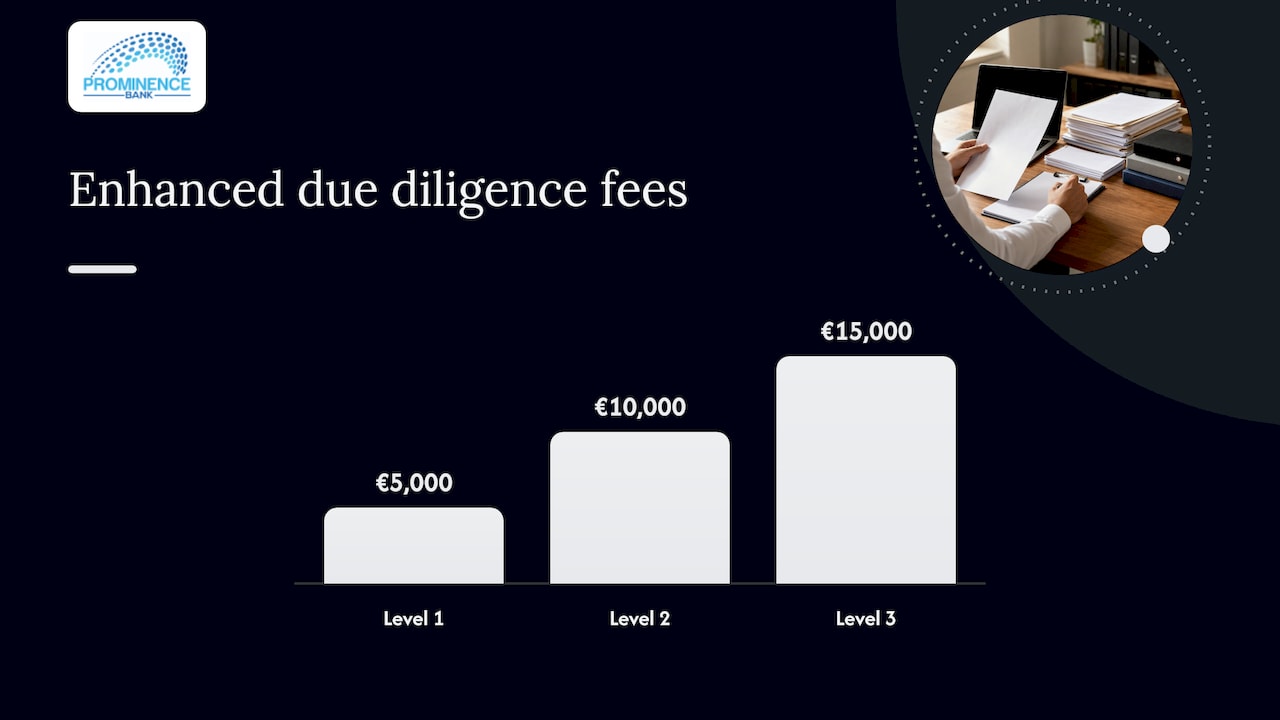
If the file is flagged as higher risk, the bank may ask for enhanced due diligence. At Prominence Bank, that is a defined, priced step: Level 1 (Enhanced Standard) costs €5,000, Level 2 (Advanced) €10,000, and Level 3 (Critical / Complex) €15,000, each as a one-off fee. The level reflects how complicated the ownership, jurisdictions and funds are. A tidy file tends to sit at the lower end.
Approval, activation and first funding
After approval you receive account details and access credentials. With a digital bank, access is online, which removes the postal delays that used to add days to traditional offshore openings. The first deposit then needs to match your paperwork. Banks compare the sending account’s name and origin against the source-of-funds file, so a wire from an unrelated third party can stall the account right when you expected to start using it.
Personal versus corporate: how timelines diverge
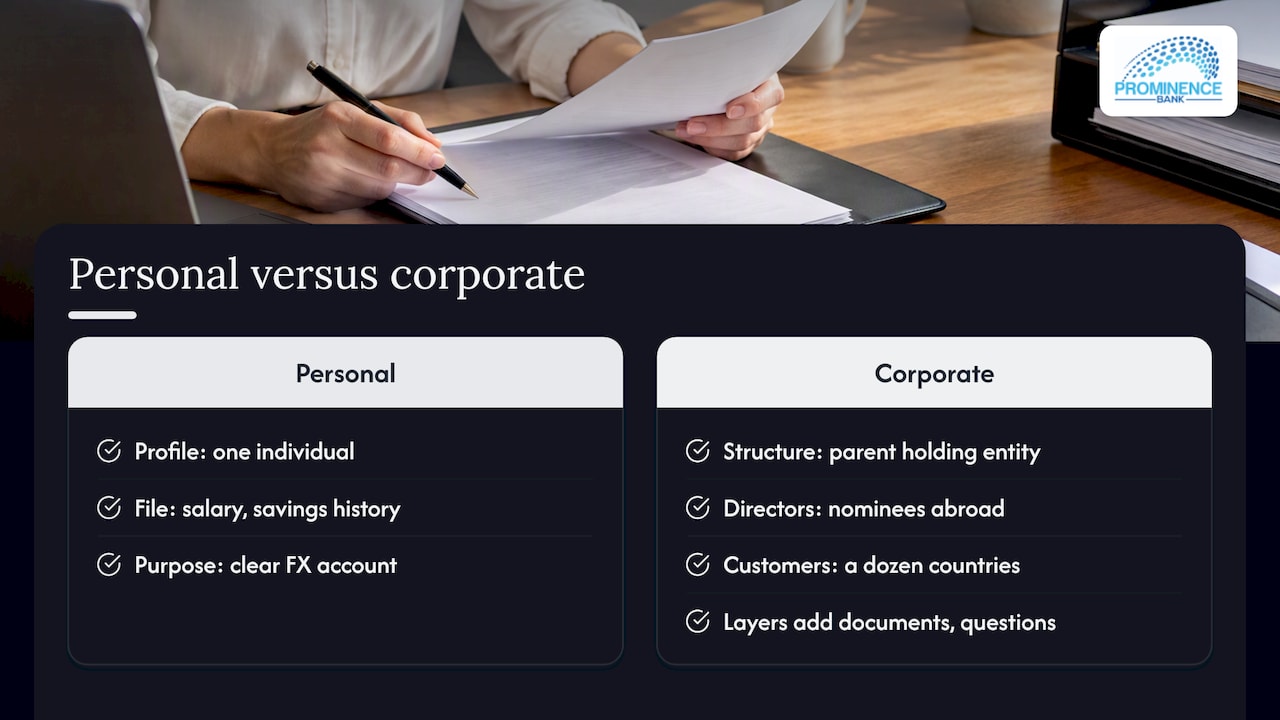
A single individual with a salary, a savings history and a clear reason for a foreign-currency account is the easy case. A company with a parent holding entity, nominee directors in another jurisdiction and customers in a dozen countries is not. Each additional layer adds documents, certifications and questions.
For U.S. persons there is another wrinkle. Banks that accept Americans for asset-protection purposes often prefer the account to be held by a foreign entity such as an LLC or trust rather than in a personal name. That means the timeline includes setting up and documenting the entity first. If that is your route, our articles on corporate bank accounts abroad for asset protection and offshore trusts for high-net-worth families explain the structures.
Numbered, KTT, crypto, custody and SKR arrangements
Specialized accounts carry more scrutiny, not less. A numbered account hides the holder’s name from day-to-day use, but the bank still verifies the real owner in full. Expect the same KYC depth, often with additional questions about why you want that level of discretion. Accounts used for KTT (e-telex) transfers, safekeeping receipts or custody services draw extra attention to the origin and purpose of the assets involved. Prominence Bank prices these openly where it can: a numbered account is €50,000 to open and €100 per month, against $/€25,000 for a standard account opening, and KTT transactions carry a 1.5% fee. The published fee for the Safekeeping Receipt (SKR) / custody service is €25,000 for the custody account plus 2%. For custody specifically, read offshore custody accounts: privacy, security and compliance.
What causes delays, and how to avoid them
The same handful of problems account for most stalled applications.
- Inconsistent details. A registered address on the incorporation certificate that differs from the one on the bank’s pre-screening form is a classic trigger for extra questions. Spell names, addresses and dates identically across every document.
- Thin source-of-funds evidence. “Business income” is not an explanation. Name the business, the period and the document that proves it.
- Unclear ownership. Every shareholder above the bank’s threshold needs identification. A chart that stops at a corporate shareholder invites a follow-up request.
- Uncertified or stale documents. Utility bills that are too old, or copies lacking the required certification, are returned and the clock restarts.
- Slow replies. A reviewer’s question left for a week is a week added to the timeline.
- Mismatched funding. A first wire from an account not in your name, or from a source you never disclosed.
A useful habit: before submitting, read your file as a stranger would. If a compliance officer could ask “why?” about any line, answer it in writing in advance.
A note for U.S. persons
If you are a U.S. person, holding a foreign account can create separate tax and reporting obligations in the United States. Those obligations depend on your own circumstances and are outside the scope of this article. Confirm them with a qualified U.S. tax adviser before you open an account.
Perspective: why preparation beats speed
We see the same pattern again and again. Clients who ask “how fast can you open it?” are often the ones whose files need the most work, and clients who ask “what do you need from me?” are usually live within a short window. Speed is mostly a by-product of clarity.
Our view is that a serious banking relationship should begin with a serious file. That is why we run onboarding fully online, with compliance aligned to international AML/KYC standards, and why we price enhanced due diligence as a transparent, tiered step rather than an open-ended surprise. High-net-worth clients and international businesses value discretion, but discretion rests on the bank knowing exactly who it is dealing with. A properly documented client is a protected client.
If you remember one thing: decide your structure, settle your source-of-funds story, and make every document agree with every other document before you apply. The calendar will take care of itself.
— Harold
Opening with Prominence Bank
Prominence Bank is a licensed digital bank serving high-net-worth individuals, international businesses and institutions, with multi-currency accounts, numbered and KTT-enabled accounts, custody and corporate banking. Standard account opening is published at $/€25,000 one-off, with all fees listed openly on our fees page. If you hold or manage a company, start with business banking; for individuals, see private banking.

Bring your documents, your structure chart and your source-of-funds explanation, and we will tell you what the review will need. Our step-by-step guide to opening an offshore account shows the full path.
A practical week-by-week plan
If you want a working schedule, this one fits a typical well-prepared application. Treat the weeks as a planning frame, not a promise from any bank.
- Week 1: Decide the account holder (you personally or an entity). Request certified copies, order proof of address, and write the source-of-funds narrative with its supporting documents.
- Week 2: Pre-screen with the bank, correct any mismatches in names or addresses, and submit the application with the ownership chart.
- Weeks 3 to 4: Compliance review. Check email daily and answer every query the same day.
- Week 5: Activation, credential setup and a small test transaction before the main funding wire.
- After funding: Calendar the FBAR and any Form 8938 obligations and brief your tax adviser.
If a company or trust has to be formed first, add that time at the front. If the file is incomplete when you apply, expect the review to stretch well beyond this plan.
FAQ
How long does it take to open an offshore account?
A simple personal account with complete documents often takes a few weeks. Corporate accounts with layered ownership can take much longer, sometimes months. The biggest variable is the quality of your file, not the bank’s processing speed.
Can I speed up the process?
Yes, mainly by preparing. Make names and addresses identical across documents, document your source of funds, provide a clear ownership chart, and reply to compliance questions immediately. Choosing a bank that accepts your profile before applying avoids the most expensive delay, a late rejection.
Is it legal for a U.S. person to have an offshore account?
Yes, provided the account is reported as required. U.S. persons must file an FBAR when aggregate foreign account values exceed $10,000 at any point in the year, and may have Form 8938 obligations as well. A tax professional can confirm what applies to you.
Does a numbered account open faster?
No. A numbered account still requires full identity and source-of-funds verification. It changes how the account is referenced in daily use, not how thoroughly the bank checks you at the start.
Can I use the account right after approval?
Only once it is activated and funded. The first deposit should come from an account in your name that matches the source-of-funds file, otherwise the bank may hold it for review.
Sources
- Report of Foreign Bank and Financial Accounts (FBAR), IRS
- FATCA information for individuals, IRS
- Comparison of Form 8938 and FBAR requirements, IRS