
SKR fees are not one number. A safe keeping receipt is a custody document, so what you pay depends on what is held, where it is held and who holds it. A real custodian puts those charges in a written schedule before you pay anything. Any party that asks for an “activation” or “verification” fee to unlock value from an SKR is the opposite of that, and you should treat the request as a warning. This guide covers what SKR fees look like, how an SKR differs from escrow, how to verify one, and what to do if you have already paid.
TL;DR
- An SKR proves that a custodian holds specific assets for you. It does not transfer ownership and it is not a payment instrument.
- Legitimate fees are custody-type charges (issuance, storage or safekeeping, administration, due diligence), disclosed in a written schedule. The published fee for the Safekeeping Receipt (SKR) / custody service is €25,000 for the custody account plus 2%.
- Escrow holds assets for one transaction and releases them on conditions. A custody account with an SKR holds assets for the owner over time.
- Upfront fees to “monetize” an SKR, pressure to act fast and refusal to let you verify with the custodian are classic advance-fee fraud signs.
- Verify the issuer directly, using contact details you found yourself, before you send a cent.
Table of Contents
- What an SKR is, and why the definition drives the fees
- What SKR fees usually consist of
- What Prominence Bank publishes
- SKR versus escrow: who holds what, and when it is released
- SKR scams: the fee pattern to recognize
- How to verify an SKR before paying any fee
- Our perspective: fees should follow the service
- Opening custody with us
- If you suspect fraud or have already paid
- FAQ
- Sources
What an SKR is, and why the definition drives the fees
A safekeeping receipt is a document issued by a bank, broker or specialized depository. It acknowledges that the issuer holds specific assets, such as securities, precious metals or legal documents, in custody on behalf of a client. In the United States it works as proof of custodial holding, not a title of ownership, and it is not a negotiable or tradable instrument in itself.
That definition tells you what you should be paying for: the custodian’s work of holding, recording and reporting on assets. You are not paying for the receipt to “turn into” money. Once you keep that in mind, most of the confusion about SKR fees disappears. A fee tied to custody is normal. A fee tied to a promised payout is not.
If you want the full mechanics of how a bank issues and administers one, our page on the custodial bank safe keeping receipt walks through the product, and our guide to how custody accounts work covers the account that sits behind it.
What SKR fees usually consist of
There is no single national price list for SKRs. Charges differ by asset type, location and custodian. In practice, a legitimate schedule contains some mix of the following.
| Fee type | What it pays for | How it is usually expressed |
|---|---|---|
| Account or onboarding fee | Opening the relationship, KYC and AML checks | One-off amount |
| Due diligence fee | Enhanced review of source of funds or complex structures | One-off amount, often tiered by complexity |
| Issuance fee | Producing and signing the receipt | One-off amount or percentage |
| Safekeeping or storage fee | Holding the asset over time | Annual or monthly, often a percentage of value |
| Administration or account fee | Statements, reporting, servicing | Monthly or quarterly flat fee |
| Transaction fee | Moving assets or funds in or out | Flat or percentage |
For scale, one published guide reports that physical precious-metals storage commonly runs 0.12% to 0.50% of the asset’s value per year, often with a quarterly minimum, while securities custody may be charged in basis points. Treat those as a rough orientation, not a quote. Real figures come from the custodian’s own schedule.
Why percentage fees need a closer look
A percentage looks small until you apply it to a large or complex holding. A 0.30% annual charge on $5 million is $15,000 a year. Ask whether the percentage is charged on the declared value or on the market value, how often it is recalculated, and whether there is a minimum. Our article on reading custody fee schedules for complex portfolios shows where overpayment tends to hide.
What Prominence Bank publishes
We publish our fee schedule openly on our fees page, and a PDF version is available as the basic fees document effective 28 August 2026. Here is what applies to a client who holds assets under custody and wants an SKR.
The published fee for the Safekeeping Receipt (SKR) / custody service is €25,000 for the custody account plus 2%. The surrounding charges are published:
| Charge | Amount |
|---|---|
| Bank account opening | 25,000 $/€ one-off |
| Numbered bank account opening | 50,000 € one-off |
| Numbered account monthly fee | 100 $/€ per month |
| Savings account monthly fee | 40 $/€ per month |
| Enhanced due diligence, Level 1 (Enhanced Standard) | 5,000 € one-off |
| Enhanced due diligence, Level 2 (Advanced) | 10,000 € one-off |
| Enhanced due diligence, Level 3 (Critical / Complex) | 15,000 € one-off |
| Proof of funds (POF) | 25,000 € one-off |
| Reference or comfort letter | 25,000 € one-off |
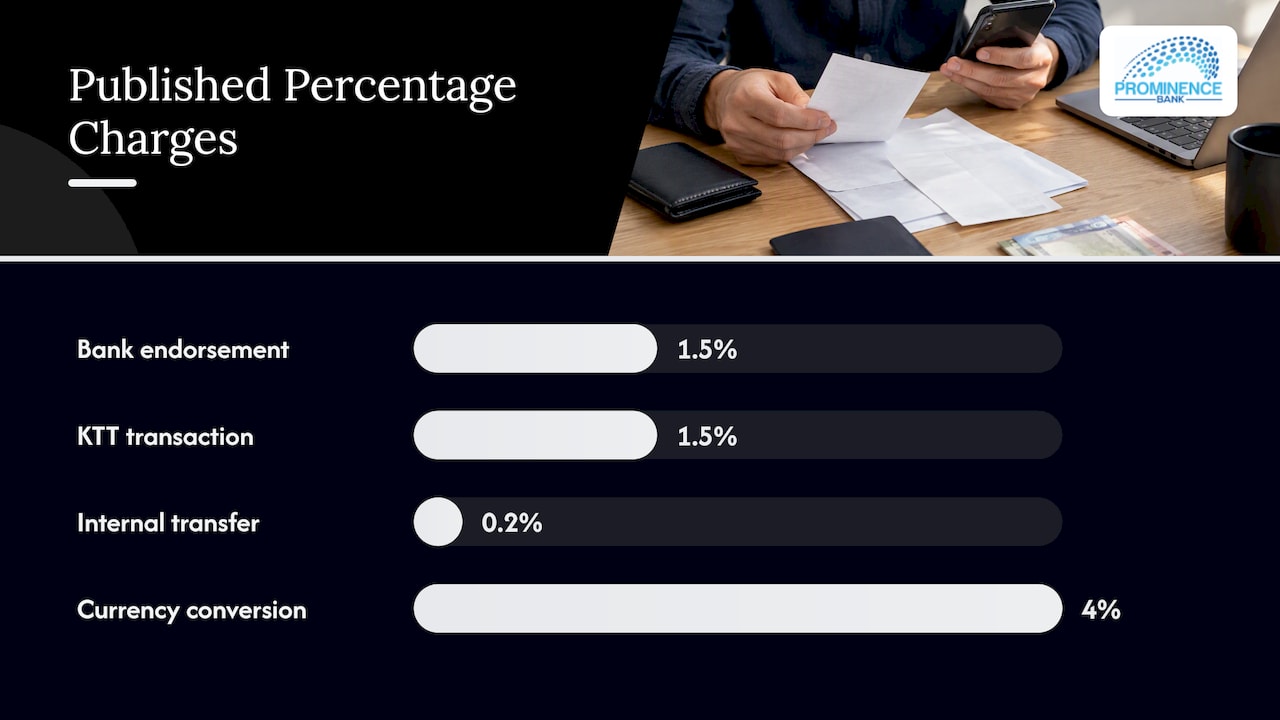
| Bank endorsement | 1.5% |
| Incoming or outgoing KTT (E-Telex) transaction | 1.5% |
| Prominence Bank internal transfer | 0.2% |
| Currency conversion | 4% |
Incoming and outgoing SWIFT or IBAN wires are listed without a published price. Always check the live fee schedule before you decide, since schedules are revised.
These are not small numbers, and we do not pretend they are. We serve high-net-worth individuals, international businesses and institutions with complex needs, and the due diligence behind a custody relationship is real work. What matters is that the amounts are written down, they are charged to an account you hold, and they are tied to a service the bank actually performs.
SKR versus escrow: who holds what, and when it is released
Readers often ask whether an SKR is a kind of escrow. It is not, and mixing them up is exactly what scammers count on.
| SKR / custody | Escrow | |
|---|---|---|
| Purpose | Holding assets for the owner, often long term | Holding assets for one transaction between parties |
| Who the custodian serves | The asset owner | Both buyer and seller, as a neutral third party |
| Release trigger | Owner’s instruction, subject to the custody agreement | Conditions in the escrow agreement are met |
| What the document proves | That specific assets are held | That funds are held pending conditions |
| Ownership effect | None; ownership stays with the owner | None; but release is conditional |
In plain terms, escrow is a short-lived arrangement built around a deal: a buyer deposits funds with a neutral third party, and the money is released once agreed conditions are met. Custody is a standing arrangement for the owner’s benefit. An SKR is evidence of the second, not a way to run the first.
Fees follow the same split. Escrow is usually priced per transaction. Custody is priced as an ongoing service. If someone sells you an SKR and also insists you pay into an “escrow” they control, ask who the escrow agent is, who regulates them, and why a custody document needs escrow at all.
This matters because fraudsters lean on escrow’s reputation. In SEC enforcement, scammers have used escrow accounts and professional-sounding contracts as a facade of legitimacy to collect advance fees from investors, directing victims to send money to purported escrow agents so the funds looked protected while they were being misappropriated.
SKR scams: the fee pattern to recognize
The typical SKR scam does not charge a custody fee. It charges a fee to unlock a promise. The pitch says the SKR can be “monetized” into cash, a non-recourse loan or a high-yield program, often through a “private placement” or “trade” scheme. To get started, you pay an activation, verification, registration or insurance fee.
This is advance-fee fraud, and regulators have described it for decades. The SEC’s investor alert on advance fee fraud advises skepticism toward offers that sound too good to be true and recommends checking claims with an unbiased source such as the SEC or a state securities regulator. The FTC has also noted that fraudulent operators charge upfront fees ranging from $30 to tens of thousands of dollars, make false promises of high earnings and point consumers to phony references.
Warning signs, in order of how reliable they are
- You are asked to pay before you can verify. A custodian that exists can be reached through channels you find independently.
- The payout is guaranteed. An SKR proves custody. No custody document guarantees a return.
- The receipt is described as cash, a bond or a negotiable instrument. In the U.S., an SKR is not negotiable or tradable in itself.
- You are told to act now. Deadlines are pressure tools, not banking practice.
- An intermediary discourages you from contacting the issuer. Real receipts survive direct verification.
- The fee goes to a person, not to the custodian. Pay only to an account in the name of the institution that issues the service, confirmed independently.
- The “escrow” is run by the party selling the product. That is not a neutral third party.
How to verify an SKR before paying any fee
Verification is simple and it is free. Do it in this order.
- Identify the issuer. Get the full legal name, jurisdiction and licensing details of the institution on the receipt.
- Find the contact details yourself. Use the institution’s own website or a regulator’s register, never the phone number or email printed on the document you were given.
- Ask the custodian directly. Confirm that the receipt number exists, who the named owner is, what assets it covers and whether the status is active. A genuine custodian will not mind. Anyone who blocks or discourages direct contact is waving a significant red flag.
- Check the regulator. For U.S. firms, look the broker or adviser up through the SEC and FINRA tools. For offshore or non-U.S. institutions, confirm the licensing authority exists and that the institution is on its register.
- Request the fee schedule in writing. Compare it against the table of fee types above. Any line that does not map to a custody service needs an explanation.
- Confirm the assets. An SKR describes assets held. Ask for a custody statement or account confirmation from the custodian that matches the receipt.
We maintain a documents verification page for documents tied to our own accounts, and a broader secure banking checklist you can run any institution through, including ours.
Our perspective: fees should follow the service
We see the same confusion every week. People arrive with a receipt from a third party, a promise of a payout and a request to pay a fee before anything happens. Our view is simple. A fee is legitimate when it pays for something the institution does for you, on an account in your name, under a schedule you saw first.
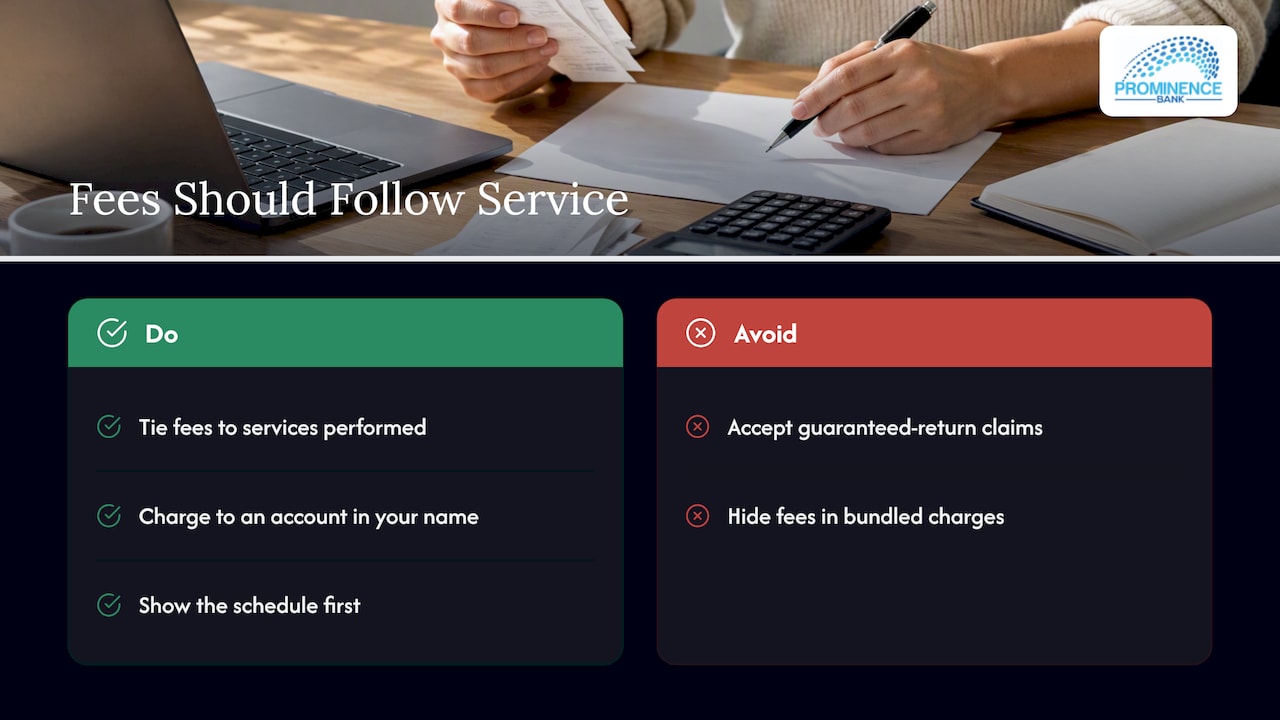
Custody is unglamorous. We hold assets, we document that we hold them, we report on them, and we charge for that. That is why our SKR service has a published fee, and why we ask for due diligence before we issue anything. The enhanced due diligence tiers on our schedule exist because a complex structure takes more review than a simple one, and we would rather say so in writing than hide it in a bundled charge.
If an SKR comes with a story about guaranteed returns, we would walk away, whoever issued it. If it comes with a custody agreement, a named custodian you can call and a schedule you can read, you are on solid ground.
— Harold
Opening custody with us
If you hold assets that need documented, secure custody, and you want an SKR issued by a bank you can verify, we can structure it. Clients typically start with an account, then add custody and the SKR service. See our custodial bank SKR page for what the service covers, then review the current fee schedule.
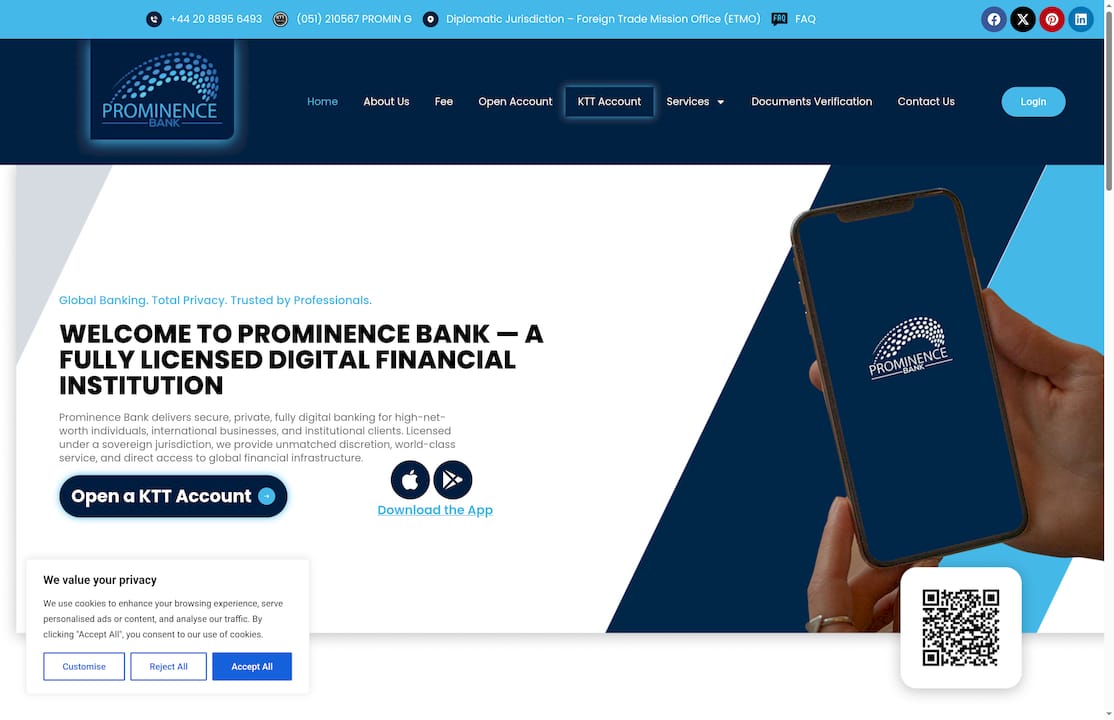
Businesses can start through our business account application. Private clients with larger or more discreet requirements can look at private banking. Institutions managing settlement or collateral will find more in our overview of treasury custody venues.
If you suspect fraud or have already paid
Act quickly, and keep everything.
- Stop paying. Do not send a further fee to “release” money you have already paid. Recovery offers that ask for another fee are a second scam.
- Preserve records. Save emails, messages, contracts, receipts, wire confirmations and the names and account details involved.
- Contact your bank at once. Ask whether the wire can be recalled. Speed matters most in the first hours and days.
- Report it. In the U.S., file with the FTC at ReportFraud.ftc.gov, the FBI’s Internet Crime Complaint Center at ic3.gov, and the SEC if securities or investment returns were promised. Your state securities regulator and attorney general also take complaints.
- Be careful with recovery services. The SEC warns that fraudsters impersonate regulators and offer to help you get your money back, so confirm any contact through official SEC channels before you respond.
- Talk to a securities or fraud attorney if the amount is significant, especially if funds crossed borders.
FAQ
How much does an SKR cost?
There is no standard price. Cost depends on the asset, its value and the custodian, and may combine one-off fees with annual or monthly custody charges. The published fee for the Safekeeping Receipt (SKR) / custody service is €25,000 for the custody account plus 2%.
Is an SKR the same as escrow?
No. Escrow holds funds for one transaction and releases them when agreed conditions are met. An SKR is a receipt showing a custodian holds specific assets for the owner, usually under an ongoing custody arrangement.
Is it normal to pay a fee to activate or monetize an SKR?
No. Legitimate custody fees pay for holding and administering assets. A fee to unlock a payout, especially with guaranteed returns or time pressure, matches the advance-fee pattern that the SEC and FTC warn about.
Can an SKR be sold or used like cash?
Not by itself. In the United States an SKR is proof of custody, not a title of ownership and not a negotiable instrument. Anyone presenting it as cash equivalent is misdescribing it.
How do I confirm an SKR is real?
Contact the issuing custodian through details you found independently and ask it to confirm the receipt, owner and assets. Check the institution’s licensing with its regulator, and get the fee schedule in writing.
Sources
- What Is a Safekeeping Receipt? Uses, Limits, and Risks
- SEC litigation release: North Star Finance LLC
- SEC Updated Investor Alert on advance fee fraud
- FTC: Operation Missed Fortune
- SEC Investor Alert: SEC impersonators
- What is an SKR (Safe Keeping Receipt)? A Factual Guide