
A safe keeping receipt (SKR) is issued after a custodian reviews an asset, accepts it under a written custody agreement, records it and delivers a receipt that describes what it holds. The receipt proves custody. It does not create a payment obligation, and it is not a loan, a guarantee or proof of creditworthiness. This guide walks through each stage in order, lists the documents a custodian usually asks for, and explains how a recipient can check an SKR directly with the issuer.
TL;DR
- An SKR is a custody document. It says a named custodian holds a described asset for a named owner, and nothing more.
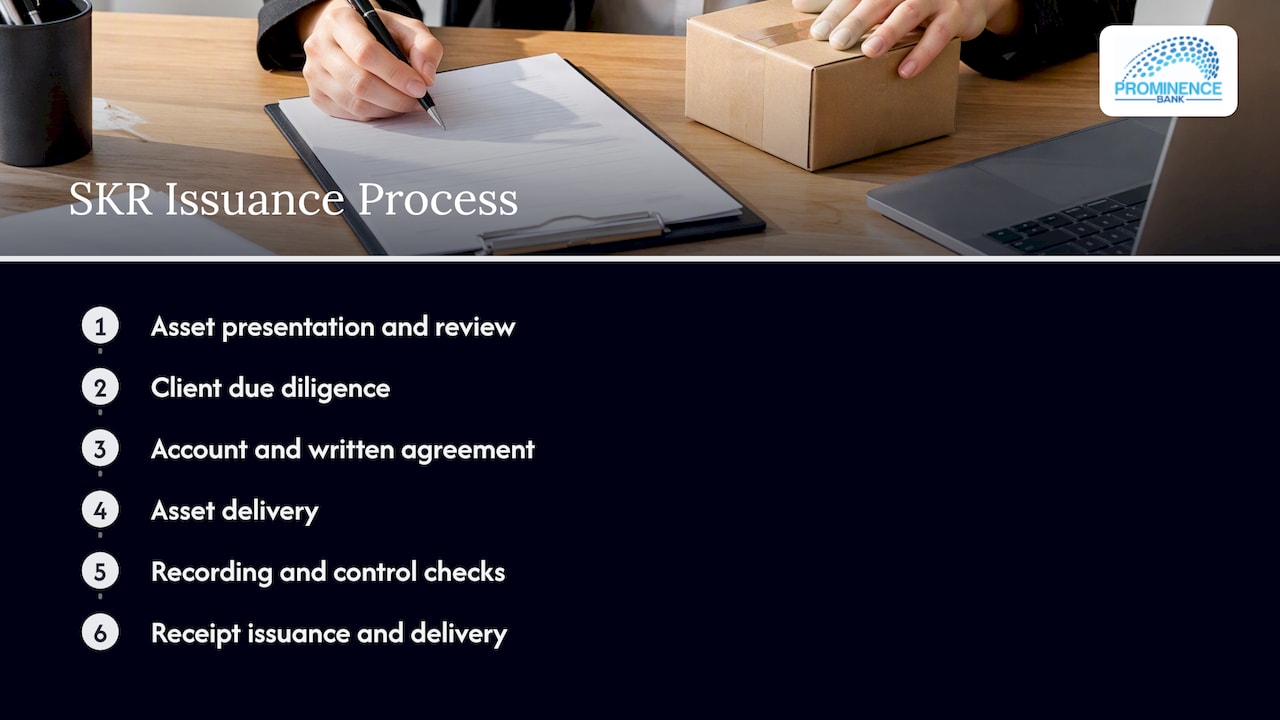
- Issuance follows a sequence: asset review, client due diligence, a written custody agreement, delivery of the asset, recording, and then the receipt itself.
- Expect to provide identity and source-of-funds records plus asset-specific papers such as purchase records, certificates, valuations and lien information.
- The only reliable verification is a direct confirmation from the issuing custodian, using contact details you found yourself.
- Anyone who sells an SKR as a monetizable instrument, or who resists verification, should be treated as a warning sign.
Table of Contents
- What an SKR is, and what it proves
- The SKR issuance process, step by step
- Documents typically needed
- Fees and timelines
- How to verify an SKR
- Red flags and what an SKR cannot do
- Who can issue an SKR, and under what rules
- Our perspective
- Starting an SKR file with Prominence Bank
- FAQ
- Sources
What an SKR is, and what it proves
An SKR is a receipt. A custodian, such as a bank, writes down that it has received specific assets and is holding them for the owner. Typical assets include precious metals, artwork, securities and important documents.
The legal point that matters most is who owns the asset afterward. Under U.S. bank guidance, assets held by a bank in a custodial capacity do not become assets or liabilities of the bank, and they remain the property of the account owner. The same guidance explains that if the bank is bought or fails, custody assets are not available to the bank’s creditors.
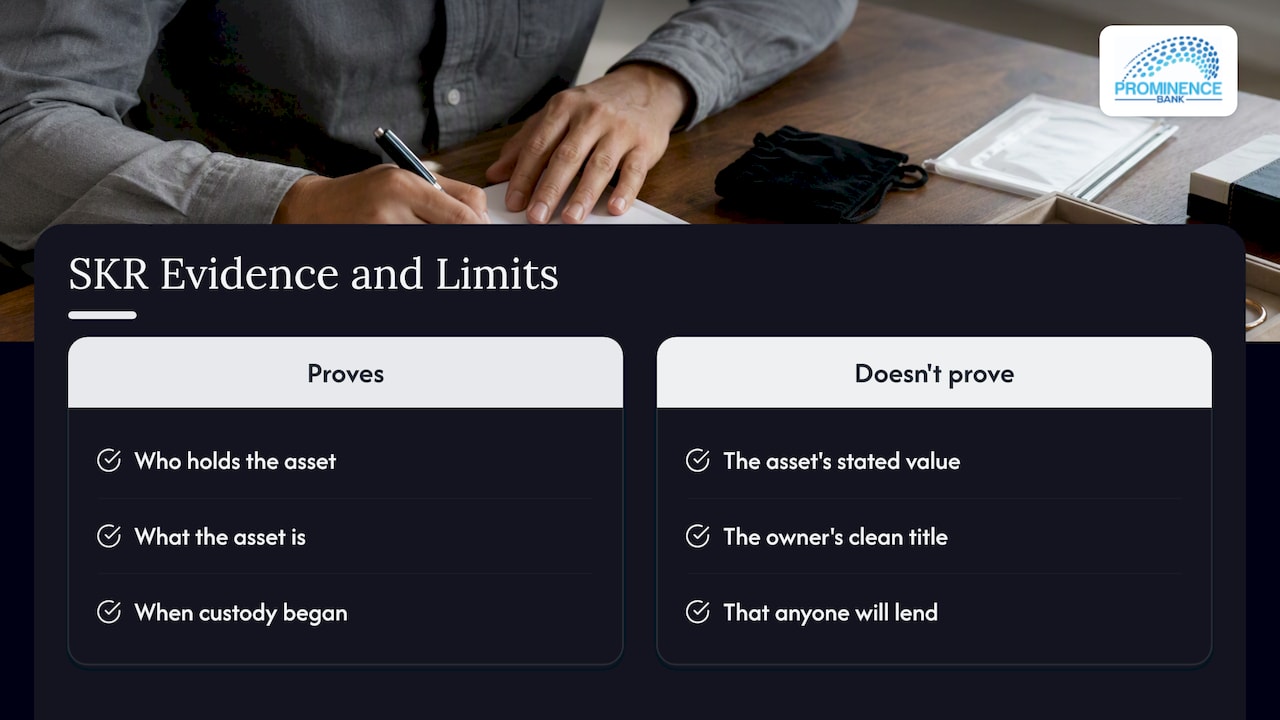
So an SKR proves three things: who holds the asset, what the asset is, and when it was taken into custody. It does not prove that the asset is worth the number written on it, that the owner has clean title, or that anyone will lend against it. Those questions need separate evidence, which is why the documents in the issuance file matter.
The SKR issuance process, step by step
Custodians differ in the details, and the exact requirements depend on the institution, its legal capacity and the type of asset. The sequence below is the one a careful custodian follows.
Step 1: Asset presentation and initial review
The owner describes the asset and the purpose of the custody arrangement: what it is, where it is now, how it is held and how it was acquired. The custodian decides whether it can safely hold that asset class at all. A vault suited to bullion may not suit paintings, and a custodian built for securities may not accept physical goods.
This is the stage where weak files get filtered out. If the owner cannot explain where the asset came from or cannot show clean title, the process should stop here.
Step 2: Client due diligence
Before accepting assets, a regulated custodian identifies and screens the client. That means identity documents, beneficial ownership for companies and trusts, and an explanation of the source of funds or source of the asset. Higher-risk or more complex relationships get deeper review.
At Prominence Bank, enhanced due diligence is charged in three published levels: Level 1 at €5,000, Level 2 at €10,000 and Level 3 at €15,000, each one-off, depending on how complex the file is.
Step 3: Custody account and written agreement
The custodian opens a custody account and the parties sign a custody agreement. It sets out what is held, who may give instructions, how the asset can be released, what the custodian is responsible for, and what it charges. Custody services are provided for a fee, so the fee schedule should be in this document or attached to it.
For readers who want the account side in more depth, our guide to custody accounts and secure asset management covers how the account is structured.
Step 4: Delivery of the asset
The asset moves into the custodian’s control. For securities, that means a transfer into the custody account. For physical items, it means a documented hand-over into a vault. The Office of the Comptroller of the Currency (OCC) notes that physical custody assets such as art, coins or jewelry call for security devices like alarms, lighting and vault controls, with records of all movements and vault access.
No receipt should be issued before this step is complete. A receipt for an asset that has not been delivered is the clearest sign something is wrong.
Step 5: Recording and control checks
The custodian records the asset in its books and keeps it separate from the bank’s own property. The OCC describes custodians’ duties as maintaining the safety of assets, keeping them segregated from the bank’s own assets and managing them under joint control. It also expects risk-based internal controls, including dual authorization for transactions and independent reconciliations.
These controls are why a receipt from a real custodian carries weight. The issuing document is backed by a process that a second person has checked.
Step 6: Issuance and delivery of the receipt
Only now is the SKR drawn up and signed by authorized officers. It identifies the issuer and the owner, describes the asset with quantity, serial numbers or other identifiers, states the date of custody, and refers to the custody terms. The receipt is then delivered to the owner, and where the owner has instructed it, confirmed to a named third party.
Our own page on custodial bank safe keeping receipts frames it the same way: a documented custody relationship built around a specific asset, from presentation through documented safekeeping.
Documents typically needed
There is no single universal checklist. What you need depends on the asset and the custodian, but files generally fall into two groups.
| Group | Typical items |
|---|---|
| Client file | Government ID, proof of address, company registration and ownership records, source-of-funds explanation, signed account application |
| Asset file | Purchase or transfer records, certificates or registration evidence, valuation or appraisal where relevant, lien and encumbrance information, chain-of-custody or delivery records |
The OCC’s guidance on asset management operations says regulated custodians must also keep records sufficient to identify customer positions and control of the assets. That is the custodian’s side of the paper trail, and it is what makes later verification possible.
A well-built receipt usually shows the asset description, quantity, stated value, custody terms and any fees. If it lacks a precise asset description, it is hard for anyone to rely on.
A quick checklist before you apply
- Gather proof of ownership for the asset, not only a description of it.
- Check for liens, pledges or disputes, and have the answer in writing.
- Get a valuation if the stated value matters to the person who will read the receipt.
- Prepare your identity and source-of-funds documents for each owner or beneficial owner.
- Read the fee schedule and the release conditions in the custody agreement before you sign.
Fees and timelines
Custody is a paid service, and the cost depends on the asset, its value and the security it needs. Be wary of any provider that promises issuance with no fees or defers all charges for months. A custodian that bears the safekeeping responsibility will charge for it.
At Prominence Bank, the published fee page lists account opening at 25,000 (in dollars or euros), one-off, a numbered account at €50,000 one-off with a €100 monthly fee, and bank endorsement at 1.5%. The published fee for the Safekeeping Receipt (SKR) / custody service is €25,000 for the custody account plus 2%. The full schedule is on our fees page.
Timelines depend almost entirely on how fast the client file and asset documents are complete. Due diligence and physical delivery are the slow parts, and the receipt itself is quick once both are done. We do not quote a fixed turnaround because it depends on your file.
How to verify an SKR
This is the question that matters most to the person receiving a receipt from someone else. A document that looks right on the page proves nothing until the issuer confirms it.
Verify with the custodian, through your own channel
Look up the custodian’s official contact details yourself, from its website or a regulator’s register, and not from the document or from the person handing it to you. Ask the custodian to confirm that it issued the receipt, the asset it covers, the owner named, and that the asset is still held. Ask for the confirmation in writing from the custodian itself.
Check the asset, not just the paper
A confirmation of the receipt number is the minimum. A lender or counterparty that is relying on the asset should also ask for a current custody statement from the custodian, issued directly to them. This mirrors what U.S. regulators expect elsewhere in finance: the SEC’s custody guidance says investment advisers can verify client assets by obtaining statements directly from the qualified custodian and comparing them with their own records.
The same guidance says that if the assets sit with an affiliate of the adviser, the adviser should take extra steps, such as seeking confirmations from entities higher in the custody chain. Apply that logic to an SKR: if the custodian is closely tied to the seller, ask who the independent party is.
Questions to ask the custodian
- Is the issuing entity licensed, and by whom?
- Does the receipt number match your records?
- Is the asset segregated from the custodian’s own property?
- Are there liens, pledges or restrictions on release?
- Who can instruct the custodian to release or transfer the asset?
If a counterparty will not let you contact the issuer, that alone is a reason to stop.
Red flags and what an SKR cannot do
Most SKR trouble comes from claims made around the document, not from the document. An SKR evidences custody. It is not a bank guarantee, not a standby letter of credit and not a payment promise. If you need a credit instrument, that is a different product with a different issuer obligation, and our explainer on the standby letter of credit shows how it differs.
Treat these as warning signs:
- The seller says the SKR can be monetized, leased or turned into a guarantee.
- Promises of high-yield, non-recourse loans against the receipt.
- Upfront “consultancy” or processing fees paid to an intermediary and not to the custodian.
- The issuer cannot be reached directly, or the seller insists on dealing only through brokers.
- No clear asset description, no serial numbers, no custody location.
- Pressure to move fast and skip confirmation.
Insider misconduct is a real risk too. In one FDIC enforcement case, an employee falsified bank records and forged loan documents, leading to felony convictions and a permanent ban from banking. A paper that looks official can still be fake, which is why confirmation from the institution, through independent contact, is the control.
Who can issue an SKR, and under what rules
A bank, a licensed depository or a professional secure-storage facility can issue one. In the United States, the rules that apply depend on the capacity and the asset. Fiduciary-account assets of national banks fall under 12 CFR Part 150, Subpart B, which requires the bank to keep custody or control and addresses when assets may be held off-premises. Broker-dealers holding customer securities follow Rule 15c3-3, which requires them to promptly obtain and maintain possession or control of fully paid customer securities.
Specialized sectors add their own conditions. For insurers, state regulators require custodial agreements to be in writing and approved by the board, and to require the custodian to indemnify against loss from negligence or dishonesty.
If your SKR will cross borders, our guide to international custody account procedures and the piece on offshore custody accounts explain the compliance questions that come with it.
Our perspective
We see the same pattern with most SKR enquiries. People arrive asking how fast a receipt can be produced, when the better question is what the receipt will be used for. A receipt is only as useful as the file behind it: clean title, a precise description, a valuation that someone credible can stand behind, and a custodian that will confirm all of it directly to a third party.
That is why we treat issuance as the end of a process, not the start. We would rather spend the time on due diligence and documentation than hand over a receipt that collapses the first time a counterparty calls us to verify it. If an arrangement only works when nobody checks it, it does not work.
We also tell clients plainly what an SKR is not. It documents custody. It is not a credit line, and we do not present it as one. Asset-backed opportunities are stronger when a lender can see a documented custody relationship and can confirm it with the custodian in one call.
— Harold
Starting an SKR file with Prominence Bank
If you hold an asset that needs a documented, verifiable custody relationship, the first step is an initial custody discussion about the asset, its documents and the purpose of the receipt. Our custody and SKR page explains how we approach it, and the fee schedule shows what is published: account opening at 25,000 in dollars or euros, enhanced due diligence from €5,000 to €15,000 depending on complexity, and the SKR / custody service at €25,000 for the custody account plus 2%.

If you are opening the account for a company, start with business banking. For an individual, see private banking.
FAQ
How long does SKR issuance take?
It depends on how quickly the client file and asset documents are complete, and on how the asset is delivered. Due diligence and physical hand-over usually take the longest, while drawing up the receipt is the short step at the end. Ask the custodian for a timeline based on your specific file.
How do I verify an SKR I received?
Contact the issuing custodian through contact details you found independently, for example on its official website or a regulator’s register. Ask it to confirm the receipt number, the asset, the owner and that the asset is still held. Do not rely on contacts printed on the receipt or supplied by the seller.
Can an SKR be used to get a loan?
A receipt can show a lender that an asset is held in custody, which may support a lending file. It is not a guarantee or a payment instrument, and it does not by itself create credit. Be skeptical of anyone who claims the receipt can be monetized or leased.
What assets can an SKR cover?
Commonly precious metals, artwork, securities and important documents. What a custodian accepts depends on its vault capabilities, licensing and risk controls. Physical items need appropriate security and movement records.
Does the custodian become the owner of the asset?
No. In a custodial arrangement the owner keeps ownership, and bank guidance says custody assets do not become the bank’s assets. The custodian holds and safeguards the asset under the agreement.
Sources
- Are my assets safe with a bank custodian? (HelpWithMyBank.gov)
- Custody Services, Comptroller’s Handbook (OCC)
- Asset Management Operations and Controls, Comptroller’s Handbook (OCC)
- Safeguarding Clients’ Assets Under Management (SEC)
- 12 CFR Part 150, Subpart B: Custody and Control of Fiduciary Assets (eCFR)
- 17 CFR 240.15c3-3: Customer Protection (eCFR)
- Custodial or Safekeeping Agreements, requirements (NAIC)
- FDIC administrative decision on falsified bank records and forged loan documents