
An asset-backed SKR is a custodian-issued receipt confirming that a specific asset sits in safekeeping. For lenders, it is useful proof of custody, but on its own it usually does not perfect a security interest: you still need a pledge or control agreement, and the perfection steps that go with it, before you can enforce a claim against that asset.
TL;DR:
- An SKR proves custody of assets like precious metals, cash, or securities but does not automatically establish enforceable security interests without a pledge or control agreement.
- Enforceability depends on attaching and perfecting the security interest through proper documentation, control, or possession, not solely on the SKR itself.
- A pledge agreement, control agreement, and, where applicable, possession are necessary to properly perfect the security interest and ensure enforceability.
- Custodians issuing SKRs face operational obligations such as AML/KYC checks, asset segregation, regular audits, and insurance, which are critical for mitigating custody risks.
- Due diligence steps must include verifying the custodian’s license, chain of custody, independent valuation, and obtaining contractual rights for inspection and control before relying on an SKR as collateral.
Table of Contents
- What an SKR is and how custody differs from ownership
- How an SKR moves through a financing transaction
- Which assets get held under an SKR and how they’re valued
- Attachment, perfection, and control under UCC Article 9
- Weighing the benefits and custody risks of relying on an SKR
- A due diligence checklist before accepting an SKR as collateral
- How a licensed custodian actually issues and supports an SKR
- Getting an SKR issued and custodied through Prominence Bank
- Where these legal and custody claims come from
- Sources
- FAQ
What an SKR is and how custody differs from ownership
A safekeeping receipt is issued by whoever physically or legally holds an asset for someone else. Issuers vary: commercial banks, depositories, and licensed custodians all use SKRs to document that they are holding gold, cash, securities, or bank instruments on a client’s behalf.
The document itself is narrow in scope. It typically records:
- The asset description and identifying details, such as serial numbers for bars or certificate numbers for securities
- The terms under which the custodian holds the asset, including any restrictions on movement
- Limited language on transferability, since most SKRs are not drafted as negotiable instruments
That narrowness matters legally. An SKR proves custody, not title. It says the bank or custodian is holding something, not that the person presenting the receipt owns it free and clear or has the right to pledge it. Confusing custody with ownership is one of the most common errors in how these documents get used, and it is exactly the gap that pledge and control agreements are meant to close.
How an SKR moves through a financing transaction
An SKR rarely appears in isolation. It shows up at a specific point in a larger sequence, and understanding that sequence is what separates a usable SKR from a piece of paper with no legal weight behind it.
- The asset owner deposits the asset (metal, cash, securities, or an instrument) with a licensed custodian
- The custodian issues the SKR, describing the asset and the custody terms
- The owner presents the SKR to a lender or counterparty as evidence the asset exists and is held safely
- The parties negotiate and sign a pledge agreement covering that specific asset
- The lender completes whatever perfection step applies, whether that’s a control agreement, a filing, or possession
Along the way, a few operational details decide whether the arrangement holds up. Endorsement language on the SKR needs to match what the pledge agreement expects. Tri-party or escrow arrangements often sit between the borrower and lender so a neutral custodian executes instructions. Sub-custodians, when they exist, usually need direct notification so there’s no confusion about who is actually holding the asset.
This structure shows up most often in trade finance, project financing, and secured lending deals where the collateral is not sitting in the lender’s own vault.
Pro Tip: Before relying on an SKR in a term sheet, confirm in writing whether the issuing custodian will also execute a control agreement. Some will not, and that changes the whole structure of the deal.
Which assets get held under an SKR and how they’re valued
Custodians issue SKRs against a fairly narrow set of asset types, mostly because these are the assets that lend themselves to physical or book-entry custody:
- Precious metals, typically gold or silver bars held in vault storage
- Cash deposits held in custodial or escrow accounts
- Marketable securities held in book-entry form
- Bank instruments such as certificates of deposit
Physical assets need an independent appraisal or assay report before a lender will assign real value to them, and that valuation typically needs refreshing on a schedule, not just at origination. Liquid, fungible assets like cash or listed securities tend to support a higher advance rate simply because they’re easier to value and easier to liquidate if something goes wrong. Physical metal, by contrast, usually gets a more conservative advance rate to account for assay risk, storage risk, and slower liquidation.
Attachment, perfection, and control under UCC Article 9
This is the part of the transaction that actually determines whether a lender can enforce a claim, and it’s where SKR-based deals most often go wrong.
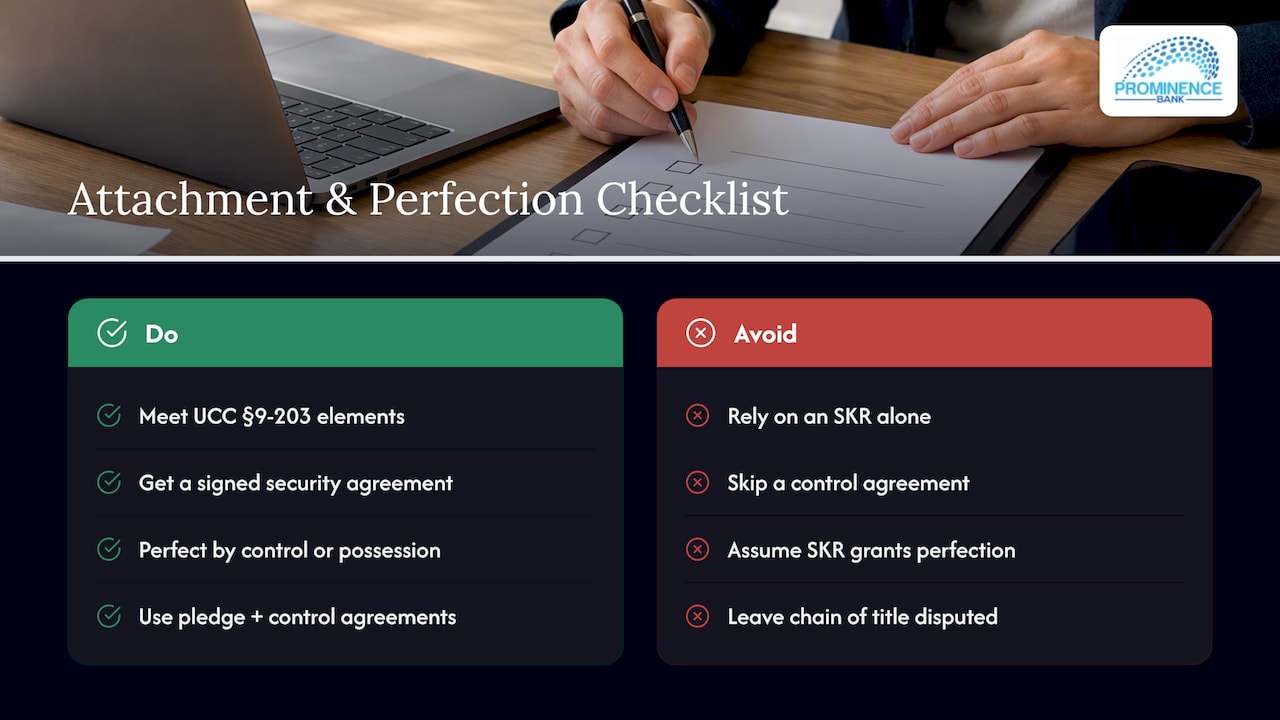
Under UCC §9-203, a security interest only becomes enforceable once three things are true: value has been given, the debtor has rights in the collateral, and there is an authenticated security agreement describing the collateral. An SKR can support that description, but it does not substitute for the security agreement itself.
Perfection is a separate question from attachment, and for deposit accounts it runs through “control.” UCC §9-104 sets out how a secured party obtains control of a deposit account: either the secured party is the bank where the account sits, or the debtor, secured party, and bank all sign an authenticated agreement under which the bank will follow the secured party’s instructions without needing further consent from the debtor. Investment property has analogous control mechanics under other Article 9 provisions.
A pledged account arrangement lets the owner keep using the account while a lender holds a conditional right to seize it on default, but perfection generally requires a three-party control agreement.
That structure, drawn from how pledged accounts work in practice, is described in detail by LegalClarity’s explanation of pledged accounts, which notes that owners often retain ownership and any economic benefit of the account right up until default.
A pledged account lets the borrower retain ownership and any interest or returns on the asset while the lender’s rights stay conditional until default, according to LegalClarity, which is the mechanism most SKR-backed lending deals are trying to replicate.
In practice, the instruments you need are a pledge agreement, a deposit account control agreement or tri-party control agreement, and, for certain asset types, possession itself as the perfection method. Deals fail when one of these is missing: no signed security agreement, no control agreement backing up the pledge, or a disputed chain of title on the underlying asset. An SKR alone addresses none of those gaps.
Weighing the benefits and custody risks of relying on an SKR
Used correctly, an SKR gives a lender documented proof that collateral exists without forcing a transfer of the asset itself, which preserves upside for the owner and adds flexibility to structured deals.
The risks sit mostly in custody and counterparty exposure rather than in the document itself:
- Counterfeit or fraudulent SKRs remain a persistent problem in cross-border finance
- Sub-custodian solvency can undermine an otherwise sound arrangement
- Unclear or missing endorsement language can block enforcement when it matters most
- Physical assets can lose value between valuation dates, leaving a lender under-collateralized
OCC custody guidance points lenders toward the standard mitigants: independent inspection of the asset, insured custody arrangements, contractual audit rights, and clearly defined release triggers written into the escrow or control agreement.
Pro Tip: Ask for audit rights in the custody agreement itself, not just in the pledge agreement. Lenders who skip this often discover they have no contractual basis to inspect the collateral until it’s already too late.
A due diligence checklist before accepting an SKR as collateral
Treat an SKR as the starting point of due diligence, not the conclusion of it.
- Confirm the custodian’s license and regulatory standing before relying on anything it issues
- Run standard KYC/AML checks on both the asset owner and the custodian
- Verify the chain of custody from origin to the current SKR
- Commission an independent valuation rather than relying on the custodian’s own figures
- Execute a signed pledge or security agreement describing the exact collateral
- Put a control agreement or tri-party agreement in place, or arrange possession where that’s the applicable method
- Confirm any required filings are made where the collateral type calls for one
- Obtain insurance certificates covering the custodied asset
| Control area | What to confirm |
|---|---|
| Custodian standing | Active license and regulatory registration |
| Chain of custody | Unbroken documentation from origin to current SKR |
| Valuation | Independent appraisal, refreshed on a defined schedule |
| Legal perfection | Signed pledge agreement plus control agreement or possession |
| Insurance | Active coverage naming the custodied asset |
| Reporting | Defined cadence for sub-custodian updates and audit access |
Operational controls matter as much as the paperwork: audit rights, substitution rules for swapping collateral, margin call triggers, and clear release conditions all need to be spelled out before the SKR does any real work in the deal. Details on how custody accounts operate day to day are covered in Prominence Bank’s overview of custody account mechanics.
How a licensed custodian actually issues and supports an SKR
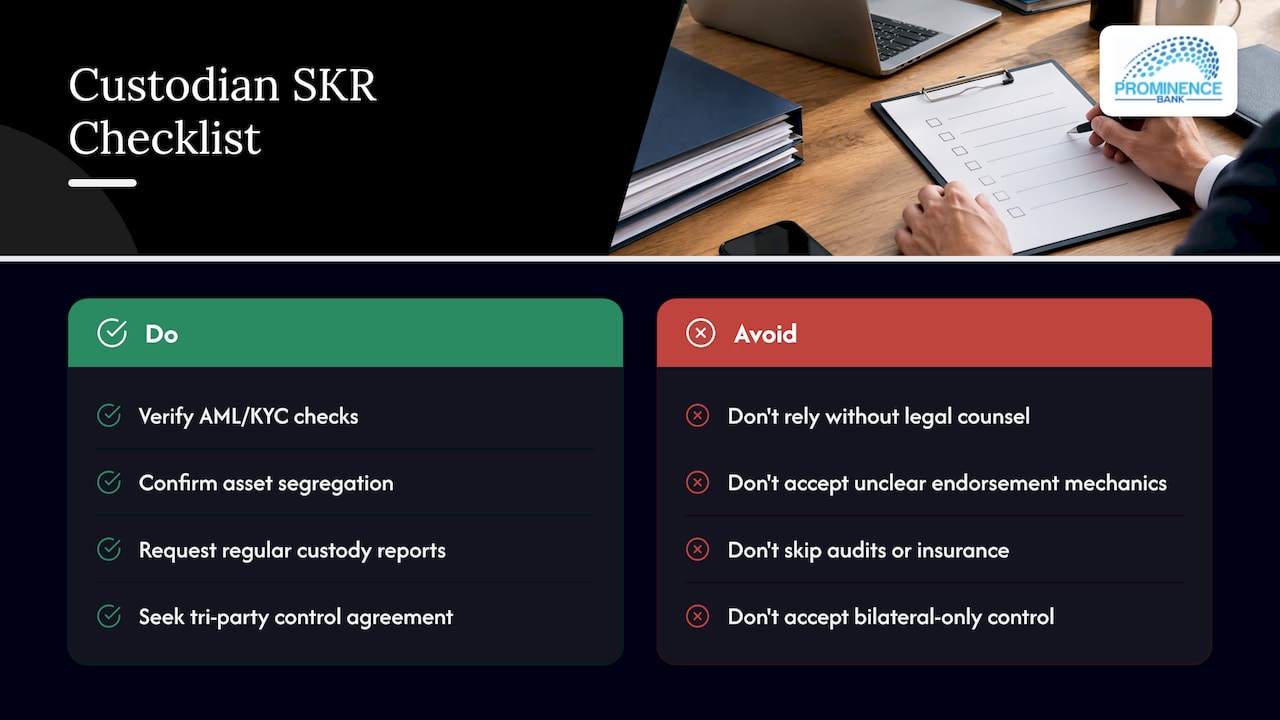
A custodian issuing SKRs carries real operational obligations: AML and KYC checks on the depositor, segregation of client assets from the bank’s own holdings, regular audits, insurance coverage, and endorsement mechanics that are unambiguous to any lender relying on the document.
Before you rely on an SKR from any issuer, ask for regular custody reporting, inspection rights over the underlying asset, and the option of a tri-party control agreement rather than a bilateral one. None of that replaces legal counsel. Review the pledge and control paperwork with counsel who can confirm the perfection mechanics actually apply to your jurisdiction and asset type before you treat the SKR as usable collateral.
— Harold
Getting an SKR issued and custodied through Prominence Bank
A licensed custodian issues safekeeping receipts and provides the custody infrastructure behind them, including custody accounts, valuation coordination, and insurance arrangements for the underlying asset. Clients working through this process typically need an asset list, proof of ownership, a recent valuation, and a clear statement of intended use for any proceeds before the custody file can move forward.

For high-net-worth individuals and institutions structuring a deal around custodied assets, private banking is the usual entry point, with corporate clients typically starting through business banking. Full pricing for SKR and related custody services is listed on the fees page, and the SKR service itself is detailed on Prominence Bank’s custodial safekeeping receipt page.
Where these legal and custody claims come from
The legal mechanics above draw on UCC Article 9, the OCC’s Comptroller’s Handbook on custody services, and practitioner guidance on pledged accounts and asset-based lending structures.
This article is general information, not a substitute for advice from a qualified financial advisor. Consult a qualified financial professional about your own circumstances before acting on anything here.
Sources
- § 9-203. Attachment and enforceability of security interest; proceeds; supporting obligations; formal requisites. | Uniform Commercial Code | LII / Legal Information Institute
- Custody Services | Comptroller’s Handbook | OCC
- What Is a Pledged Account? Definition and How It Works – LegalClarity
FAQ
What is an SKR in banking?
An SKR, or safekeeping receipt, is a document a custodian issues to confirm it is holding a specific asset on someone’s behalf. It proves custody, not ownership, which is why lenders typically need a separate pledge or control agreement before treating it as enforceable collateral.
What is an SKR in a gold transaction?
In a gold-backed deal, the SKR confirms that a named quantity of gold, usually identified by bar serial numbers, sits in a custodian’s vault under the depositor’s name. It does not by itself transfer title or give a lender rights to seize the metal; that requires a pledge agreement and, for physical bullion, possession-based perfection.
What is an asset-backed loan facility?
An asset-backed loan facility is a credit line secured by specific collateral, such as receivables, inventory, securities, or custodied assets like those documented by an SKR. The lender’s rights depend on properly attaching and perfecting its security interest under UCC Article 9, not on the existence of a receipt alone.
What is the difference between PTC and DA?
A pledge and trust certificate (PTC) structure and a deposit account (DA) arrangement both involve pledging an asset as collateral, but they apply to different asset types and use different perfection routes. A deposit account is perfected through control under UCC §9-104, while other pledged structures rely on possession or a security agreement tailored to the specific asset involved.