
An international bank account signatory is someone the bank authorizes to operate an account, such as signing checks, moving funds, or approving payments, without holding ownership of the money inside it. That separation between control and ownership is the whole point of the role, and it’s also where most people get tripped up. If you have signature authority over any foreign account and the combined balance you can access tops $10,000 at any moment during the year, you likely owe an FBAR filing, whether or not a dollar of it is yours.
TL;DR:
- Signatories with control over foreign accounts exceeding $10,000 at any time must generally file an FBAR, regardless of ownership interest or transaction purpose.
- Banks verify new signatories through identity checks, screening against sanctions and PEP lists, and often require wet signatures or in-person meetings for high-risk cases.
- Signatory authority is governed by specific mandates, which may require one or multiple signatures depending on the account setup and internal controls, impacting transaction approval.
- Changes to signatories involve a documented process with corporate resolutions, updated mandates, and identification, typically taking about a week if paperwork is complete.
- Signatory liability is joint and several, meaning each signer can be held responsible for unauthorized transactions, emphasizing the need for regular reviews and strict controls.
Table of Contents
- Who Can Be a Signatory on an International Account?
- FBAR, Form 8938, and the Reporting Traps Signatories Walk Into
- How Banks Verify a New Signatory’s Identity
- Signing Mandates: The Rule That Governs How Signatures Actually Work
- Adding or Removing a Signatory: The Checklist and Timeline
- What Signatories Are Actually Liable For
- When Multiple Signatories Create More Problems Than They Solve
- Why Signatory Policies Differ From Bank to Bank
- How Local Law Shapes What a Signatory Can Actually Do
- Keeping Signatory Documents Secure
- A Practitioner’s View on Where Signatory Setups Go Wrong
- Where Prominence Bank Fits Into Your Signatory Setup
- Sources
- FAQ
Who Can Be a Signatory on an International Account?
Banks assign signatory status to a fairly narrow set of roles, and the choice of who gets named shapes how the account actually runs day to day. A director or officer with signatory rights usually reflects legal authority already baked into the company’s governance documents. An employee, by contrast, might get narrow, transaction-limited access purely for operational convenience, like processing payroll or paying vendors, without any say in larger financial decisions.
Trustees occupy a different category entirely: they sign on behalf of a trust’s beneficiaries, carrying fiduciary duties that a regular corporate signatory does not.
- Directors and officers: broad authority tied to their corporate role, often unlimited within the account’s mandate.
- Employees: task-specific access, frequently capped by transaction size or type.
- Trustees: fiduciary signatories acting for beneficiaries, bound by trust law as much as bank policy.
- Signatory-only appointees: people with zero ownership stake, added purely to execute transactions on the owner’s behalf.
The signatory-only category matters most for compliance purposes. Someone in that role can move money freely within their mandate but has no claim on the account’s assets, which is precisely the scenario that triggers the reporting rules covered next.
FBAR, Form 8938, and the Reporting Traps Signatories Walk Into
FBAR (the Report of Foreign Bank and Financial Accounts) applies to anyone with signature authority over a foreign account, not just owners. The rule catches people who never expected to be on the hook: a controller who can sign wires for a foreign subsidiary, a regional manager with authority over a branch’s local account, an adult child added to a parent’s account overseas.
Filing threshold: If the combined value of every foreign account you can sign on exceeds $10,000 at any point in the calendar year, you generally must file an FBAR, even with no ownership interest.
Penalties scale sharply with intent. Non-willful violations draw civil penalties that, while serious, are far less severe than willful ones, which can include criminal exposure on top of steep fines. Form 8938 is a separate, often confused obligation: it applies to specified foreign financial assets tied to ownership interest, with its own thresholds that vary by filing status and residency, and it does not replace or override FBAR. Check IRS guidance directly, since the two regimes track different assets and use different math. One frequent edge case: employees with signature authority but no financial interest can sometimes qualify for a limited FBAR exemption, but only under narrow conditions tied to their employer’s own reporting.
How Banks Verify a New Signatory’s Identity
Before anyone gets added to an international account, the bank runs that person through identity verification and screening required under AML/KYC standards. This isn’t paperwork for paperwork’s sake. Regulators hold the bank accountable for who touches the account, so the verification step protects the institution as much as the client.
Expect the bank to request:
- A government-issued ID (passport is standard for international accounts)
- Proof of current address, typically a utility bill or bank statement
- A specimen signature card
- A passport-style photo for identity matching
Behind the scenes, the bank also screens the applicant against politically exposed person (PEP) lists, sanctions databases, and adverse media, and checks how the new signatory connects to the account’s beneficial ownership structure.
Pro Tip: Digital verification handles most routine signatory additions, but if the new signatory is a PEP or the mandate allows large-value transfers, expect the bank to fall back on wet-ink signatures or an in-person verification call. Building that buffer into your timeline saves a lot of frustration.
Prominence Bank’s own documents verification process follows this same logic, matching the depth of the check to the risk the signatory represents.
Signing Mandates: The Rule That Governs How Signatures Actually Work
A signing mandate is the operating instruction that tells the bank exactly how signatures combine to authorize a transaction. It’s a different document from the list of named signatories, and confusing the two is one of the most common onboarding mistakes companies make. The mandate plus the board resolution together create the enforceable authority the bank actually records and honors.
Common mandate structures include:
- Singly: any one named signatory can act alone.
- Jointly, any two of four (or similar combinations): a specified subset must sign together.
- Jointly, all signatories: every named party must approve, the tightest possible control.
- Special or bespoke instructions: custom rules, such as requiring a second signature only above a certain transaction size.
Tighter mandates reduce the odds of internal fraud or unilateral error, but they also add friction to routine payments. A multi-signatory corporate account with a two-of-four structure, for instance, strikes a workable balance for mid-sized businesses that want oversight without grinding every wire transfer to a halt.
Adding or Removing a Signatory: The Checklist and Timeline
Changing who can operate an account means assembling two separate document sets: one for the company, one for the individual.
Corporate documents:
- Updated board resolution naming the new or removed signatory
- Revised signing mandate reflecting the change
- Completed authorized signatory form
- Specimen signature card for any newly added signatory
Individual documents:
- Government-issued ID and proof of address
- Passport photo
- Any enhanced due diligence documents the bank requests for higher-risk profiles
Most institutions accept these submissions through a secure digital portal, but wet-ink signatures still get required for higher-risk mandate changes or when the bank needs extra supporting documentation.
Timeline benchmark: Plan for about a week after the bank receives complete documentation. Missing paperwork, unclear beneficial ownership, or a PEP match are the usual culprits behind longer waits.
Prominence Bank’s account workflow guide walks through this same sequence for corporate clients opening or restructuring international accounts.
What Signatories Are Actually Liable For
Signatory status carries real legal exposure, and too many people accept the role without understanding what they’re agreeing to. Bank account terms typically make signatories jointly and severally liable for authorized transactions, meaning the bank can pursue any signatory individually for the full amount of a disputed or fraudulent transfer, not just a proportional share. Civil liability is the more common risk, but improper or unauthorized activity can escalate into criminal exposure, particularly when a signatory knowingly facilitates money laundering or sanctions evasion.
A few controls meaningfully cut that exposure:
- Dual-signature mandates on anything above a set transaction threshold
- Hard transaction limits tied to each signatory’s role
- Regular audit log reviews, not just annual ones
- Periodic reauthorization of every signatory, not a “set it and forget it” list
Keep signed mandates, board resolutions, and specimen signatures on file for as long as the account stays open, plus several years after closure, since disputes can surface long after a transaction clears. Bring in legal or tax counsel the moment a signatory’s authority intersects with a cross-border tax question or a suspected compliance breach. Waiting until a regulator asks is the wrong time to figure out your paperwork.
When Multiple Signatories Create More Problems Than They Solve
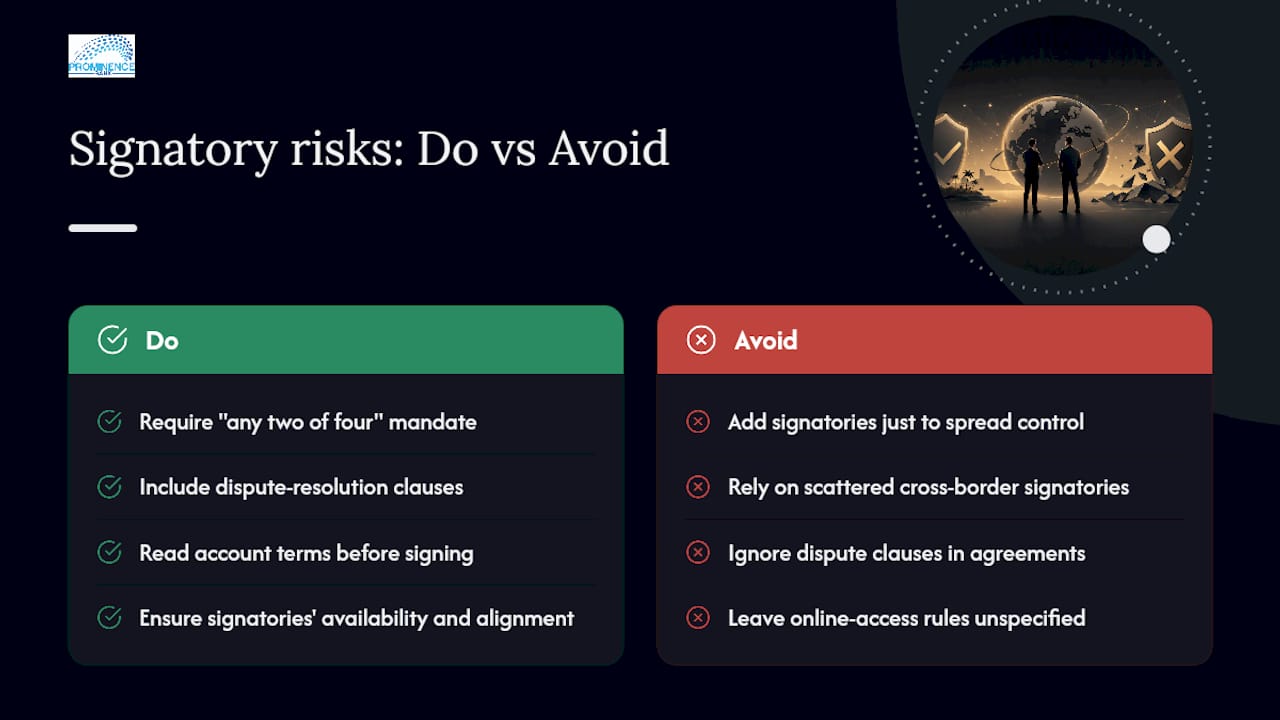
Adding signatories to spread out control sounds smart in theory. In practice, every additional name on the account is another point of potential disagreement, and international accounts amplify that risk because the people involved often sit in different countries, time zones, and legal jurisdictions.
Disputes typically surface in one of two ways. Either two signatories disagree on a specific transaction and the bank freezes the disputed function until it’s resolved, or a company’s internal governance breaks down and multiple people start issuing conflicting instructions to the bank. Most banks respond to the second scenario by suspending online access entirely until the company sorts out its own house, which can leave an otherwise healthy business unable to pay a supplier for weeks.
The fix isn’t fewer signatories necessarily. It’s a mandate that anticipates disagreement before it happens. A well-drafted “any two of four” structure, for example, means no single person can move money alone, but it also means the company needs at least two available, aligned people at all times, which matters for businesses with signatories scattered across regions with different holiday schedules and working hours.
Dispute resolution clauses buried in account opening agreements matter more than most companies realize until they need them. Read that section before you sign, not after a disagreement lands you in it.
Why Signatory Policies Differ From Bank to Bank
There’s no single universal rulebook for how banks handle signatories, and that variation catches international account holders off guard constantly. One institution might process a signatory change entirely online. Another might insist on a notarized signature and a phone verification call for the identical request.
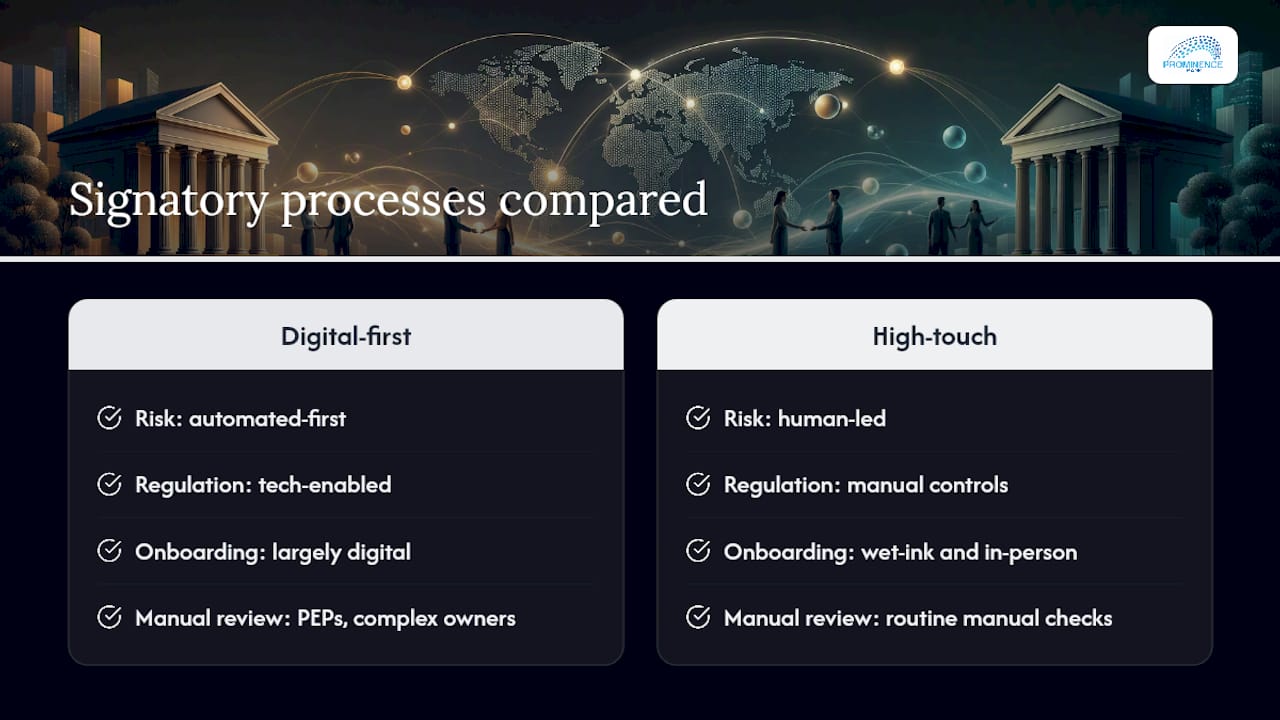
The differences usually come down to three factors: the bank’s own risk appetite, the regulatory framework it operates under, and how much of its onboarding is digitized versus manual. A bank built around high-touch private banking relationships tends to lean on human verification and wet-ink documentation as a matter of institutional culture, not just regulatory necessity. A digitally native institution, by contrast, automates identity verification and mandate recording, reserving manual review for genuinely high-risk cases like PEP matches or complex ownership structures.
This is worth checking before you open an account, not after. Ask directly how the bank handles routine signatory additions, what triggers a manual review, and how long a typical change takes. The answers tell you a lot about how that bank will treat you when something more urgent comes up.
How Local Law Shapes What a Signatory Can Actually Do
Signatory rights don’t travel with a uniform rulebook across borders. The jurisdiction where an account is domiciled, and sometimes the jurisdiction where the signatory resides, determines what authority actually means in a legal dispute.
Some countries treat a signing mandate as close to ironclad, so long as it’s properly documented and matches the account’s governing resolution. Others give courts more latitude to look past the paperwork and examine the underlying relationship, particularly in cases involving family trusts or closely held companies where the line between signatory and beneficial owner gets blurry. Trust structures raise the stakes further: a trustee’s signatory authority is bound by fiduciary duty under the law of the jurisdiction governing the trust, which may differ entirely from where the bank account itself sits.
For company decision-makers, the practical takeaway is straightforward: never assume the signatory rules that apply in your home jurisdiction carry over cleanly to an account opened elsewhere. A mandate drafted under one country’s corporate law might not hold the same weight in a dispute heard in another. When the amounts involved are significant or the ownership structure is at all complex, getting a local legal opinion on signatory enforceability before you finalize the mandate is worth the cost.
Keeping Signatory Documents Secure
Board resolutions, specimen signatures, and signing mandates are sensitive documents, and treating them casually creates exposure that has nothing to do with the bank’s own security. A specimen signature in the wrong hands is a template for forgery. A copy of a board resolution naming signatories tells anyone who finds it exactly who to target for a fraudulent request.
Store these records in an access-controlled system, not a shared drive with company-wide permissions. Limit viewing rights to the people who actually need them, generally legal, finance leadership, and whoever manages the banking relationship directly. Keep both digital and physical originals, since some jurisdictions and some banks still want a wet-ink original on file even when the working copy lives digitally.
Review the full signatory list on a set schedule, at minimum annually, and immediately whenever someone leaves the company or changes roles. Departed employees who stay on an account as an active signatory are a far more common source of fraud than most companies assume. Set calendar reminders tied to mandate reviews rather than relying on someone to remember, because in a busy finance department, this is exactly the kind of task that quietly slips.
A Practitioner’s View on Where Signatory Setups Go Wrong
The single most common mistake is a mismatch between the board resolution and the actual signing mandate on file. Someone updates one document and forgets the other, and the bank ends up holding two records that contradict each other. Missing specimen signatures and mandates with no transaction limits at all are close behind.
At Prominence Bank, mandates get captured digitally at onboarding and tied directly into the AML/KYC workflow, so the resolution, the mandate, and the verification record stay linked rather than living in three separate files. The fix that saves the most time isn’t complicated: send the bank a complete, internally consistent package the first time, and build transaction limits into the mandate from day one rather than adding them after something goes wrong.
— Harold
Where Prominence Bank Fits Into Your Signatory Setup
If you’re managing signatories across borders, the real cost usually isn’t the bank fees. It’s the hours lost to mismatched paperwork, unclear mandates, and verification delays that a more digitally organized bank would have caught upfront. Some banks build onboarding processes that capture mandates and signatory records digitally and cross-check them against board resolutions from the start, helping avoid reconciling contradictory files months later.
Onboarding for a multi-signatory corporate account runs through a straightforward document checklist, government ID and proof of address for each signatory, a specimen signature, and your board resolution, and Prominence Bank’s Enhanced Due Diligence review scales to match risk level rather than applying the same heavy process to every applicant. Standard business banking accounts support multiple signatories with documented, auditable mandates from day one. If you’re ready to move forward, start the business account application and check current account fees before you submit your paperwork.
Sources
- What Is a Bank Signatory? Roles, Rights, and Liabilities – LegalClarity
- FFIEC BSA/AML Examination Manual — Assessing Compliance With BSA Regulatory Requirements
- IRS official site
- Authorized signatories and signing mandates: Getting the account mandate right | Creodata
FAQ
Is It Illegal for a U.S. Citizen to Have a Foreign Bank Account?
No, owning or having signature authority over a foreign bank account is legal for U.S. citizens. What’s mandatory is reporting it: signature authority over foreign accounts that together exceed $10,000 at any point in the year generally requires an FBAR filing, and failing to file is where the legal trouble starts.
Who Can Be a Signatory on a Bank Account?
Banks typically allow directors, officers, employees, trustees, and signatory-only appointees to serve as signatories, depending on the account’s mandate and the person’s documented relationship to the account owner. Each role carries different authority: a director often has broad access, while an employee may be limited to specific transaction types.
How Many Signers Can You Have on an International Account?
There’s no fixed cap. Banks support anywhere from a single signatory to several, and the mandate, such as “jointly any two of four”, determines how those signers must act together rather than limiting the total headcount.
What Happens If I Have More Than $10,000 in a Foreign Bank Account?
If you have ownership or signature authority and the combined balance across your foreign accounts exceeds $10,000 at any point during the year, you’re generally required to file an FBAR. Form 8938 may apply separately based on ownership interest and different thresholds, so check IRS guidance to confirm which filings apply to your situation.