
Network rails now permit transfers up to $10 million per customer credit transfer, but that number is not your number. Your real ceiling is set by your bank, your account channel, and how well you have documented the payment in advance. If you need to move a large sum this week, the first call is not to a wire form. It is to your treasury desk or private banker, who can confirm the channel, cutoff time, and paperwork before you initiate anything.
TL;DR:
- FedNow’s new $10 million transfer limit applies only on the network level; individual banks can set much lower limits based on their risk policies.
- Most banks restrict online transfer limits to tens or hundreds of thousands of dollars, with higher limits available through treasury or private banking channels.
- Fraud risk, liquidity management, and compliance requirements primarily drive banks to cap transfer amounts well below the FedNow ceiling.
- Large transfers require pre-notification, documentation, and often dual authorization, with scheduling at least one business day in advance to avoid delays.
- For cross-border or complex deals, Fedwire and SWIFT remain preferable, as they support staged settlement and verification beyond instant network limits.
Table of Contents
- What Are High Value Transaction Limits Right Now?
- How Do Bank Channels Change Your Transfer Limit?
- Why Do Banks Cap Transfers Below the Network Maximum?
- How Do You Move Money Above Your Online Limit?
- What Does the Higher FedNow Cap Change for You?
- The Prominencebank Perspective on High-Value Transfers
- Ready to Move a High-Value Transfer? Start Here
- Sources
- FAQ
What Are High Value Transaction Limits Right Now?
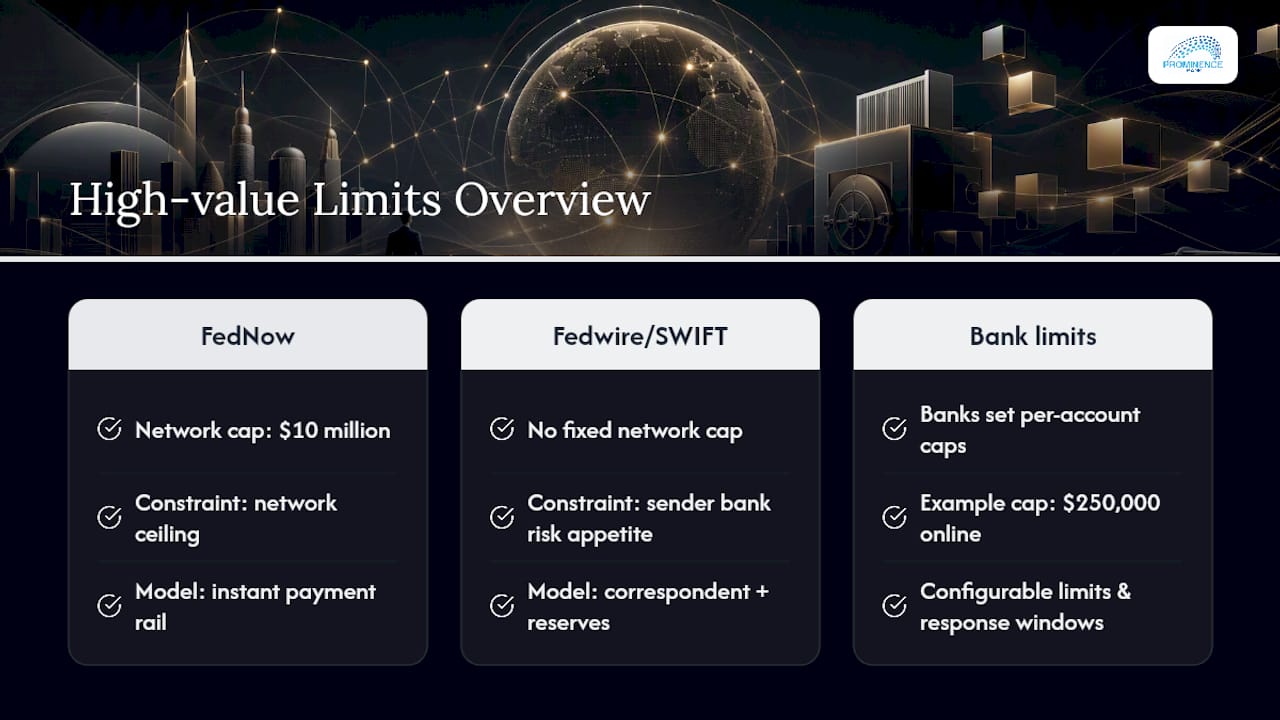
The headline number changed on November 12, 2025. That is when the FedNow network transaction limit for customer credit transfers and liquidity management transfers rose to $10 million, up from the previous cap. It was the largest jump since FedNow launched, and it put the Federal Reserve’s instant payment rail within range of transactions that once required a same-day wire.
Fedwire and SWIFT correspondent banking operate on a different model entirely. They do not cap institutional transfers at a fixed network ceiling the way FedNow does. Instead, they settle through a mesh of correspondent relationships and reserve balances, and no federal statute caps the dollar amount a wire can carry. The constraint on a SWIFT payment is almost always the sending bank’s internal risk appetite, not the network’s technical ceiling.
Here is the part most clients miss. A $10 million network allowance is a maximum, not a guarantee. FedNow’s own operating procedures let each participating bank configure its own default and per participant maximum transaction values, along with reserved response windows that govern how fast a receiving institution must confirm a payment. A bank can technically support $10 million and still cap your account at $250,000 online because that is where its own risk committee drew the line.
So the network figure tells you what is technically possible across the rail. It does not tell you what your bank will actually let you send from your login. Those are two different numbers, and confusing them is the single most common mistake high-value clients make when planning a large transfer.
How Do Bank Channels Change Your Transfer Limit?
Online banking limits, phone limits, branch limits, and treasury desk limits are not the same number, and the gap between them can be enormous. Industry benchmarking on wire limits shows online daily caps commonly sitting in the tens of thousands to low hundreds of thousands of dollars at many retail-facing institutions, while in-branch or treasury-managed transfers are negotiable and often run into the millions.
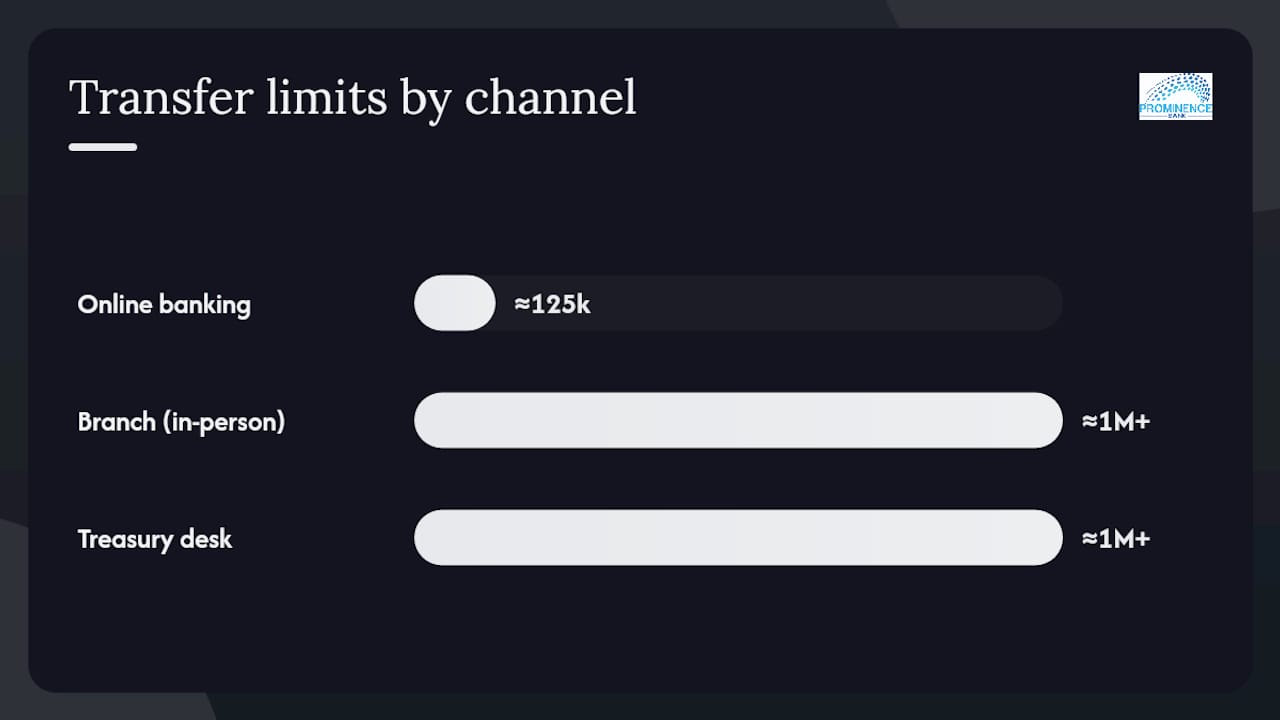
The logic behind that gap is verification. A treasury officer or private banker can confirm your identity, the commercial purpose of the transfer, and the underlying documentation in real time. An app-based transfer cannot do that, so banks build in a much smaller default ceiling for self-service channels.
Three factors shift where you land on that scale:
- Account tier. A standard business checking account and a dedicated private banking or corporate relationship carry different default limits from day one.
- Relationship history. A client with two years of consistent, documented activity gets a higher default cap than a brand-new account, even at the same tier.
- Verification level. Completing enhanced due diligence up front, rather than scrambling for it mid-transfer, often unlocks a permanent limit increase instead of a one-time exception.
Most banks offer a one-time uplift process for a specific transfer that exceeds your standing limit. Expect dual authorization (a second signer or officer sign-off) and, for anything moving into seven figures, a direct conversation with a treasury or private banking contact rather than a chat-based support ticket.
Why Do Banks Cap Transfers Below the Network Maximum?
Fraud risk drives most of the gap between what FedNow allows and what your bank allows. Account takeover fraud on a $10 million transfer is catastrophic in a way a $10,000 fraud loss is not, so banks build conservative online defaults specifically to blunt that exposure. Every institution also manages its own liquidity exposure. A bank participating in an instant payment rail has to be ready to settle that amount immediately, and unlimited exposure to instant, irrevocable transfers is a balance sheet risk few institutions accept without limits.
Compliance adds another layer. AML and OFAC screening on a large transfer takes time, and a payment that looks unusual for the account can trigger a manual hold or return even after it clears the initial system checks. FedNow’s reserved response windows add a technical constraint on top: if the receiving bank cannot confirm within the timeout clock, the payment fails, which is one more reason banks keep instant-rail defaults conservative even as the network ceiling climbs.
How Do You Move Money Above Your Online Limit?
Getting a seven or eight figure transfer through cleanly is a sequencing problem more than a technical one. Miss a step and you are looking at a delayed settlement, a bounced instant payment, or a compliance hold that costs you a full business day.
- Pre-notify your bank. Call your treasury desk or private banker before you touch a transfer form, and confirm which rail fits the payment: FedNow for speed under $10 million, Fedwire or SWIFT for larger or more complex cross-border settlement.
- Assemble documentation early. Contracts, invoices, proof of funds, and full beneficiary details should be ready before you initiate, not gathered after compliance asks for them.
- Request a limit uplift or channel change. For amounts above your standing cap, ask for a one-time exception or a permanent tier increase, and expect dual authorization on the sending side.
- Confirm timing and cost. Cutoff times, intermediary bank routing, and currency conversion fees all vary by rail, so get these confirmed in writing before you send, especially on cross-border legs.
- Build in a buffer. Schedule during business hours and give treasury at least one business day of lead time so the institution can provision liquidity and complete due diligence without rushing.
Pro Tip: Never split a large payment into smaller pieces to dodge a limit or a review threshold. That looks like structuring to a compliance system, and it will trigger exactly the scrutiny you were trying to avoid.
Treasury-managed transfers also benefit from direct identity verification that self-service channels can’t replicate, which is precisely why the desk route clears faster for large sums despite feeling slower to arrange.
What Does the Higher FedNow Cap Change for You?
For domestic business payments under $10 million, instant settlement is now genuinely on the table where it used to require a same-day wire and a waiting period. That is a real shift for payroll funding, supplier settlement, and time-sensitive liquidity moves.
For anything layered with escrow conditions, multi-party FX, or cross-border legal complexity, Fedwire and SWIFT remain the safer route, since those rails are built for staged settlement and correspondent-bank verification. Confirm interoperability with your bank before assuming an instant rail will handle a deal it was not designed for.
The Prominencebank Perspective on High-Value Transfers
Most guidance on transfer limits treats the network cap as the story. It is not. The real story is that a $10 million FedNow ceiling means almost nothing to a client whose bank still runs on a retail risk model built for average account balances, not institutional flows.
High-value transfers are often handled through multi-currency accounts, KTT-enabled transaction flows, and dedicated treasury and private banking channels designed for this client type. When you request a large transfer, expect pre-notification, full documentation review, and a dedicated contact rather than a support queue. Security and AML/KYC compliance are not a separate hurdle bolted onto the process. They run alongside it, because that is what keeps a large, discreet transfer from turning into a delayed one.
— Harold
Ready to Move a High-Value Transfer? Start Here
A retail-style banking app is built for average balances, not seven and eight figure moves. That gap is exactly where Prominencebank operates: multi-currency business accounts, KTT-enabled flows, and a treasury and private banking desk built specifically for clients who need a large transfer handled with documentation, discretion, and a real person on the other end of the line.

If you are opening a new relationship, review the business banking or corporate banking options to see which structure fits your transfer volume, and check the current fee schedule before you initiate anything above your standing limit. From there, the next step is simple: contact a Prominencebank private banker to confirm your channel and arrange treasury handling for the transfer you have in mind.
Sources
Limits vary by institution and change over time. Confirm your exact figures directly with your bank, and see the Federal Reserve’s FedNow transaction limits page for the current network maximum.
This article is general information, not a substitute for advice from a qualified financial advisor. Consult a qualified financial professional about your own circumstances before acting on anything here.
FAQ
What Is the Current FedNow Transfer Limit?
FedNow’s network limit for customer credit transfers and liquidity management transfers is $10 million per transfer, effective November 12, 2025. Individual banks can set lower limits for their own customers regardless of this network ceiling.
Is There a Federal Cap on Wire Transfer Amounts?
No federal law sets a maximum dollar amount for a wire transfer. Practical limits come from each bank’s own policy, which varies by account type, channel, and client relationship.
Why Is My Online Transfer Limit So Much Lower Than My Bank’s Maximum?
Online channels carry lower default limits because they cannot verify identity and intent the way an in-branch or treasury conversation can. Requesting a limit increase or routing the payment through a treasury or private banking desk typically resolves this.
Does Prominencebank Support High-Value Transfers?
Yes. Prominencebank supports multi-currency accounts, KTT-enabled transaction flows, and dedicated treasury and private banking channels built for high-value and institutional transfers.
How Far in Advance Should I Notify My Bank About a Large Transfer?
Give your treasury desk or private banker at least one business day of lead time, plus full supporting documentation, before initiating a transfer above your standing limit. This allows time for liquidity provisioning and compliance review without delaying settlement.