
The visible fee on an outgoing international wire typically runs $25 to $50, but that number is almost never the real cost. Foreign exchange markup and correspondent bank deductions usually take more than the sender fee itself. The three moves that cut total cost the most: use a provider with transparent FX pricing, send in the recipient’s currency or route through a cheaper rail like ACH, and initiate online instead of at a branch.
TL;DR:
- The biggest hidden costs on international wires come from FX markup and intermediary deductions, often exceeding the visible sending fee.
- Using a provider with transparent FX rates, sending in the recipient’s currency, or initiating online can significantly reduce total transfer costs.
- “Our” fee instruction ensures the sender covers all fees and guarantees the recipient gets the intended amount, making costs more predictable.
- Sending small amounts under $1,000 through alternative rails like ACH or specialized FX providers usually offers better value than traditional bank wires.
- For high-volume or recurring transfers, holding funds in multi-currency accounts with transparent FX pricing can eliminate costly markup and improve overall efficiency.
Table of Contents
- Where Your Money Actually Goes on an International Wire
- What Do Banks Actually Charge for International Wires?
- What Do OUR, SHA, and BEN Mean on a Wire?
- How to Lower the Total Cost of an International Transfer
- Wire Transfer vs. ACH vs. FX Provider: Which Should You Use?
- A Worked Example: The Real Cost of Sending $5,000 Abroad
- Why Transparency in FX Pricing Changes the Math
- Bank on Transparent Pricing for Cross-Border Payments
- Sources
- FAQ
Where Your Money Actually Goes on an International Wire
Four separate deductions hit an international wire, and only one of them shows up on your receipt.
The sending fee is what your bank charges you to initiate the wire, typically disclosed upfront. The receiving fee is what the beneficiary’s bank charges to accept it, usually deducted before the money hits their account. Both are flat dollar amounts and both are easy to compare across banks.
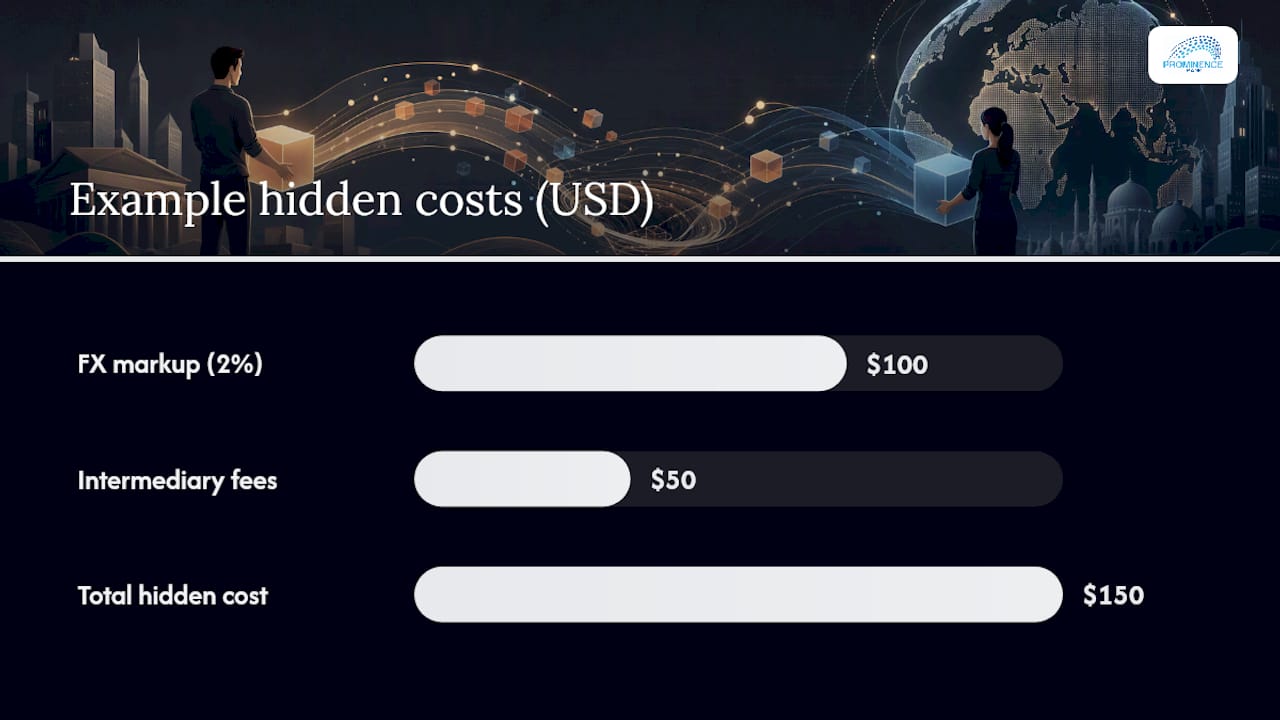
The part nobody prints on a fee schedule is the FX markup. When you send U.S. dollars that get converted to euros, pesos, or yen, your bank sets its own exchange rate, and that rate sits above the mid-market rate you’d see on Google or Reuters. That spread is commonly 1% to 3% above the real rate, and it’s baked silently into the number your recipient sees, not itemized as a separate line.
Then there’s the intermediary deduction. Wires routed through SWIFT often pass through one or more correspondent banks before reaching the destination bank, and each one can skim a “lifting fee,” commonly $10 to $30 per hop.
- Sending fee: disclosed, flat, easy to shop
- Receiving fee: deducted on arrival, rarely negotiable
- FX markup: hidden in the exchange rate, usually the biggest cost
- Intermediary deductions: $10 to $50 per correspondent bank in the chain
**A “no-fee” wire can still cost you $150 on a $5,000 transfer. **If your bank waives the sending fee but marks up the exchange rate by 2%, that’s $100 gone before intermediary deductions even factor in.
What Do Banks Actually Charge for International Wires?
There’s no federal cap on wire fees. The Office of the Comptroller of the Currency’s consumer guidance confirms banks set and disclose their own pricing, which is why the range across institutions is wide and worth checking before you send.
A national survey of U.S. banks found typical median wire transfer fees generally fall near $25 for outgoing domestic wires, $45 for outgoing international wires, and $15 for incoming wires.
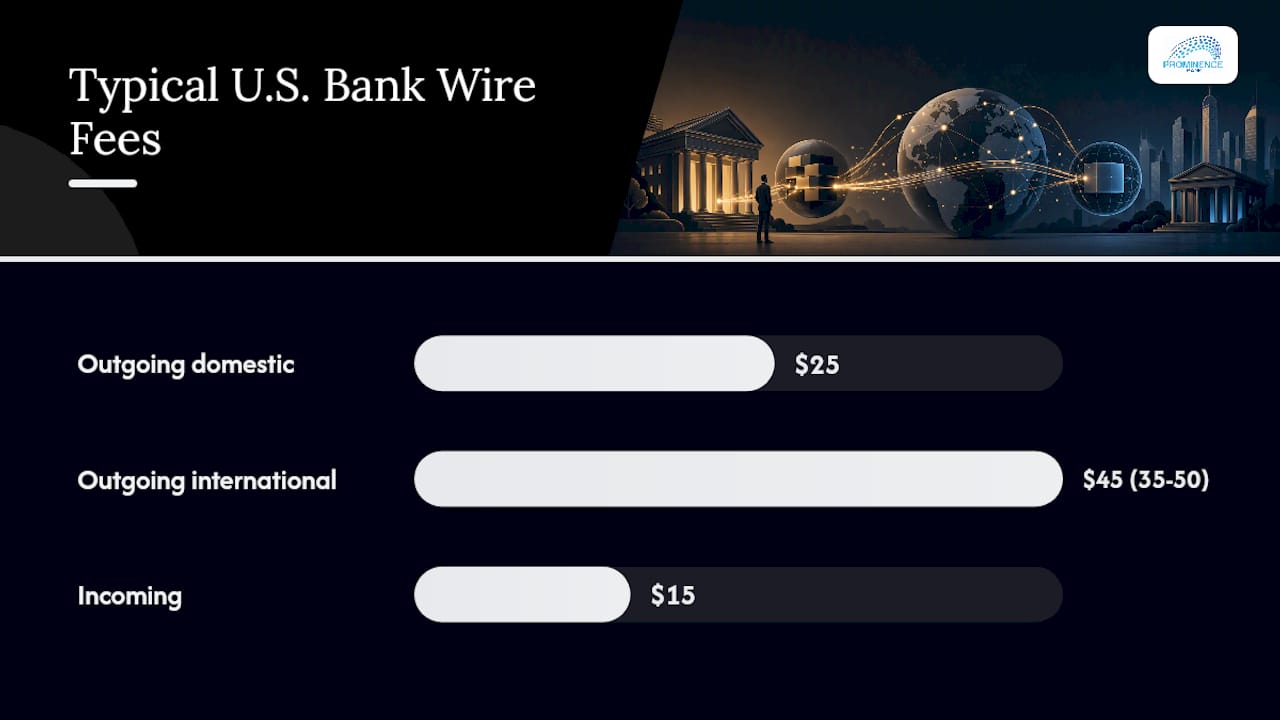
Those figures come from NerdWallet’s bank fee analysis, and Bankrate’s research puts outgoing international wires in a similar $35 to $50 band, depending on the institution.
Two nuances matter more than the headline number. First, initiating a wire online instead of at a branch often knocks $5 to $15 off the fee. Second, some banks waive the sender fee entirely when you send in the recipient’s local currency instead of U.S. dollars, since they make that money back on the exchange-rate spread instead. A handful of online-first banks skip wire fees altogether as a way to attract higher-balance customers, but that doesn’t mean the transfer is free. Check the FX rate they quote against the mid-market rate before assuming you got a better deal.
What Do OUR, SHA, and BEN Mean on a Wire?
Every international wire carries a fee-allocation instruction, and picking the wrong one can quietly cost your recipient money they were expecting to receive in full.
- OUR means the sender pays all fees, including any intermediary deductions along the route. The recipient gets the exact amount you intended, but you pay more upfront and the total cost is harder to predict in advance.
- SHA (shared) means the sender pays their bank’s fee and the recipient absorbs any intermediary and receiving-bank deductions. This is the default for most commercial payments and it’s usually cheaper for the sender.
- BEN means the beneficiary pays everything, including the sending bank’s fee. It’s rare in practice and generally only makes sense when the recipient explicitly requests it.
Use OUR when a contract guarantees the recipient a specific net amount, like a real estate deposit or a payroll payment. Use SHA for routine commercial invoices where a small deduction on the receiving end is expected. Reserve BEN for situations where the recipient has specifically asked to cover the cost. Fee-allocation guidance from cross-border payment specialists backs this same hierarchy for contractor and supplier payments.
How to Lower the Total Cost of an International Transfer
Cutting your international remittance fees starts with comparing the right number, not the one your bank wants you to look at.
- Compare net arrival amounts, not flat fees. A $0 sender fee with a 2.5% FX markup costs more than a $45 fee with a 0.3% markup on most transfer sizes.
- Check the implied FX rate against the mid-market rate before you commit. SmartAsset’s guidance on evaluating FX transparency recommends pulling up the real-time mid-market rate and comparing it directly to your bank’s quote.
- Send in the recipient’s local currency when your bank’s foreign-currency pricing beats its USD wire pricing, but verify this by checking the quoted rate, not just the waived fee.
- Initiate online and watch for balance or transaction thresholds that waive sender fees entirely.
- Use a transparent-FX provider or international ACH for smaller payments. Below roughly $1,000, flat wire fees eat a disproportionate share of the transfer, and alternative rails are typically more efficient at that size.
- Batch payments or negotiate treasury pricing if you’re sending recurring or high-volume transfers; corporate FX desks routinely offer better per-transaction economics than retail wire pricing.
- Confirm fee allocation before you send, and request OUR when the recipient needs to receive a guaranteed gross amount.
Pro Tip: Ask your bank for the exact exchange rate before you authorize the wire, then check it against a live mid-market rate. A 1.5% gap on a $10,000 transfer is $150 you’ll never see itemized on any statement.
Wire Transfer vs. ACH vs. FX Provider: Which Should You Use?
The right rail depends on transfer size, urgency, and how much the visible fee versus the FX markup matters to your situation.
Bank wires make sense when speed and finality matter most, for large, time-sensitive payments like closing on property or funding a business acquisition. A practical screening rule from cross-border payment specialists: transfers under $1,000 rarely justify wire fees, while transfers above roughly $25,000 with tight timing often justify the cost of a bank wire with negotiated FX.
- International ACH works well for recurring, non-urgent payments like payroll or vendor invoices, usually at a fraction of wire cost, though it settles slower and carries lower per-transaction limits.
- Transparent-FX providers typically beat bank wires on total cost for many corridors by cutting FX margins and avoiding intermediary deductions, though funding times and payout speed vary by provider and destination country.
- Virtual cards or managed cross-border programs fit businesses making repeat payments to the same vendors, where rebates or negotiated rates compound over volume.
A Worked Example: The Real Cost of Sending $5,000 Abroad
Send $5,000 through a typical bank wire and the deductions stack fast: a $45 sending fee, a $20 intermediary deduction, a $15 receiving fee, and a 2% FX markup (about $100 on $5,000). Your recipient nets roughly $4,820, a total cost of about $180, or 3.6%.
| Cost component | Bank wire | Transparent-FX provider |
|---|---|---|
| Sending fee | $45 | $0–$15 |
| Intermediary deduction | $20 | $0 |
| Receiving fee | $15 | $0–$10 |
| FX markup (approx.) | $100 (2%) | $25 |
| Estimated total cost | ~$180 | ~$25–$50 |
The FX markup alone can cost more than every flat fee combined, which is exactly why providers built around transparent exchange rates often beat bank wires on total cost even when their line-item fee looks similar or higher.
Why Transparency in FX Pricing Changes the Math
Most of what makes international transfers expensive isn’t the fee schedule, it’s the exchange rate nobody shows you until after the money moves. A specialist digital bank built for cross-border clients approaches this differently: multi-currency accounts let you hold and convert funds at a visible rate instead of accepting whatever markup gets buried in a wire quote, and direct correspondent relationships reduce how many intermediary hops your payment passes through.
For clients moving significant sums internationally, traceability matters as much as price. Tools like MT103 confirmations and UETR tracking let you follow a payment through the correspondent chain instead of guessing where it sits, which is the kind of detail that matters for high-value transfers where predictability is worth more than saving a few dollars on the sending fee.
— Harold
Bank on Transparent Pricing for Cross-Border Payments
If you’re moving money internationally often enough that FX markup and intermediary deductions are eating real dollars every month, the fix isn’t shopping for a slightly cheaper wire fee, it’s holding funds in a structure that avoids the markup entirely. Prominence Bank’s multi-currency account lets high-value senders and international businesses hold and convert balances across currencies without routing every payment through a chain of correspondent banks.
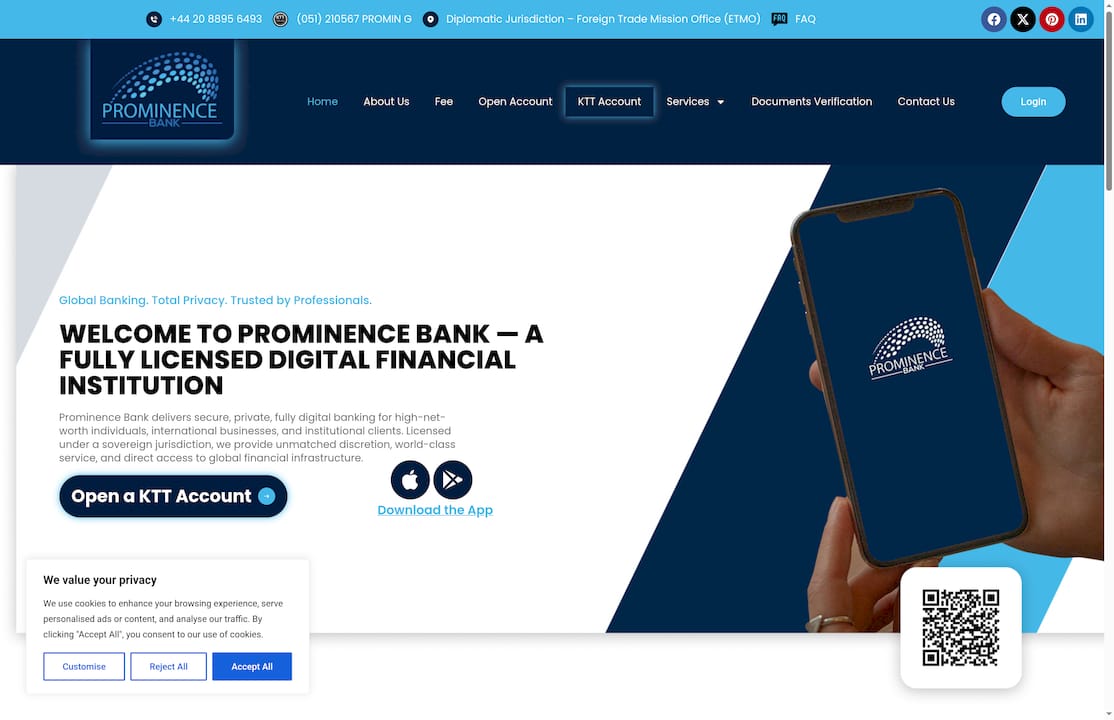
That structure matters most for frequent payers: businesses settling supplier invoices abroad, institutions moving treasury balances across jurisdictions, or individuals managing wealth across borders who need predictable net amounts, not a number that shrinks between sending and receiving. Compliance runs on standard AML/KYC screening, and online account access means you’re not waiting on a branch to move money on your schedule.
If your international payment volume has reached the point where FX markup shows up as a real line item on your books, open a Prominence Bank account and get a direct look at what transparent multi-currency banking does for your total cost.
This article is general information, not a substitute for advice from a qualified financial advisor. Consult a qualified financial professional about your own circumstances before acting on anything here.
Sources
- Wire transfer fee disclosure (HelpWithMyBank)
- Wire transfers: what banks charge (NerdWallet)
- Bank wire transfer fees (Bankrate)
- Average wire transfer fee and FX markup explanation (SmartAsset)
FAQ
What happens if you wire transfer more than $10,000?
Banks must file a Currency Transaction Report with FinCEN for cash transactions over $10,000, but a standard wire transfer of that size doesn’t trigger the same cash-reporting rule. Your bank may still flag it for standard AML review, which is routine and doesn’t delay a properly documented transfer.
How do I avoid a foreign transaction fee on international payments?
Use a provider or account that quotes exchange rates transparently against the mid-market rate rather than one that bundles a markup into a “no-fee” wire, and compare the net amount your recipient will actually receive before you send.
Can you transfer $10,000 from a U.S. bank to an international bank?
Yes, most U.S. banks allow international wires well above $10,000, though some set daily or per-transaction limits that require calling ahead or using online banking tiers with higher thresholds.
Which U.S. bank is best for international wire transfers?
The best choice depends on your transfer size and frequency: occasional senders should compare visible fees and FX markup at their existing bank, while frequent or high-value senders typically get better total-cost outcomes from a digital bank with multi-currency accounts or a specialist FX provider built around transparent pricing.