
FX risk hedging means using financial instruments, mainly forwards, options, and swaps, to lock in or protect against exchange rate movements that would otherwise hit cash flow, earnings, or balance sheet value. Corporates should hedge whenever a foreign currency exposure is large enough, and certain enough, to threaten a budget rate, a margin target, or a covenant. Done right, hedging does not eliminate currency risk; it converts an unpredictable outcome into a bounded, budgeted one.
TL;DR:
- Hedge only when foreign currency exposure could threaten key financial targets or covenants, especially for large and certain exposures.
- Use forward contracts for predictable, fixed future transactions, while options and swaps suit uncertain or longer-term needs, balancing certainty and cost.
- Quantify and monitor all currency exposures regularly, applying scenario analysis and stress testing to prepare for geopolitical shocks and market surprises.
- Centralize governance and documentation to ensure hedge effectiveness and compliance, avoiding costly misclassification or ineffective hedge performance.
- Build a robust, multi-currency banking infrastructure to streamline exposure management, settlement, and reporting, minimizing operational friction and errors.
Table of Contents
- What Is Foreign Exchange Risk, and Where Does It Come From?
- Why Hedge FX Exposure? Objectives and Trade-Offs
- Forwards, Options, and Swaps: Matching the Tool to the Job
- Building a Hedging Program: Cash-Flow, Balance-Sheet, and Net Investment
- Measuring Exposure: VaR, Hedge Accounting, and Reporting Impact
- Setting Up a Corporate Hedging Program: A Step-by-Step Approach
- FX Hedging in Practice: Three Common Corporate Scenarios
- How Prominencebank Supports Corporate FX Hedging Programs
- Beyond VaR: Scenario Analysis and Stress Testing
- How Macro and Geopolitical Shifts Reshape FX Risk
- Regulatory and Compliance Considerations in FX Hedging
- Is the Hedge Working? Measuring Cost Against Benefit
- Treasury Management Systems and FX Technology
- What Treasurers Get Wrong About Hedging Trade-Offs
- Put Your Hedging Program on Real Banking Infrastructure
- Sources
- FAQ
What Is Foreign Exchange Risk, and Where Does It Come From?
Foreign exchange risk shows up in three distinct forms, and mixing them up is the most common mistake finance teams make when building a hedging policy.
Transaction risk hits when you have a confirmed receivable or payable in a foreign currency. A U.S. manufacturer that invoices a German buyer in euros carries transaction risk from the invoice date until cash lands in the bank. Translation risk arises when you consolidate a foreign subsidiary’s financial statements into the parent’s reporting currency. The subsidiary’s local performance might be fine, yet a weaker euro or peso can shrink reported revenue and equity on the group’s books. Economic risk is the slow-burn version: a sustained currency shift that erodes competitiveness, even without a single specific transaction on the table, the kind of exposure a Japanese exporter feels when the yen strengthens against every customer’s currency at once.
These categories map to different financial statement targets:
- Transaction exposure threatens near-term margins and cash flow.
- Translation exposure threatens reported earnings and consolidated equity.
- Economic exposure threatens long-run firm value and competitive position.
Educational references, including Investopedia’s overview of foreign exchange risk, group exposures this way for good reason: each type calls for a different hedging response, which is exactly where most companies go wrong first.
Why Hedge FX Exposure? Objectives and Trade-Offs
Hedging exists to protect a number you already promised somebody: a budget rate given to the board, a gross margin target given to investors, or a dividend stream given to a parent company. The objective is rarely to make money on currency moves. It’s to remove currency volatility from a plan that has enough uncertainty already.
That protection isn’t free. Weighing the following trade-offs is part of the job:
- Option premiums cost real cash upfront, whether or not the option ever gets exercised.
- Locked-in forwards remove downside risk but also remove upside if the currency moves in your favor.
- Counterparty and liquidity risk appear the moment you enter any derivative contract with a bank or dealer.
Before reaching for a derivative, many companies address exposure operationally by requiring payment in specific currencies, as discussed in operational payment-currency strategies that can reduce FX risk without derivatives. The U.S. International Trade Administration notes that requiring payment in U.S. dollars shifts FX risk to the foreign buyer, but this may reduce export opportunities if competitors quote in the buyer’s local currency.
Pro Tip: Run the natural-hedge option first. If you can invoice, net exposures internally, or match foreign revenue against foreign costs, you cut the derivative book down to only what actually needs a contract.
Forwards, Options, and Swaps: Matching the Tool to the Job
Picking an instrument comes down to one question: how much certainty do you need, and how much are you willing to pay to keep upside alive?
-
Forward contracts lock in an exchange rate for a future date, giving you budget certainty with no upfront premium. A CFO’s guide to corporate FX hedging confirms forwards remain the core instrument for exactly this reason. Companies with recurring, predictable flows often build a “forward strip,” a series of forward contracts staggered across future months, to smooth out the budget rate over a whole fiscal year rather than betting on a single date.
-
FX options cost a premium but let you participate if the currency moves your way, useful when a deal is likely but not yet signed, or when management wants downside protection without giving up potential gains.
-
Currency swaps exchange principal and interest payments in two currencies over a longer horizon, the standard tool for hedging foreign-currency debt or balance-sheet mismatches rather than a single trade.
-
Non-derivative methods, invoicing in your own currency, netting intercompany flows, or matching costs to revenue currency, cost nothing in premium but offer less precision.
Tenor and counterparty selection matter as much as the instrument itself. A three-month forward with a well-rated bank counterparty behaves very differently from a two-year forward with a thinly capitalized dealer, particularly during periods of market stress.
Building a Hedging Program: Cash-Flow, Balance-Sheet, and Net Investment
Most corporate programs fall into a small number of standard structures, and picking the wrong one for the exposure is a common, costly error.
- Cash-flow hedges cover forecasted transactions, like next quarter’s expected euro sales, that haven’t happened yet. U.S. Bank’s guidance on FX risk management notes that cash-flow hedges commonly rely on hedge accounting treatment, since the underlying transaction is still a forecast rather than a booked asset or liability.
- Balance-sheet (remeasurement) hedges cover receivables and payables already sitting on the books, exposure that’s certain in amount but still subject to daily currency swings until settlement.
- Net investment hedges protect the parent’s equity stake in a foreign subsidiary, often using foreign-currency debt or cross-currency swaps rather than short-dated forwards.
On governance, treasuries generally choose between two philosophies. A tactical (selective) approach hedges opportunistically based on market views, useful for companies with strong in-house FX expertise. A strategic (policy-driven) approach hedges a fixed percentage of exposure on a rolling schedule regardless of market opinion, the more common choice for companies that want predictable outcomes over market timing. For a deeper look at how these approaches interact with treasury governance, see Prominencebank’s guide to international treasury management.
Measuring Exposure: VaR, Hedge Accounting, and Reporting Impact
You cannot hedge what you haven’t measured, and measurement is where a lot of otherwise sound hedging programs quietly fail.
- Value at Risk (VaR) estimates the maximum expected loss on an FX position over a given time horizon at a set confidence level, giving treasury a single number to size hedge ratios against.
- Exposure mapping catalogs every currency, amount, and settlement date across the business, the raw input VaR and every other measurement tool depends on.
- Hedge accounting under FASB and IASB standards determines whether a hedge’s fair value changes hit other comprehensive income (OCI) or flow straight through the income statement.
An IMF working paper on exchange rate risk management points out that transaction risk is usually hedged more systematically than translation risk, largely because transaction exposure is easier to quantify and time precisely. Getting hedge accounting designation right at inception, not after the fact, is what lets a company smooth reported earnings instead of absorbing markto-market swings straight into net income. Refer to FASB’s hedge accounting guidance for the specific effectiveness-testing requirements that apply to your designation.
Setting Up a Corporate Hedging Program: A Step-by-Step Approach
Building or overhauling a hedging program follows a fairly consistent sequence across companies, regardless of size or industry.
- Map and quantify every exposure. List currency, notional amount, and expected settlement date for every material FX flow, forecasted and booked.
- Set objectives and a budget rate. Decide what rate the business plan assumes, and pick a benchmark, spot rate, forward curve, or average rate, against which hedge performance will be judged.
- Select instruments and tenor mix. Match forwards, options, and swaps to the certainty level and accounting treatment each exposure requires.
- Establish governance. Define counterparty limits, required documentation for hedge accounting, approval thresholds, and reporting cadence to the CFO and audit committee.
- Monitor and recalibrate. Review hedge effectiveness and exposure forecasts on a regular cycle, quarterly at minimum, and adjust the program as the business changes.
Pro Tip: Document your hedge designation memo on day one, not after the auditors ask. Retroactive hedge accounting documentation is one of the fastest ways to lose OCI treatment on a trade you already executed.
For a broader view of how this checklist fits into the treasurer’s full mandate, Prominencebank’s guide to corporate treasury covers exposure mapping and policy design in more depth.
FX Hedging in Practice: Three Common Corporate Scenarios
- An exporter with a confirmed order in a foreign currency, due in 90 days, typically locks in a simple forward contract or a short forward strip. The certainty of the receivable matches the certainty forwards provide, with no premium cost.
- An importer with recurring monthly payables, but uncertain volumes month to month, often layers a staggered forward strip for the predictable base volume and adds options to cover the variable portion without overcommitting capital to a fixed rate.
- A parent company with a large foreign subsidiary weighs a net investment hedge, frequently structured through foreign-currency borrowing, to offset translation losses on consolidated equity, particularly when the subsidiary represents a material share of group net assets.
How Prominencebank Supports Corporate FX Hedging Programs
A hedging strategy is only as good as the banking infrastructure executing it. Prominencebank’s foreign exchange banking services are built around the practical mechanics treasuries need once the policy is set on paper.
- Multi-currency business accounts that hold and settle exposures in the currencies you actually invoice and pay in, without unnecessary conversion steps.
- Treasury solutions designed for the reporting and reconciliation work that follows every hedge execution.
- Trade finance and FX execution support that connects directly to global settlement infrastructure.
None of this replaces your hedge accounting policy or your board-approved risk limits, Prominencebank isn’t a substitute for that governance work. What it does is remove friction between the decision to hedge and the operational reality of settling that hedge across currencies and time zones. As Prominencebank’s own service overview describes, the model is built for international businesses managing exactly this kind of complexity.
Beyond VaR: Scenario Analysis and Stress Testing
VaR answers “what’s my likely loss under normal conditions?” It does a poor job answering “what happens if a central bank surprises the market on Tuesday morning?” That’s the gap scenario analysis and stress testing exist to close.
Scenario analysis applies a specific, named event, a 10% devaluation, a surprise rate hike, a trade tariff announcement, to the current exposure book and calculates the resulting P&L or OCI impact. Unlike VaR, which relies on historical volatility and correlation patterns, scenario analysis lets treasury test conditions that haven’t happened yet but plausibly could, based on current geopolitical or macro signals.
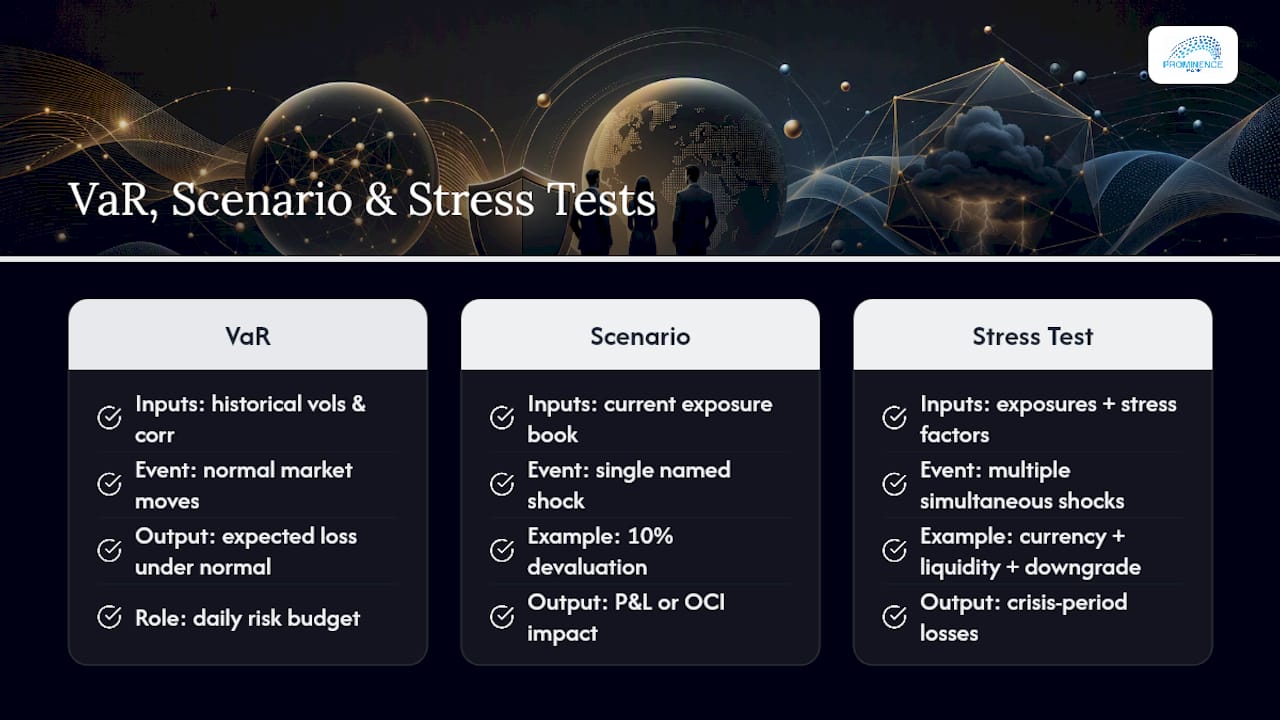
Stress testing goes further by combining multiple adverse events simultaneously: a currency shock paired with a liquidity squeeze paired with a counterparty downgrade. This matters because VaR models built on calm-market data routinely understate losses during genuine crises, exactly the periods when hedges matter most and when correlations between currencies tend to break down or invert.
A practical treasury program runs both in parallel. VaR sets the day-to-day risk budget and sizing discipline. Scenario analysis and stress testing validate that the hedge book still holds up if 2026 delivers a shock nobody priced into the base case, an emerging-market currency peg breaking, a sudden shift in central bank policy, or a geopolitical event that freezes cross-border payment flows for a window of days. Treasuries that skip this step tend to discover their hedge ratio was calibrated for a world that no longer exists, usually at the worst possible moment.
How Macro and Geopolitical Shifts Reshape FX Risk
Currency markets move on interest rate differentials, inflation surprises, and capital flows most days. Then a geopolitical event arrives and rewrites the whole picture in a single trading session, a sanctions announcement, an election result, a conflict escalation, a surprise tariff.
Interest rate policy remains the dominant driver in ordinary conditions. When one central bank raises rates while another holds steady, capital flows toward the higher-yielding currency, and corporates with exposure on the wrong side of that gap feel it directly in their budget rate. Inflation differentials work on a longer timeline but push in the same direction, a currency with persistently higher inflation tends to depreciate against one with tighter price stability, the mechanism behind decades of emerging-market currency drift.
Geopolitical shocks behave differently: they’re discontinuous, hard to forecast, and often move multiple currencies at once through risk-off capital flight into perceived safe havens like the U.S. dollar or Japanese yen. A company with clean, well-hedged transaction exposure can still get hurt if a geopolitical shock widens credit spreads and makes rolling forward contracts more expensive, or if it triggers capital controls that block currency conversion entirely in a subsidiary’s home market.
This is precisely why static, once-a-year hedging reviews fall short. Treasuries operating in 2026 face a currency environment where rate differentials, trade policy shifts, and geopolitical flashpoints can each move independently, sometimes within the same quarter. Programs built around a rolling review cycle, not an annual one, catch these shifts before the budget rate assumption becomes obsolete.
Regulatory and Compliance Considerations in FX Hedging
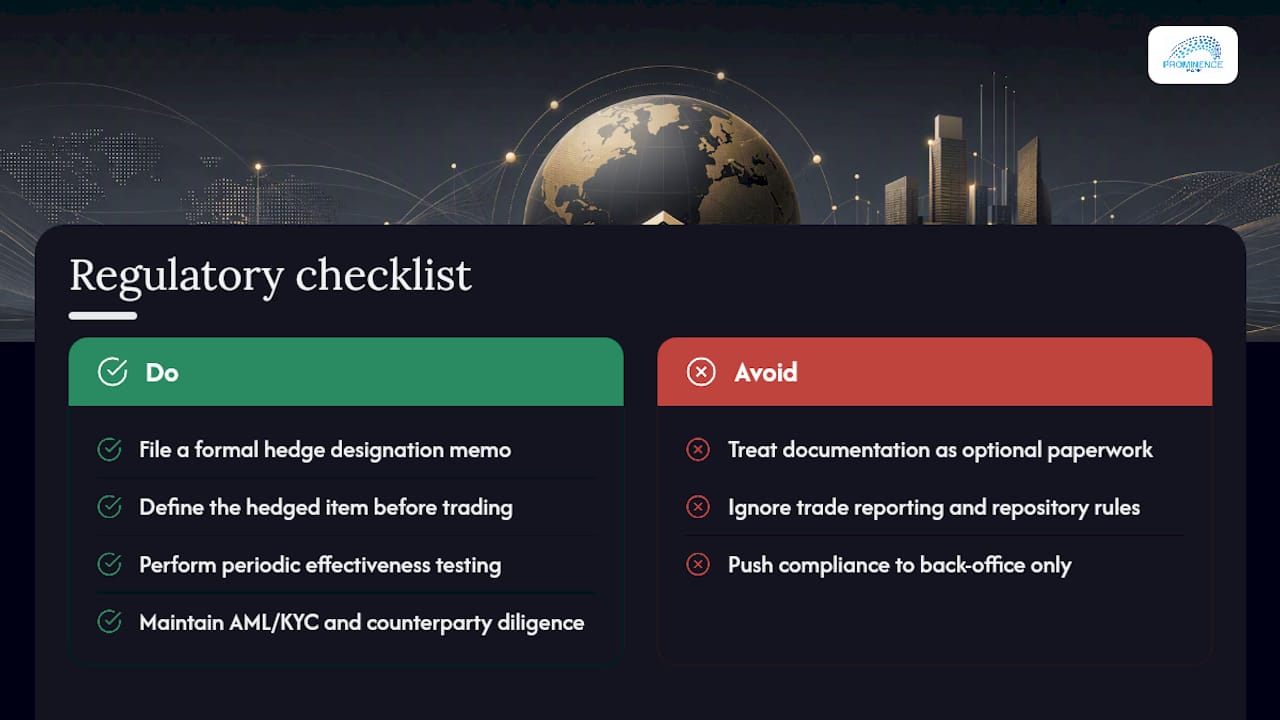
Hedge accounting is where regulation and treasury strategy intersect most directly. Under both FASB and IASB frameworks, a derivative only qualifies for favorable accounting treatment, keeping fair value changes in OCI rather than the income statement, if it meets strict designation and effectiveness-testing requirements at inception, not after the trade is booked.
Failing that designation test doesn’t make the hedge illegal or improper. It just means the mark-to-market swings flow straight into net income, creating exactly the earnings volatility the hedge was supposed to prevent. This is a documentation problem as much as an accounting one: treasuries need a formal hedge designation memo, a defined hedged item, and periodic effectiveness testing on file before an auditor asks for it.
Beyond accounting, corporates operating across borders also answer to anti-money laundering and know-your-customer requirements at every banking relationship used to execute hedges, along with counterparty due diligence standards that vary by jurisdiction and instrument type. Derivative reporting obligations, trade repository requirements in many markets, add another compliance layer that treasury and legal teams need to track jointly rather than treating as a back-office afterthought.
None of this is exotic. It’s standard operating discipline for any treasury running a derivatives book. The companies that get burned aren’t the ones using forwards and options, they’re the ones treating hedge accounting documentation as optional paperwork instead of a prerequisite for the accounting treatment they’re counting on.
Is the Hedge Working? Measuring Cost Against Benefit
A hedging program earns its keep by reducing the range of outcomes, not by making money on every trade. Judging a hedge purely on whether it beat the spot rate misses the point entirely.
The right comparison is against the budget rate the business plan assumed. If a treasury locked in a rate through a forward and the market later moved favorably, the hedge “cost” the company upside, but it delivered exactly what it was designed to deliver: certainty against the number the board approved. Effectiveness measurement should track three things: how closely actual outcomes tracked the budget rate, how much premium was spent on optional protection relative to the loss it would have prevented, and how much earnings volatility the hedge removed compared to an unhedged baseline over the same period.
Cost matters too, and it’s not just the visible premium on an option. Forward points, the bid/ask spread on execution, and the operational cost of managing documentation and counterparty relationships all belong in the true cost of a hedging program. A company that saves on premium by skipping options but then absorbs a wider unhedged range hasn’t actually saved money, it’s shifted the cost from a line item into unpredictable P&L noise.
The most useful internal benchmark isn’t “did we beat the market,” it’s “did the range of outcomes shrink compared to doing nothing.” A hedge program that consistently narrows the gap between best case and worst case, even if it never produces a windfall, is doing its job.
Treasury Management Systems and FX Technology
Spreadsheets can track a handful of forward contracts. They fall apart fast once a company runs dozens of exposures across multiple currencies, tenors, and legal entities, which is why most mid-size and larger corporates eventually move exposure tracking into a dedicated treasury management system (TMS).
A TMS centralizes exposure data pulled from ERP systems, bank accounts, and trading platforms into one place, which is the foundation everything else depends on. From there, most platforms handle deal capture and confirmation for forwards, options, and swaps, hedge accounting calculations including effectiveness testing and OCI tracking, and cash flow forecasting that feeds directly into exposure mapping.
The practical payoff shows up in two places. First, real-time visibility replaces the lag of manually consolidating currency positions across subsidiaries at month-end, which is often when problems get caught too late to act on. Second, integration with banking platforms lets treasury execute and settle hedges without re-entering data across three or four disconnected systems, cutting the operational error rate that comes with manual re-keying.
Smaller companies with a handful of currency pairs and modest volumes may not need a full TMS deployment, a well-structured spreadsheet with disciplined update cadence can cover that case. But once exposure spans more than a few currencies or entities, the manual approach becomes the bottleneck, not the strategy.
What Treasurers Get Wrong About Hedging Trade-Offs
Most hedging mistakes trace back to governance, not instrument selection. Centralize policy setting and risk limits at the CFO or group treasury level, but let regional teams execute within those limits. Fully centralized execution is slow and misses local market timing; fully decentralized policy invites inconsistent risk-taking that nobody can see until it’s already a problem.
On cost, don’t chase the cheapest hedge. The right question is whether the premium buys enough certainty to justify giving up potential upside, not whether a forward is “free” and an option “costs money.” Free has a price too: zero flexibility if the market moves in your favor.
Counterparty vetting deserves more attention than it usually gets. A hedge is only as good as the institution standing behind it when the contract needs to settle.
— Harold
Put Your Hedging Program on Real Banking Infrastructure
Every step in a hedging program, exposure mapping, instrument execution, settlement, reporting, eventually needs a bank account that can actually hold and move the currencies involved without adding friction. That’s the gap Prominencebank is built to close for international businesses running active FX programs.
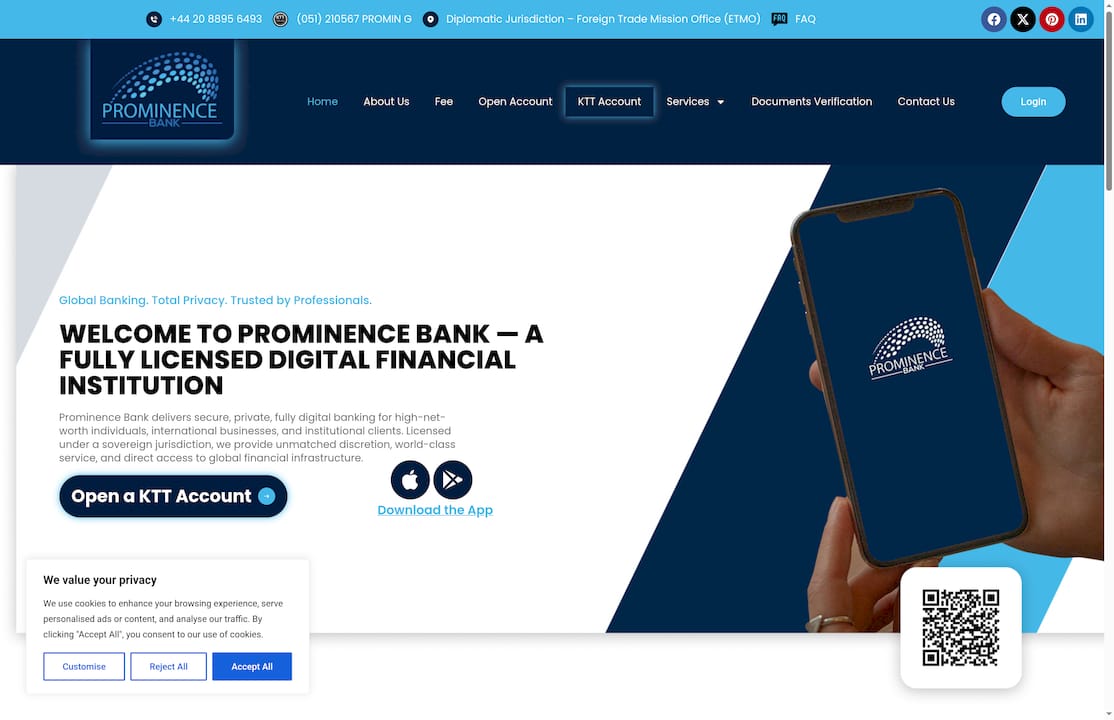
Multi-currency business accounts can hold euros, dollars, yen, and other major currencies side by side, settling hedges in the currency they’re denominated in rather than forcing an extra conversion step that erodes the value of the hedge itself. Corporate clients running structured treasury operations can pair that account with Prominencebank’s corporate finance and treasury solutions for execution support that lines up with your accounting and reporting cadence, not against it.
If your current banking setup makes exposure mapping harder than it needs to be, or settlement takes days instead of hours, that’s worth fixing before the next hedge strip rolls off. Start with a multi-currency account built for exactly this kind of cross-border treasury work, and request an account setup walkthrough to see how it fits your existing hedging policy.
Sources
- Foreign Exchange Risk
- Risk management strategies for foreign exchange hedging
- Exchange rate risk management paper (IMF working paper)
FAQ
What Is FX Risk Hedging?
FX risk hedging is the use of financial instruments, mainly forwards, options, and swaps, to protect a company’s cash flow, earnings, or balance sheet from adverse currency movements.
What Is Hedging in FX Trading?
In FX trading, hedging means taking an offsetting position, typically a forward or option contract, so a loss on the underlying currency exposure is matched by a gain on the hedge, and vice versa.
How Do You Hedge Against Forex Risk?
Map every currency exposure by amount and timing, then match instruments to the exposure type: forwards for certain future transactions, options for uncertain ones, and swaps for longer-term balance-sheet or debt exposure, ideally executed through a bank partner like Prominencebank that can settle across multiple currencies.
What Is an Example of FX Risk?
A U.S. company that sells $10 million worth of goods invoiced in euros faces transaction risk. If the euro weakens before payment arrives, the dollar value of that receivable shrinks even though the euro invoice amount never changed.