
TL;DR:
- Managing offshore custody accounts without a clear framework exposes significant wealth to regulatory penalties and asset loss. Proper management requires asset segregation, licensed custodians, routine reconciliations, and compliance with reporting obligations like FBAR and FATCA. Active oversight, documented governance, and annual reviews are essential to ensure privacy, security, and legal defensibility in international custody arrangements.
Managing offshore custody accounts without a clear framework is one of the fastest ways to expose significant wealth to regulatory penalties, asset freezes, or outright loss. The risks are not theoretical. Misidentified custodians, missed FBAR filings, and inadequate asset segregation have cost high-net-worth individuals and corporate clients millions in penalties and legal fees. This guide walks you through the core requirements, step-by-step management practices, operational controls, and reporting obligations you need to run offshore custody arrangements that are genuinely private, genuinely secure, and fully defensible under international law.
Table of Contents
- Core requirements for offshore custody accounts
- Step-by-step management process for privacy, security, and compliance
- Operational practices and reconciliation: Keeping accounts secure
- Reporting obligations and compliance checkpoints
- Why true offshore privacy requires compliance, not just secrecy
- Where to find advanced offshore custody solutions
- Frequently asked questions
Key Takeaways
| Point | Details |
|---|---|
| Asset segregation essentials | Keeping assets in distinct accounts with qualified custodians is vital for legal protection and regulatory compliance. |
| Privacy is compliance | True privacy comes from thorough documentation and adherence to disclosure rules, not secrecy from authorities. |
| Annual reporting required | Offshore custody arrangements must meet annual reporting obligations like FBAR and FATCA to avoid penalties. |
| Operational best practices | Daily reconciliations, independent statements, and annual surprise audits help maintain secure custody accounts. |
| Crypto custody needs governance | Effective crypto custody relies on documented multi-signature controls and clarity over key management frameworks. |
Core requirements for offshore custody accounts
Every offshore custody arrangement rests on two non-negotiable pillars: asset segregation and the use of a qualified custodian. Without both, you are exposed to custodial misuse, regulatory sanctions, and potential loss of assets in the event of a custodian’s insolvency.
Custody arrangements for client assets rely on segregation and qualified-custodian requirements. For US investment advisers, Rule 206(4)-2 mandates specific safeguards: using a qualified custodian, notifying clients of the custodian’s identity, delivering quarterly account statements directly from the custodian, and conducting an annual surprise verification by an independent public accountant. These standards set the baseline for any offshore custody arrangement that needs to withstand regulatory scrutiny.
Beyond US-specific rules, global custody operationalized as holding assets legally for clients while coordinating settlement across markets requires sub-custodian networks and ongoing reconciliation and reporting. Asset segregation is a core requirement to prevent custodial misuse across every major jurisdiction.
Before you review your current setup or explore a new one, use this offshore bank account setup guide to confirm you are starting from a structurally sound foundation.
Core requirements for legal compliance:
- Assets must be held in segregated accounts, clearly separate from the custodian’s own funds
- The custodian must be licensed and regulated in its home jurisdiction
- Clients must receive quarterly statements directly from the custodian, not through an intermediary
- Annual surprise verification by an independent public accountant is required under Rule 206(4)-2
- Sub-custodian arrangements must be documented and disclosed
- Reconciliation must occur on a regular, scheduled basis with records maintained
| Requirement | Standard | Frequency |
|---|---|---|
| Asset segregation | Mandatory, all jurisdictions | Ongoing |
| Qualified custodian | Licensed, regulated entity | At setup and annual review |
| Client statement delivery | Direct from custodian | Quarterly |
| Surprise verification | Independent public accountant | Annual |
| Reconciliation | Internal and sub-custodian | Daily/monthly |
| Sub-custodian disclosure | Written documentation | At setup and on change |
Pro Tip: Consider spreading assets across two or more qualified custodians in different jurisdictions. This reduces concentration risk and provides operational continuity if one custodian faces regulatory action or insolvency proceedings.
Review the secure banking checklist to confirm your custodian arrangements meet these baseline standards before moving to the management process.
Step-by-step management process for privacy, security, and compliance
Having the right custodian structure is only the starting point. The ongoing management process is where most clients either protect or inadvertently undermine their arrangements. Privacy and compliance are not opposing forces. They are complementary when the process is designed correctly.
Offshore tax-information reporting obligations under CRS and FATCA apply in parallel to custody relationships. Financial institutions must identify account holders and controlling persons, then make annual reports to tax authorities through Automatic Exchange of Information (AEOI). Ignoring these obligations does not preserve privacy. It creates a paper trail of non-compliance that is far more damaging.
The offshore asset protection risks are real: offshore arrangements can increase confidentiality and create barriers to collection, but they do not remove reporting obligations. Privacy can be undermined by disclosure failures under FBAR or FATCA, or by fraudulent-transfer laws if assets are moved improperly.
Step-by-step management process:
- Select a regulated custodial structure in a jurisdiction with a strong legal framework and bilateral tax treaties
- Complete full KYC and AML documentation at onboarding, including beneficial ownership declarations
- Obtain written confirmation of asset segregation and sub-custodian arrangements from your custodian
- Register with relevant tax authorities and determine your AEOI reporting obligations under CRS and FATCA
- Schedule quarterly statement reviews and reconcile against your own internal records
- Conduct an annual review of the trust deed, custody agreement, and any power of attorney arrangements
- File all required annual reports (FBAR, Form 8938, and local equivalents) before applicable deadlines
- Engage a qualified tax advisor in your home jurisdiction annually to review any structural changes
| Factor | Asset protection and privacy | Compliance and disclosure |
|---|---|---|
| Information exposure | Minimized within legal limits | Required for tax authorities |
| Custodian identity | Confidential to third parties | Disclosed to regulators |
| Account statements | Delivered securely to client | Available to authorities on request |
| Beneficial ownership | Protected by jurisdiction law | Reported under CRS/FATCA |
| Asset location | Offshore, legally held | Declared in annual filings |
Pro Tip: Document every decision made during account onboarding in a structured file. When annual reporting season arrives, this documentation dramatically simplifies the preparation of FBAR and FATCA filings and reduces the risk of errors that trigger audits.
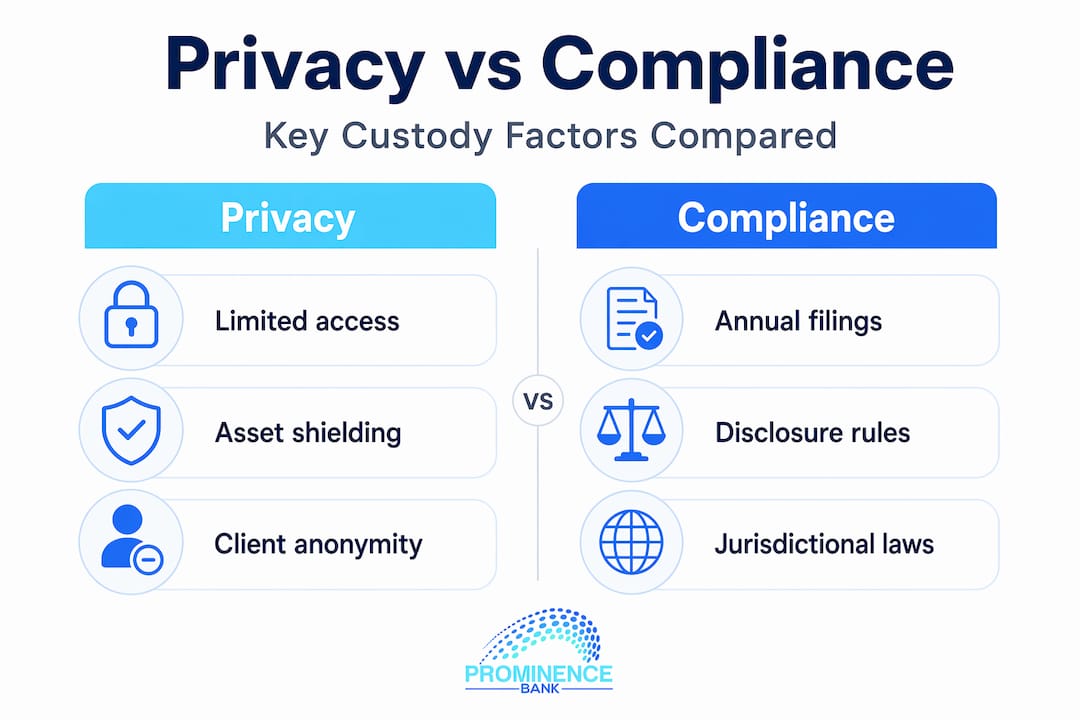
The online bank compliance guide provides additional detail on how to structure your compliance calendar. For clients using offshore structures specifically for asset protection, the asset protection banking abroad resource covers jurisdiction-specific considerations worth reviewing alongside your legal counsel.
For clients operating in regulated industries such as marine assets or high-value movables, brokerage compliance steps offer a practical parallel for understanding how custody and compliance intersect in specialized asset classes.
Operational practices and reconciliation: Keeping accounts secure
Day-to-day operational discipline is what separates accounts that remain secure over time from those that develop vulnerabilities. Reconciliation, settlement coordination, and fraud prevention are not administrative tasks. They are active risk controls.

Custody services include secure safekeeping, settlement coordination, ongoing monitoring and administration, daily reconciliations, valuation updates, income and corporate action processing, and reporting. Segregation and reconciliation are the core operational controls that prevent custodial misuse and ensure accurate reporting.
For clients holding assets through offshore trusts or cryptocurrency structures, governance decisions become even more critical. Offshore trusts and custody structures require ongoing administration and custody governance decisions. For crypto specifically, custody hinges on private key control and whether a third-party custodian holds keys under the relevant legal and regulatory frameworks.
Key operational processes to maintain:
- Daily reconciliation of positions and cash balances against custodian records
- Regular valuation updates for all asset classes, including illiquid holdings
- Settlement coordination across multiple markets and time zones
- Income processing and corporate action management (dividends, interest, rights issues)
- Fraud prevention controls including dual authorization for large transactions
- Periodic review of sub-custodian performance and financial stability
- Documented escalation procedures for discrepancies or suspected unauthorized activity
Critical note on custody governance: Whether you hold traditional securities or digital assets, the governance framework around your custody arrangement must be written, reviewed annually, and tested against real scenarios. For crypto holdings, the absence of a documented multi-signature policy or a clear protocol for key recovery is not a minor oversight. It is an existential risk to the assets themselves.
Pro Tip: Insist on independent public accountant verification annually, even if your custodian’s internal controls appear strong. Independent verification catches discrepancies that internal reviews miss and provides a defensible record if your arrangement is ever scrutinized by regulators.
The crypto custody security guide covers the specific governance requirements for digital asset custody in offshore structures. For broader confidentiality practices across your custody arrangements, private banking confidentiality outlines how leading institutions structure information controls.
For clients who need secure physical or digital asset mapping as part of their governance framework, secure mapping solutions provide a practical tool for maintaining organized records of asset locations and custodian relationships.
Reporting obligations and compliance checkpoints
Annual reporting is not optional, and the penalties for non-compliance are severe. US persons with offshore custody accounts face two primary reporting frameworks: FBAR under the Bank Secrecy Act and FATCA under the Foreign Account Tax Compliance Act.
Statistic callout: Any US person with foreign financial accounts exceeding $10,000 in aggregate value at any point during the calendar year must file FinCEN Form 114 (FBAR). Failure to file carries civil penalties of up to $10,000 per non-willful violation and up to $100,000 or 50% of account value per willful violation.
Offshore trusts are not one-time setups and require annual filings, periodic reviews of the trust deed, and active management of custody and compliance. For crypto, the distinction between trustee-controlled keys and third-party custodian-held keys determines which reporting framework applies and what multi-signature governance is recommended.
| Document or filing | Who it applies to | Deadline | Threshold |
|---|---|---|---|
| FBAR (FinCEN Form 114) | US persons with foreign accounts | April 15 (auto-extension to Oct 15) | $10,000 aggregate |
| FATCA Form 8938 | US persons, specified foreign assets | Tax return due date | $50,000 to $600,000 depending on filing status |
| CRS annual report | Non-US account holders via FFIs | Varies by jurisdiction | No minimum threshold |
| Trust annual review | Offshore trust beneficiaries | Annually | All trust structures |
| Custody agreement review | All offshore custody clients | Annually | All custody arrangements |
Practical compliance steps:
- Confirm your custodian’s classification as a Foreign Financial Institution (FFI) under FATCA and verify their GIIN registration
- Obtain year-end statements from all custodians by January 31 to support FBAR and Form 8938 preparation
- Review beneficial ownership records annually and update for any changes in trust or corporate structure
- Engage a US-qualified tax attorney or CPA with international experience to prepare and file all required forms
- Maintain a compliance calendar with all filing deadlines, review dates, and custodian notification requirements
- Retain all account statements, correspondence, and compliance records for a minimum of seven years
The secure private banking setup guide walks through how to structure your initial account documentation to support annual reporting from day one. For clients managing complex corporate structures, advanced corporate account management tips covers the additional compliance layers that apply to multi-entity offshore arrangements.
Why true offshore privacy requires compliance, not just secrecy
Here is the uncomfortable truth that most clients do not hear until after a problem surfaces: privacy in offshore custody is not about hiding assets. It is about controlling information within a legal framework that limits who has access to it and under what conditions.
The clients who achieve the strongest long-term privacy outcomes are not the ones who minimize disclosure. They are the ones who build airtight compliance frameworks that leave no room for regulatory challenge. When your FBAR is filed correctly, your custodian is properly qualified, and your annual verification is documented, there is no vulnerability for a regulator or litigant to exploit. That is real privacy.
Operational diligence is the mechanism. Every missed reconciliation, every undocumented custodian change, and every late filing creates an opening. And in the current environment of discreet banking, where international regulatory cooperation has never been more sophisticated, those openings get found.
The reality of offshore privacy in 2026: Regulatory cooperation between jurisdictions has expanded significantly under CRS and FATCA. The assumption that offshore automatically means invisible is not just wrong. It is dangerous. The clients who maintain genuine privacy do so because their arrangements are legally unassailable, not because they are hidden.
The most effective offshore custody strategies treat every account and every trust as subject to annual review, regardless of what a local advisor says about the stability of the current structure. Structures that were compliant three years ago may not be compliant today. Jurisdictions change their frameworks. Bilateral agreements expand. The only protection is active, documented management.
Where to find advanced offshore custody solutions
Managing offshore custody accounts at this level of complexity requires more than a generic banking relationship.
Prominence Bank offers specialized offshore custody solutions designed for high-net-worth individuals and corporate clients who need privacy, security, and full compliance with international AML/KYC standards. Operating under the sovereignty of the Extraterritorial Trade Mission Office (ETMO), Prominence Bank provides access to multi-currency banking solutions that support sophisticated custody arrangements across multiple asset classes and jurisdictions. For corporate clients building or restructuring offshore structures, the corporate account setup for global businesses resource provides a direct path to establishing compliant, secure accounts with full digital access and institutional-grade confidentiality controls.
Frequently asked questions
What qualifies as a “qualified custodian” for offshore custody?
A qualified custodian must be a regulated entity capable of providing asset segregation and independent statements that meet jurisdiction-specific requirements, including those under Rule 206(4)-2 for US-connected arrangements. Banks, registered broker-dealers, and certain foreign financial institutions typically qualify, provided they meet licensing and segregation standards.
Do offshore custody accounts improve privacy, and are there limits?
Offshore accounts can meaningfully increase confidentiality by limiting third-party access to account information, but reporting obligations remain under CRS, FATCA, and FBAR. Privacy is strongest when the legal structure is sound and all disclosure requirements are met proactively.
What reporting forms do U.S. individuals with offshore custody accounts need?
US persons typically need to file FBAR (FinCEN Form 114) for foreign accounts exceeding $10,000 and FATCA Form 8938 for specified foreign financial assets above applicable thresholds. The exact filing requirements depend on account value, filing status, and whether assets are held individually or through a trust or entity.
How should crypto assets be managed in offshore custody structures?
Crypto custody hinges on private key control and whether a third-party custodian holds keys under relevant legal and regulatory frameworks. Documented multi-signature governance and clear key recovery protocols are essential safeguards for any offshore crypto custody arrangement.
What operational checks are vital to maintaining secure offshore custody?
Daily reconciliation, periodic independent statements, and annual surprise verification by an independent public accountant are the core operational safeguards. Settlement coordination and documented escalation procedures for discrepancies round out a complete operational control framework.