
TL;DR:
- Online banking compliance involves rigorous AML, KYC, and transaction monitoring standards similar to traditional banks.
- High-net-worth individuals face enhanced due diligence, ongoing monitoring, and source-of-wealth verification due to complex profiles.
- Technology alone doesn’t ensure compliance; a strong culture, trained staff, and effective oversight are essential.
Online banking is not a regulatory shortcut. Many high-net-worth individuals assume that moving their financial activity online means fewer questions, faster approvals, and lighter scrutiny. The reality is the opposite. Digital banks operate under the same rigorous Anti-Money Laundering and Know Your Customer frameworks as traditional institutions, and for complex international profiles, the compliance bar is even higher. Understanding how Customer Identification Programs, Customer Due Diligence, Enhanced Due Diligence, and real-time transaction monitoring work is not optional for sophisticated clients. It is the foundation of protecting your wealth, your reputation, and your access to global financial infrastructure.
Table of Contents
- What is online bank compliance?
- The AML/KYC lifecycle: From onboarding to continuous monitoring
- Deep dive: Perpetual KYC and advanced technologies
- Edge cases and common pitfalls for HNWI compliance
- Why compliance is more than just a tech challenge
- Secure your high-value banking with trusted compliance
- Frequently asked questions
Key Takeaways
| Point | Details |
|---|---|
| Compliance is mandatory | Rigorous AML/KYC processes are required for all online banks, especially for high-net-worth clients. |
| Tech-driven change | AI, pKYC, and real-time monitoring are transforming compliance efficiency and lowering risks. |
| Complexity for HNWIs | Enhanced due diligence and source-of-wealth checks intensify with cross-border or complex financial structures. |
| Continuous vigilance | Even with advanced tools, ongoing oversight, deep verification, and expert reviews remain essential. |
What is online bank compliance?
Online bank compliance is the full legal, regulatory, and procedural framework that governs how digital banks collect, verify, and monitor client information and financial activity. It is not a single rule. It is a layered system designed to prevent financial crime, protect clients, and maintain the integrity of the global financial system.
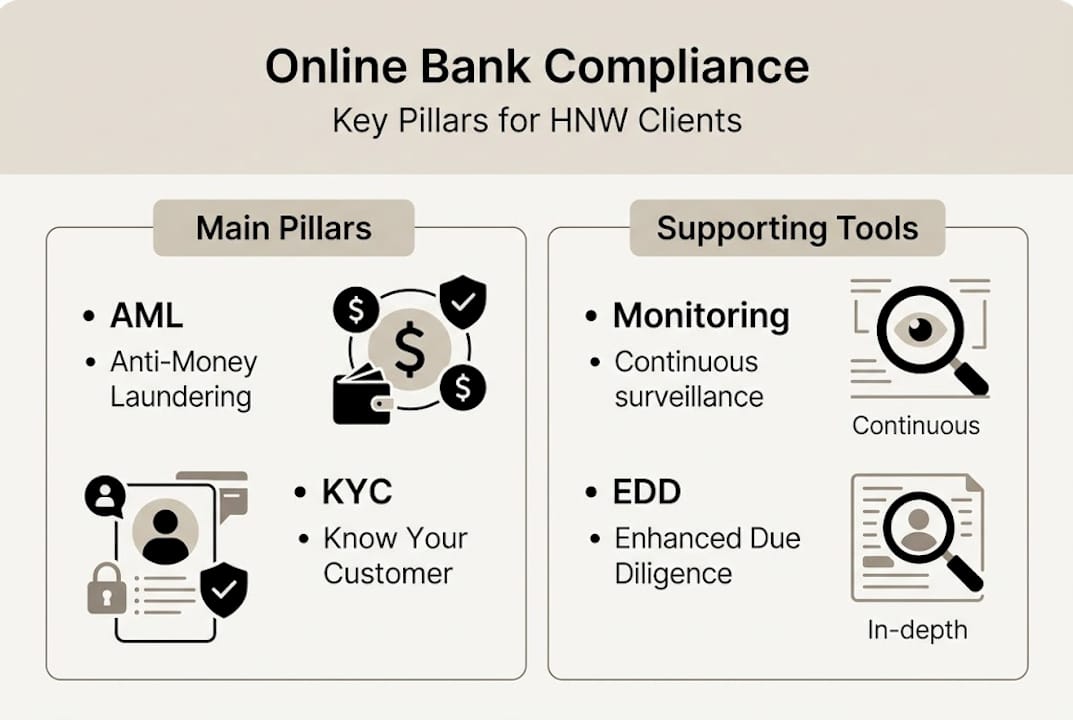
At its core, compliance in online banking centers on three pillars: Anti-Money Laundering (AML), Know Your Customer (KYC), and secure transaction monitoring. AML rules require banks to detect and report suspicious activity. KYC rules require banks to verify who their clients actually are. Transaction monitoring ties both together by flagging unusual patterns in real time.
The regulatory context spans multiple jurisdictions. The Financial Action Task Force (FATF) sets global standards that most national regulators adopt. In the United States, the Bank Secrecy Act (BSA) governs AML requirements. In Europe, the Anti-Money Laundering Directives (AMLD) apply. In the UK, the Money Laundering Regulations (MLR) are the primary framework. Banks operating internationally must align with all relevant layers simultaneously.
The core mechanics include:
- Customer Identification Program (CIP): Verifying identity at onboarding using government-issued documents, biometrics, or electronic ID verification.
- Customer Due Diligence (CDD): Assessing client risk profiles, business structures, and the nature of expected transactions.
- Enhanced Due Diligence (EDD): A deeper review applied to high-risk clients, including most HNWIs, politically exposed persons (PEPs), and complex corporate structures.
- Transaction monitoring: Ongoing surveillance of financial activity against expected patterns.
- Suspicious Activity Reports (SARs) and Suspicious Transaction Reports (STRs): Formal filings when red flags cannot be resolved.
A risk-based approach is foundational to how banks allocate compliance resources, concentrating effort on higher-risk profiles rather than applying uniform scrutiny to every client.
| Compliance component | Primary purpose | Applies to |
|---|---|---|
| CIP | Identity verification | All clients |
| CDD | Risk profile assessment | All clients |
| EDD | Deep-dive due diligence | High-risk, HNWIs, PEPs |
| Transaction monitoring | Ongoing activity review | All accounts |
| SAR/STR filing | Regulatory reporting | Flagged accounts |
For HNWIs and international business leaders, understanding the document verification steps required at each stage is the first practical move toward a smooth banking relationship. The goal is not just passing compliance checks. It is building a verifiable financial profile that supports your global activity long term. You can also explore secure online account opening to understand what a best-in-class digital onboarding process looks like in practice.
“Compliance is not a gate. For sophisticated clients, it is the infrastructure that makes global banking possible.”
The AML/KYC lifecycle: From onboarding to continuous monitoring
Compliance does not end when your account is approved. It is a continuous process that evolves as your financial activity, legal structures, and risk profile change. Understanding the full lifecycle helps you anticipate what your bank will ask and why.
The lifecycle moves through four main stages:
- Onboarding: Identity verification via CIP, initial CDD, and for high-risk profiles, EDD. This is where electronic ID verification (eIDV) and biometric checks occur.
- Risk scoring: Your profile is assigned a risk tier based on factors like jurisdiction, entity type, PEP status, and transaction complexity. This score determines how frequently your account is reviewed.
- Transaction monitoring: Every transaction is measured against your expected activity profile. Deviations trigger alerts, which compliance teams investigate.
- SAR/STR reporting: If an alert cannot be resolved, the bank files a regulatory report. You may not be informed this has occurred.
High-net-worth individuals face enhanced checks including source-of-wealth (SoW) verification, detailed risk scoring, EDD interviews, and tailored monitoring frameworks. The reason is straightforward: complex legal structures, cross-border holdings, and large transaction volumes create more potential vectors for financial crime, whether or not any exists.

One of the most underestimated challenges is onboarding friction. Digital banks face significant drop-off at the eIDV step, where clients abandon the process because the verification requirements feel burdensome. For banks, this is a tension between user experience and regulatory obligation. For clients, it is a signal to prepare documentation in advance.
The table below shows how compliance intensity scales with client profile:
| Client type | Onboarding level | Monitoring frequency |
|---|---|---|
| Standard retail | CIP + basic CDD | Periodic |
| Business client | CIP + CDD + structure review | Regular |
| HNWI / PEP | CIP + CDD + EDD + SoW | Continuous |
Pro Tip: Use AI-driven eKYC and biometric verification tools before engaging a new bank. Having a pre-verified digital identity package, including SoW documentation and entity structure charts, reduces onboarding time significantly and signals to compliance teams that you are a well-organized, low-friction client.
For a broader view of how security in digital banking supports your financial goals, or for a step-by-step breakdown of corporate banking compliance, both are worth reviewing before your next account opening.
Deep dive: Perpetual KYC and advanced technologies
Traditional KYC relied on periodic reviews, typically annual or triggered by a major event. That model is becoming obsolete. The industry is moving toward perpetual KYC (pKYC), an always-on, event-driven approach that updates client risk profiles in real time as new information becomes available.
Key stat: pKYC cuts compliance costs by 15 to 20% while reducing the window of undetected risk that periodic reviews leave open.
Instead of waiting for an annual review to catch a change in a client’s PEP status or a new offshore entity, pKYC systems flag the change the moment it appears in connected data sources. For HNWIs with dynamic portfolios, this is both a protection and a responsibility. Your bank knows about changes to your profile faster than ever.
The technologies driving this shift include:
- AI and machine learning: Detect behavioral anomalies in transaction patterns that rule-based systems miss.
- Biometric verification: Facial recognition and liveness detection reduce identity fraud at onboarding and during re-verification.
- Blockchain records: Immutable audit trails for document verification and transaction history.
- Natural language processing (NLP): Scans adverse media, sanctions lists, and court records continuously.
AI and ML technologies advance monitoring capabilities significantly, but they also introduce privacy and integration challenges that banks must manage carefully. GDPR and equivalent data protection laws require that even automated compliance systems handle personal data with strict controls.
Pro Tip: When evaluating a digital bank, ask directly how they implement pKYC and whether their monitoring systems are AI-driven or rule-based. The answer tells you a great deal about how they will handle your account as your financial profile evolves.
Exploring how technology shapes compliance at the institutional level, or reviewing a private banking setup guide that integrates these tools, gives you a practical baseline for what modern compliance infrastructure should look like.
Edge cases and common pitfalls for HNWI compliance
Even the most sophisticated compliance systems have failure points. For HNWIs, the risks are concentrated around a specific set of edge cases that deserve direct attention.
The red flags that trigger the most intensive scrutiny include offshore shell companies, family office structures with opaque beneficial ownership, inconsistencies between declared source of wealth and actual transaction patterns, and connections to politically exposed persons through business or family relationships.
The pitfalls that cause the most damage are often technological. Deepfake fraud in video KYC rose 900%, and 87% of EDD cases for ultra-high-net-worth individuals involve offshore structures. Banks that rely solely on client-supplied documents without independent verification are exposed. Clients who assume their documentation is sufficient without understanding what banks are actually checking are equally exposed.
The 1MDB scandal remains the most cited case study in HNWI compliance failure. It demonstrated that independent SoW verification and a strong compliance culture matter as much as any technology stack. When compliance teams defer to relationship managers or client reputation rather than applying rigorous independent checks, the consequences can be severe for both the institution and the client.
Best practices to avoid compliance failures:
- Maintain current, independently verifiable SoW documentation at all times
- Disclose all beneficial ownership structures proactively, not reactively
- Conduct your own due diligence in real estate and other asset classes before presenting them as SoW evidence
- Test your identity verification documents against current eIDV standards before onboarding
- Engage compliance counsel when entering new jurisdictions or establishing new entities
- Review your bank’s adverse media monitoring practices annually
For clients holding digital assets, understanding secure crypto account opening is especially relevant, as crypto holdings introduce additional SoW complexity that many banks are still developing frameworks to assess.
“The clients who navigate compliance most successfully are not those with the simplest profiles. They are those with the most organized and transparent ones.”
Why compliance is more than just a tech challenge
Here is the uncomfortable truth that most banks and their clients avoid: technology does not make compliance work. Culture does.
We have seen institutions deploy the most advanced AI monitoring platforms available and still fail catastrophically because their compliance teams lacked the authority, training, or institutional support to act on what the systems flagged. A pKYC system that generates alerts nobody reviews is not compliance. It is theater.
For HNWIs and business leaders, this means the right question to ask a prospective bank is not just “what technology do you use?” It is “what happens when your system flags my account?” Who reviews it? What is their authority? How quickly do they act? The answers reveal whether compliance is genuinely embedded in the bank’s operations or simply documented in a policy manual.
Banks must invest in audit culture, ongoing staff training, and expert-led review committees that operate independently of revenue pressure. Clients should demand clarity on these processes, not just reassurance. Exploring how technology and compliance integrate at the operational level gives you the vocabulary to ask the right questions.
Pro Tip: Choose financial partners who can articulate both their technical tools and their human oversight processes. The combination of the two is what separates genuine compliance from regulatory box-checking.
Secure your high-value banking with trusted compliance
Understanding compliance is the first step. Working with a bank that executes it at the highest level is the next.
At Prominence Bank, our AML/KYC protocols are built for the complexity that high-net-worth individuals and international business leaders actually face. We combine advanced pKYC technology with experienced compliance specialists who understand multi-jurisdictional structures, PEP considerations, and source-of-wealth documentation at a granular level. Our corporate banking solutions are designed for exactly this kind of client. Whether you are establishing an offshore account or accessing our premium banking services, our team is ready to guide you through every compliance requirement with precision and discretion.
Frequently asked questions
What is the Customer Identification Program (CIP) in online banking?
CIP is the initial process banks use to verify a client’s true identity during online onboarding, forming the foundation of all compliance efforts. Without a completed CIP, no account can be activated or funded.
How does perpetual KYC improve compliance compared to traditional methods?
Perpetual KYC uses AI and ML for real-time risk profile updates, reducing undetected risk windows and cutting compliance costs by 15 to 20% compared to periodic annual reviews.
What makes HNWI online bank compliance more complex?
HNWIs require higher scrutiny due to complex legal structures, cross-border transactions, and potential PEP connections, all of which require enhanced due diligence and source-of-wealth verification beyond standard checks.
What is a common technological pitfall in online bank compliance?
High onboarding drop-off at eIDV and deepfake fraud rising 900% in video KYC are two of the most significant technological vulnerabilities in digital banking compliance today.
How do international rules impact online bank compliance?
Global standards from FATF shape the core requirements, but national frameworks like the BSA and AMLD add jurisdiction-specific obligations that banks serving international clients must align with simultaneously to remain fully compliant.