
Treasuries with real controls in place should pilot stablecoins now, starting with cross-border vendor payouts and intercompany settlement. Done right, this means near-instant settlement, 24/7 rails, and lower transfer friction than wire networks offer. Skip the pilot if you cannot yet document custody, approval authority, and issuer diversification. Governance readiness, not enthusiasm, decides the timeline.
TL;DR:
- Pilot stablecoins for cross-border vendor payments and intercompany settlements where settlement speed, cost, and measurable benefits can be quickly demonstrated.
- Limit exposure to a single issuer to about half of total holdings and diversify across at least two to five issuers to mitigate risks from depegs or issuer failures.
- Use custody models that match position size and risk, preferring segregated roles and options with insurance, SOC reporting, and layered control structures.
- Adopt a clear, one-page policy covering token eligibility, custody rules, limits, approval authorities, and fallback paths, with real-time dashboards and reserve monitoring.
- Only proceed with pilots when governance, segregation of duties, SLAs, and reconciliation automation are in place, and regulatory and custody documentation are confirmed.
Table of Contents
- What Is Stablecoin Treasury Management?
- Where Should Treasury Deploy Stablecoins First?
- What Risks Does Stablecoin Treasury Management Carry?
- Which Custody Model Fits Your Treasury?
- Which Chains Should Hold Your Float?
- What Belongs in a One-Page Treasury Policy?
- How Do You Run a 90-Day Stablecoin Pilot?
- Prominence Bank Practitioner Notes
- What Are the Tax Implications of Stablecoin Treasury Use?
- How Do Stablecoins Integrate With Existing ERP and Treasury Systems?
- What Regulatory and Legal Issues Should Treasury Address?
- How Do You Manage Volatility and Market Shock Risk?
- When Should You Actually Pilot?
- How Prominence Bank Supports Your Stablecoin Pilot
- Sources
- FAQ
What Is Stablecoin Treasury Management?
Stablecoin treasury management means holding, allocating, and deploying dollar-pegged tokens on public blockchains the same way a treasury team handles cash, money market funds, or short-term paper. The distinction that trips up most finance teams: the stablecoin is the asset, and the blockchain is the settlement rail underneath it. Confusing the two leads to bad risk assessments, because a token can be sound while the chain or bridge moving it is not.
That separation creates risk surfaces a bank deposit never has: issuer solvency, bridge security, custody architecture, and smart-contract bugs all sit between your treasury and its cash. A bank deposit has one counterparty. A stablecoin position can have four or five, stacked.
Allocation follows the same logic as any liquidity ladder. Operating businesses typically hold 60% to 90% of near-term operating cash in cash-equivalent stablecoins, reserving the remainder for runway assets and a small yield sleeve. Treasury for stablecoins works best as one tier of a broader multi-currency treasury management strategy, not a wholesale replacement for it.
Where Should Treasury Deploy Stablecoins First?
Not every use case deserves a pilot slot. Prioritize the ones with clean before/after metrics and contained downside.
- Cross-border vendor and supplier payments. Stablecoins settle near-instantly compared with multi-day correspondent banking chains, and the cost difference on high-volume corridors is easy to measure within a quarter.
- Payroll and mass contractor disbursements. Batch payouts to global contractors expose FX markup and settlement lag fastest, making this a high-visibility proof point.
- Intercompany settlement and liquidity rebalancing. Moving float between subsidiaries without waiting on banking hours cuts idle-cash days.
- Automated cash sweeps. Excess float above a defined threshold moves into stablecoin holdings on a schedule, then back to fiat when needed.
- Yield on scoped excess float. A narrow, clearly bounded sleeve, never the operating buffer, can earn yield while the rest of the book stays liquid.
Each of these is measurable in weeks, which matters when you are building a case for board sign-off.
What Risks Does Stablecoin Treasury Management Carry?
Four risk categories cover almost every incident treasuries have faced with stablecoins, and each has a control that meaningfully reduces it.
- Issuer risk. USDC’s depeg event in March 2023 showed that even large, audited issuers can wobble under stress. Cap any single issuer at roughly half of total stablecoin holdings and hold at least two issuers at all times.
- Bridge risk. Cross-chain bridges have lost over $1 billion historically to exploits. Favor canonical issuance and native minting over third-party bridges wherever the chain supports it.
- Custody risk. MPC wallets, multi-signature setups, hardware security modules, and qualified custodians each carry different recovery and insurance profiles. Match the model to position size, not convenience.
- Smart-contract and operational risk. Role-based access control, segregation of duties, tiered approval thresholds, and continuous monitoring catch the errors that manual review misses.
Pro Tip: Write your incident response plan before you move a dollar on-chain. Define exit rights, vendor SLAs, and a fallback fiat payment path so a stalled bridge or a paused contract never becomes a payroll miss.
Bake incident readiness into the pilot from day one; retrofitting it after a near-miss is far more expensive than designing it up front.
Which Custody Model Fits Your Treasury?
No single custody model wins outright. Qualified custodians give you regulated third-party oversight and insurance backing, at the cost of some flexibility and speed. MPC wallets distribute signing keys across parties so no single point of compromise can move funds, favored by teams that want self-custody without a lone-signer risk. Multi-sig setups are simpler to audit but slower operationally. Many institutional treasuries run a hybrid: qualified custody for bulk reserves, MPC for active operating float.
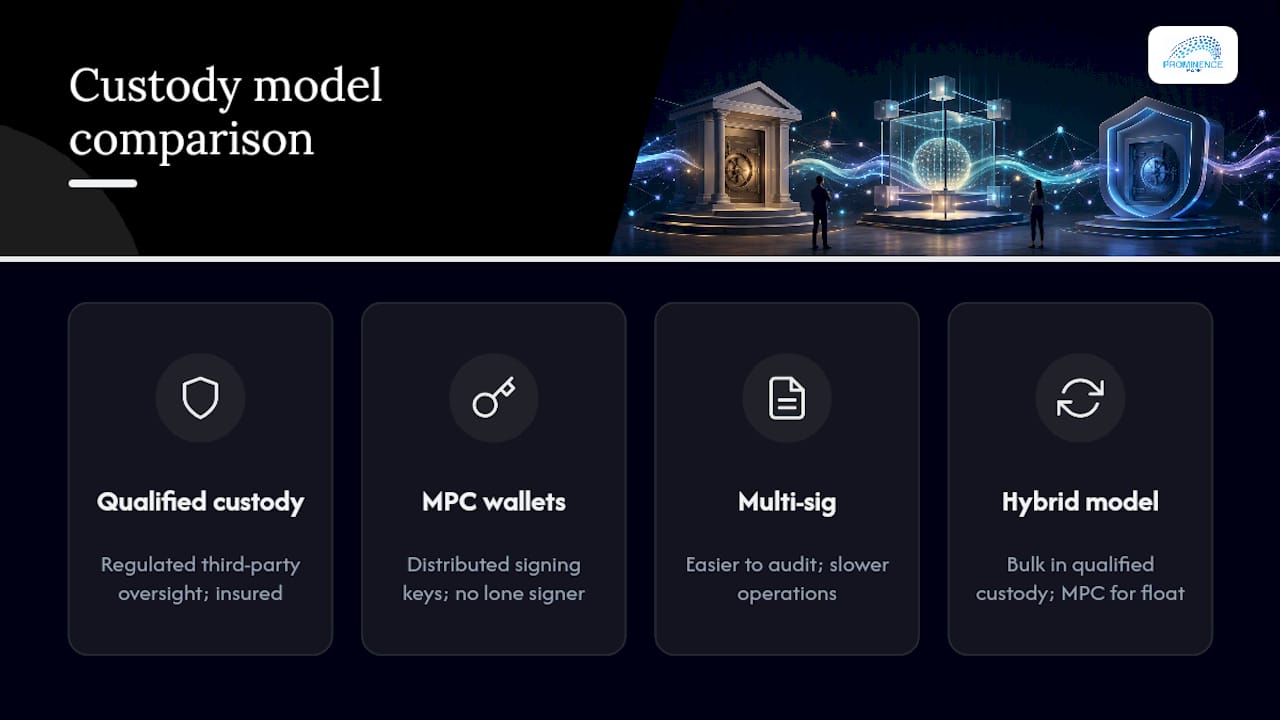
The stronger architectural move is separating custody, execution, reporting, and reconciliation into distinct contracts and risk surfaces rather than treating a vendor as one bundled black box. When you vet a custody provider, check insurer coverage limits, request SOC reports, and confirm the integration footprint matches your existing treasury and ERP stack. A provider that cannot produce a current SOC 2 report should not hold institutional float, full stop.
Which Chains Should Hold Your Float?
Chain choice trades off three variables: settlement speed, transaction fees, and liquidity depth. High-liquidity chains handle large redemptions without slippage; cheaper, faster chains suit smaller, frequent payment runs. Institutional treasuries in 2026 typically operate across three to seven blockchains and two to four issuers, spreading concentration risk the same way a bond desk ladders maturities.
Judge issuers on reserve transparency, redemption speed under stress, and regulatory posture in their home jurisdiction. A workable allocation rule: hold your operating buffer where you actually spend it, park runway assets and bulk positions on the deepest-liquidity chain available, and keep any yield sleeve small and separately tracked. Chasing marginal fee savings across a dozen chains adds more reconciliation overhead than it saves.
What Belongs in a One-Page Treasury Policy?
A workable stablecoin policy fits on one page and answers five questions before a single dollar moves on-chain.
- Eligible tokens. Name the specific stablecoins approved for treasury use and the issuer cap for each.
- Custody rules. State which custody model applies at which position size threshold.
- Chain and issuer limits. Set the maximum exposure per chain and per issuer, matching the diversification caps above.
- Approval authorities. Define who can initiate, approve, and release funds, with dollar thresholds tied to each role.
- Fallback paths. Document the fiat payment route to use if the primary rail is unavailable.
Pair the policy with a reporting cadence: real-time on-chain dashboards for daily visibility, plus monthly attestations or continuous Proof of Reserve monitoring for audit purposes. Periodic attestations alone no longer satisfy institutional-grade scrutiny; boards increasingly expect verifiable, real-time solvency data. When you present the policy to audit or the board, lead with the caps and the fallback plan. Those two items answer the first question every audit committee asks: what happens when something breaks.
How Do You Run a 90-Day Stablecoin Pilot?
A pilot succeeds or fails on scope discipline. Keep it narrow, instrumented, and reversible.
- Weeks 1 to 2: Design. Define pilot scope (one payment corridor or one intercompany route), set KPIs, and complete compliance pre-checks.
- Weeks 3 to 6: Build and test small. Integrate custody, on/off-ramps, and reconciliation automation at low transaction volume.
- Weeks 7 to 10: Scale carefully. Increase volume incrementally while monitoring reconciliation accuracy and settlement times.
- Weeks 11 to 12: Stress-test and review. Run a deliberate fallback drill and present results against your original KPIs.
Treasury teams that build a “3 a.m. test” into pilot design, meaning the fallback path works even when nobody senior is awake to intervene, report fewer incidents during real outages. Go/no-go hinges on whether reconciliation matched fiat records without manual patching and whether the fallback triggered cleanly during the drill.
Prominence Bank Practitioner Notes
Harold’s governance-first checklist starts with continuous Proof of Reserve monitoring rather than trusting a quarterly attestation. When Prominence Bank integrates custody with on- and off-ramps, the checks focus on three things: reconciliation accuracy against fiat ledgers, approval-chain integrity across roles, and fallback-path testing before go-live, not after. Treat these as prerequisites, not nice-to-haves, before scaling past a pilot.
What Are the Tax Implications of Stablecoin Treasury Use?
Tax treatment of stablecoins tracks the treatment of digital assets generally in most jurisdictions, which means it rarely matches the accounting simplicity treasurers expect from cash. A dollar-pegged token is frequently classified as property rather than currency for tax purposes, so converting between fiat and stablecoins, or between different stablecoins, can trigger a taxable event even when the dollar value barely moves.
Three areas deserve specific attention from your tax team before scaling volume. First, foreign exchange and gain/loss recognition: intercompany transfers denominated in stablecoins may need to be tracked at the transaction level, not netted at month-end, because small basis differences accumulate across high-frequency transfers. Second, withholding and reporting obligations for cross-border vendor and contractor payments do not disappear because the payment rail changed. If a payment would trigger 1099 or equivalent reporting in fiat, the same obligation typically applies when paid in stablecoins. Third, transfer pricing documentation for intercompany settlement needs to reflect the actual settlement mechanism, since auditors increasingly ask how digital-asset transfers were valued and timed relative to the underlying commercial transaction.
None of this is a reason to avoid stablecoins. It is a reason to loop in tax counsel before the pilot, not after the first quarter-end close. Jurisdictional treatment varies enough that a policy written for one country’s tax code will not transfer cleanly to another, so multinational treasuries should get local guidance for each entity in scope rather than applying a single global assumption.
How Do Stablecoins Integrate With Existing ERP and Treasury Systems?
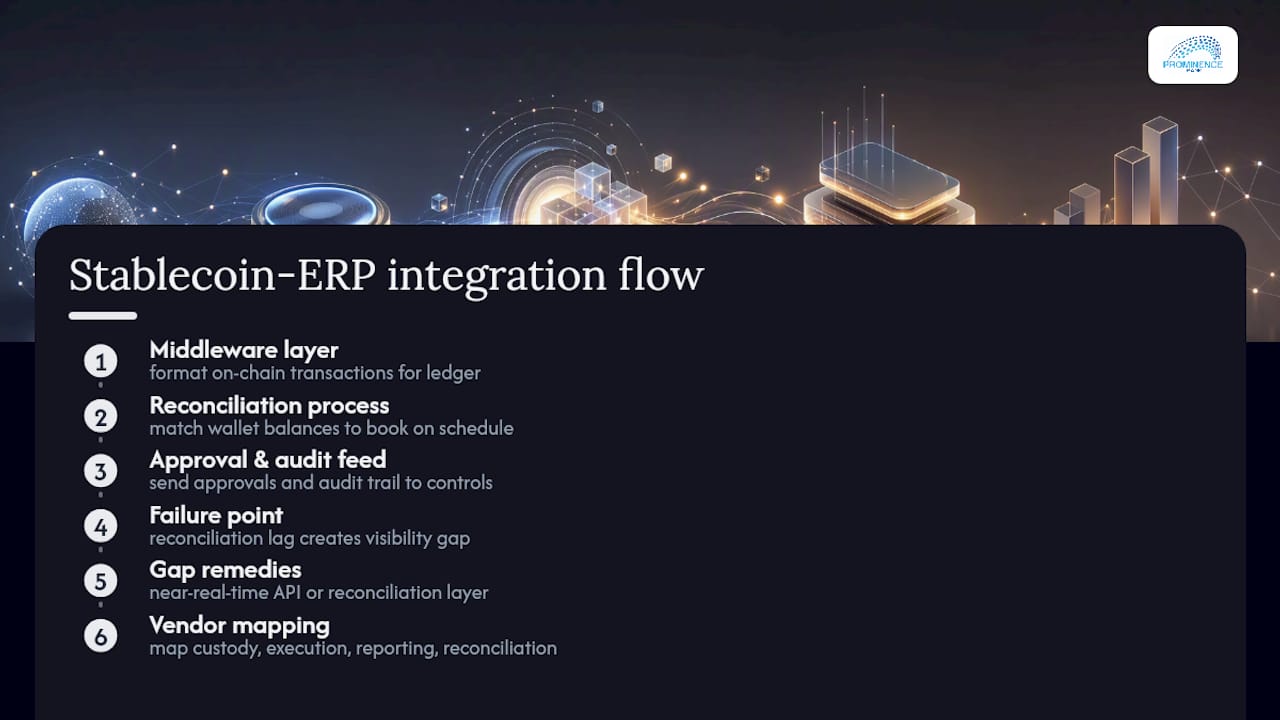
Most treasury management systems and ERP platforms were not built with native blockchain connectors, which means integration usually happens through a middleware layer rather than a direct plug-in. That layer typically handles three jobs: pulling on-chain transaction data into a format your general ledger recognizes, reconciling wallet balances against book balances on a defined schedule, and feeding approval and audit-trail data back into your existing controls framework.
The practical failure point is reconciliation lag. A treasury that settles payments on-chain in seconds but reconciles against the ERP once a day creates a visibility gap where the two systems disagree about cash position. Closing that gap requires either near-real-time API feeds from your custody provider into the ERP, or a dedicated reconciliation layer that timestamps every on-chain event and matches it against the corresponding ledger entry automatically.
Vendor selection matters here as much as the technology. A robust enterprise architecture treats custody, execution, reporting, and reconciliation as separate contracts and risk surfaces, which means your integration plan should map each of those four functions to a specific system or provider rather than assuming one platform handles all of it. Treasuries that skip this mapping exercise tend to discover the gaps during their first month-end close, which is the worst possible time to find them. Building the integration around your existing corporate treasury function rather than around the blockchain layer keeps the accounting team from having to relearn their close process from scratch.
What Regulatory and Legal Issues Should Treasury Address?
Regulatory treatment of stablecoins varies by jurisdiction and continues to develop, so treasury and legal need a standing process for tracking changes rather than a one-time review. The IMF’s ongoing work on cross-border payments reflects how actively regulators globally are reassessing digital-asset rails, and institutional treasuries should expect the rules governing custody, reserve backing, and reporting to keep shifting over the next several years.
Three legal questions belong in every pilot’s pre-check, not after launch. First, confirm the regulatory status of each issuer you plan to hold in the jurisdictions where your entities operate; an issuer treated as compliant in one country may face a different classification elsewhere. Second, verify AML and KYC obligations attach correctly to on-chain counterparties the same way they would to a traditional banking relationship, since regulators do not treat blockchain settlement as an exemption from existing compliance frameworks. Third, document custody arrangements in a way that satisfies your auditors’ expectations for asset segregation and control, since “the tokens are in a wallet” is not an answer that survives an audit committee meeting.
Work with counsel who understands both your entity structure and the specific issuers and chains in scope. Generic guidance rarely holds up when a regulator asks a pointed question about a specific reserve composition or redemption mechanism.
How Do You Manage Volatility and Market Shock Risk?
Dollar-pegged stablecoins are designed to hold a fixed value, but “designed to” is not the same as “guaranteed to,” and treasury needs a plan for the gap between those two. The 2023 USDC depeg event, triggered by exposure to a failed regional bank, is the clearest recent proof that even a well-capitalized, widely trusted issuer can trade meaningfully off its peg during a stress event.
Three controls reduce exposure to that kind of shock without requiring treasury to predict it. Diversification across issuers, capping any single issuer at roughly half of total holdings, means a depeg event on one token dents the portfolio rather than the whole operating balance. Real-time monitoring of oracle price feeds and reserve composition gives treasury an early warning before a depeg becomes public news, since on-chain data often moves faster than headlines. A pre-approved fallback payment path, tested during the pilot’s stress-test phase, means a depeg event triggers a documented procedure instead of an emergency meeting.
Market shocks are not limited to issuer depegs. Bridge exploits, chain congestion during network stress, and liquidity crunches during broader crypto market volatility can all disrupt settlement even when the stablecoin itself holds its peg. Treat these as separate risk categories in your monitoring dashboard rather than lumping everything under “stablecoin risk,” because the response to a bridge exploit looks nothing like the response to an issuer depeg.
When Should You Actually Pilot?
Pilot if you have an approved policy, real segregation of duties, signed vendor SLAs, and automated reconciliation. Delay if regulatory treatment in your jurisdiction is still unclear, you lack audit evidence for custody, or your volumes are too small to justify the operational lift. Bank deposit tokens and improved correspondent rails remain reasonable middle-ground alternatives while you build that readiness.
— Harold
How Prominence Bank Supports Your Stablecoin Pilot
Most treasuries running this pilot need three things at once: an account structure that speaks fiat and digital assets fluently, a custody-aware workflow that does not force a rebuild of existing approval chains, and reporting clean enough to hand an auditor without translation. Some digital banks offer that combination rather than bolting digital-asset support onto a legacy retail platform.
Institutional onboarding includes policy template guidance drawn from the governance checklist above, support for custody and on/off-ramp integration, and reconciliation-ready reporting designed to satisfy audit committees, not just internal finance. If your treasury already operates multi-currency accounts for cross-border operations, layering in a stablecoin pilot means fewer new relationships to manage, not more. Start by reviewing institutional banking services from a digital bank and requesting a scoped conversation about your pilot’s custody and reporting requirements.
Sources
- Stablecoin treasury management (Chainlink article)
- Stablecoin Treasury Management: 2026 Best Practices | Support
- Stablecoin guide for treasury (Kyriba)
- Stablecoin treasury management (BitGo blog)
FAQ
Who Is the Largest Holder of Stablecoins?
Large centralized exchanges, market makers, and a growing number of corporate treasuries hold the biggest stablecoin balances, with public entities’ onchain reserves collectively exceeding $35 billion as of early 2026.
Does the Trump Family Own a Stablecoin?
A stablecoin called USD1 was launched by World Liberty Financial, a crypto venture with ties to the Trump family; this article does not evaluate that project and readers should consult primary regulatory filings for current ownership details.
Why Are Banks Against Stablecoins?
Traditional banks often view stablecoins as competition for deposit funding and payment fee revenue, and some worry that large-scale stablecoin adoption could pull deposits out of the banking system during stress periods. Not every bank opposes them; some, including digital-first institutions, actively support institutional stablecoin adoption when governance and custody controls are in place.
Are Stablecoins Backed by the Treasury?
No single U.S. government body directly backs commercial stablecoins. Most major stablecoins claim reserve backing in cash and short-term Treasury securities held by the issuer, which is why reserve transparency and Proof of Reserve verification matter so much to institutional buyers.
How Much Should a Treasury Hold in Stablecoins?
Most operating businesses keep 60% to 90% of near-term operating cash in cash-equivalent stablecoins, with the remainder in runway assets and a small, separately tracked yield sleeve.