
A precious metals custody account is an arrangement in which a bank, trustee or vault holds your gold, silver, platinum or palladium on your behalf, and you keep the economic ownership. In the US the phrase usually points to one of two very different things: a retirement account governed by IRS rules, or a non-retirement custody or safekeeping arrangement where you set the terms with the institution. This guide explains both, what the costs look like, and which questions protect you.
TL;DR
- Inside an IRA, the IRS requires bullion to be held by a bank or an IRS-approved nonbank trustee. Keeping it at home is a prohibited transaction.
- Outside an IRA, custody is a contract. The paperwork (title, segregation, insurance, audit rights) matters more than the brand name.
- The biggest cost is often not storage but the dealer spread, which the CFTC says can reach 10% or more.
- A custodian generally does not vouch for what you bought. Vetting the dealer and the metal is your job.
- Prominence Bank offers custody and safekeeping receipt (SKR) services to private and institutional clients. The published fee for the Safekeeping Receipt (SKR) / custody service is €25,000 for the custody account plus 2%.
Table of Contents
- What a custody account actually is
- A note for U.S. investors
- What you are paying for
- Allocated, unallocated and receipts
- A custodian is not your due diligence
- Questions to ask before you open an account
- Perspective: what we see from the custody side
- How custody works at Prominence Bank
- Who should and should not use this kind of account
- Frequently asked questions
- Sources
What a custody account actually is
Custody separates two jobs that people often blur together: owning an asset and safeguarding it. You decide what to buy, sell or transfer. The custodian keeps the asset safe, records it in your name or for your benefit, and acts on your instructions.
For precious metals that raises practical questions a securities account never has to answer. Is the metal physically set aside with your name on it, or are you owed a quantity from a pooled stock? Who inspects it? Who insures it, and for what value? What happens if the custodian fails? A custody account is only as good as the answers written into the agreement.
We have written a general primer on how custody accounts work for wealth clients, which covers the structure that sits under metals, securities and other assets alike.
A note for U.S. investors
If you are a U.S. person, holding a foreign account can create separate tax and reporting obligations in the United States. Those obligations depend on your own circumstances and are outside the scope of this article. Confirm them with a qualified U.S. tax adviser before you open an account.
What you are paying for
Custody pricing is rarely a single number. Expect some combination of the following.
- Dealer spread. The gap between what a dealer sells at and what it will buy back at. The CFTC warns that dealers set their own spreads and that the price may need to move by a large margin before you break even. Its 10 questions guide puts spreads at 10% or more in some cases.
- Storage and insurance. Usually charged annually, often as a flat amount or a percentage of value. The CFTC lists storage, insurance and administrative fees among the other costs to consider.
- Account and administrative fees. Setup, annual maintenance, transaction and delivery or transfer charges.
- Verification and documentation. Statements, audits, certificates, letters.
A worked example shows why the spread dominates. Suppose a dealer’s spread is 10% and you hold the metal for five years. Before any storage fee, the metal has to rise about 10% in value just for you to get back what you paid. Storage and insurance then add a drag each year. This is arithmetic on the CFTC’s stated spread range, not a forecast of prices, which can fall as well as rise.
Our separate guide on reading custody fee schedules shows how to compare quotes that are built differently, for example a flat fee against a basis-point fee, and how complex portfolios get overcharged.
Allocated, unallocated and receipts
These terms decide what you own if something goes wrong, so insist on seeing them defined in the contract.
- Allocated (segregated) storage: specific bars or coins are set aside and identified, typically by serial number or weight list. You hold title to those items.
- Unallocated or pooled storage: you hold a claim for a quantity of metal against a pool. It is cheaper, but you may rank as a creditor of the holder rather than as the owner of identified items.
- A custody or safekeeping receipt: a document that evidences that an asset has been deposited with an institution. What it proves depends entirely on who issues it, what it describes and what the issuer undertakes.
A receipt is only as strong as its issuer and its wording. Read the description of the asset, the location, the party that bears the loss, and the conditions for release. If you want to see how we approach this, our page on the custodial bank safekeeping receipt (SKR) sets out the service.
A custodian is not your due diligence
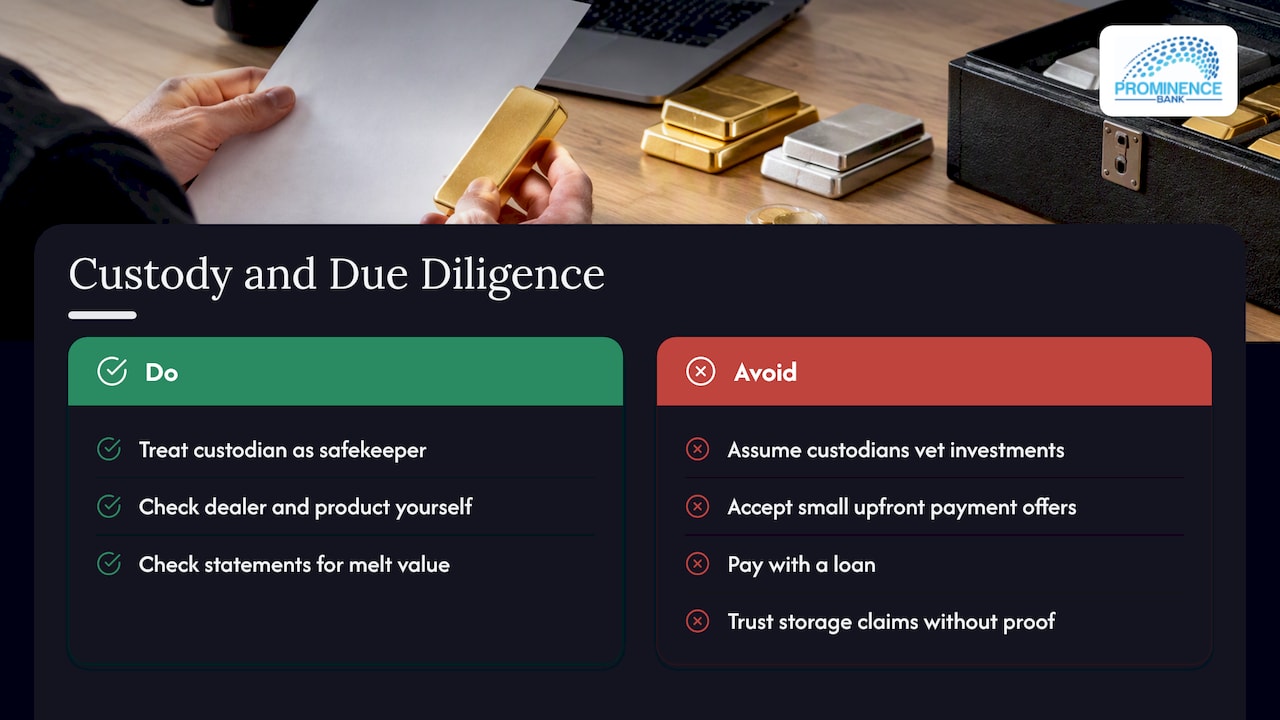
This is the point most buyers miss. According to the SEC’s Office of Investor Education and Advocacy and its partners, self-directed IRA custodians do not evaluate the quality or legitimacy of an investment and do not verify the financial information provided to them. The alert also cautions that fraudsters target retirees by steering them into such accounts to buy overpriced coins.
The SEC’s investor bulletin on custody explains the custody rule that applies to registered investment advisers who hold client funds or securities. That rule protects clients of advisers. It is not a guarantee that a metals vault will check what is in the box. Treat the custodian as a safekeeper, and treat the dealer and the product as your own responsibility.
The CFTC also advises on warning signs. Its guidance on gold as an investment cautions against offers that ask for only a small percentage of the price up front or that let you pay with a loan. It also cautions against claims that your metal will be stored in a bank or other secure facility without proof. And the 10 questions guide reminds buyers to check statements for the melt value, meaning the weight of metal times the spot price.
Questions to ask before you open an account
Use this as a checklist. Get every answer in writing.
- Who is the legal custodian, and what is its regulatory status? For an IRA, is it a bank or on the IRS nonbank list?
- Is storage allocated or pooled? Will you receive a bar list with serial numbers?
- Where is the metal held, and by whom? Is the vault operator a separate company from the custodian, and who bears loss between them?
- What is insured, for how much, and who is the beneficiary?
- What is the full fee schedule? Setup, annual, storage, insurance, transfer, delivery, closing.
- How do you sell or withdraw? Timing, minimums, buyback spread, and who pays for shipping.
- What reporting do you receive, and can you request an independent audit or inspection?
- Who sold you the metal, and are they pressuring you? The CFTC notes that fraud schemes commonly rely on high-pressure, act-now sales tactics. A reputable firm will let you take your time.
Perspective: what we see from the custody side
We work with private clients, businesses and institutions who want assets held safely, discreetly and in a form they can prove. Metals clients tend to come to us with the same underlying worry: they want to know that what they own exists, is identified as theirs, and can be released on their instruction.
Our view is that custody should be boring. The documentation should say exactly what is held, where, in whose name and under what conditions, and the fee should be something you can add up on one page. When a custody offer leans on fear, urgency or vague claims about “secure facilities”, we treat that as a reason to slow down, not speed up.
We also think precious metals deserve honest framing. They are a store of value many clients like for diversification, but prices are volatile, and the CFTC says plainly that they are not guaranteed against loss. Custody protects the asset from theft and misplacement. It does not protect you from price moves or from a bad purchase.
— Harold
How custody works at Prominence Bank
Prominence Bank is a digital bank serving high-net-worth individuals, international businesses and institutional clients. Custody sits alongside our private, business and corporate banking, and our safekeeping receipt (SKR) service. For clients who hold assets across jurisdictions, our guide to international custody account procedures walks through the steps, and the piece on offshore custody accounts covers privacy, security and compliance trade-offs.
What our published fee page lists today, exactly as published:
| Item | Published fee |
|---|---|
| Bank account opening | 25,000 $/€ one-off |
| Numbered bank account opening | 50,000 € one-off |
| Numbered account monthly fee | 100 $/€ per month |
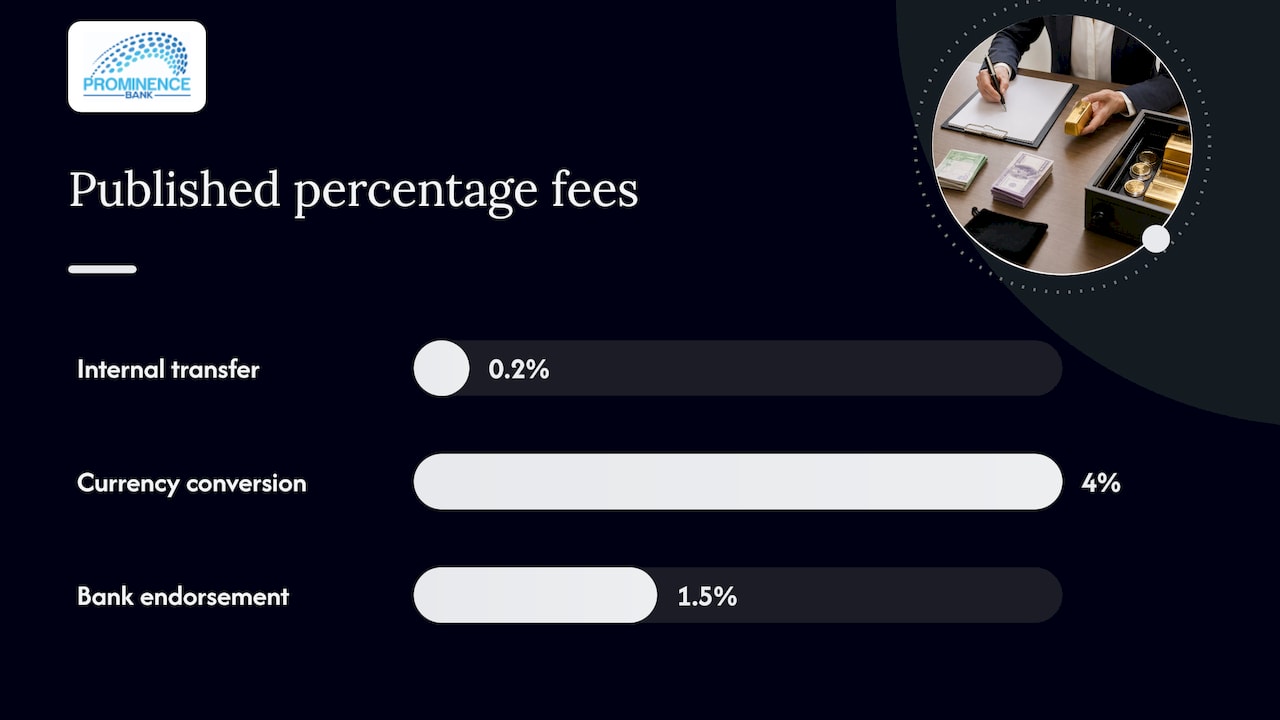
| Prominence Bank internal transfer | 0.2% |
| Currency conversion | 4% |
| Bank endorsement | 1.5% |
| Enhanced due diligence, Level 1 / 2 / 3 | 5,000 € / 10,000 € / 15,000 € one-off |
| Safekeeping receipt (SKR) / custody service | €25,000 for the custody account + 2% |
These fees reflect who the bank serves: clients with significant assets and, often, complex structures. They are not the economics of a small retail storage account, and you should weigh them against the size of the holding you plan to place. Enhanced due diligence is applied at one of three levels depending on complexity, and we run international AML/KYC checks on every relationship. The published fee for the Safekeeping Receipt (SKR) / custody service is €25,000 for the custody account plus 2%.
If you are ready to look at the numbers, see the full fee schedule. If you are comparing account types, our private banking page covers personal clients, and companies can start with the business account application.
Who should and should not use this kind of account
It tends to fit if you hold metals or other assets at a scale where a formal custody agreement, documented title and bank-grade onboarding make sense, or if you are a business or institution that needs a receipt or custody evidence for a transaction or collateral arrangement.
It tends not to fit if you are buying a small quantity of coins as a hobby, you need a tax-advantaged IRA wrapper, or you have been approached by an unsolicited seller pushing a time-limited deal. In the retirement case, use a bank or an IRS-approved nonbank trustee and verify its status on the IRS list. In the unsolicited case, stop and check with your state securities regulator or the CFTC before sending money.
For tax questions, such as how a sale is reported or how a distribution is taxed, speak to a CPA or tax attorney who knows collectibles and retirement accounts. For retirement accounts specifically, your plan administrator or an adviser regulated in your state can confirm what your plan allows.
Frequently asked questions
Can I keep IRA gold at home?
No. The IRS says bullion in an IRA must be held by a bank or an IRS-approved nonbank trustee for the exception to the collectibles rule to apply. Taking possession can be treated as an immediate distribution, generally taxed as ordinary income, with a possible 10% additional tax if you are under 59½. Confirm your situation with a tax professional.
Does a custodian check that my metal is genuine?
Generally not. The SEC and its partners warn that self-directed IRA custodians do not evaluate the quality or legitimacy of investments. You are responsible for vetting the dealer, the product and the price, so ask for itemized invoices and compare them with the melt value.
What is the difference between allocated and unallocated storage?
Allocated storage sets aside identified bars or coins that you hold title to. Unallocated storage gives you a claim on a quantity from a pool, which is usually cheaper but can leave you a creditor of the holder. The contract language decides which you have, so read it before funding.
Does Prominence Bank publish a price for custody?
We publish prices for account opening, monthly fees, transfers, endorsements, due diligence and the SKR / custody service.
Sources
- IRS: Retirement plans FAQs regarding IRAs
- IRS: Investments in collectibles in individually directed qualified plan accounts
- IRS: Approved nonbank trustees and custodians
- CFTC: 10 Things to Ask Before Buying Physical Gold, Silver, or Other Metals
- CFTC: Understand Risks and Markets before Reacting to Internet Hype
- CFTC: Gold Isn’t Always a Safe Investment
- Investor.gov: Self-Directed IRAs and the Risk of Fraud
- SEC: Investor Bulletin, Custody of Your Investment Assets