
Out-of-band authentication verifies a login or transaction by requiring confirmation over a separate communication channel, reducing the risk from a single compromised channel. The National Institute of Standards and Technology defines the technical requirements for these authenticators, and the Federal Reserve treats out-of-band verification as a core layered control for banks guarding against payment fraud.
TL;DR:
- Out-of-band authentication relies on a separate channel, like a push notification or hardware key, to verify transactions and reduce compromise risks.
- Using SMS or voice calls over the public phone network is acceptable only as a fallback due to their vulnerabilities from SIM swap and signaling attacks.
- Layered controls combining device recognition, behavioral monitoring, and transaction details display significantly improve security in financial operations.
- Risk-based rules and regular monitoring should be applied to account changes, especially phone number updates and device enrollments, for better protection.
- Transitioning toward phishing-resistant authenticators like FIDO2 keys and passkeys provides the strongest defense against intercept and relay attacks.
Table of Contents
- How out-of-band authentication works step by step
- Which channels count as out-of-band, and how they compare
- What out-of-band authentication stops and where it falls short
- OOBA in financial services: use cases and regulator expectations
- Best practices for teams implementing out-of-band authentication
- How to enroll in and use out-of-band authentication safely
- Where out-of-band authentication fits among identity controls
- Prominence Bank and institution-grade transaction security
- Sources
- FAQ
How out-of-band authentication works step by step
The typical flow starts with an action on a primary channel: a customer logs into online banking or submits a wire transfer request. That action triggers a challenge sent through a second, independent channel, a push notification, a code sent to a registered device, or a prompt inside an authenticator app. The user reviews and approves that challenge, and only then does the original session or transaction continue.
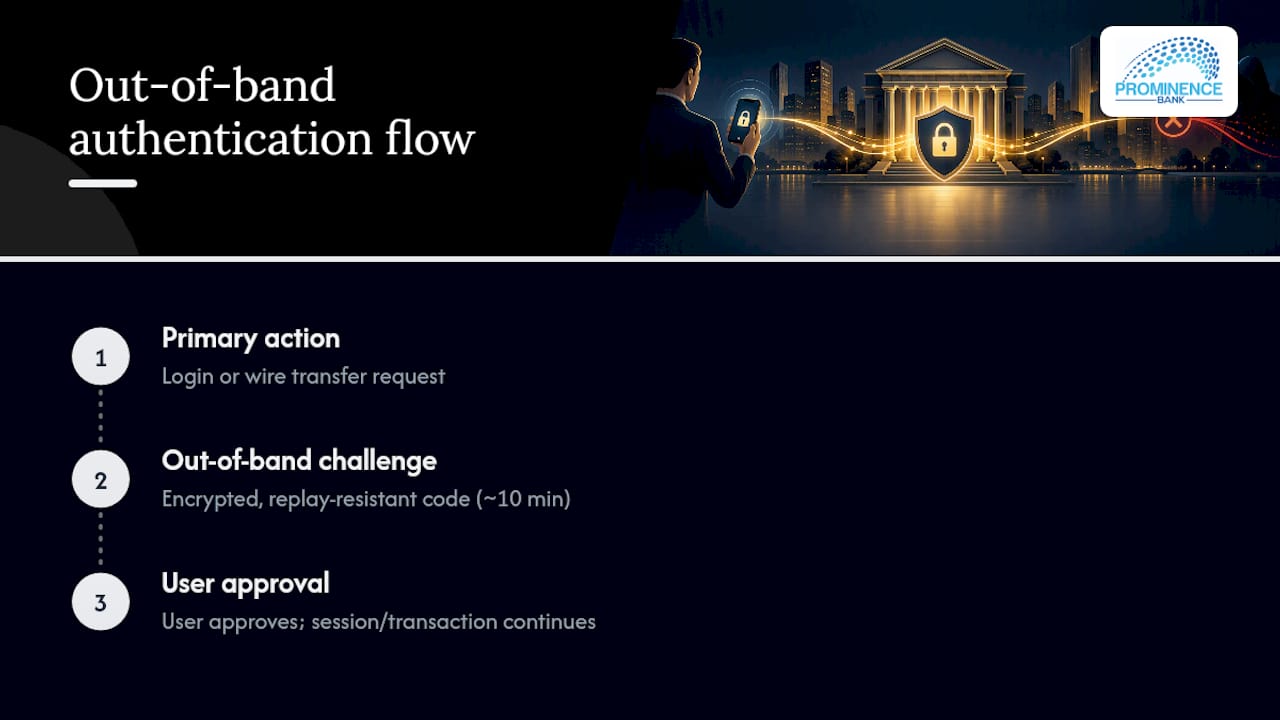
The technical requirements behind this are specific. NIST SP 800-63B requires that out-of-band authenticators use authenticated, protected channels, encrypt secondary-channel communication when the delivery method is not the public telephone network, and generate secrets with replay resistance and sufficient entropy so they cannot be guessed or reused. Guidance around short-lived secrets generally points toward validity windows of around ten minutes, after which the code or prompt expires and a fresh challenge is required.
Channel authentication matters as much as secret strength. A same-device flow, where the challenge appears on the same phone used to log in, is acceptable only when the implementation prevents information from leaking across channels without the user taking an action, something secure elements, trusted execution environments, or platform attestations help guarantee.
This is a different concept from multi-factor authentication generally. MFA groups methods by factor category: something you know, something you have, something you are. Out-of-band authentication is about channel separation specifically, using a second communication path rather than a second factor type, though the two overlap in most real deployments.
Which channels count as out-of-band, and how they compare
Out-of-band authentication shows up in several forms, each with different security properties.
- SMS or voice calls over the public telephone network, the most familiar form but also the weakest due to SIM swap and number-porting risk.
- App-based one-time codes, generated inside an authenticator app without needing a network connection at the moment of entry.
- Push approval notifications, where the user taps “approve” or “deny” inside a dedicated app.
- Hardware security keys using FIDO or WebAuthn, which bind cryptographic keys to a physical device.
- QR or visual codes, often used to link a session on one device to an approval on another.
- Dedicated transaction-approval devices, common in corporate banking for high-value payment sign-off.
PSTN delivery, meaning SMS and voice, carries restrictions in NIST’s guidance because phone numbers can be hijacked through SIM swap fraud or ported to another carrier without the account holder’s knowledge. It remains acceptable mainly as a fallback option rather than a primary control. Same-device flows can be reasonably secure when the receiving app stores keys in a secure element and the operating system prevents other apps from reading that channel, but they lose most of their value if the device itself is compromised by malware.
What out-of-band authentication stops and where it falls short
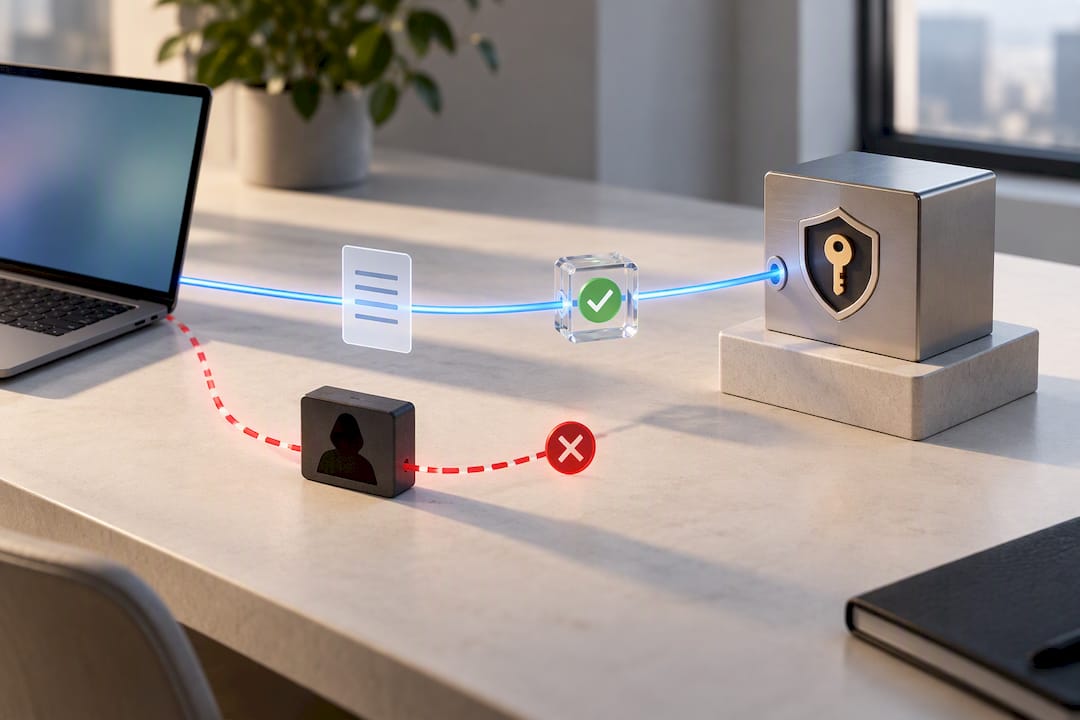
Out-of-band authentication earns its place by defending against malware that has infected the primary login channel: even if a password is stolen or a session is hijacked on a laptop, the approval request lands somewhere else. It also supports transaction integrity checks, since a challenge can display the payment amount and recipient rather than a generic “approve” button, and it enables dual authorization for sensitive actions that require two separate people to sign off.
The limitations are real and increasingly exploited. Real-time phishing relays can intercept a one-time code the instant a victim types it into a fake site and forward it to the attacker before it expires. Push bombing, also called MFA fatigue, floods a victim with approval requests until they tap “approve” out of frustration or confusion. SMS and voice channels remain exposed to SIM swap attacks and, at the carrier network level, to SS7 signaling vulnerabilities that can intercept messages entirely.
CISA has been explicit that push-based approval is not phishing-resistant, since the attacker only needs the victim to approve a prompt rather than steal a code. Its recommended interim mitigation is number matching, where the user must enter a number shown on the login screen into the approval prompt, preventing blind taps. The stronger fix is migrating toward phishing-resistant authenticators such as FIDO or WebAuthn security keys and passkeys, which cryptographically bind the approval to the specific site requesting it and cannot be relayed the way a code or a push tap can.
OOBA in financial services: use cases and regulator expectations
Banks lean on out-of-band authentication most heavily around money movement. Wire transfers, changes to beneficiary details, high-value transactions, and administrative changes like updating a registered phone number or adding a new payee all typically trigger a separate-channel challenge before execution.
Interagency guidance from the Federal Reserve frames this as one layer among several, recommending that institutions tailor authentication strength to the customer type, the transaction’s sensitivity, and the institution’s own risk assessment rather than applying one fixed rule everywhere. The OCC’s supplemental guidance on internet banking security specifically flags that out-of-band verification loses its value when the challenge lands on the same device that initiated the transaction, since a compromised device defeats the separation entirely.
A few patterns recur across regulatory expectations and practical deployments:
- Layered controls, combining device recognition, behavioral monitoring, and out-of-band checks rather than relying on any single method.
- Dual authorization for business accounts, requiring two authorized users to approve transfers above a set threshold.
- Device authentication and binding, so a new phone or browser triggers additional verification before it can approve transactions.
- Transaction-detail display, showing the beneficiary name and exact amount inside the approval challenge itself.
That last point deserves emphasis. A generic “approve this login” prompt tells the user nothing about what they are actually authorizing. A prompt that reads the destination account and dollar amount back to the user gives them a real chance to catch a wire transfer that has been silently altered by malware or a fraudulent instruction, which is closer to what transaction-verification guidance recommends for business payments.
Best practices for teams implementing out-of-band authentication
Service owners deploying out-of-band authentication have specific, standards-aligned choices to make about where to invest first.
- Default to phishing-resistant authenticators such as FIDO2 security keys or passkeys wherever the user base and platform support them.
- Enable number matching on push-based approvals if a full FIDO rollout is not yet feasible, since it closes the blind-tap gap that enables push bombing.
- Treat any phone number change as binding a new authenticator, requiring the same verification rigor as enrolling a brand-new device.
- Monitor for SIM swap and number-porting events on accounts that still rely on SMS or voice as a fallback channel.
- Apply risk-based step-up rules, demanding stronger verification for new devices, unfamiliar locations, high-value transactions, or beneficiary edits, while keeping routine, low-risk actions frictionless.
- Log every denied or ignored approval request and route repeated denials to a fraud review workflow rather than letting them disappear silently.
Operational hygiene matters as much as the authentication method itself: secrets need sufficient entropy, validity windows should stay short, and rate limits should cap how many challenges an account can generate in a given period.
Pro Tip: Rotate and test your incident response plan for denied MFA prompts the same way you’d test a backup restore, because the first time you need it is the worst time to discover it doesn’t work.
How to enroll in and use out-of-band authentication safely
Getting this right as an individual account holder is mostly about a short setup routine and a few habits that hold up under pressure.
- Register a device or app during enrollment, choosing an authenticator app or a hardware security key over SMS where the option exists.
- Save recovery codes somewhere offline, since losing your second factor without a backup often means a slow account recovery process.
- Test the recovery flow once, before you actually need it under stress.
- Never approve a prompt you did not request, and treat a sudden flood of approval requests as a sign someone else has your password.
- Report repeated or unexpected prompts to your provider immediately rather than dismissing them.
If a device is lost or you suspect a SIM swap, contact your provider right away to remove the compromised authenticator and re-enroll a new one before resuming normal account activity. The FTC’s consumer guidance on two-factor authentication walks through this enrollment and recovery process in more detail.
Where out-of-band authentication fits among identity controls
Out-of-band authentication is a strong integrity check for verifying transactions, but it was never designed to be the only defense for account access. The realistic priority list starts with phishing-resistant MFA for login, adds out-of-band challenges with transaction details for money movement, and layers risk-based step-up on top for anything unusual. Number matching is a reasonable stopgap, not a destination. Organizations that treat it as one, rather than a bridge to FIDO adoption, tend to relearn the push-bombing lesson the hard way.
— Harold
Prominence Bank and institution-grade transaction security
Some banks build layered security into how clients open and use accounts, from secure onboarding through ongoing transaction controls on wire transfers and administrative changes. 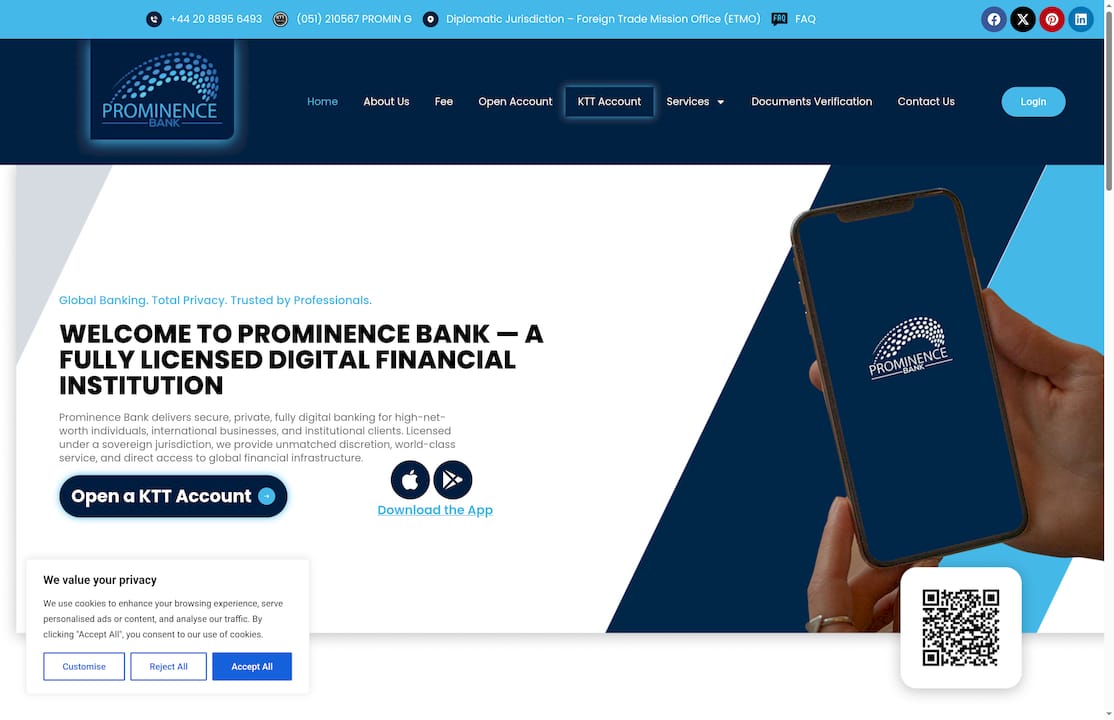
For businesses and individuals evaluating a bank built around discretion and multi-currency access, Prominence Bank’s business banking services are a starting point worth reviewing directly.
This article is general information, not a substitute for advice from a qualified financial advisor. Consult a qualified financial professional about your own circumstances before acting on anything here.
Sources
- NIST SP 800-63B: Digital Identity Guidelines: Authentication and Lifecycle Management
- Implementing number matching in MFA applications — CISA
- Interagency guidance on authentication and access to financial institution services and systems — Federal Reserve
- Use two-factor authentication to protect your accounts — Federal Trade Commission
FAQ
What does “out-of-band authentication” mean?
Out-of-band authentication means verifying a login or transaction through a communication channel separate from the one used to initiate the request, such as approving a laptop login through a code sent to a phone app. The separation limits damage if the primary channel is compromised, though the NIST SP 800-63B guidelines note it still requires encrypted, authenticated channels to be effective.
How do I fix an authentication error?
Start by confirming the second-channel device, whether that’s a phone or a security key, has a working connection and is the one currently registered on the account. If the prompt never arrives or is repeatedly denied, contact the provider to check for a lost device, a changed phone number, or a locked account rather than retrying indefinitely.
Is SSO better than 2FA?
Single sign-on and two-factor authentication solve different problems: SSO centralizes login across multiple applications, while 2FA adds a second verification step to any single login. They work best together, since SSO without a strong second factor concentrates risk into one login point rather than reducing it.
What are the four types of authentication?
Common frameworks describe authentication factors as something you know (a password), something you have (a phone or security key), something you are (a fingerprint or other biometric), and somewhere you are (location or network context). Definitions vary across sources, and out-of-band authentication typically layers on top of these factors rather than replacing any of them.