
Offshore asset-backed lending is a loan from a foreign or cross-border lender where the repayment source is backed by specific assets you pledge, such as securities, receivables, equipment, property or custodied holdings, rather than by your general creditworthiness. For a U.S. borrower, the loan itself is the easy part. The hard parts are proving that the collateral is real and controlled, perfecting the lender’s security so it holds up in a foreign court, and staying compliant with U.S. reporting and sanctions rules the whole time.
This guide explains the terminology, which assets lenders accept, how the process runs, what costs to expect, and which U.S. rules follow you offshore.
TL;DR
- Asset-backed lending looks to a ring-fenced pool of assets for repayment. Asset-based lending looks to a business’s balance sheet. The two are often confused, and lenders price and document them differently.
- Liquid, verifiable, easily controlled collateral (securities, cash, receivables, custodied assets) is the easiest to pledge across borders. Real estate and equipment need local-law security work.
- A U.S. person with foreign accounts above the reporting thresholds must file FBAR and may need Form 8938. Borrowing offshore does not remove those duties.
- Expect enhanced due diligence, sanctions screening and a source-of-funds review. Lender-side fees and valuation haircuts matter as much as the interest rate.
- The biggest risk is enforcement: a foreign court may not recognize security created under U.S. law, so local counsel is part of the cost of doing the deal.
Table of Contents
- What offshore asset-backed lending actually means
- Which assets can secure an offshore loan
- Crypto, custody accounts, numbered accounts, KTT and SKR as collateral
- How the process works, step by step
- Costs, terms and what to negotiate
- U.S. rules that follow you offshore
- Risks to weigh before you borrow
- Our perspective
- Where Prominence Bank fits
- FAQ
- Sources
What offshore asset-backed lending actually means
The phrase gets used loosely, so start with the three terms that overlap.
Asset-based lending (ABL) is a business loan product. The OCC’s handbook describes it as a specialized product that provides fully collateralized credit facilities to borrowers, using balance sheet assets such as receivables and inventory as the borrowing base. The lender looks at the operating company and the current value of what it holds.
Asset-backed lending is structured differently. According to the Secured Finance Network, it centers on lending against a pool of assets legally separated from the operating entity, often in a bankruptcy-remote special purpose vehicle. The lender’s exposure is to how that pool performs, not to the business as a going concern.
Offshore adds a jurisdiction layer. The lender, the borrower, the collateral, or the account where the collateral sits is outside the United States. That can happen for good commercial reasons: the assets are abroad, the counterparties are international, or the borrower wants multi-currency banking with a lender that understands complex structures.
In practice, you will meet three versions:
- A U.S. borrower pledging foreign-held assets to a foreign lender.
- A foreign company or SPV borrowing against receivables or trade flows from a lender with global reach.
- A borrower pledging assets held in custody at the lending institution itself, which makes control of the collateral simple.
The third version is often the cleanest operationally, because the lender holds what secures its loan.
Which assets can secure an offshore loan
Lenders want collateral they can value daily, control without the borrower’s cooperation, and sell quickly. The more an asset resembles cash, the better the terms tend to be.
Securities and liquid holdings
The best-documented example is the securities-backed line of credit. FINRA notes that eligible collateral typically includes stocks, bonds and mutual funds held in fully paid-for cash accounts, and that firms often require a minimum market value of $100,000. FINRA also says the lender sets the borrowing limit based on the quantity and type of collateral, with typical limits ranging from 50 to 95 percent of the asset value. Those figures describe U.S. securities-backed lines, not every offshore facility, but they show the logic: a lower advance rate for volatile assets, a higher one for stable ones.
Receivables, inventory and trade assets
For operating businesses, receivables and inventory form the borrowing base. The collateral is only as good as the lender’s ability to verify it. The OCC handbook points to inaccurate collateral valuation, fraud and weak controls among the risks ABL lenders face, which is why you should expect field audits, reporting covenants and tight eligibility criteria. Our guide on negotiating the borrowing base covers how finance managers can push back on those criteria.
Real property, equipment and shares
These assets are harder to move across borders because the law that governs the security is usually the law where the asset sits. In the United States, real property may be secured by a mortgage or deed of trust recorded in county land records, and security interests in equipment, inventory and receivables can generally be perfected by filing a UCC financing statement, while shares may be perfected by filing or by possession or control. The same source notes that it is uncommon for security over U.S. assets to be created under a foreign-law document because of enforceability and perfection questions, and that local counsel matters for real-property security.
Quick comparison
| Collateral type | How the lender usually secures it | What slows the deal down |
|---|---|---|
| Listed securities, cash | Control of the account or custody | Valuation haircuts, margin calls |
| Receivables | Assignment and UCC filing or local equivalent | Debtor verification, dilution |
| Inventory, equipment | Security interest, sometimes physical inspection | Appraisals, location of goods |
| Real property | Mortgage or deed of trust in local records | Local counsel, title work |
| Custodied or digital assets | Control through the custodian | Proof of ownership, key control |
Crypto, custody accounts, numbered accounts, KTT and SKR as collateral
These are the assets our readers ask about most, and the answer is the same for each: acceptance depends on what the lender can verify and control, not on the label.
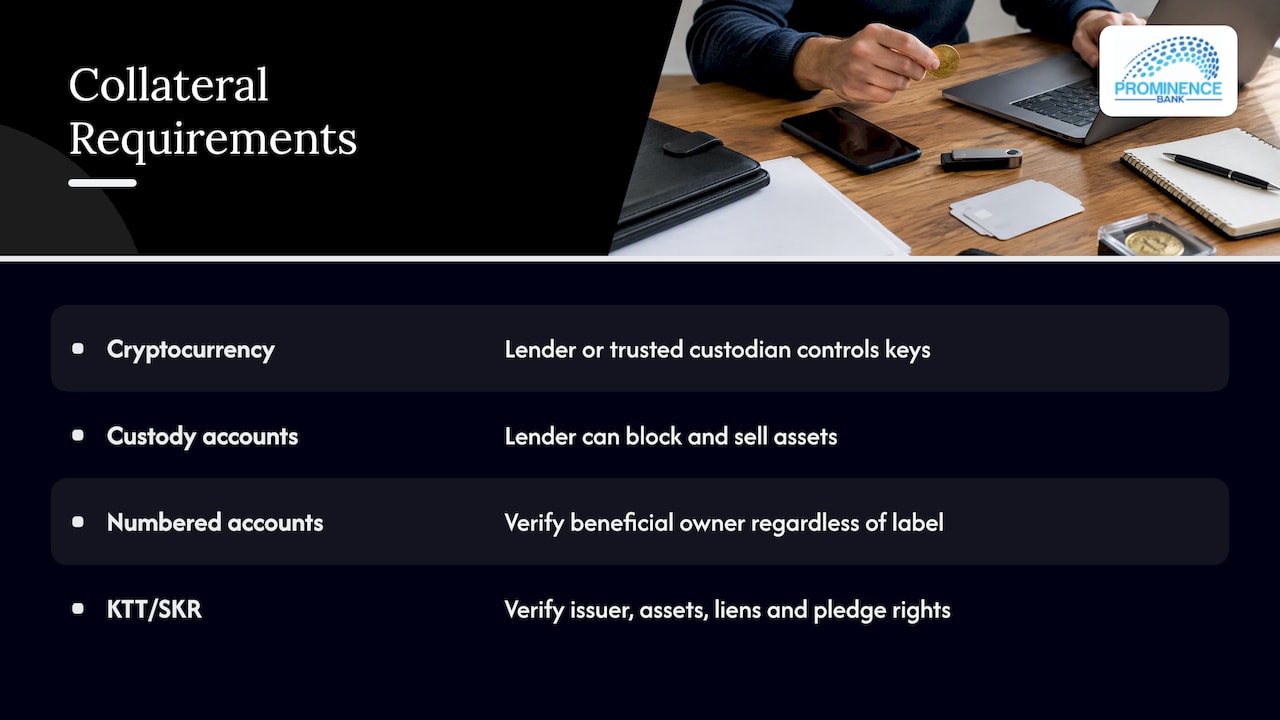
Cryptocurrency. Federal banking agencies state that crypto-asset safekeeping requires risk management and control of cryptographic keys. They add that fiduciary services must comply with applicable law, while non-fiduciary services are set by client contract. For a borrower, that means a lender will want the coins held where the lender, or a custodian it trusts, controls the keys. Coins on a personal device are hard to pledge.
Custody accounts. Assets already in custody at the lending institution are the simplest collateral, since the lender can block them and sell them under the loan agreement.
Numbered accounts. A numbered account changes how an account is labeled in daily operations. It does not change the lender’s need to know who owns it. Expect full beneficial-owner verification regardless of naming.
KTT and SKR. A KTT (key tested telex) is a bank-to-bank funds transfer message, and a safekeeping receipt (SKR) is a document evidencing assets held in safekeeping. Both are instruments whose value depends entirely on the issuing bank and the underlying assets. Before any lender accepts one as collateral, expect it to verify the issuer, confirm the assets actually exist and are unencumbered, and confirm the instrument can legally be assigned or pledged. A receipt that cannot be tied to verified assets is not collateral.
How the process works, step by step
The exact sequence varies by lender and by collateral, but most offshore asset-backed facilities follow this path.
- Define the purpose and the collateral. Decide what you are borrowing for and which assets you can pledge without breaking other agreements, such as existing liens or trust restrictions.
- Pick the structure. A direct pledge by you, a pledge by your company, or a pledge by an SPV that holds the assets. The SFNet distinction above matters here, because an SPV limits the lender’s recourse to the pool.
- Submit the application and ownership documents. Corporate records, beneficial-owner details, financial statements and proof that you own the assets.
- Pass due diligence. Identity checks, source-of-funds review, sanctions screening and, for complex structures, enhanced due diligence. The lender values the collateral independently.
- Receive a term sheet. It sets the advance rate, pricing, fees, covenants, margin-call mechanics and governing law.
- Document and perfect the security. This is where counsel in each relevant jurisdiction earns their fee. Security must be created and registered properly in the place that counts.
- Fund and monitor. Disbursement usually comes after conditions precedent are met. Afterward, the lender tracks collateral value and compliance reports.
- Repay or refinance. On repayment the lender releases the security. If collateral value falls, expect a request for top-up collateral or partial repayment.
Timelines depend heavily on how clean your documents are and how many jurisdictions are involved. Ask any lender for a written checklist up front, so you are not collecting documents for weeks after the term sheet.
Costs, terms and what to negotiate
Public benchmark rates for offshore facilities do not exist in the way mortgage rates do, because pricing is set per deal. What you can do is know every cost line before you sign. Ask for all of the following in writing:
- Interest rate and its basis, fixed or floating, and the reference rate.
- Advance rate against each asset class, and how often it is recalculated.
- Upfront, arrangement and legal fees, including the lender’s own counsel, which borrowers usually reimburse.
- Valuation, audit and monitoring costs.
- Currency conversion charges if the loan or collateral is in a different currency from your income. Our piece on multi-currency FX spreads shows how quickly these add up on large amounts.
- Margin-call and default terms: cure periods, who can sell the collateral, and how shortfalls are treated.
- Governing law and forum for disputes.
The default terms deserve the most attention. Cross-border risks include foreign-court recognition and enforcement challenges, declines in collateral value that can trigger repayment or asset sales, and shortfalls after liquidation. If the collateral sells for less than the debt, you may still owe the difference.
Banking costs around the loan
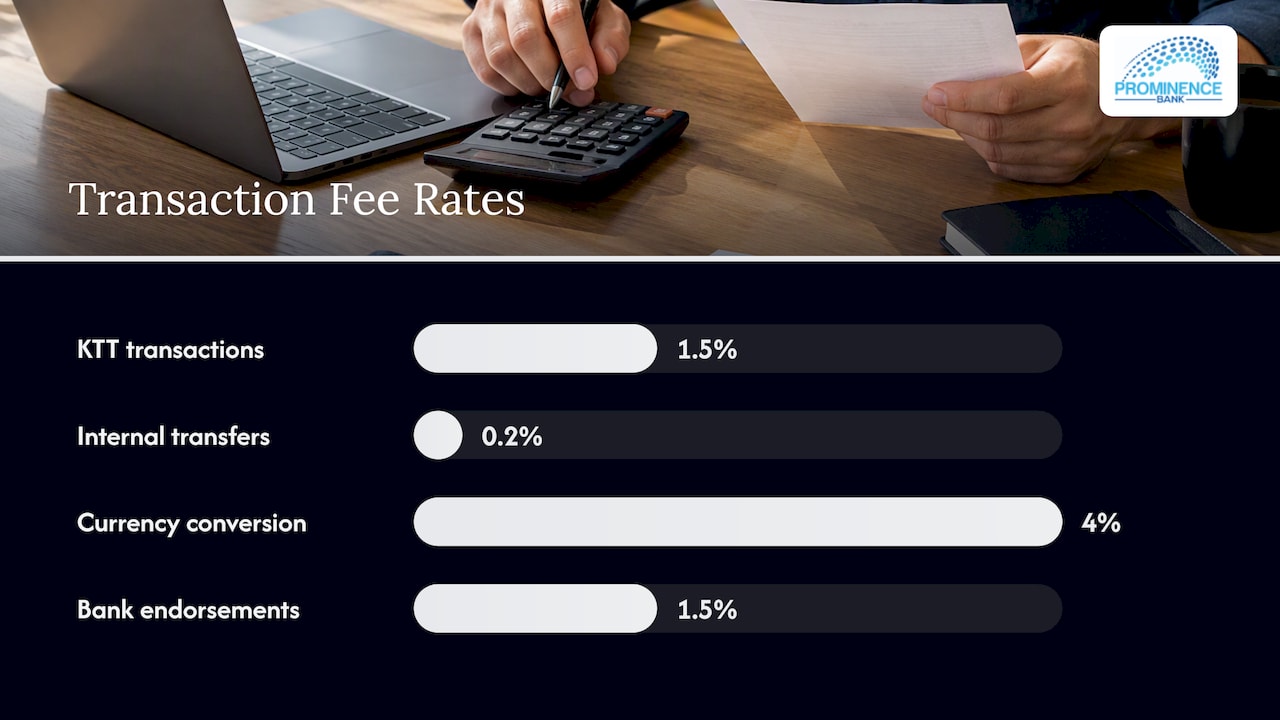
The loan is only one cost. The account that holds your collateral and moves your money has its own schedule. At Prominence Bank, the published fee schedule lists a one-off bank account opening fee of 25,000 (in dollars or euros), a numbered account opening fee of €50,000 with a monthly fee of 100 in dollars or euros, KTT (e-telex) transactions at 1.5%, internal transfers at 0.2%, currency conversion at 4% and bank endorsements at 1.5%. Enhanced due diligence is charged in three levels: €5,000, €10,000 and €15,000, depending on complexity. Reference or comfort letters and proof of funds are each €25,000. Wire transfer and safekeeping receipt pricing is not published on that page, so ask for it before you plan around it.
U.S. rules that follow you offshore
Borrowing from a foreign lender does not move you outside U.S. law. Four areas deserve a checklist.
Foreign account reporting
U.S. citizens and residents with a foreign account exceeding $10,000 in aggregate value at any time during the calendar year must file FinCEN Report 114 (FBAR). The same National Taxpayer Advocate report explains that FATCA requires U.S. citizens, resident aliens and certain non-resident aliens to report foreign assets above specified thresholds on Form 8938, and that foreign financial institutions must report certain U.S. accounts or face withholding. If your collateral or loan proceeds sit in a foreign account, the account likely counts. Our guides on FBAR filing for offshore accounts and signatory rules walk through who must report.
Sanctions
Loan agreements commonly define prohibited jurisdictions and persons subject to sanctions administered by U.S. authorities, as in this U.S. Treasury loan agreement. Collateral enforcement is not exempt either: OFAC states that its non-enforcement policies for specific collateral actions do not relieve parties from other regulatory requirements or applicable law. Screen the lender, the collateral issuer and every counterparty before you sign, not after. See our explanation of the sanctions screening process and the common OFAC screening failures.
Where and how security is perfected
UCC Sections 9-301 and 9-307 govern filing location based on the debtor’s location. U.S. organizations are located where they are formed, while rules for foreign obligors vary by jurisdiction. The American Bar Association guide also warns that foreign courts may not recognize the validity or priority of security interests created under U.S. law or perfected by UCC filings, so foreign counsel is needed.
Tax
Interest deductibility, withholding and the treatment of any collateral sale are tax questions specific to your facts. Bring a U.S. tax adviser into the term-sheet stage, not the filing season.
Risks to weigh before you borrow
- Enforcement risk. A security interest that is strong on paper may be weak in a court that does not recognize it.
- Valuation risk. Falling collateral prices can trigger repayment demands or forced sales at the worst moment.
- Concentration risk. Pledging one asset class, or one custodian, ties your fate to it.
- Documentation and fraud risk. Instruments you cannot verify, including receipts and telex-type messages, invite fraud. Verification is the lender’s job and also your protection.
- Compliance risk. Missed FBAR or Form 8938 filings, or a sanctions match on any party, can freeze the whole structure.
A sound structure also considers your wider plan. Our guides on offshore asset protection techniques and why offshore corporate structures exist explain how lending fits into the bigger picture.
Our perspective
Most failed cross-border secured deals fail at the same point: the collateral looked good in a spreadsheet, but nobody could prove who controlled it.
That is why we think of the account as the foundation of the loan. When your assets, your cash flows and your documentation sit in one institution built for international clients, due diligence is faster to complete and easier to defend. Prominence Bank is a licensed digital bank that serves high-net-worth individuals, international businesses and institutions, with multi-currency accounts, custody, safekeeping receipts, trade finance and structured finance under one roof.
We also believe in doing the compliance work early. Our onboarding follows international AML/KYC standards, and we offer enhanced due diligence tiers for complex structures, so clients know what the review will involve before they commit. Discretion matters to our clients, and it is built on proper verification rather than avoiding it.
If you plan to borrow against assets, start by deciding where those assets will be held, how they will be evidenced, and who will control them. Everything else in the facility follows from those answers.
Harold
Where Prominence Bank fits
If you are structuring a facility around assets you hold or plan to hold abroad, the first step is usually the right account. We offer business banking for operating companies, corporate banking for complex structures, and private banking for individuals, along with custody, safekeeping receipts, trade finance and structured finance services. Account opening and due diligence fees are listed openly on our fees page.

Corporate clients can start with the business account application and tell us what collateral and structure they have in mind.
FAQ
Is offshore asset-backed lending legal for U.S. persons?
Borrowing from a foreign lender is not prohibited in itself, but you must follow U.S. reporting, tax and sanctions rules. That includes FBAR and, where thresholds are met, Form 8938 for foreign accounts and assets. Have a U.S. attorney and tax adviser review the structure before signing.
How much can I borrow against my assets?
It depends on the asset type and the lender. For U.S. securities-backed lines, FINRA reports typical limits of 50 to 95 percent of asset value, with more volatile holdings getting lower advance rates. Offshore facilities are priced individually, so the term sheet is the only reliable answer.
Can I pledge cryptocurrency or a safekeeping receipt?
Sometimes, if the lender can verify ownership and control. For crypto, that means control of the keys, often through a custodian. For a safekeeping receipt, the lender will check the issuer, the underlying assets and whether the instrument can legally be pledged.
What happens if the collateral loses value?
You will usually face a margin call: add collateral or repay part of the loan. If you cannot, the lender may sell the collateral, and you may owe any shortfall after the sale. Read the cure period and the sale rights in the agreement before signing.
Do I need a local lawyer?
Yes. Foreign courts may not recognize security created under U.S. law, and real-property security in particular needs local counsel. Budget for counsel in each jurisdiction where the collateral or the lender sits.
Sources
- Asset-Based Lending, Comptroller’s Handbook (OCC)
- Asset-based lending, or asset-backed lending? (Secured Finance Network)
- Securities-Backed Lines of Credit Explained (FINRA)
- Lending & Secured Finance, Legal 500 United States 2024
- Crypto-Asset Safekeeping by Banking Organizations (OCC)
- National Taxpayer Advocate 2020 Purple Book
- Sample loan agreement (U.S. Department of the Treasury)
- OFAC FAQ 1124
- Cross-Border Lending: A Brief Guide for U.S. Secured Lenders (American Bar Association)