
A zero balance account structure links one master account to one or more sub-accounts that carry no cash of their own. At the end of each business day, whatever sits in the sub-accounts is swept into the master, and any shortfall created by checks or payments is covered from the master. You keep one pool of cash to manage while every department, entity or purpose still gets its own account number. This guide explains how the mechanics work, how to design the structure, where it can go wrong, and how it differs from a capital call account.
TL;DR
- A ZBA is a sub-account that is swept back to a master concentration account, so it sits at $0 after the daily cycle. The balance is not forbidden; it is cleared.
- The regulator’s description is simple: a deposit-to-deposit sweep, usually between accounts owned by the same legal entity.
- The real benefits are control and visibility: one pool of cash, separate accounts for payroll, payables or receipts, and less idle money.
- The real risk is intraday exposure: the bank may pay items before the covering funds arrive, so structure and limits matter.
- A capital call account is a different tool. It receives investor money against a commitment, and a ZBA can sit behind it for disbursements.
Table of Contents
- What a zero balance account structure is
- How the daily cycle works
- Why companies use a ZBA structure
- Designing the structure: decisions that matter
- Drawbacks and operational risks
- ZBA versus other cash structures
- Where capital call accounts fit
- Perspective: what we see in complex structures
- Setting up accounts with Prominence Bank
- A practical checklist before you set one up
- FAQ
- Sources
What a zero balance account structure is
The FDIC describes a ZBA as a deposit-to-deposit sweep that involves a master concentration account connected with one or more subsidiary accounts. The instructions typically call for funds in the subsidiary accounts at day’s end to be swept to the master.
So, to answer the common question of what type of account a ZBA is: it is a business (corporate) checking-type account that works as an operating account, tied to a master account by a standing sweep instruction. It is not a savings product and it earns nothing on its own. The point is the arrangement around it.
Three parts make up the structure:
- The master (concentration) account. This is where cash actually lives. Treasury looks at this account to see the company’s position.
- The zero balance sub-accounts. Each one serves a single purpose: payroll, accounts payable, a regional office, a division, a collections account.
- The sweep rule. A standing instruction at the bank that moves funds between the two every business day.
Because the master and the sub-accounts are generally owned by the same legal entity, the FDIC notes that the movement usually does not change the customer’s insurance status. That matters if you are weighing deposit coverage across entities. Where the sub-accounts belong to different legal entities, the picture changes, and you should confirm with your bank and counsel.
How the daily cycle works
The cycle is mechanical, and it helps to see it in order.
- Morning. A sub-account opens the day at $0.00.
- During the day. Deposits arrive, or checks and electronic debits are presented against the sub-account.
- End of day. The bank totals the activity. If the sub-account has a credit balance, it is swept up into the master. If it is overdrawn by presented items, the master funds the difference.
- Next morning. The sub-account is back at zero, and the master shows the net result.
A worked example makes this concrete. Say a company runs a payroll account and a payables account under one master.
| Account | Activity during the day | End-of-day sweep | Closing balance |
|---|---|---|---|
| Payroll (ZBA) | $180,000 in payroll debits clear | $180,000 pulled from master | $0 |
| Payables (ZBA) | $95,000 in vendor checks clear | $95,000 pulled from master | $0 |
| Collections (ZBA) | $310,000 in customer receipts arrive | $310,000 pushed to master | $0 |
| Master | Net effect: +$35,000 | n/a | Prior balance plus $35,000 |
The finance team never has to forecast how much to park in payroll or payables ahead of time. The master absorbs the swings, and the bank only needs one funded account.
How much money can be kept in a zero balance account
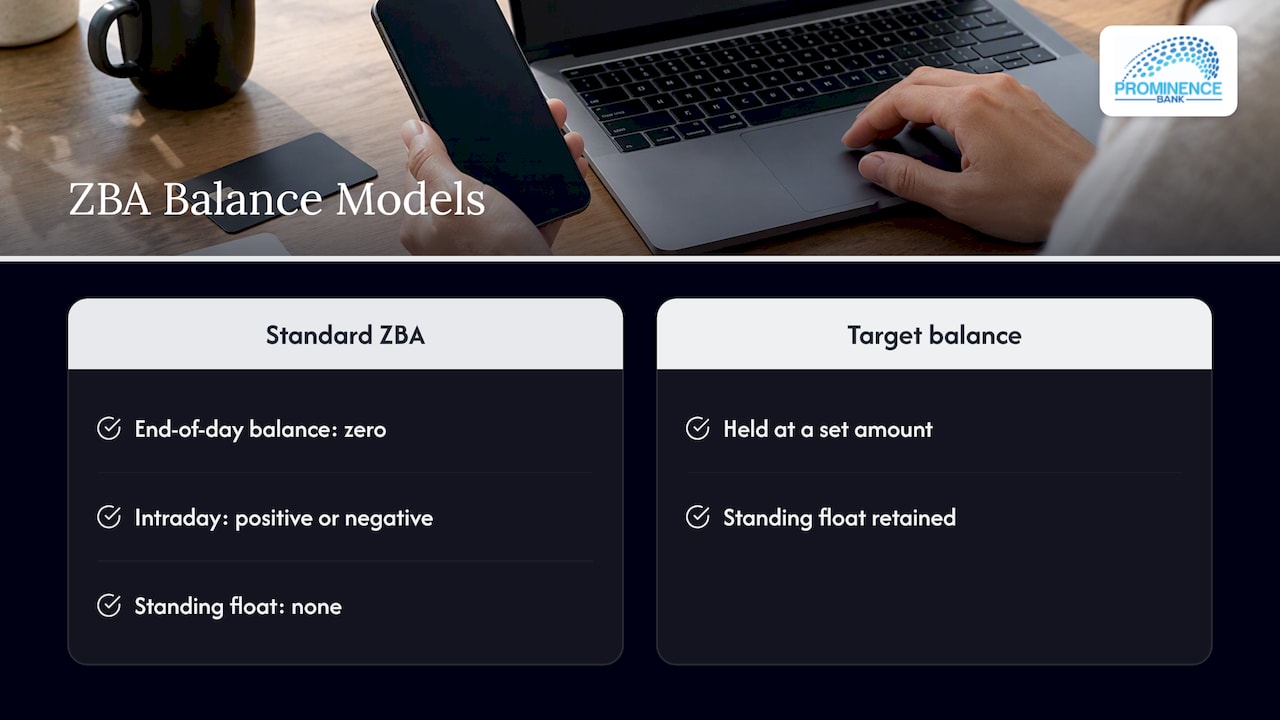
In practice, none overnight. By design the sub-account closes each day at zero, so the question is really about how much can pass through it. That depends on the limits and approvals set with the bank, and on the funding in the master. During the day a ZBA can show a positive or negative balance, because the sweep happens at the close of the cycle. Some banks also offer a target balance variant, where the sub-account is held at a set amount instead of zero. This suits an account that needs a standing float.
Why companies use a ZBA structure
Most of the benefits come from separating where money is spent from where money is held.
- Fewer idle balances. Cash is not stranded in a dozen accounts. The treasury team sees and deploys one pool.
- Clean separation of purposes. Payroll, payables, tax and collections each have their own account and their own audit trail, without each needing funding.
- Simpler reconciliation. The sub-account activity ties to a single purpose, so exceptions are easy to spot.
- Delegated autonomy. A subsidiary or business unit can run its own account, with the group controlling the master.
- Less manual transfer work. No one has to wire money into payroll on Thursday afternoon.
- Better forecasting. One net number each day is easier to forecast than many gross balances.
It works best for organizations with several entities, divisions or high-volume payment streams. A single-entity business with one operating account and low volume probably does not need it, and the extra fees are not worth it.
Designing the structure: decisions that matter
Pick the number of sub-accounts by purpose, not by habit
One account per function is the usual rule. Separate payroll from vendor payments, and keep receivables apart from both. More accounts give more visibility but also more to maintain and more fees. Review the list yearly and close anything that is unused.
Decide who owns each account
If the sub-accounts belong to the same legal entity as the master, the structure is simple. If they belong to different subsidiaries, the sweep becomes an intercompany transfer. That brings in intercompany loan documentation, tax treatment and transfer pricing questions that your accountants must settle. A structure that looks neat on a diagram can create real compliance work. For deeper reading on that topic, see our piece on controls for complex corporate structures and our explainer on corporate banking structures, roles and risks.
Consider holding companies and cross-border entities
Where a group has a holding company, ask whether it needs its own account at the top of the structure. We covered the trade-offs in whether a holding company should have its own bank account. Cross-border groups face another layer: currency. A single-currency sweep is easy. Multi-currency groups typically run one master per currency, or they pay conversion costs on every sweep, so check the conversion fee before you design anything. Our own published conversion fee is 4%, listed on the fees page, so a structure that converts daily would be expensive and should be avoided.
Set approval and signing rules
Who can change the sweep rule? Who can add a sub-account? These are control questions as much as treasury ones. A multi-signatory corporate account setup is one way to require more than one approver for changes at the master level.
Document the purpose of each account
Write one line per account: what it is for, who owns it, who can sign, which master it sweeps to. Auditors and your bank’s compliance team will ask. Keeping that register current is part of good corporate account management.
Drawbacks and operational risks
A ZBA is not free of risk, and the main one belongs to the bank rather than to you. The FDIC’s examination manual notes that ZBAs can create credit exposure for remote banks when checks are paid against insufficient collected balances, in the expectation that covering funds will arrive before the close of the business day. It adds that this intraday exposure, in effect unsecured lending against uncollected funds, does not show in the bank’s financial statements, and the amounts can be large enough to exceed the bank’s capital.
What does that mean for a corporate customer?
- Expect limits and scrutiny. Banks set intraday limits on ZBAs and may ask for financial information. A thinly funded master can lead to refused items.
- Funding failures cascade. If the master does not hold enough to cover the day’s net debits, sub-account items can be returned or the master can go overdrawn. Monitor the master’s projected position each morning.
- Fraud exposure is concentrated. A fraudulent check on a sub-account is covered by the master automatically. Use positive pay or similar controls on payables and payroll accounts.
- Fees add up. Banks usually charge maintenance per sub-account, plus per-item fees. Compare the total cost with the interest you gain from consolidating.
- Intercompany complexity. As noted, multi-entity sweeps create loans between entities that must be recorded and priced.
- Currency limits. Cross-border sweeps rarely work in a single step, and time zones make “end of day” ambiguous.
None of these is a reason to avoid the structure. They are reasons to set it up deliberately, with your bank, your auditor and your tax adviser involved before you go live.
ZBA versus other cash structures
| Structure | What it does | Best for |
|---|---|---|
| Zero balance account | Sub-accounts swept to $0 daily into a master | Disbursement and collection accounts under one entity or group |
| Target balance account | Sub-account held at a set amount, excess swept, shortfall topped up | Accounts that need a standing float |
| Notional pooling | Balances netted for interest purposes without moving cash | Multi-entity groups where permitted |
| Physical cash concentration | Actual transfers to a central account, often across banks | Groups spread over several banks |
A ZBA is the simplest and most widespread of the four. The others solve problems it does not.
Where capital call accounts fit
Readers who search for this topic often also ask about capital call accounts, so it is worth separating the two.
A capital call is a fund manager’s formal demand that investors deliver money they have already committed to a private fund. The money is used to buy companies, cover fees or support portfolio operations, as LegalClarity explains. After the transfer settles, the administrator updates the investor’s ledger to show more contributed capital and less unfunded commitment.
The notice period comes from the governing agreement. One LLC agreement filed with the SEC, for example, requires the managing member to give each member a capital call notice at least 5 business days before the due date. Your own documents will set their own period. Missing a call has consequences too: operating agreements can provide for dilution, forfeiture of preferred returns or a forced buyout.
The difference is in function:
- A capital call account is a receiving account. Investor money arrives in lumps, on a schedule driven by deals, and it is held until it is deployed. It should show a balance.
- A ZBA is a funding and clearing account. It should show none at the end of the day.
They can work together. A fund vehicle might receive contributions in a segregated capital call account, then fund payments for fees, expenses and acquisitions from operating sub-accounts that sweep to zero against it. The first account is the reservoir; the others are the taps. Keep the investor money in an account whose purpose is clearly documented, so the administrator can reconcile every contribution to the investor’s capital account.
One caution: if investor capital is meant to be held for a specific purpose or segregated by the fund documents, do not let a sweep mix it with the manager’s own operating cash. Ask your fund counsel to confirm that the sweep rules match the partnership or LLC agreement.
Perspective: what we see in complex structures
We work with clients whose account structures look very different from a single-company ZBA: holding companies, international subsidiaries, family offices and funds. The pattern we see is that people design the sweep first and the governance second, and the order should be reversed.
Before asking how to sweep, ask who owns each account, who may instruct the bank, what the documents say about commingling, and which jurisdiction’s rules apply. A ZBA on a clean single-entity structure is a convenient tool. A ZBA across entities in three countries is a legal and tax design that happens to use a bank account. We would rather a client spend an extra week on the register of accounts than discover in an audit that the sweeps were undocumented intercompany loans.
We also encourage separation when it protects a client: personal wealth away from operating companies, investor money away from management cash. Our write-up on why account separation matters for high-net-worth clients goes into this. Zero balance structures are about efficiency. Separation is about protection. A good structure uses both, each where it belongs.
— Harold
Setting up accounts with Prominence Bank
If your group needs separate operating accounts across entities and currencies, we can help you work out the account layout before anything is opened. Our business banking and corporate banking teams handle multi-currency and multi-entity set-ups, and you can start with the business account application. Fees are published: bank account opening is listed at 25,000 (USD or EUR) one-off, and our internal transfer fee is 0.2%, both on the fees page. Whether a particular sweep arrangement is available for your structure is something to confirm with us at onboarding, not to assume from this article.
A practical checklist before you set one up
- List every account you run and the purpose of each.
- Mark the legal owner of each one. Flag any sub-account owned by a different entity from the master.
- Estimate the daily net debits and credits for each, so you can size the master’s funding.
- Ask your bank about intraday limits, per-account fees and what happens when the master is short.
- Add fraud controls to payables and payroll sub-accounts.
- Agree who can change sweep rules, and require two approvers.
- Ask your accountant how intercompany sweeps will be recorded and priced.
- Review the structure every year and close dormant sub-accounts.
FAQ
What are the drawbacks of a zero balance account?
The main ones are fees per sub-account, reliance on the master being funded each day, and concentrated fraud exposure. The bank also carries intraday credit risk, which is why it sets limits and may review your finances. Across entities, sweeps can create intercompany loans and tax questions.
What type of account is a zero balance account?
It is a business operating account, linked by a standing sweep to a master concentration account. The FDIC classes the arrangement as a deposit-to-deposit sweep. It holds no cash overnight and is mainly used for payroll, payables, collections or divisional spending.
How much money can be kept in a zero balance account?
By design, nothing is kept overnight, because the balance is swept to zero at the close of the day. During the day it can hold or owe sizeable amounts, within limits set by your bank. If you need a standing float, ask about a target balance account instead.
How does a ZBA work?
Each day, deposits and payments hit the sub-account. At day’s end the bank sweeps any credit into the master and funds any debit from the master, so the sub-account opens the next morning at zero. You see one net position in the master rather than several separate balances.
Is a capital call account the same as a ZBA?
No. A capital call account receives and holds investor contributions against commitments, so it carries a balance. A ZBA clears to zero daily. A fund can use both: one to receive contributions, others to pay expenses.
Sources
- FDIC: Sweep Account Disclosure Requirements, Frequently Asked Questions
- FDIC: Section 4.6 Miscellaneous Banking Activities
- SEC filing: LLC agreement with capital call notice terms
- LegalClarity: What Are Capital Calls and How Do They Work?
- LegalClarity: Capital Contribution in Real Estate