
A private asset custody bank holds securities, cash or digital assets on your behalf, settles trades, reports on positions and keeps your property separate from its own. It does not lend your assets out or decide how to invest them unless you hire it to. This guide explains how custody works under U.S. rules, what protects you and what doesn’t, and what to ask before you move assets. It also covers how our own custody and private banking services fit in.
TL;DR
- Custody means safekeeping, settlement and reporting. It is a contractual service, and it is not the same as a fiduciary role or a deposit account.
- A bank custodian holds client assets apart from its own. Brokerage protection (SIPC) and bank deposit insurance (FDIC) work differently, so know which one applies to your assets.
- If an investment adviser manages your money, the SEC custody rule generally requires a qualified custodian and direct account statements to you.
- Digital assets need real control over private keys. Ask exactly how keys are generated, stored and recovered.
- At Prominence Bank, account opening starts at 25,000 $/€ one-off, and SKR and custody pricing is quoted by us, not published.
Table of Contents
- What a private asset custody bank actually does
- Custody is not the same as fiduciary management
- Custody bank, trust bank, or brokerage?
- Protection: FDIC, SIPC and what neither covers
- The SEC custody rule, if an adviser is involved
- Digital assets: custody means control of the keys
- Sanctions and beneficial ownership
- A checklist for choosing a custodian
- Perspective: what we see in private custody
- What custody looks like at Prominence Bank
- Compliance expectations you should plan for
- Common mistakes
- FAQ
- Sources
What a private asset custody bank actually does
In banking, custody is the service of holding assets on a customer’s behalf: securities, cash or digital assets, with safekeeping, settlement and reporting. It is not lending and it is not deposit-taking. The Congressional Research Service notes that as of September 2021, 387 deposit-taking institutions held $259 trillion in custody and fiduciary assets. Custody is a very large, mostly invisible part of the financial system.
The OCC’s Comptroller’s Handbook describes the typical services as settlement, safekeeping and reporting of marketable securities and cash. It also stresses that a custody relationship is contractual. Your agreement defines what the bank must do, and just as importantly, what it does not do.
“Private” in this context usually means one of two things. Either the bank serves individuals and families (a private bank’s custody desk), or it serves privately held vehicles such as family offices, funds and operating companies. In both cases the client typically wants three things: segregation of assets, clean reporting, and discretion in how the relationship is run.
Custody is not the same as fiduciary management
People often mix up two roles. A custodian holds and services assets. A fiduciary, such as a trustee, holds legal authority to manage assets in your best interest. The OCC handbook draws this line, and the liabilities and requirements differ significantly between the two.
Why it matters in practice:
- A pure custodian generally acts on your instructions or those of your adviser. It settles the trade, it does not choose it.
- A trustee or discretionary manager can make decisions, and carries the duties that come with that power.
- Some institutions offer both. Read which hat the bank is wearing for each part of your relationship.
If you want a plain-language primer from our side, our piece on custody accounts for wealth clients walks through the basics.
Custody bank, trust bank, or brokerage?
The U.S. has several types of institution that can hold your assets. Their legal frameworks and protections differ.
| Type | Core business | Typical protection | Best for |
|---|---|---|---|
| Full-service commercial bank | Deposits, loans, plus custody and fiduciary services | Deposits FDIC-insured within limits; custody assets held under contract | Clients who want one relationship |
| Trust or custody bank | Administration, settlement and safekeeping; little or no retail lending | Governed by banking and trust law | Institutions, funds, large portfolios |
| Broker-dealer | Trading and execution, with custody as an add-on | SIPC covers certain securities and cash held for trading | Active traders |
| Digital or specialized private bank | Online access, multi-currency, tailored services | Depends on charter and agreement | Cross-border clients |
The Congressional Research Service explains that trust companies have a different business model from commercial banks, which focus on deposits, checks and loans. A trust company mainly administers trusts and holds assets for others.
Protection: FDIC, SIPC and what neither covers
This is where many investors are surprised. Three things are easy to confuse.
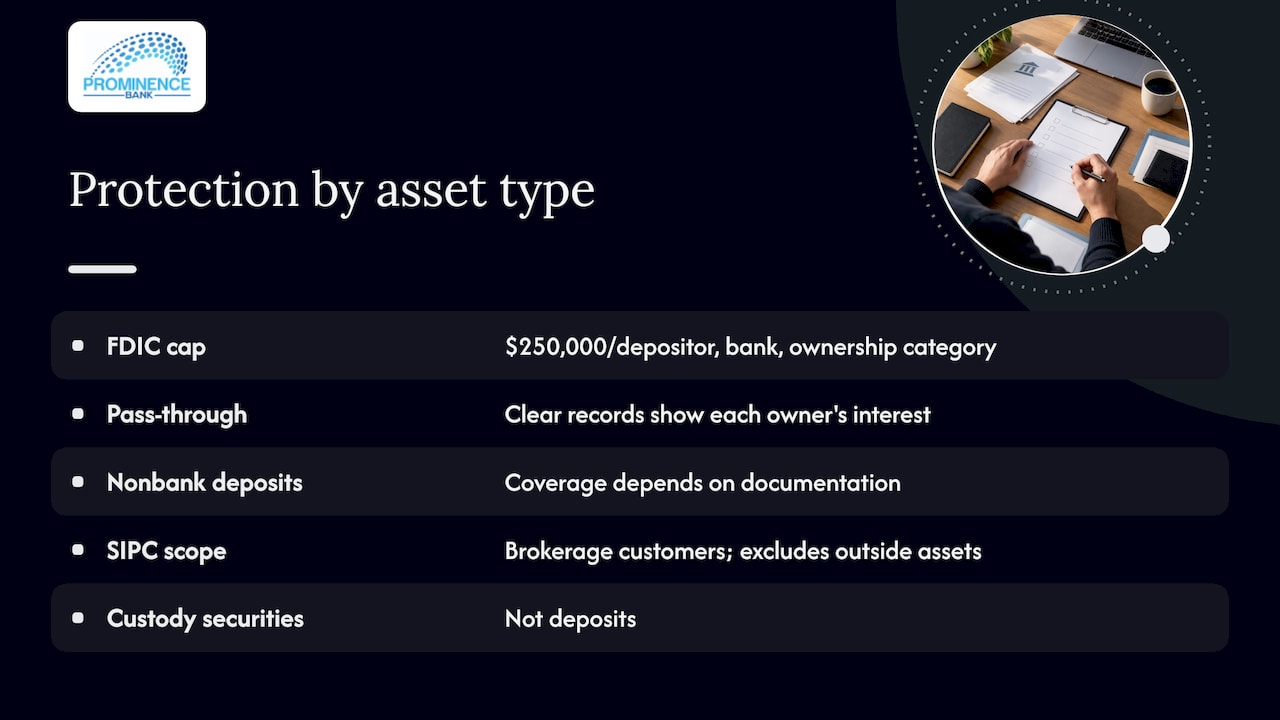
FDIC insurance covers deposits at insured banks, up to $250,000 per depositor, per bank, per ownership category. Securities held in custody are not deposits. The FDIC also explains that when a nonbank company deposits your money at an insured bank, coverage depends on how the arrangement is documented.
Pass-through coverage can extend FDIC insurance to the real owners when a third party places funds at a bank, but only if records clearly show each owner’s interest. The FDIC’s guidance on pass-through deposit insurance lists 14 ownership categories and warns that poor recordkeeping in pooled accounts can jeopardize coverage.
SIPC protection applies to brokerage customers, and the SEC’s investor bulletin on custody makes clear it does not extend to assets held outside the broker-dealer.
The practical takeaway: before you move anything, ask in writing what legal protection applies to each asset class in the account, and which regulator oversees the institution holding it.
The SEC custody rule, if an adviser is involved
If a registered investment adviser has custody of your funds or securities, the SEC’s custody rule (Rule 206(4)-2) generally requires that they be held by a qualified custodian: a bank, a registered broker-dealer, a futures commission merchant or certain foreign financial institutions. The custodian must send account statements directly to you at least quarterly. That gives you a check that does not run through the adviser.
If you are an adviser, a family office or a fund manager, this is the first filter on your custodian list. If you are an investor, it is a useful question for your adviser: who is the qualified custodian, and do I receive statements straight from them?
Digital assets: custody means control of the keys
Crypto custody is its own discipline. Under the interagency statement on crypto-asset safekeeping by banking organizations, issued by the OCC, the Federal Reserve and the FDIC, banks safekeeping crypto need serious risk management around keys and operations. The core idea is exclusive control. If someone else can move the assets, you don’t have custody.
Questions worth asking any custodian of digital assets:
- Who generates and holds the private keys, and where?
- Is cold storage used, and how are withdrawals authorized?
- How are keys recovered if a person leaves or a device fails?
- Are client assets segregated on-chain or pooled?
- What independent audit or attestation covers the setup?
Regulators are also granting more trust charters to digital asset firms. The OCC has reviewed applications such as the Laser Digital National Trust Bank charter. For deeper reading from us, see our notes on cold storage custody banking and on making institutional crypto custody auditable.
Sanctions and beneficial ownership
A custodian is exposed if it cannot say who really owns what it holds. Treasury’s OFAC addresses this in its sanctions compliance FAQs. Knowing the client means looking past the name on the account to the underlying interests, especially in omnibus structures.
For you, this means a serious custody bank will ask a lot of questions: source of funds, ownership chains, purpose of the account. Be suspicious of any institution that doesn’t. Our write-up on OFAC screening failures and fixes covers what compliance teams get wrong.
A checklist for choosing a custodian
Use this before you sign anything.
- Charter and regulator. Who licenses and supervises the institution, and where? Ask for the name of the authority and verify it independently.
- Segregation. Are your assets held in your name or a nominee name, and are they kept apart from the bank’s own assets?
- Scope of duty. Does the agreement say custody only, or custody plus fiduciary duties?
- Asset coverage. Securities, cash, precious metals, digital assets, safekeeping receipts: which does the bank actually hold, and how?
- Reporting. How often, in what format, and can your accountant or adviser get direct access?
- Settlement and currencies. Which markets and currencies can it settle, and what does conversion cost?
- Fees. Are all fees published or quoted in writing before you commit?
- Exit. How do you move assets out, and how long does it take?
- Jurisdiction and tax. U.S. persons have reporting duties on foreign accounts. Talk to a U.S. tax adviser before opening anything offshore.
Perspective: what we see in private custody
Most people who come to us ask about privacy first. We would put it third. First comes clarity on who holds the asset and under what contract. Second comes whether you can document your ownership at any moment, for an auditor, a counterparty or a regulator. Privacy is real and valuable, but it works because the paperwork is clean, not in place of it.

We built Prominence Bank as a fully digital institution for high-net-worth individuals, international businesses and institutional clients. We operate under the Extraterritorial Trade Mission Office (ETMO) framework, which is a different regulatory setting from a U.S. bank charter. U.S. clients should understand that difference, ask us questions about it, and weigh it with their own legal and tax advisers. We would rather you ask hard questions now than discover the answers later.
Our view on assets: custody should be boring. Segregated, reported, reconciled, with no surprises. Complexity belongs in your structure, not in your safekeeping.
— Harold
What custody looks like at Prominence Bank
Our offering is built around multi-currency business accounts, private numbered accounts, cryptocurrency banking, safekeeping receipts (SKR), KTT-enabled accounts, trade finance and wealth management, all with online access. Clients typically use us for cross-border structures where discretion and speed of onboarding matter.
For the way custody and international accounts fit together, our guides on international custody account procedures and offshore custody accounts explain the steps in more detail. If you are comparing structures, our asset management guide for high-net-worth individuals is a good next read. Institutions holding government paper can look at treasury securities custody venues.
Published fees
We publish our core fees on our fees page. Current figures as read on that page:
| Service | Fee |
|---|---|
| Bank account opening | 25,000 $/€ one-off |
| Numbered bank account opening | 50,000 € one-off |
| Numbered account monthly fee | 100 $/€ per month |
| Savings account monthly fee | 40 $/€ per month |
| KTT (E-Telex) transaction, incoming or outgoing | 1.5% |
| Internal transfer within Prominence Bank | 0.2% |
| Currency conversion | 4% |
| Bank endorsement | 1.5% |
| Proof of funds or reference/comfort letter | 25,000 € one-off each |
| Enhanced due diligence, levels 1, 2, 3 | 5,000 €, 10,000 €, 15,000 € one-off |
SWIFT/IBAN wire fees and SKR or custody service pricing have no published price. Ask us for a written quote before you commit. Account opening fees are substantial and non-refundable, so we want you to be sure the structure fits before you apply.
Where to start
If you are a business or institution, begin with business banking or corporate banking. If you are an individual or family, see our private banking page. When you are ready, the business account application is the next step. Our private banking setup guide shows what to prepare.
Compliance expectations you should plan for
Every serious custodian runs anti-money-laundering and know-your-customer checks. Expect to provide identity documents, proof of address, source-of-wealth evidence and an explanation of how the account will be used. Complex structures take longer and may need enhanced due diligence, which is why our EDD fees are tiered by complexity.
Prepare ahead:
- Certified corporate documents and an ownership chart down to the individuals.
- Evidence of where the funds came from, such as sale agreements, audited accounts or tax filings.
- A clear statement of intended activity: expected volumes, currencies and counterparties.
- A named contact on your side who can answer follow-up questions quickly.
Our overview of online bank compliance for high-net-worth clients goes through this in more depth.
Common mistakes
Treating custody like a deposit. A custody account holding securities does not carry FDIC insurance on those securities. Know which part of your balance is a deposit and which is held in custody.
Skipping the contract. Because custody is contractual, the agreement is the product. Read the sections on liability, sub-custodians and termination.
Ignoring sub-custody. Large custodians often use local agents in other markets. Ask where your assets sit and who is responsible if the local agent fails.
Pooling without records. In pooled arrangements, weak records of individual owners can undermine protection, as the FDIC guidance above warns.
Forgetting your own reporting duties. Holding assets abroad does not remove U.S. tax and reporting obligations. A U.S. tax professional should review any foreign account before you open it.
FAQ
What does custody mean in banking?
It means the bank holds assets for you and handles safekeeping, settlement and reporting. It does not own the assets and, as a pure custodian, does not manage them. The relationship is set by your contract.
What is the custody rule for private funds?
The SEC custody rule requires registered investment advisers with custody of client funds or securities to keep them with a qualified custodian, such as a bank or registered broker-dealer. The custodian must send statements directly to clients at least quarterly. Private fund advisers should confirm their exact obligations with securities counsel.
Are assets in a custody account FDIC-insured?
Not as a rule. FDIC insurance covers deposits up to $250,000 per ownership category at an insured bank, while securities in custody are held as your property under a contract. Cash balances may be deposits, so ask the bank how each balance is classified.
Is a custody bank the same as a brokerage?
No. A brokerage focuses on trading and is covered by SIPC for certain assets held with it. A custody bank is governed by banking law and focuses on safekeeping and servicing, so the protections and the legal framework differ.
Sources
- Bank Custody, Trust Banks, and Cryptocurrency, Congress.gov
- An Analysis of Bank Charters and Selected Policy Issues, Congress.gov
- Custody Services, Comptroller’s Handbook, OCC
- Investor Bulletin: Custody of Your Investment Assets, Investor.gov
- Pass-through Deposit Insurance Coverage, FDIC
- Is My Money Insured by the FDIC?, FDIC
- Crypto-Asset Safekeeping by Banking Organizations, Federal Reserve
- Corporate Decision #1377, Laser Digital National Trust Bank, OCC
- OFAC FAQ 335, U.S. Treasury