
A corporate treasury account is a business bank account that a company’s treasury function uses to hold operating cash, concentrate balances from other accounts, fund payments and put surplus cash to work. It differs from an everyday checking account in what sits around it: sweeps, multi-currency balances, payment controls, reporting and a named person accountable for liquidity. This guide explains how these accounts work, what U.S. rules touch them and what to check before you open one, including with an offshore or digital bank.
TL;DR
- A treasury account is defined by its job (liquidity, concentration, funding, payments), not by a product label. Banks package it differently.
- Most treasury arrangements run on standing instructions, such as automated sweeps, not discretionary investing by the bank.
- U.S. entities cannot use a “private” or “numbered” account to avoid disclosing owners. Beneficial ownership, FBAR and sanctions rules still apply.
- Compare fees line by line, including conversion, wire and due diligence charges, before you compare headline features.
- Ask who actually holds your assets, and which third parties sit between you and your money.
Table of Contents
- What a corporate treasury account actually does
- How the money moves: sweeps, pooling and standing instructions
- A note for U.S. companies
- Where your assets sit: custody and third parties
- What to check before you open a treasury account
- What a treasury account costs at Prominence Bank
- Our perspective: treasury is about control, not secrecy
- Opening an account with us
- FAQ
- Sources
What a corporate treasury account actually does
The treasury function exists to know the company’s cash position and to move cash where it is needed. The account is the tool. In practice a treasury account usually covers four jobs:
- Liquidity: holding the cash buffer that covers payroll, suppliers and tax dates.
- Concentration: pulling balances from subsidiary or regional accounts into one place so you can see and use them.
- Funding and investing: deploying excess cash, or drawing on credit, according to written policy.
- Payments: sending and receiving money in several currencies, with approval controls.
If you want the broader function around the account, our guide What Is Corporate Treasury? A Guide for Global Finance Leaders covers roles and governance. For cross-border groups, International Treasury Management: 2026 Strategy Guide goes deeper on structure.
Treasury account versus a standard business account
A standard business checking account is built for daily transactions. A treasury account adds structure on top of it. The differences that matter:
| Feature | Standard business account | Treasury account |
|---|---|---|
| Main purpose | Day-to-day deposits and payments | Managing liquidity across accounts and currencies |
| Cash use | Balance sits as deposited | Sweeps or pooling move surplus cash on standing rules |
| Currencies | Often one | Often several, with conversion at set rates |
| Controls | Basic signers | Multi-signatory approval, user roles, audit trail |
| Reporting | Monthly statements | Intraday or on-demand balance and transaction reporting |
| Relationship | Branch or online support | Dedicated relationship contact, tailored terms |
Not every bank offers every line of that table. When a bank says “treasury account,” ask which of these it means.
How the money moves: sweeps, pooling and standing instructions
A common misunderstanding is that a treasury account means someone is actively investing your cash. Usually it does not. The OCC’s Comptroller’s Handbook on custody services describes bank custody as typically settlement, safekeeping and reporting of customers’ marketable securities and cash, a contractual relationship whose services vary by customer. The bank executes what your agreement says. It does not decide for you.
In a typical setup:
- Sweeps move balances above a target level into an interest-bearing or investment vehicle at the end of the day, and back when needed.
- Pooling nets the balances of several accounts, physically or notionally, so a deficit in one is covered by a surplus in another.
- Target-balance rules keep each operating account at the level you set.
Write these rules into your treasury policy first, then ask the bank to implement them. A bank that wants to design the policy for you is selling a product, not serving a treasury.
A note for U.S. companies
If you are a U.S. person, holding a foreign account can create separate tax and reporting obligations in the United States. Those obligations depend on your own circumstances and are outside the scope of this article. Confirm them with a qualified U.S. tax adviser before you open an account.
Where your assets sit: custody and third parties
Two questions decide how safe a treasury balance really is.
Who holds the assets? SEC Commissioner Hester Peirce has argued that custody is the bedrock of institutional trust. In her September 2025 remarks on custody and institutional confidence, the central idea is that a regulated custodian keeps client assets legally separate from its own. Ask any provider where your assets are recorded, in whose name and under which regulator.
Who sits between you and the bank? Many banks deliver deposit and cash management through third-party technology providers. The joint statement from the banking agencies on third-party deposit arrangements notes that banks are not discouraged from serving any lawful class of customer, and that these arrangements need risk management. The practical risk for you is operational: if a provider in the chain fails, access to funds can be delayed even when the money is safe.
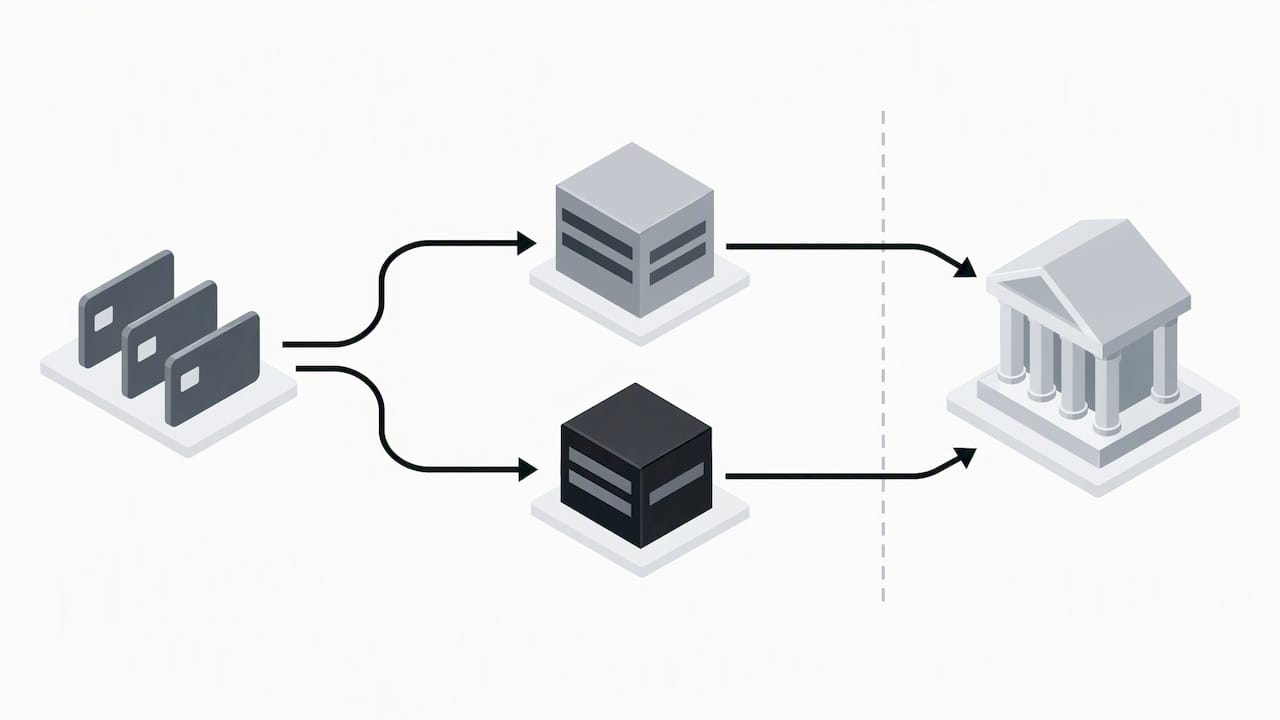
That is why a serious treasury keeps a second route for collections. If your business takes card or online payments in a category that mainstream processors decline, a specialist such as payment processing built for high-risk merchants can keep revenue flowing while your treasury account remains the place where settled cash is concentrated. Keep those two layers distinct in your policy: collection is one risk, custody of the balance is another.
What to check before you open a treasury account
Use this list with every bank you consider, including us.
- Regulatory status and jurisdiction. Who licenses and supervises the bank, and what does that mean for your deposit protection and legal recourse?
- Beneficial owner process. What documents will you provide for each 25% owner and the control person? Expect enhanced checks for complex structures.
- Fee schedule in full. Opening, monthly, wire, conversion, document and due diligence fees. Currency conversion is often the largest recurring cost for multi-currency treasuries.
- Sweep and pooling options. Are they automated, and what are the cut-off times?
- Access and controls. Multi-signatory approvals, user roles, audit logs, and how a power of attorney is handled. See our bank-first guide to corporate account power of attorney.
- Third parties. Which outside providers touch your cash or data?
- Exit terms. How quickly can you move the balance out if you need to?
For structuring decisions before you apply, our corporate account structuring checklist for executives works well as a worksheet.
What a treasury account costs at Prominence Bank
Fees are where treasury accounts differ most, so here are ours as published on our fees page:
| Item | Fee |
|---|---|
| Bank account opening | 25000 $/€ one-off |
| Numbered bank account opening | 50000 € one-off |
| Numbered bank account monthly fee | 100 $/€ per month |
| Savings bank account monthly fee | 40 $/€ per month |
| Incoming or outgoing KTT (E-Telex) transaction | 1.5% |
| Prominence Bank internal transfer | 0.2% |
| Currency conversion | 4% |
| Bank endorsement | 1.5% |
| Enhanced due diligence, Level 1 / 2 / 3 | 5000 € / 10000 € / 15000 € one-off |
| Proof of funds, reference or comfort letter | 25000 € one-off each |
SWIFT and IBAN wire transfers are published at 1% (minimum $/€100), and outgoing transfers also carry applicable SWIFT/SEPA charges. The published fee for the Safekeeping Receipt (SKR) / custody service is €25,000 for the custody account plus 2%. These are not retail-bank fees. They reflect a private, relationship-led model with in-depth onboarding. The $/€25,000 account opening fee is refunded in full if an application is declined, and it is non-refundable once the account has been approved and opened. Do the arithmetic against your expected volume: at a 4% conversion fee, a company that converts large amounts regularly should hold balances in the currencies it pays out in.
Our perspective: treasury is about control, not secrecy
We see the same mistake from new corporate clients: they arrive asking how private an account can be, when the better question is how controlled it can be. Discretion is a real service, and for principals with legitimate reasons to protect commercial information it matters. But a treasury account that cannot withstand a compliance review is a liability, however private it is.
Our view, built on how we serve international businesses and institutional clients:
- Be transparent with the bank. We perform full KYC and AML checks, and complex structures go through enhanced due diligence. Prepare the ownership chart and source-of-funds evidence before you apply, and the process is faster.
- Separate roles. Keep the account that receives revenue, the account that holds reserves and the account that pays out distinct. Each can have different signatories and rules.
- Match currency to obligation. Hold what you will spend. Avoid converting twice.
- Decide your own sweep and custody rules. A bank executes instructions. It should not be inventing your risk appetite.
- Know your home-country duties. If you are a U.S. person, FBAR, beneficial ownership and sanctions rules are your responsibility whichever bank you use.
Our digital model gives you online access to multi-currency accounts, and our corporate and business banking teams work with complex structures. We think the right fit is a client who values privacy and also values clean compliance.
— Harold
Opening an account with us
If your treasury needs multi-currency business accounts, KTT-enabled transfers or custody services, start with Corporate Banking or Business Banking, then submit the business and corporate account application. Our fees are listed before you apply, so you can model the cost first. For a step-by-step view of the process, read how to open an offshore bank account.
FAQ
What is the difference between a treasury account and a checking account?
A checking account handles daily deposits and payments. A treasury account adds liquidity tools: sweeps, pooling, multi-currency balances, approval controls and richer reporting. The name matters less than the features, so ask the bank to list them.
Does a treasury account earn interest?
Only if the agreement provides for it. Many arrangements use standing instructions to sweep surplus cash into an interest-bearing option, but the rate, the vehicle and the risk differ by provider. Read the terms and ask where swept cash is held.
Are corporate deposits FDIC insured?
At an FDIC-insured U.S. bank, corporation accounts are covered up to $250,000 per ownership category per bank, as the FDIC explains. That limit does not apply to institutions outside the FDIC system, so confirm what protection your bank offers.
Can a numbered account hide the owners from the bank?
No. Banks subject to the FinCEN CDD rule must identify owners of 25% or more and a control person at account opening. A numbered account changes how the account is referenced, not what the bank must know.
Does a U.S. company have to report a foreign treasury account?
If the aggregate value of your foreign financial accounts exceeds $10,000 at any time in the year, an FBAR filing is generally required, per the IRS guidance. Speak with a U.S. tax adviser about your specific structure.
Sources
- FDIC: Corporation, Partnership and Unincorporated Association Accounts
- FinCEN: CDD Final Rule
- FinCEN: CDD Rule FAQs
- IRS: Internal Revenue Manual 4.26.16, FBAR
- OFAC: A Framework for OFAC Compliance Commitments
- Commerce, Treasury and Justice: Tri-Seal Compliance Note
- OCC: Comptroller’s Handbook, Custody Services
- SEC: Commissioner Peirce on custody and institutional confidence
- OCC and agencies: Joint Statement on third-party deposit arrangements