
An offshore foundation bank account is an account opened in the name of a foundation, a legal entity with its own identity, in a jurisdiction outside the United States. For a US person it can work as a segregated home for family or business assets. It does not make those assets invisible or untouchable. Reporting duties stay with you, and a US court can still reach you personally. This guide covers how the structure works, what the bank will ask for, what it costs, and how foundations, Cook Islands trusts and Nevis trusts compare.
TL;DR
- A foundation is a legal person, so the bank account opens in the foundation’s own name, separate from yours.
- US persons must report foreign accounts: FBAR is due once the combined balance of foreign accounts passes $10,000 at any point in the year, and foreign trust or foundation dealings can trigger Form 3520.
- Offshore protection works best when it is planned from a solvent position, with full tax disclosure. Hiding assets is the strategy that fails.
- Expect due diligence to be heavy. Banks want the full structure, the source of funds and the people behind it, and costs add up before the first deposit.
Table of Contents
- What a foundation bank account actually is
- Who this setup suits, and who it does not
- What US persons must report
- Offshore trust or domestic trust?
- Cook Islands or Nevis
- How banks treat foundation accounts
- What the account should do for you
- Our perspective
- Prominence Bank fees you should budget for
- A sensible order of operations
- FAQ
- Sources
What a foundation bank account actually is
A foundation sits between a company and a trust. Like a company, it is a legal person: it can hold property, sign contracts and open a bank account in its own name. Like a trust, it is usually created to hold assets for a purpose or for beneficiaries, governed by a charter and rules rather than by shareholders.
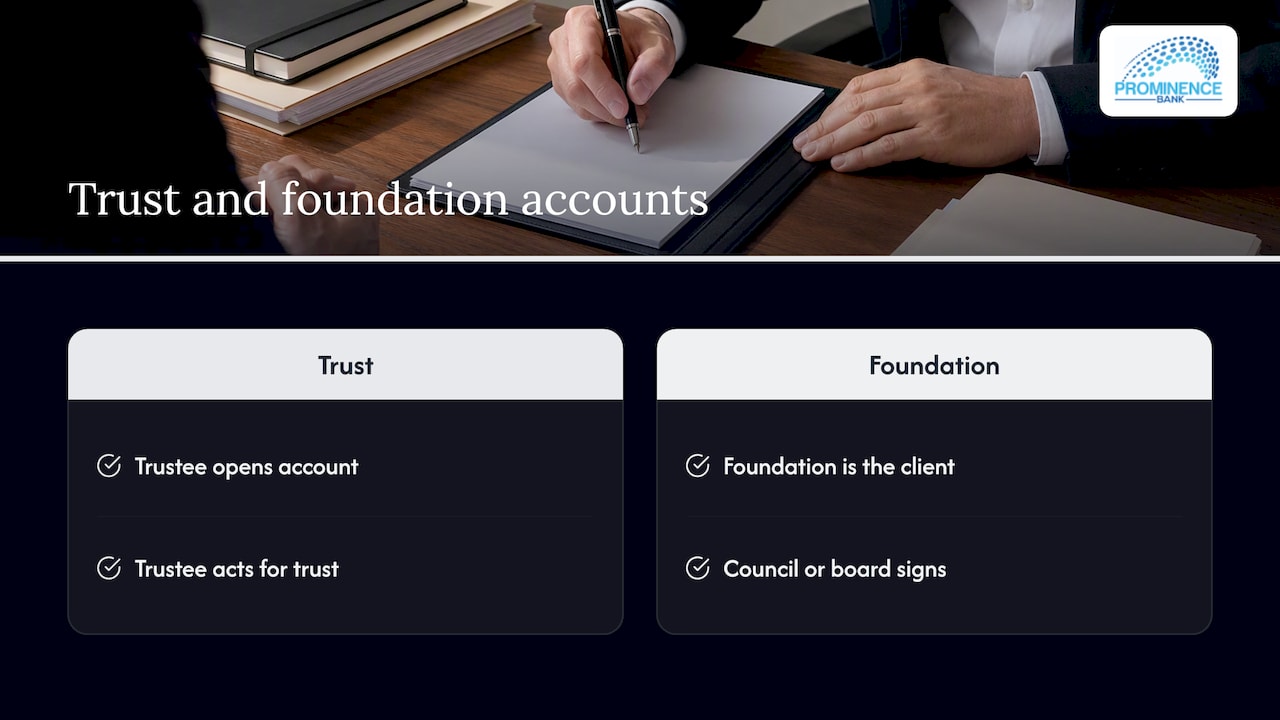
That difference matters at the bank. With a trust, the trustee typically opens the account on the trust’s behalf. With a foundation, the foundation itself is the client. Its council or board members sign, and the founder’s role is set out in the charter.
The account’s job is practical. It receives the endowment, collects income, and pays out to beneficiaries or for the foundation’s stated purposes. Keeping that money in a dedicated account, apart from your personal and operating accounts, is what gives the structure its integrity. Mixing personal spending with foundation money is one of the quickest ways to weaken the separation that the whole arrangement relies on.
Practitioners point to jurisdictions such as Panama, the Cook Islands and Nevis as places with banking and legal environments that recognize these structures. The reasoning is that, unlike some domestic settings, offshore regimes do not automatically accept US court judgments, so a creditor has to start again locally.
Who this setup suits, and who it does not
A foundation account makes sense when there is a real reason for a separate legal vehicle:
- Families planning succession across several countries.
- Business owners in higher-risk sectors who want a layer between personal wealth and operating liability.
- Expats and global entrepreneurs with assets, income or heirs in more than one jurisdiction.
- Holders of investment portfolios or custody assets who want them segregated from daily banking.
It does not suit someone who already faces a lawsuit or a known claim and wants to move assets out of reach. Asset protection is planning done in advance, from a solvent position, not a response to a claim that already exists. Transfers made to defeat a present creditor can be unwound as fraudulent, and they can also expose you to contempt findings.
It also does not suit anyone hoping for a tax saving. Offshore accounts and trusts are tax-neutral for US persons: the filings are disclosures, not taxes, and any pitch that promises tax savings should make you walk away.
What US persons must report
This is the part most guides bury. If you are a US citizen, green card holder or US resident, the IRS expects to see the structure.
FBAR (FinCEN Form 114)
You must file if you have a financial interest in, or signature authority over, foreign financial accounts whose aggregate maximum value exceeded $10,000 at any time in the calendar year. The threshold is the total across all foreign accounts, not per account. Signature authority counts, so if you sit on the foundation’s council and can sign on its account, you may have a filing duty even when you do not own the money. FinCEN’s own guidance says that each US person with a financial interest in or signature authority over foreign financial accounts must report it.
We cover the mechanics and the penalty exposure in our FBAR guide for offshore accounts.
Form 3520 and foreign trusts or foundations
Transfers to a foreign trust, ownership of one, and certain distributions or foreign gifts are reported on Form 3520. The cost of missing it is steep: the penalty can be the greater of $10,000 or 35% of the gross reportable amount, with further $10,000 penalties for each 30-day period of non-compliance after IRS notification. Whether a particular foundation is treated as a foreign trust, a corporation or something else for US tax purposes depends on its terms and your role in it. That classification is a question for a US international tax attorney or CPA before you fund anything, not after.
Why “the IRS can’t see it” is wrong
The FATCA regime exists to combat tax evasion by US persons holding accounts and other financial assets offshore. Foreign financial institutions report, and US persons report. Practitioners are blunt that attempting to hide assets through an offshore foundation without tax disclosure rarely prevents enforcement. Build the structure on the assumption that everything will be disclosed, and it will hold up.
Offshore trust or domestic trust?
Many readers arrive at foundations while comparing trusts. The core difference is where a court can reach.
A domestic asset protection trust (DAPT) is a self-settled trust in one of roughly 20 US states whose statutes shield it from the settlor’s creditors. It protects only if the court hearing the case honors that state’s law. A US court that disagrees can order the assets handed over, because they sit within its reach.
An offshore asset protection trust (FAPT) places assets under foreign law with a foreign trustee. Practitioners note that foreign jurisdictions do not automatically recognize US judgments, so a creditor must litigate again, locally, at real expense.
| Factor | Domestic trust (DAPT) | Offshore trust (FAPT) |
|---|---|---|
| Governing law | A US state statute | Foreign statute |
| Court reach | US courts keep jurisdiction over the assets | Foreign courts decide; US judgments not automatically recognized |
| Creditor’s path | Motion in a court already involved | New proceedings abroad |
| Cost to set up and run | Generally lower | Generally higher, with foreign trustee and reporting |
| US reporting | Ordinary US returns | Form 3520, FBAR and related filings |
The offshore edge is real but not absolute. In documented cases such as Portnoy, Brooks and Lawrence, US courts held settlors in civil contempt or applied bankruptcy sanctions for failing to turn over trust assets, even where the foreign trustee could not be compelled. A foreign statute protects the structure. It cannot stop a US judge from pressuring you, the person standing in the courtroom.
A foundation is a different vehicle again. It is not a trust, so the trust-law comparisons above do not transfer one-for-one. Some owners place a foundation, or an LLC, beneath a trust. Both the Cook Islands and Nevis trusts commonly own an underlying LLC as part of the overall structure, and that company is where the operating bank account often sits.
Cook Islands or Nevis
Both are mainstream choices for US clients. The differences are about track record, cost and procedure.
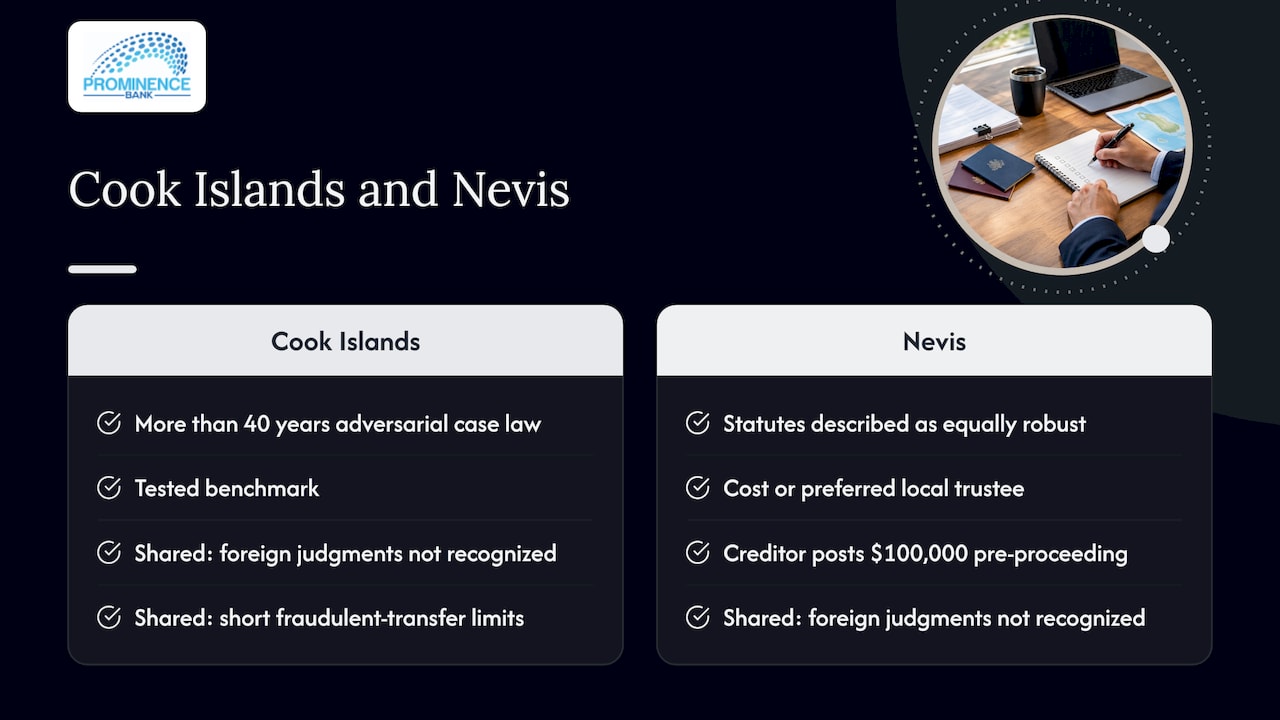
Cook Islands. Practitioners call it the tested benchmark, with more than 40 years of adversarial case law, including cases against US federal agencies. That history is the main reason people choose it.
Nevis. Its statutes are described as equally robust. Cost or a preferred local trustee often tips the choice toward it. A distinctive feature is the bond requirement: a creditor must post $100,000 with the Ministry of Finance before proceedings can begin, which discourages speculative or low-value claims.
Both share similar features: non-recognition of foreign judgments and short limitation periods for fraudulent transfer claims. For most families the choice comes down to the professionals involved, the budget, and how much the structure will be tested. Neither removes your US reporting duties.
How banks treat foundation accounts
The bank sees a foundation as a higher-complexity client than a plain personal account, and underwrites accordingly.
What you should expect to provide:
- The foundation’s charter, registration documents and the rules governing it.
- Identification and proof of address for the founder, council members, protector (if any) and beneficiaries.
- A structure chart showing every entity and person up to the ultimate beneficial owners.
- Source of funds and source of wealth, documented, not just declared.
- The purpose of the account and the expected flows: who pays in, who gets paid, in what currencies and volumes.
- Tax residency and US tax status for each controlling person.
Why the bill can grow. Some providers price foundation accounts with risk-weighted annual fees that can escalate, sometimes doubling, if the foundation includes an underlying company or a Politically Exposed Person is involved. Those fees come on top of setup costs. Ask for the full fee schedule before you commit, including what triggers a repricing.
Initial deposit expectations at specialized offshore banks have been reported in the $25,000 to $50,000 range, though each bank sets its own terms.
Common reasons applications stall: vague source of funds, a structure chart that does not match the documents, nominee arrangements nobody can explain, and a stated purpose that does not fit the expected activity. Our walkthrough of how to open an offshore bank account step by step and the global account opening requirements for HNW clients cover the paperwork in more detail.
What the account should do for you
When you choose a bank for a foundation or a trust-owned entity, test it against practical needs:
- Multi-currency capability. Foundations with international beneficiaries or investments need to receive and pay in several currencies without friction.
- Online access. Council members often live in different countries. A fully digital bank lets them review and approve activity without travelling.
- Custody and safekeeping. If the foundation holds securities or other assets, segregated custody matters. See our piece on offshore custody accounts, privacy, security and compliance.
- Transparent fees. Published, itemized pricing beats a quote that appears only after your documents are in.
- Compliance posture. A bank that applies serious AML/KYC standards will ask hard questions. That is a feature: it protects the account from being frozen later.
Our perspective
We see the same misunderstanding often. People ask us how to make an offshore account private, when the better question is how to make it defensible. Privacy in banking means that your financial information is handled with discretion and shared only through proper legal channels. It does not mean that nobody knows the account exists.
For US clients, we advise three habits. First, tell your tax adviser before you open anything, and let them decide how the foundation or trust is classified. Second, document the origin of every dollar going in, because the enhanced due diligence that follows is far easier with a paper trail you prepared in advance. Third, keep the structure plain. Every extra layer adds fees, reporting forms and questions from compliance, and rarely adds protection.
The jurisdiction and the legal vehicle matter. But a protective structure also depends on how it is used: separate accounts, real governance, honest filings. The clients who are happiest years later are the ones who treated the structure as a long-term arrangement and not as a trick.
— Harold
Prominence Bank fees you should budget for
We publish our fee schedule so you can plan before you apply. If you are considering an entity account for a foundation-linked or trust-linked structure, these are the figures that matter most. Whether your specific foundation fits our onboarding is something we assess case by case during application.
| Service | Fee |
|---|---|
| Bank account opening | $25,000 / €25,000 one-off |
| Numbered bank account opening | €50,000 one-off |
| Numbered account monthly fee | $100 / €100 per month |
| Savings account monthly fee | $40 / €40 per month |
| Enhanced due diligence, Level 1 | €5,000 one-off |
| Enhanced due diligence, Level 2 | €10,000 one-off |
| Enhanced due diligence, Level 3 (critical or complex) | €15,000 one-off |
| KTT (E-Telex) transaction, incoming or outgoing | 1.5% |
| Prominence Bank internal transfer | 0.2% |
| Currency conversion | 4% |
The three due diligence levels reflect how complex the structure is. A foundation with an underlying company and several controlling persons will generally sit higher than a single-owner account. Wire transfer and safekeeping receipt pricing is not published, so ask us for it directly.
The full schedule is on our fees page. If the account is for an operating company beneath your structure, start with our business banking or corporate banking pages. For individual and family wealth, see private banking. For the reasoning behind these structures, read why offshore trusts matter for high-net-worth families and our offshore asset protection techniques guide.
A sensible order of operations
- Define the purpose. Succession, asset segregation, holding investments, or supporting a business. The purpose drives the vehicle.
- Get US tax advice first. Ask a US international tax attorney or CPA how the foundation or trust will be classified and which forms apply (FBAR, Form 3520 and others).
- Pick the jurisdiction and the professionals. Compare the Cook Islands, Nevis and other options on track record, cost and the service providers you trust.
- Assemble the documents. Charter, IDs, structure chart, source of wealth evidence.
- Choose the bank and read the fee schedule. Look for repricing triggers, minimum balances and due diligence charges.
- Fund the account cleanly. Wire from accounts in your own name, with documentation, and keep records.
- File every year. Put FBAR and any Form 3520 on your calendar. Penalties for missing them are far larger than the cost of filing.
FAQ
Can a US citizen have an offshore bank account?
Yes. Holding a foreign account is legal. What the law requires is disclosure: you must file an FBAR when your combined foreign account balances exceed $10,000 at any point in the year, and other forms may apply depending on your structure. Your tax adviser should confirm exactly which.
What is a foundation bank account?
It is a bank account held in the name of a foundation, a legal entity that exists separately from its founder. The account receives the foundation’s endowment and income and pays out to beneficiaries or for its stated purposes. Because the foundation is the client, the bank reviews its charter, its council and the people behind it.
Can the IRS track offshore accounts?
Assume it can. FATCA was designed to combat tax evasion by US persons holding offshore accounts, and it relies on reporting by both account holders and foreign institutions. Nondisclosure is what creates risk, not the account itself.
Is an offshore trust better than a domestic trust?
Often it is stronger against creditors, because foreign courts do not automatically honor US judgments and US courts keep jurisdiction over domestic trusts. But a US court can still pressure the settlor personally, and offshore structures cost more and carry more reporting. The right answer depends on your risk, assets and budget.
Cook Islands or Nevis for a trust?
The Cook Islands has the longer litigation record, which practitioners treat as a benchmark. Nevis has similar statutory protections, a $100,000 bond requirement for creditors, and is sometimes chosen for cost or trustee preference. Both require full US reporting.
Sources
- IRS: FBAR Reference Guide
- FinCEN: Reminder of requirement to file FBAR
- IRS: Discussion of international tax forms, FATCA and FBAR
- Speiser Law: Foreign vs. domestic asset protection trusts
- Lobb Plewe: Domestic vs. offshore asset protection planning
- Alper Law: Domestic vs. offshore asset protection trusts
- Alper Law: Cook Islands trust vs. Nevis trust
- Blake Harris Law: Cook Islands trust vs. Nevis trust
- Lexology: Five key differences between a Cook Islands and Nevis trust
- Wealthweb: Offshore asset protection
- Binderr: How to open a bank account for a foundation
- The Jerz Group: Panama foundation banking