
Corporate crypto banking means a business account that can handle both fiat money and digital-asset flows without the bank treating every deposit as a threat. In the U.S. the rules are clearer than they were two years ago. Getting an account is still mostly a question of how well you document your business, which bank type you approach, and whether your structure survives that bank’s compliance review.
This guide covers what regulators now allow, why compliant crypto companies still lose accounts, how correspondent banking fits in, and a checklist for choosing a bank.
TL;DR
- Federal regulators now treat crypto custody and certain stablecoin activity as permissible for national banks, but each bank still sets its own risk appetite.
- Your regulatory status decides everything: a business that exchanges or transmits virtual currency for others is a money transmitter and must register as an MSB with FinCEN.
- Accounts are usually lost to automated monitoring and weak documentation, not to crypto itself. Build your file before you apply.
- Fewer, deeper banking relationships with one counterparty tend to work better than a chain of correspondent banks.
- Expect enhanced due diligence. Budget for it and ask every bank about its fees up front.
Table of Contents
- What corporate crypto banking actually covers
- What U.S. rules allow in 2026
- Why compliant crypto companies still lose accounts
- Correspondent banking for crypto: what it is and what is changing
- How to choose a crypto-friendly corporate bank
- Prepare the file before you apply
- Our perspective
- Where Prominence Bank fits
- FAQ
- Sources
What corporate crypto banking actually covers
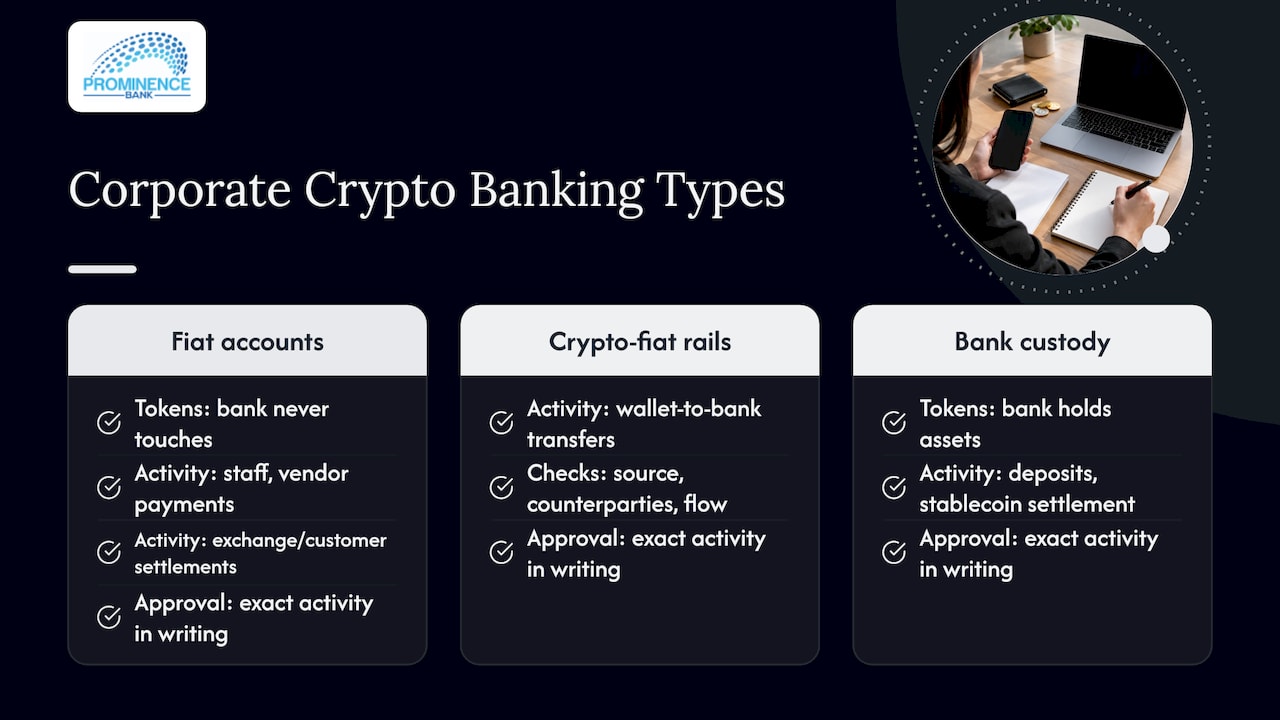
The phrase gets used for three different things, and mixing them up leads to the wrong bank.
Fiat accounts for crypto businesses. The company holds dollars, euros or other currencies, pays staff and vendors, and receives settlement from exchanges or customers. The bank never touches the tokens. This is what most crypto firms need first.
Crypto-to-fiat rails. The business moves money between wallets or platforms and its bank account. Here the bank cares about where funds came from, which counterparties are involved and whether the flow looks like trading, payments or something else.
Custody and digital-asset services at the bank itself. The bank holds assets, supports a blockchain-based deposit product or settles stablecoins. This is the smallest category, and it is where U.S. regulation has moved most recently.
For a treasury team, the practical question is simple: which of these three do you need, and does the bank’s policy say yes to that exact activity in writing?
What U.S. rules allow in 2026
Two developments matter most for banks.
On March 7, 2025, the Office of the Comptroller of the Currency reaffirmed that crypto-asset custody, distributed ledger activity and certain stablecoin activities are permissible for national banks and federal savings associations. The accompanying Interpretive Letter 1183 rescinds the earlier letter that had required banks to get supervisory non-objection first. That removes a procedural barrier. It does not oblige any bank to say yes to you.
On July 18, 2025, the GENIUS Act was signed into law as P.L. 119-27. According to the Congressional Research Service overview, it creates a regime for U.S. payment stablecoins and permits banks to hold stablecoins and reserves in custody, use blockchains and issue tokenized deposits. If your business issues or settles in stablecoins, read the current version of that summary and talk to counsel about which category you fall into.
Are you an MSB?
This is the question banks ask first. Under FinCEN’s guidance on virtual currency, a mere user of virtual currency, for example a company paying suppliers in tokens, is not a money services business. An administrator or exchanger, which includes exchanges, OTC desks and payment processors that accept and transmit convertible virtual currency, is a money transmitter and must register as an MSB and run an anti-money laundering program.
The cost of getting this wrong is real. FinCEN’s consent order against Bittrex shows how the agency treats a registered MSB that falls short of its Bank Secrecy Act duties.
The recordkeeping and travel rule threshold for funds transfers is $3,000, and agencies have proposed a lower $250 threshold for international transfers. Check the current status of that proposal before you design your payment flows around either number.
Why compliant crypto companies still lose accounts
The most common story is not fraud. A company with a clean business sends a sudden burst of wire activity from an exchange, an automated monitoring system flags it, and the account is restricted before anyone has read the explanation.
Treasury guidance published in 2025 says banking regulators should make sure risk expectations do not discriminate against lawful digital-asset firms solely because of their industry. That is the policy direction. In practice, a bank still has to be able to defend each relationship at its next audit, so it asks you for evidence rather than assurances.
A few patterns recur:
- Source-of-funds gaps. Transfers arrive with no paper trail linking them to your revenue or investors.
- Flows that do not match the application. You said you would process payments, and the account looks like trading.
- Structure the bank cannot read. Layered entities, nominee directors or an unclear ultimate beneficial owner.
- Wrong bank type. A generalist bank with no crypto policy will treat any exchange-related wire as high risk. Practitioners who place these accounts say crypto-aware institutions use dedicated rails that treat crypto-to-fiat conversion as an internal movement rather than an external high-risk transfer. Treat that as an industry view, not a guarantee.
Even bank-built blockchain products do not change the paperwork. J.P. Morgan’s own description positions its blockchain deposit accounts as deposit accounts, which means the same know-your-business, sanctions and audit expectations apply as for a standard corporate wire. A blockchain-native platform does not exempt you from recordkeeping.
Correspondent banking for crypto: what it is and what is changing
A correspondent bank holds accounts for other banks and payment companies so they can reach currencies and payment systems they do not access directly. For a crypto business, it matters in two places: when your own bank relies on a correspondent to send a USD or EUR wire abroad, and when you are a payment company that needs reach in many corridors.
The weakness of the traditional model is the chain. Each correspondent runs its own risk review, and any one of them can refuse or delay a crypto-adjacent payment. Your bank may be happy with you while its correspondent is not.
The direction of travel is toward consolidation: fewer counterparties, each with broader reach across FX, settlement and compliance. For a corporate treasurer, the questions to ask are:
- Which correspondents does the bank use for each currency I need?
- Has the bank ever rejected or returned a crypto-related payment, and how does it notify clients?
- Can I get a named relationship manager and a documented escalation path when a wire is held?
- Does the bank provide SWIFT, local rails and internal transfers under one set of terms?
If the answers are vague, the bank is probably reselling access it does not control.
How to choose a crypto-friendly corporate bank
Banks fall into rough types. Compare by type, because the right one depends on your activity.
| Bank type | Good for | Watch for |
|---|---|---|
| Large national bank | Operating accounts for businesses that merely use crypto, or hold it on the balance sheet | Slow onboarding, automated flags on exchange flows, closure risk |
| Community or specialty U.S. bank | Exchanges, OTC desks and payment firms that can show a mature AML program | Concentration risk if the bank has few crypto clients, limited currencies |
| Trust company or qualified custodian | Safekeeping of digital assets | Not a full operating account; you will still need a bank for payroll and vendors |
| International digital bank | Multi-currency treasury, cross-border groups, clients who need privacy and global access | Jurisdiction and regulatory framework differ from the U.S.; verify exactly what it is licensed to do |
A practical checklist
- Written policy. Ask for the bank’s stance on your exact activity: custody, exchange flows, stablecoin settlement, mining revenue, token sales.
- Licenses first. Banks often reject applicants whose license or jurisdictional structure does not fit their risk appetite. Decide on your registrations before approaching them, not after.
- Fee transparency. Enhanced due diligence, document issuance, conversion and wire fees can outweigh monthly charges. Get the full schedule.
- Transaction limits and monitoring. Ask what triggers a review and how fast a hold is released.
- Exit terms. How much notice does the bank give before closing, and can you move funds out in the meantime?
Prepare the file before you apply
Banks underwrite the story and the documents together. A strong application includes:
- Certificate of formation, ownership chart down to every person with substantial ownership or control, and IDs.
- Business plan with expected monthly volumes, counterparties, currencies and countries.
- Evidence of source of funds and source of wealth for principals.
- Your AML and sanctions policy, plus MSB registration where it applies.
- A list of the exchanges, custodians and wallet providers you use.
- Tax status and reporting: beneficial ownership, and for U.S. persons with foreign accounts, FBAR and FATCA obligations. This explainer on FATCA and CRS filing mistakes is a useful primer for expats and finance teams with cross-border holdings.
If your compliance function is thin, outside review pays for itself. Firms that build and audit financial technology describe security and compliance programs for financial institutions that map closely to what a bank will test, and reading that material helps you anticipate the questions.
On the client side, our own reading of the requirements is collected in MSB banking requirements: a bankability checklist and in our note on FinCEN beneficial ownership reporting.
Our perspective
We see the same mistake repeatedly: businesses treat the bank as a vendor to be chosen after everything else. For crypto-linked companies the bank decides what is possible. It is the most demanding counterparty you will have, so you design for it from day one.
Three convictions shape how we work with corporate clients:
- Documentation is the product. A clean file, a clear structure and honest volume projections are worth more than any promise about speed. Banks that onboard quickly without asking hard questions are the ones that close accounts later.
- Jurisdiction is a design choice. Where the bank sits, and the framework that regulates it, affects how your flows are read. We publish plainly what that means in our guide to digital banking jurisdiction, because clients should know what they are choosing. Prominence Bank operates under the Extraterritorial Trade Mission Office (ETMO) framework, not as a U.S.-chartered bank, and we say so up front.
- Discretion and compliance are not opposites. Privacy means your affairs are not public. It does not mean skipping AML and KYC. We apply international AML/KYC standards to every account.
If you take one habit from this article, make it this: write the answer to every question a compliance officer might ask before they ask it.
— Harold
Where Prominence Bank fits
Prominence Bank is a licensed digital bank for international businesses, high-net-worth individuals and institutions. For companies that work with digital assets, we offer a cryptocurrency bank account, multi-currency business accounts, KTT-enabled accounts and custody services, and we explain our approach to digital currency on its own page. Corporate groups with complex structures can read about our corporate banking service, and you can start with the business account application.
The published fees are as follows, so you can budget before you apply:
| Item | Published fee |
|---|---|
| Bank account opening | 25,000 $/€ one-off |
| Numbered bank account opening | 50,000 € one-off |
| Numbered account monthly fee | 100 $/€ per month |
| Incoming or outgoing KTT (E-Telex) | 1.5% |
| Prominence Bank internal transfer | 0.2% |
| Currency conversion | 4% |
| Enhanced due diligence, Level 1 / 2 / 3 | 5,000 € / 10,000 € / 15,000 € one-off |
These accounts are for businesses and individuals with complex, international needs, not for everyday retail use, and the account opening fee is non-refundable. Full schedule on our fees page. Wire transfer and SKR custody pricing is not published there, so ask us directly.
FAQ
What is a crypto-friendly corporate bank?
It is a bank with a written policy that accepts your specific type of crypto activity and has the compliance staff to monitor it. That is different from a bank that has simply not yet noticed your flows. Ask for the policy and the fee schedule before you apply.
Do I need to register as an MSB?
It depends on what you do. A business that only uses virtual currency is not an MSB, while an exchanger or administrator that accepts and transmits it is a money transmitter under FinCEN guidance. If you are unsure, get advice from a lawyer who handles Bank Secrecy Act matters before you approach a bank.
What is the $3,000 rule for banks?
It is the Bank Secrecy Act recordkeeping and travel rule threshold: for funds transfers of $3,000 or more, institutions must collect and pass along identifying information. Agencies have proposed a lower threshold for international transfers, so confirm the current rule with your bank or counsel.
Can a U.S. bank hold my company’s crypto?
Federal rules now allow national banks to offer crypto-asset custody without seeking prior supervisory non-objection, per the OCC’s 2025 announcement. Whether a particular bank does so is its own decision, so ask each one.
Why would a bank close a crypto company’s account?
Usually because monitoring flagged activity the file could not explain: unclear source of funds, volumes beyond projections or an opaque ownership structure. Keep your documentation current and tell your bank about changes in your business before the flows change.
Sources
- OCC news release 2025-16, March 7, 2025
- OCC Interpretive Letter 1183
- Congressional Research Service: GENIUS Act overview
- FinCEN guidance FIN-2013-G001
- FinCEN consent order, Bittrex
- FinCEN and Federal Reserve proposed rule on recordkeeping and travel rule
- Treasury digital assets report under EO 14178
- Banking for crypto, fintech and high-risk businesses
- Crypto business banking and licensing sequence
- Blockchain deposit accounts overview
- Security and compliance for financial institutions
- FATCA vs CRS filing guide