
Physical pooling moves cash into a header account through daily sweeps, creating intercompany loans on participant books. Notional pooling leaves balances where they sit and nets them virtually for interest purposes, preserving account ownership but relying on bank offset rights. Choose physical pooling when you need clean legal separation and documented intercompany positions, and notional pooling when interest optimization matters more and your bank supports the offset structure.
TL;DR:
- Physical sweeps can run daily or weekly; zero balance drains subsidiary accounts completely, while target balance preserves a chosen operating buffer.
- Notional pools require bank offset rights and usually participant cross guarantees, while support for multicurrency arrangements across borders is less common.
- Both structures face arm’s length tax scrutiny; benchmark interest rates and document pooling benefits, while physical sweeps also require loan agreements and reconciliations.
- Before launch, test sweep timing against slow settlement days and arrange fallback funding, because missed cutoffs or outages can leave subsidiaries unable to pay obligations.
- Groups facing multicurrency and cross border needs can combine central currency sweeps with notional netting, subject to bank support and tax review.
Table of Contents
- Physical Pooling vs Notional Pooling at a Glance
- How Physical and Notional Pooling Work Day to Day
- Accounting, Tax, and Legal Implications to Plan For
- Implementation Checklist for Setting Up a Pool
- Deciding Between Physical and Notional Pooling
- Principal Risks and How to Mitigate Them
- How a Digital Bank Supports Pooling in Practice
- Open the Accounts Your Pooling Structure Needs
- FAQ
- Sources
Physical Pooling vs Notional Pooling at a Glance
The two methods solve the same problem, idle cash sitting in scattered accounts, through fundamentally different mechanics. Physical pooling actually transfers funds; notional pooling only calculates as if they were combined.
- Fund movement: physical pooling sweeps real balances into a header account; notional pooling leaves funds in place and nets them virtually.
- Accounting effect: physical sweeps generally create intercompany loans between the pool leader and participants, while notional pooling keeps each entity as the legal owner of its own account.
- Bank requirements: notional pooling depends on the bank’s willingness to grant offset rights and usually requires cross-guarantees; physical pooling needs fewer special bank permissions.
- Cross-border and currency reach: physical pooling handles multicurrency groups more easily through sweeps into a central currency; notional pooling’s availability across borders and currencies is more limited.
- Cost and complexity: notional pooling often reduces external funding costs through the pooling benefit calculation, but it carries more legal and tax documentation overhead than a straightforward sweep structure.
How Physical and Notional Pooling Work Day to Day
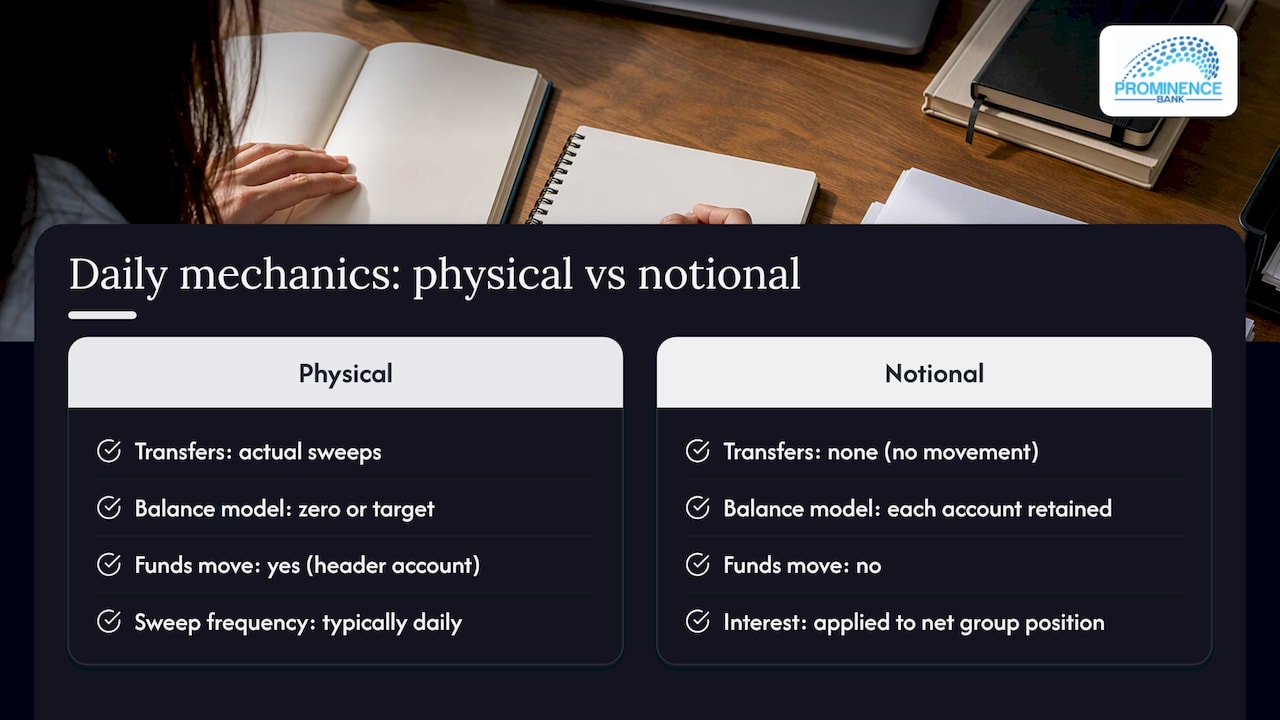
Physical pooling runs on sweep mechanics. A zero-balance structure drains each subsidiary account to exactly zero at the end of each cycle, moving every dollar of surplus into the header account and funding any shortfall from it automatically. A target-balance structure instead leaves a set buffer in each account and sweeps only the excess above that threshold, which preserves local liquidity for day-to-day operating needs. Sweeps typically run daily, though some groups settle weekly depending on volume and banking relationships.
Notional pooling skips the transfer entirely. Each entity keeps its own account and balance, and the bank calculates net positions across the group, applying interest to that consolidated figure rather than to each account separately. No funds change hands, no intercompany loan is created, and the statement simply reflects a netted interest calculation.
Currency adds friction to both approaches, but physical pooling tends to be simpler when a group operates largely in one currency, since cross-currency sweeps require conversion at each transfer. Notional pooling can aggregate multiple currencies virtually, but bank support for true multicurrency notional pools is far less common.
Accounting, Tax, and Legal Implications to Plan For
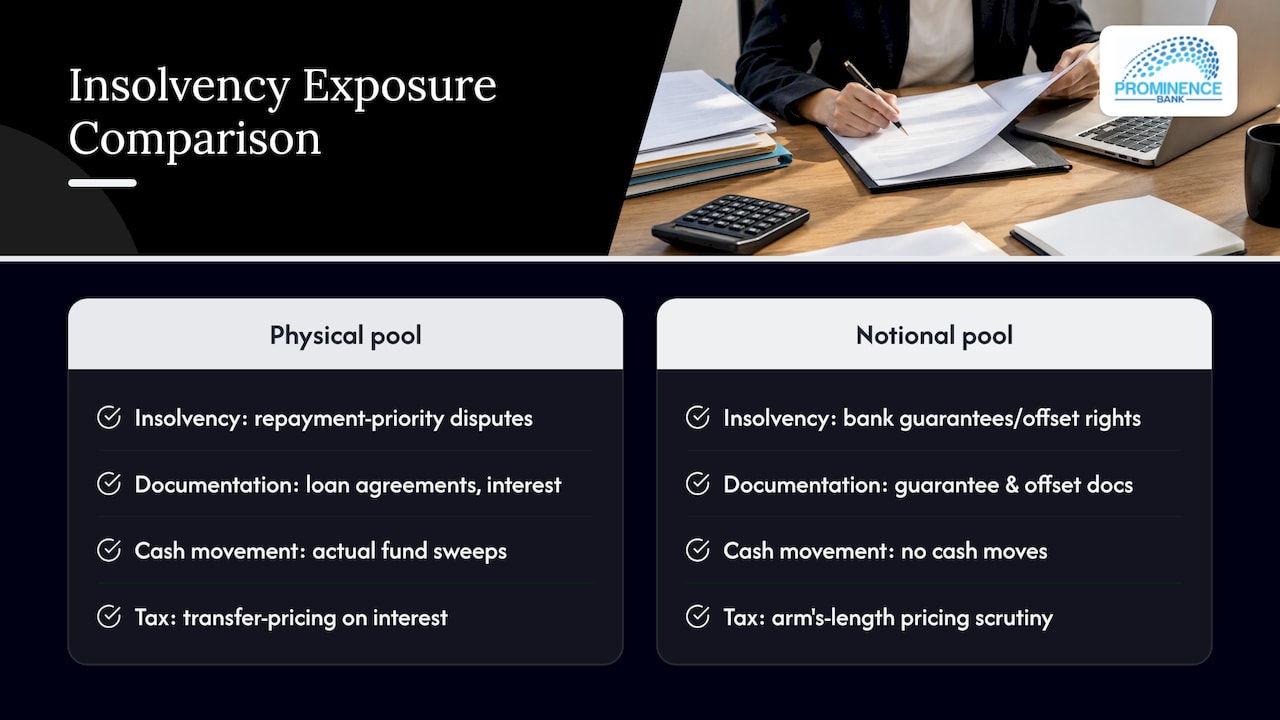
Physical pooling’s fund movements generate real intercompany loan balances on the books of both the pool leader and each participant, which means every sweep needs a documented loan agreement, an interest rate, and ongoing reconciliation; learn more about related-party tax and transfer-pricing in Bulgaria. Notional pooling avoids that intercompany loan trail because no cash actually moves, but it substitutes a different dependency: the bank’s offset rights and the participants’ willingness to provide cross-guarantees supporting the bank’s exposure across the pool.
Tax authorities scrutinize both structures for arm’s-length pricing. The tax risk in cash pools centers on whether intercompany interest rates reflect what unrelated parties would charge, and treasuries typically mitigate that risk by benchmarking rates and documenting the pooling benefit, the measurable savings from pooled versus separate account interest.
Insolvency consequences diverge sharply between the two. A participant’s bankruptcy in a physical pool can trigger disputes over loan repayment priority, while a notional pool’s insolvency exposure runs through the bank’s guarantee and offset documentation. Clear contribution and indemnity agreements matter in both cases, but for different reasons.
Implementation Checklist for Setting Up a Pool
Before activating either structure, work through the operational decisions that determine whether the pool runs smoothly or creates reconciliation headaches later.
- Set sweep frequency, cut-off times, and settlement windows that match your banking partners’ processing schedules.
- Choose between zero-balance and target-balance policy, and size the buffer each subsidiary keeps if you use target balancing.
- Confirm the bank’s documentation on right of offset, cross-guarantees, and any credit lines tied to the pool structure.
- Verify your systems support intraday visibility, automated reconciliation, and FX conversion where multiple currencies are involved.
- Review our practical treasury cash pooling guide for a fuller implementation walkthrough.
Pro Tip: Test your sweep logic against a slow settlement day before go-live. A single missed cut-off can leave a subsidiary short on payroll funding.
Deciding Between Physical and Notional Pooling
The right structure depends less on theory and more on your group’s legal, tax, and banking constraints.
- Choose physical pooling when you need strict legal separation between entities and clear, documented intercompany loan positions.
- Choose notional pooling when interest optimization is the priority, cross-border complexity is limited, and your bank supports the offset structure.
- Consider a hybrid approach, sweeping balances into a central currency pool and applying notional netting within it, when multicurrency and cross-border needs are both high.
- Always test the tax and insolvency consequences of either structure before committing, since both carry documentation requirements that are far easier to set up correctly than to fix after the fact.
Our corporate banking structures guide walks through how these decisions interact with broader account architecture.
Principal Risks and How to Mitigate Them
Both pooling methods carry risk that grows if left undocumented. Contractual protection comes first: contribution and indemnity agreements between participants, paired with explicit bank offset language, limit disputes when something goes wrong.
Transfer-pricing exposure is the next priority. Interest rates applied to intercompany balances or pooled positions need documentation showing they reflect arm’s-length terms, which protects against the tax risk described in AFP’s guidance on pooling arrangements.
Operationally, build fallback funding options and daylight liquidity controls so a delayed sweep or a bank system outage does not leave a subsidiary unable to meet payment obligations. Set FX limits where multicurrency sweeps are involved. Finally, put the pool structure in front of a treasury governance committee on a regular schedule and run scenario tests, including a participant default scenario, so the contractual protections get exercised before they are needed for real.
How a Digital Bank Supports Pooling in Practice
Implementing either pooling method depends heavily on what the bank can actually support, not just what the treasury team designs on paper. Our platform supports multi-currency business accounts suitable for groups employing sweeps or notional pooling across multiple currencies, featuring real-time transfer capabilities that maintain accurate zero-balance or target-balance policies throughout the day.
We provide treasury and corporate banking services designed to assist with documentation aspects of pooling, including account structures, transfer records, and reconciliation data necessary for finance teams managing intercompany loan records or offset documentation in notional pooling. Treasury teams evaluating a new pool structure can request a technical consultation to confirm infrastructure capabilities before committing to a design.
Open the Accounts Your Pooling Structure Needs
Whatever structure you land on, physical sweeps, notional netting, or a hybrid, you need multi-currency accounts that move funds in real time and hold up under audit. We offer business banking and corporate banking built for groups running exactly this kind of structure.
Start your business account application to see how our account infrastructure fits your pooling design, or reach out to discuss a corporate banking setup tailored to your group’s entities.
FAQ
What does notional pooling mean?
Notional pooling means a bank calculates interest on the combined, or netted, balances of several accounts without physically moving any funds between them. Each entity keeps legal ownership of its own account, and the arrangement typically depends on bank offset rights and participant guarantees.
What are the three most common types of liquidity management strategies?
Treasury teams generally rely on physical cash concentration, notional pooling, and hybrid structures that combine both. A hybrid approach often sweeps balances into a central currency account and then applies notional netting within that currency.
What are the three types of cash?
Treasury commonly distinguishes operating cash held for day-to-day needs, reserve cash held as a buffer against shortfalls, and strategic or excess cash available for investment or debt reduction. How each category is treated shapes whether a zero-balance or target-balance sweep policy makes sense for a given entity.
How does bank offset work in a notional pool?
Bank offset lets a bank treat multiple linked accounts as a single credit exposure for interest and risk purposes, even though each account remains separately owned. Regulatory discussion around Basel III raised questions about this practice, though practitioner analysis indicates offset and haircut approaches keep notional pooling workable for most banking relationships.
Does physical pooling always create an intercompany loan?
Physical pooling typically does create an intercompany loan position each time cash sweeps from a participant account into the header account, since the participant is effectively lending its surplus to the pool leader. That position needs a documented interest rate and loan agreement to withstand tax and audit scrutiny.