
Dual authorization banking requires at least two different people to approve a transaction or an administrative change before a bank system will execute it, so no single employee or compromised login can move money or alter account controls alone. It applies mainly to high-value outgoing payments and sensitive changes like adding a new payee, and it functions as a required control inside a layered-security program rather than as an optional feature.
TL;DR:
- MFA verifies identity at login, while maker checker controls what that person can complete; the system should block makers from approving their own submissions.
- Require second approval for large or irreversible wires, ACH and payroll batches, payee edits, payment templates, and permission changes that could preserve an attacker’s access.
- Enforce role separation across web, mobile, and batch channels, and keep timestamped records naming who submitted and approved each change.
- Set documented approval thresholds and urgent exception rules, review permissions regularly, and adjust alerts or limits if checkers start approving without meaningful review.
Table of Contents
- What Is Maker-Checker and How Does It Differ From MFA?
- Where Dual Authorization Belongs in Banking Systems
- The Architecture Behind Reliable Dual Authorization
- Best Practices for Implementing Dual Authorization
- Approval Workflows: What Makers and Checkers Actually See
- How Prominence Bank Applies These Controls
- Getting the Sequence Right Without Slowing the Business Down
- A Banking Partner Built for Multi-Signatory Control
- FAQ
- Sources
What Is Maker-Checker and How Does It Differ From MFA?
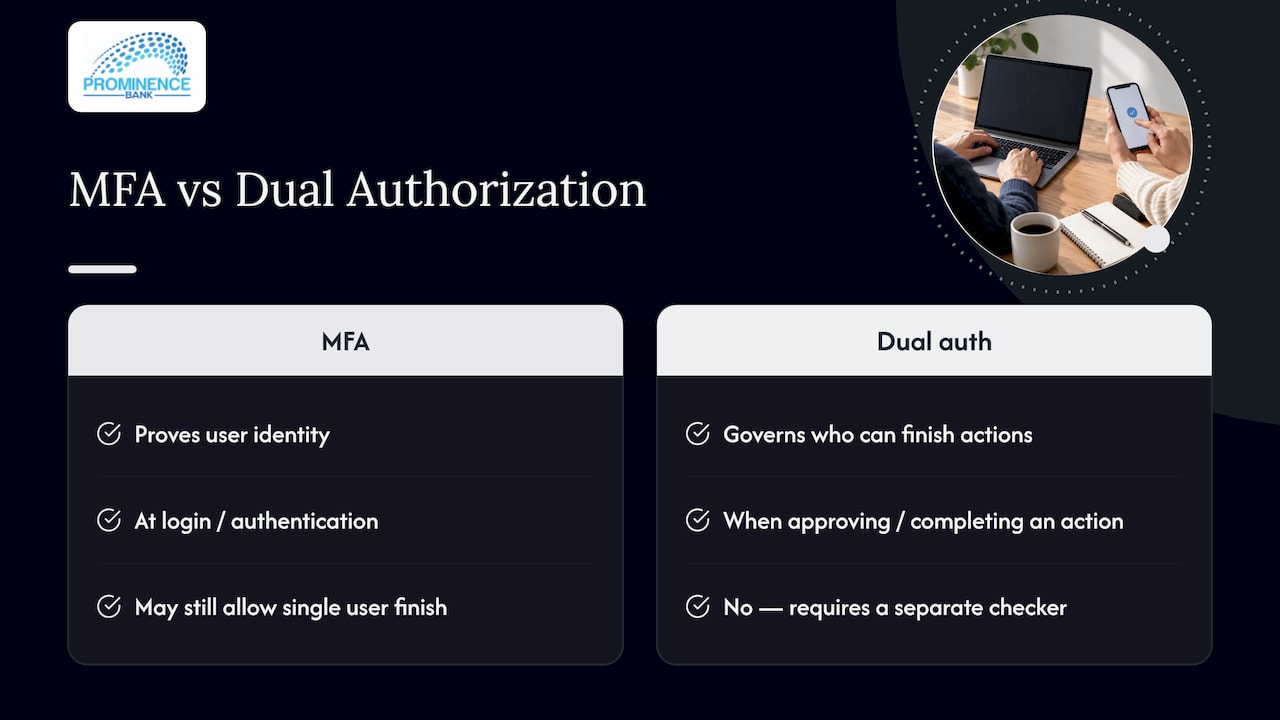
The CSRC glossary defines dual authorization as a control that requires at least two authorized individuals to complete certain operations, so one person cannot finish a sensitive task unilaterally. Practitioners often call this maker-checker or four-eyes: one person (the maker) initiates a transaction or change, and a second person (the checker), with different credentials and no ability to also act as maker on the same item, reviews and approves it.
This is a segregation-of-duties control, built on the principle of least privilege: nobody holds enough permission alone to both create and finish a sensitive action. It is easy to confuse with multi-factor authentication, but the two solve different problems. MFA proves that the person logging in is who they claim to be. Dual authorization governs what that verified person is allowed to finish by themselves once inside the system. A bank can have strong MFA and still be exposed if a single authenticated user can both create and approve a wire.
Where Dual Authorization Belongs in Banking Systems
Not every click in a banking platform needs a second approver, but certain categories carry enough risk that a single point of failure is unacceptable. The clearest cases involve irrevocable payment rails and the administrative settings that control who can touch money in the first place.
- Outgoing wire transfers and SWIFT or IBAN payments, especially cross-border and large-value instructions that cannot easily be reversed once sent.
- ACH batches and payroll runs, where a single error or manipulation affects many accounts at once.
- Adding or editing payee details, since a changed account number on an existing payee is a common fraud pattern.
- Creating or modifying payment templates, which attackers exploit to plant a fraudulent destination for future use.
- Changing user permissions or entitlements, because this is how a compromised account escalates into broader access.
The FFIEC IT Examination Handbook notes that dual authorization matters for administrative channels precisely because attackers who compromise one set of credentials often use those channels to persist access rather than attempting an immediate, more detectable theft.
The Architecture Behind Reliable Dual Authorization
A maker-checker rule is only as strong as the system enforcing it. Several components need to work together for the control to hold up under an audit or an actual fraud attempt.
- Entitlement models that assign distinct maker and checker roles, with the system itself blocking a user from approving their own submission, not just a policy telling them not to.
- Audit trails that log who made each change and who approved it, with timestamps precise enough to reconstruct the sequence during forensic review, as explained in detail on the audit-trail and compliance features page.
- Transaction locking and approval queues that hold a pending item in a visibly separate state so it cannot be executed, edited, or duplicated while awaiting sign-off.
- API-level enforcement and cross-channel consistency, so the same rule applies whether the transaction originates on the web portal, a mobile app, or a batch upload.
Application vendors build this directly into their platforms. Oracle’s banking documentation describes dual-authorization workflows that require a secondary approval before specific operations complete, confirming this is standard functionality in modern banking software rather than a custom build.
Pro Tip: Name roles by function, not by job title (for example, “Payment Maker” and “Payment Checker”), so entitlements stay clear even as staff change positions.
Best Practices for Implementing Dual Authorization
Dual authorization works best as one layer in a broader control stack, not a standalone fix. Pairing it with multi-factor authentication, transaction limits, and ongoing monitoring closes gaps that any single control leaves open.
- Combine MFA at login with dual authorization at the transaction level, since each addresses a different point of failure.
- Set clear dollar or percentage thresholds that trigger mandatory second approval, with documented exception handling for urgent cases.
- Review entitlements on a regular schedule to catch entitlement creep, where staff accumulate approval rights they no longer need as roles change.
- Document policies and retain logs in a format ready for examiner review, not just internal use.
OCC and FFIEC guidance stresses layered security and dual controls for critical systems, paired with granular audit trails that support both forensic analysis and regulatory examination. A practical controls-assessment checklist should confirm that maker and checker roles are system-enforced, that logs capture both identities with timestamps, that thresholds are documented, and that entitlement reviews have an owner and a cadence.
Approval Workflows: What Makers and Checkers Actually See
The day-to-day experience of dual authorization varies by channel, but the underlying pattern stays consistent: submit, hold, review, release.
- Single-transfer flow: a maker submits payment details, the item moves to a pending-approval queue, and a checker sees the amount, destination, and any flagged anomalies before approving or rejecting.
- Batch and payroll handling: checkers get a summary view with exceptions highlighted, so a thousand-line payroll run does not require reading every row, only the ones that deviate from pattern.
- Administrative change workflow: a permission or payee change is staged but not activated until a second approver signs off, preventing live exposure during the review window.
- Operational details: notifications alert checkers promptly, timeouts return stale requests to the maker, alternate approvers cover absences, and every step is retained in the audit record.
Good checker screens surface context (amount, recipient history, deviation from typical pattern) rather than raw data alone, which speeds legitimate approvals without weakening the review.
How Prominence Bank Applies These Controls
Multi-signatory setups are a natural fit for corporate structures with more than one principal, and that is where dual authorization earns its keep in practice.
- Corporate account structures can support multi-signatory setups, so outgoing payments and sensitive changes may require sign-off from more than one authorized signer.
- Entitlements are scoped per user within business banking and corporate banking relationships, separating who can initiate instructions from who can approve them.
- Activity tied to account changes and transactions may be logged to support audit trails for internal review and regulatory inquiry.
These controls sit alongside the broader account protections described in our security features overview for high-value and corporate clients.
Getting the Sequence Right Without Slowing the Business Down
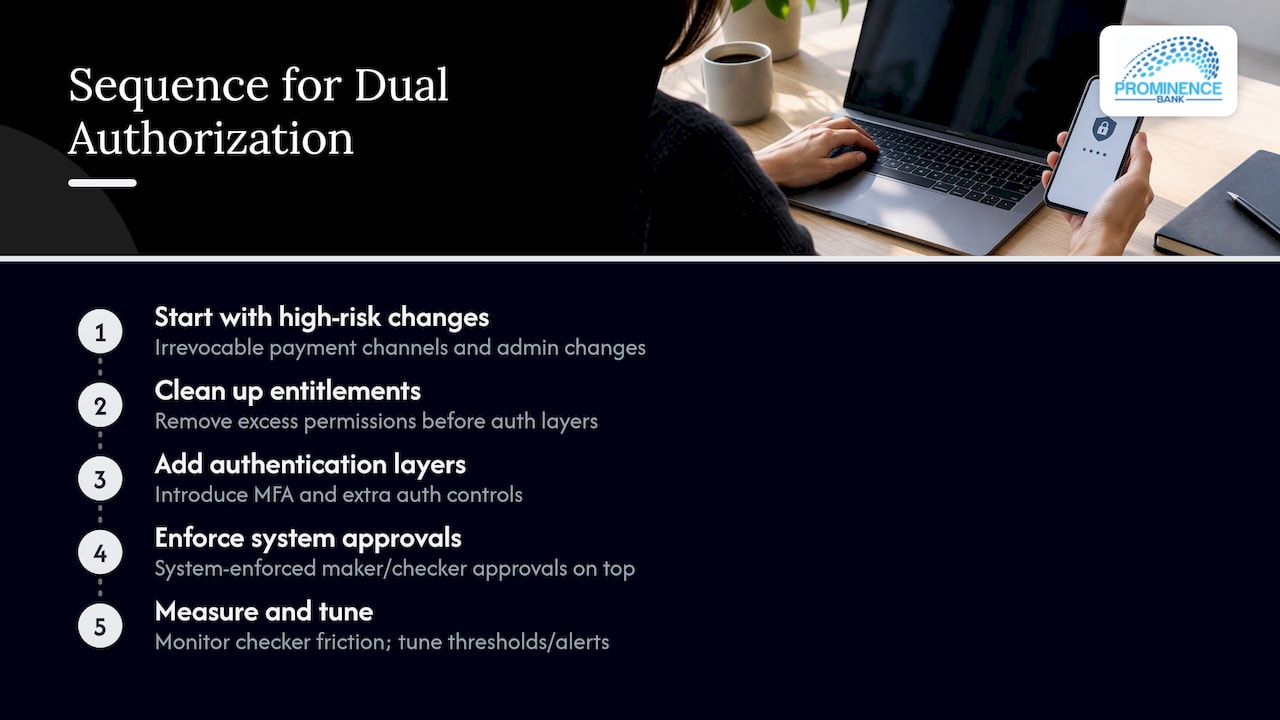
Start with irrevocable payment channels and administrative changes, since those carry the highest cost if a single point of failure fails. Clean up entitlements before adding layers of authentication, then let system-enforced approvals sit on top of both. Teams that skip the entitlement cleanup end up with dual authorization in name only, since a maker and checker who share the same excess permissions is not real segregation.
Measure friction honestly: if checkers are rubber-stamping without reviewing, thresholds or alerts need tuning, not removal.
— Harold
A Banking Partner Built for Multi-Signatory Control
When your business needs more than one person to sign off on a wire or an entitlement change, the account itself has to support that structure, not just your internal policy. We built our corporate account structures around multi-signatory controls and scoped entitlements, so dual authorization is enforced at the account level rather than left to manual checks. For details on fees and account types, see our fee schedule, and when you are ready to discuss how a multi-signatory structure fits your operation, start a business account application.

FAQ
What is dual authorization?
Dual authorization is a control requiring at least two authorized people to approve certain operations, so no single person can complete the action alone, as defined by NIST. In banking, it is commonly called maker-checker: one person initiates a transaction or change, and a separate person with distinct permissions must approve it.
How do I set up two-factor authentication on my bank account?
Two-factor authentication is typically enabled in your online or mobile banking settings, usually under security or login preferences, and requires a second verification step like a code sent to your phone in addition to your password. This is separate from dual authorization, since MFA confirms identity at login while dual authorization governs approval of transactions once logged in.
What is a dual banking system?
The term “dual banking system” most often refers to a country having both state and federally chartered banks operating in parallel, which is a regulatory structure distinct from dual authorization controls. If you are researching transaction approval controls rather than bank chartering, the relevant concept is maker-checker or dual authorization, not a dual banking system.
Does an authorization hold take money out of your account?
An authorization hold reduces your available balance temporarily while a transaction is pending, but the funds are not actually withdrawn until the transaction settles. If the hold is released without settlement, the reserved amount becomes available again, though the exact timing depends on your bank’s processing procedures.
Why does dual authorization matter for administrative changes, not just payments?
Dual authorization on administrative actions like adding a payee or changing user entitlements matters because these changes often enable future fraud rather than causing immediate loss, as the FFIEC operational controls guidance notes. A compromised account that can unilaterally add a payee or expand its own permissions can persist access long after the initial breach.
Sources
- dual authorization – Glossary | CSRC
- Authentication and Access to Financial Institution Services and Systems (FFIEC / OCC guidance)
- FFIEC IT Examination Handbook — Internal and operational controls
- 4.39 Dual Authorization — Oracle documentation